
Managing AI Like a Software Development Manager: A New Paradigm for AI-Assisted Programming
Introduction
As AI-assisted programming becomes increasingly prevalent, developers are discovering that success with AI tools requires more than just technical prowess. In fact, the skills needed to effectively utilize AI for programming bear a striking resemblance to those of a Software Development Manager (SDM). This insight opens up a new perspective on how we should approach AI collaboration in software development.
But before we dive in, let's get some perspective on where we actually are:
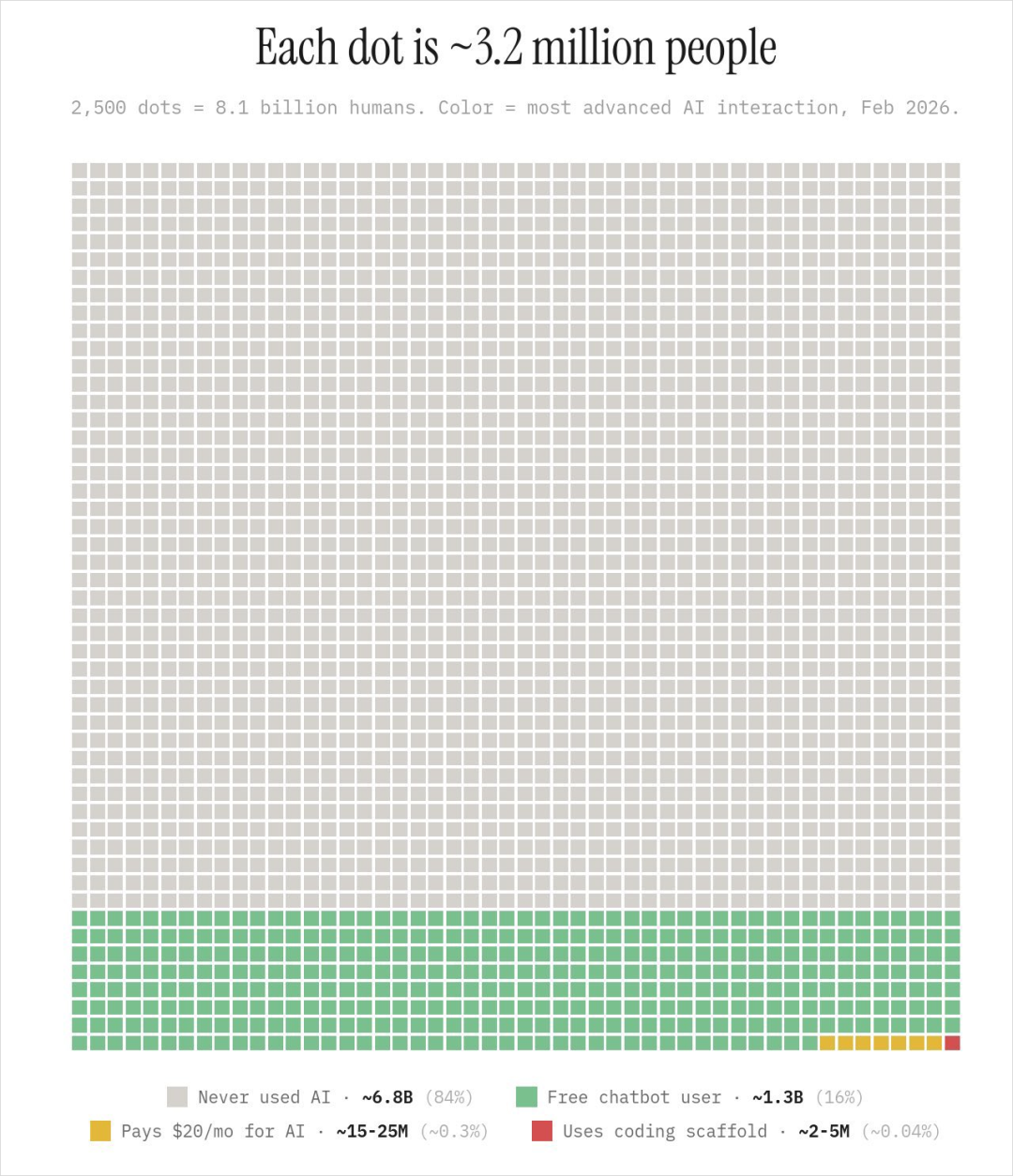 AI adoption grid — each dot is ~3.2 million people
84% of the world's population has never had a single AI conversation. Only 16% have used a free chatbot. About 0.3% pay $20/month for AI. And the fraction using coding agents like Claude Code? Roughly 0.04% — a nearly invisible red dot in the corner.
Think about what the internet looked like when only 16% of the world was online — that was around 2005. We're not in the late stages of AI adoption. We haven't even reached the middle. We're still at the very beginning.
This means the skills we discuss below aren't just nice-to-have — they're an early-mover advantage that will compound over years.
The Core Insight: AI as a Team Member, Not a Search Engine
One of the most common mistakes people make with AI is treating it like a fancy search engine — type a question, get an answer, done. That approach works, but it barely scratches the surface of what AI can do.
A more accurate mental model: AI is like a brilliant intern.
This intern graduated from MIT with a thousand degrees, has knowledge spanning every field, executes tirelessly around the clock, and never complains. But it's still an intern. It doesn't know your specific situation, your boss's preferences, your company's unwritten rules, or the constraints you're working under.
So you have to tell it.
When we write prompts or comments for AI, we're essentially ensuring that our requests are well-defined and executable. This mirrors how SDMs structure tasks for their teams. The key questions we ask are remarkably similar:
-
Is the problem properly defined?
-
Does the AI (or team member) have sufficient context to complete the task?
-
Can we reasonably expect successful implementation given the available resources?
You can't just say "write me a proposal." You need to say: "I need a proposal for a cloud migration project, budget is $200K, timeline is Q3, the CTO prefers conservative approaches, we're currently on AWS but evaluating GCP, and I need three options with trade-off analysis."
The first approach is search-engine thinking. The second is manager thinking — and it's what gets real results.
These questions form the foundation of effective task delegation, whether to human developers or AI systems.
Five Essential Skills for AI-Assisted Programming
1. Understanding Your Resources
Just as SDMs must understand their team members' capabilities, developers need to grasp AI's capabilities and limitations:
Technical Aspects:
-
Context window limitations
-
Potential for hallucination
-
Strengths in pattern recognition
-
Weaknesses in logical consistency
Choosing the Right Model:
Not all AI models are created equal. The gap between a free-tier model and a frontier model is enormous — like the difference between asking an undergraduate intern and a senior architect. Many people's first impression of AI is shaped by weaker models, and they walk away thinking "AI is just okay." That's like judging all cars by test-driving a golf cart.
If you're serious about AI-assisted development, invest in the best tools available. The ROI on a $20/month AI subscription is among the highest of any professional tool investment.
Motivation Strategies:
-
For AI: Effective prompt engineering, temperature settings, system context
-
For comparison - Human teams: Career growth, recognition, technical challenges
2. Strategic Delegation
Knowing when to delegate is crucial. But even more important is building the reflex to ask in the first place.
Before starting any task, pause for one second and ask: "Can AI help me with this? How?"
Many developers don't fail at using AI — they fail at remembering to use it. We're so accustomed to doing things manually that we reach for old habits even when a powerful tool is sitting right there.
Make this a deliberate practice. After a few weeks, it becomes instinct. After a few months, the compounding efficiency gains are remarkable.
Key Considerations:
-
Task complexity and scope
-
Required domain knowledge
-
Risk assessment
-
Quality requirements
3. Effective Task Decomposition
Breaking down complex problems is essential:
Example Structure:
-
Initial problem analysis
-
Component identification
-
Sequential prompt design
-
Integration planning
# Example of task decomposition for AI
def complex_task(problem):
    # 1. Analysis
    requirements = ai.analyze_requirements(problem)

    # 2. Component Identification
    components = ai.break_down_into_components(requirements)

    # 3. Sequential Implementation
    for component in components:
        solution = ai.implement_component(component)
        validate_solution(solution)

    # 4. Integration
    return integrate_components(components)
A practical approach: set yourself a goal to automate one repetitive task per week. It doesn't have to be grand — auto-generating weekly reports, scraping and summarizing data, templating routine emails. The task itself matters less than building the muscle of thinking in terms of delegation and decomposition.
4. Quality Assurance
Implementing robust QA processes:
Verification Strategies:
-
Automated testing (AI-assisted)
-
Code review guidelines
-
Performance benchmarking
-
Security validation
Beware of AI Flattery:
There's an important pitfall that every AI-assisted developer needs to watch for: AI is designed to be encouraging. Tell it your architecture idea, and it will say "great approach." Show it your code, and it will say "clean and well-structured." Ask it to evaluate your proposal, and it will find something positive to highlight.
This constant positive feedback creates a dangerous illusion — the feeling that everything you're producing is excellent.
But AI's praise is a starting point, not a verdict. The real test is the real world: Does the code pass production load? Do users actually want the feature? Does the system hold up under edge cases?
A good SDM doesn't just accept status reports at face value — they verify, they test, they challenge assumptions. Apply the same rigor to AI output. Enjoy the encouragement, but always validate against reality.
5. Continuous Learning
Establishing feedback loops:
Learning Sources:
-
AI output analysis
-
Error patterns
-
Success cases
-
Community feedback
Don't Wait Until You're Ready:
One of the biggest traps in learning AI-assisted development is over-preparing. People read articles, save tutorials, join communities, buy courses — and then never actually start.
The best approach is to start now, even if it's messy. You'll ask bad questions. You'll get useless answers. You'll waste time on dead ends. None of that matters. What matters is that you started.
AI evolves so fast that what you learn today might be outdated in three months. You're better off spending those three months using AI and learning by doing than spending them preparing to use it.
Start with the clumsiest approach possible. Get smarter along the way. This beats waiting for the perfect moment by orders of magnitude.
The Evolution of Software Engineering
This shift in skill requirements doesn't spell the end for traditional software engineering roles. Instead, it represents an evolution:
Traditional Focus → New Focus
-
Algorithm implementation → System design
-
Manual coding → Strategic problem solving
-
Library knowledge → Architecture decisions
-
Syntax mastery → AI collaboration skills
Historical Parallel: The Calculator Revolution
The current AI transition mirrors the calculator's impact on mathematics:
Before Calculators:
-
Emphasis on mental arithmetic
-
Value placed on computation speed
-
Complex manual calculation techniques
After Calculators:
-
Focus on problem-solving
-
Emphasis on mathematical thinking
-
Higher-level mathematical exploration
Similarly, AI is shifting focus from implementation details to higher-level software design and architecture decisions.
Future Implications
The role of software engineers is evolving, not disappearing. In fact, the emergence of AI is creating new opportunities and challenges that make skilled software engineers more valuable than ever. Let's explore the key areas where software engineers will continue to be essential:
1. System Architecture: The Foundation of Success
The complexity of modern software systems demands architects who can:
-
Design scalable systems that effectively integrate AI components
-
Make critical decisions about where to deploy AI vs. traditional solutions
-
Ensure system reliability while incorporating potentially non-deterministic AI behaviors
-
Design robust fallback mechanisms for AI system failures
2. AI Collaboration Strategies: Beyond Basic Prompting
Software engineers are developing sophisticated approaches to AI collaboration:
-
Creating reusable prompt templates and libraries
-
Developing middleware to optimize AI resource usage
-
Building tools for prompt testing and validation
-
Implementing AI output verification systems
3. Quality Assurance: Ensuring AI Reliability
Modern QA has evolved to include:
-
AI output validation frameworks
-
Automated testing of AI-human interactions
-
Performance monitoring of AI systems
-
Security testing for AI-specific vulnerabilities
4. Problem Decomposition: The Art of Breaking Down Complexity
Engineers are developing new methodologies for:
-
Identifying AI-solvable components in complex problems
-
Creating hybrid solutions combining AI and traditional approaches
-
Managing AI context limitations through smart problem splitting
-
Designing efficient workflows for AI-human collaboration
5. Technical Leadership: Guiding the AI Revolution
Software engineers are becoming AI transformation leaders by:
-
Developing AI adoption strategies for development teams
-
Creating best practices for AI-assisted development
-
Training teams on effective AI collaboration
-
Making strategic decisions about AI tool integration
The Expanding Role of Software Engineers
Rather than being replaced, software engineers are becoming:
-
AI System Architects: Designing robust, scalable systems that effectively integrate AI
-
AI Collaboration Experts: Developing best practices and patterns for AI-human teamwork
-
Quality Guardians: Ensuring AI systems meet reliability and security standards
-
Problem Solving Strategists: Making critical decisions about AI vs. traditional approaches
-
Technical Leaders: Guiding organizations through AI transformation
Taste: The Human Edge AI Can't Replace
AI can generate ten architecture proposals, but it can't tell you which one is right for your system. It can write a hundred implementations, but it can't judge which one has the most elegant trade-offs. It can produce endless options, but it can't make the final call.
That judgment — knowing what "good" looks like — is taste. And taste is the one thing AI cannot replicate.
When everyone has access to the same AI tools, the baseline of what AI can produce becomes table stakes. Your competitive advantage becomes your ability to evaluate, select, and refine. To develop this, there are no shortcuts: study great systems, understand why they work, build your own, compare, find the gaps, iterate.
Your personal experience also matters here. The projects you've shipped, the production incidents you've debugged at 3am, the architectural decisions you've regretted — AI doesn't have those. When you bring that lived experience to bear on AI-generated output, the result is something neither you nor AI could produce alone.
The key to success in this evolving landscape is not just technical skill, but the ability to:
-
Think strategically about system design
-
Understand both AI capabilities and limitations
-
Make informed decisions about technology choices
-
Lead teams through technological transformation
-
Maintain focus on business value and user needs
Conclusion
The AI-assisted programming era requires a new mindset — one that combines traditional software engineering skills with managerial competencies. By approaching AI collaboration with an SDM's perspective, developers can maximize the benefits of AI while maintaining high-quality software development practices.
Remember: the future is already here, it's just not evenly distributed. With 84% of the world yet to have their first AI conversation, those of us learning to work with AI effectively are building skills that will compound for years to come.
Success in this new paradigm depends not on fighting against AI's capabilities, but on learning to manage and direct them effectively. The future belongs to those who can master this delicate balance of technical expertise and resource management.
Use AI to save time — but invest that saved time wisely. Build things. Ship things. And don't forget to look up from the screen once in a while.
Note: This article is part of my ongoing series on AI-assisted work. Stay tuned for more insights and practical guides.