
Days 2-4: The Monorepo Migration Sprint (111 Commits in 3 Days)
Three days. 111 commits. And I'm pretty sure half of them have commit messages that just say "fix css."
Day 2: CSS Restoration Hell — 38 Commits
When I unified the Tailwind config into packages/config, every app that relied on custom design tokens broke. Not in an obvious "red error screen" way. In a subtle "the background is slightly wrong and why is that button 2px smaller" way.
The problem: each app had evolved its own CSS variable namespace. BaZi used --bz-* tokens. Tarot used --tarot-*. Astrology used --zx-*. Unifying the Tailwind config meant these all had to coexist without collision, while still allowing each app its own visual identity.
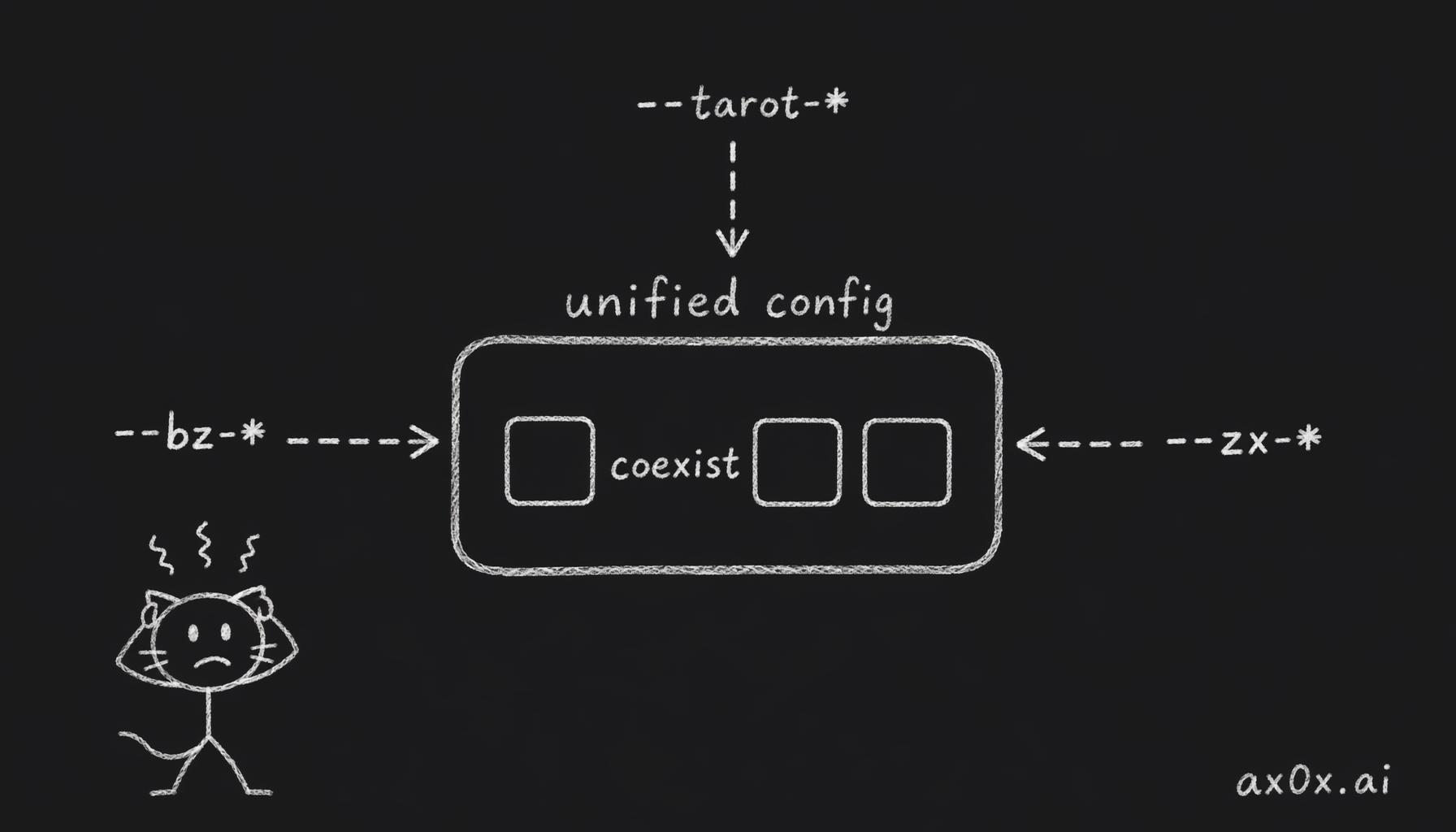 How three CSS variable namespaces coexist without collision under one unified config
38 commits. Each one fixing some CSS gap I'd missed. But by the end I'd also extracted 4 new shared packages: PDF generation, chat history, shared chat UI, and common React hooks.
The package extraction was the real win. Three apps each had their own ChatPanel component with slightly different implementations. Three apps each had PDF export code with the same html2canvas workflow. Extracting these into packages/ui and packages/pdf meant a single fix would propagate everywhere.
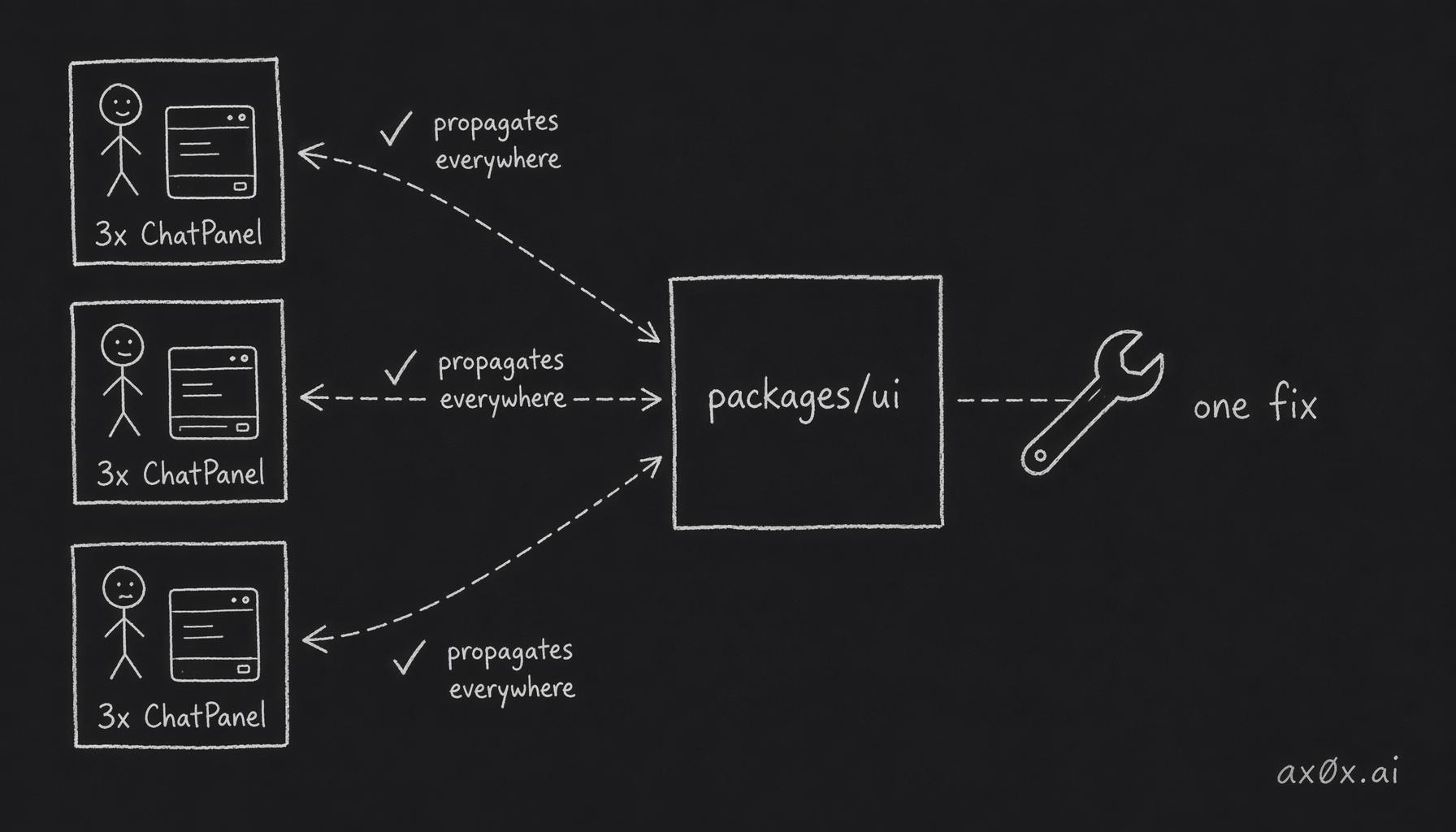 Extracting three duplicate components into one shared package so a single fix propagates everywhere
Day 3: App #6 and WeChat Detection — 17 Commits
Added MBTI personality test as the sixth app. Easier to integrate because I built it knowing it would go into the monorepo — it used the shared packages from day one.
The more interesting challenge was WeChat browser detection. A massive percentage of Chinese internet traffic goes through WeChat's built-in browser, which has quirks: limited getUserMedia support, different OAuth flow requirements, restricted window.open behavior. The user agent sniffing needed to check for MicroMessenger across Android, iOS, and desktop variants, plus the WeChat Work variant (wxwork).
Later (PR #41), this detection got hardened further when real devices exposed false negatives — some WeChat versions embed a different UA string than documented.
Day 4: The Big Day — 56 Commits
The Unified API Package
The biggest architectural win of the entire project. packages/api standardized how all apps talk to AI models.
Before: each app had its own streaming route with ~80 lines of boilerplate for ReadableStream setup, SSE event formatting, error handling, and credit deduction. Duplicated 15+ times.
After: createAIStreamResponse() — a single helper that takes a config object with lifecycle hooks:
-
initEvents— emit initial data before AI streaming starts -
onComplete— save results, log costs -
onError— handle failures gracefully -
refundCreditsOnError— automatically refund if the stream dies
52 API routes migrated into this pattern. Claude Code did the migration by looking at one example and applying it to the rest. An hour of wall-clock time vs. what would have been a full day manually.
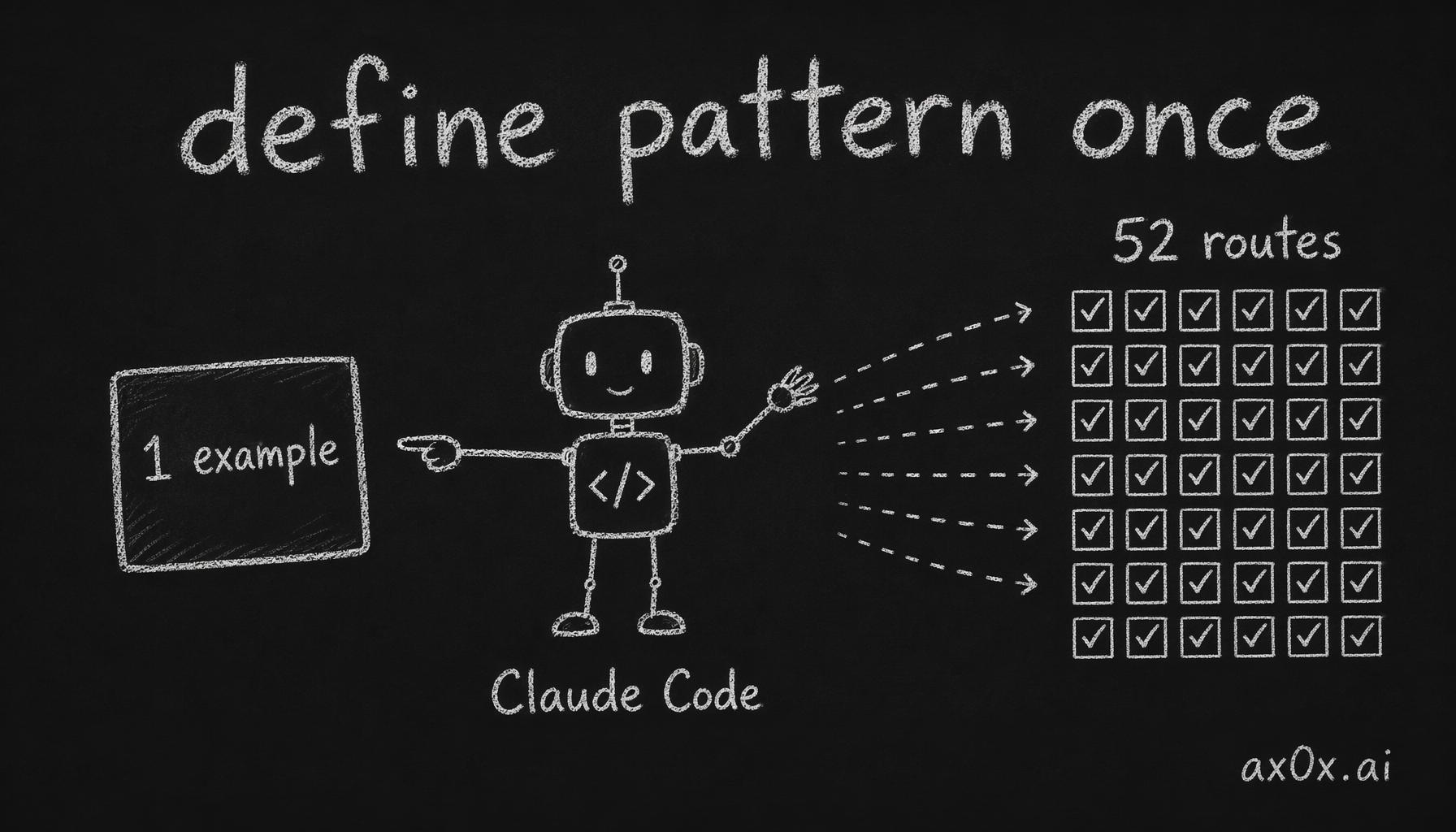 Define the migration pattern once, then let Claude Code fan it out across 52 routes
The Content Filter v1
Also built on Day 4: a DFA-based sensitive word filter. This is critical for the China market. Metaphysics content naturally includes terms that trigger naive keyword filters — 算命 (fortune-telling), 破财 (wealth loss), 桃花劫 (romantic disaster). A standard profanity filter would block half our legitimate content.
The DFA (Deterministic Finite Automaton) approach builds a trie from the word list and streams through text character by character. This version blocked entire messages containing sensitive words — later iterations would get more sophisticated.
GDPR and Legal
Knocked out bilingual terms of service and privacy policy. Not glamorous, but necessary. These would later be completely rewritten (PR #83) with separate Chinese and English versions and China AI regulatory compliance clauses.
The Moment
Around 11 PM I started all 6 apps locally, logged in with one account, and watched credits sync across tabs. One login. One credit balance. Six products. It actually worked.
Three days ago I had 5 separate apps. Now I had one platform.