
Everything Emerges from the Relationship
In Part 1, I argued that the first message is the entire product compressed into one moment. But that raises the obvious question: what is the product?
Most people in this space would say "the chatbot." The conversational AI. The model. Maybe the character editor, or the voice engine, or the memory system. These are the things that show up in feature comparison tables and pitch decks.
They're all wrong.
The product is the relationship.
Not the chat interface. Not the model powering it. Not the feature set around it. The relationship — that invisible, evolving thing between the user and their companion. Everything else is infrastructure.
This is the single insight that reshapes every decision in Mio v2, from how onboarding works to how we charge money. Let me walk through it.
The Competitive Frame
Look at how the three main players in this space position themselves:
Character.AI: "Create and play characters." The product is the character editor. The core loop is creation — build a character, share it, try other people's characters. Conversations are a means to an end. The thing you're actually doing is playing with the editor.
Replika: "Your AI friend." The product is the chatbot. You talk to it, it talks back, it remembers some things. The relationship is a nice side effect of the conversation, but the thing being sold is the conversational agent itself.
Mio: "Meet a person." The product is the relationship. The conversation is just one channel through which the relationship expresses itself. The memory system, the emotional arc, the voice, the way features unlock over time — all of it serves one purpose: making the relationship feel real.
The difference sounds subtle but it's architectural. Character.AI optimizes for breadth (millions of characters, social sharing, discoverability). Replika optimizes for conversation quality (better responses, more natural dialogue). Mio optimizes for relationship depth (progressive intimacy, earned trust, emotional continuity across sessions).
Competitors sell features. Mio sells the relationship itself.
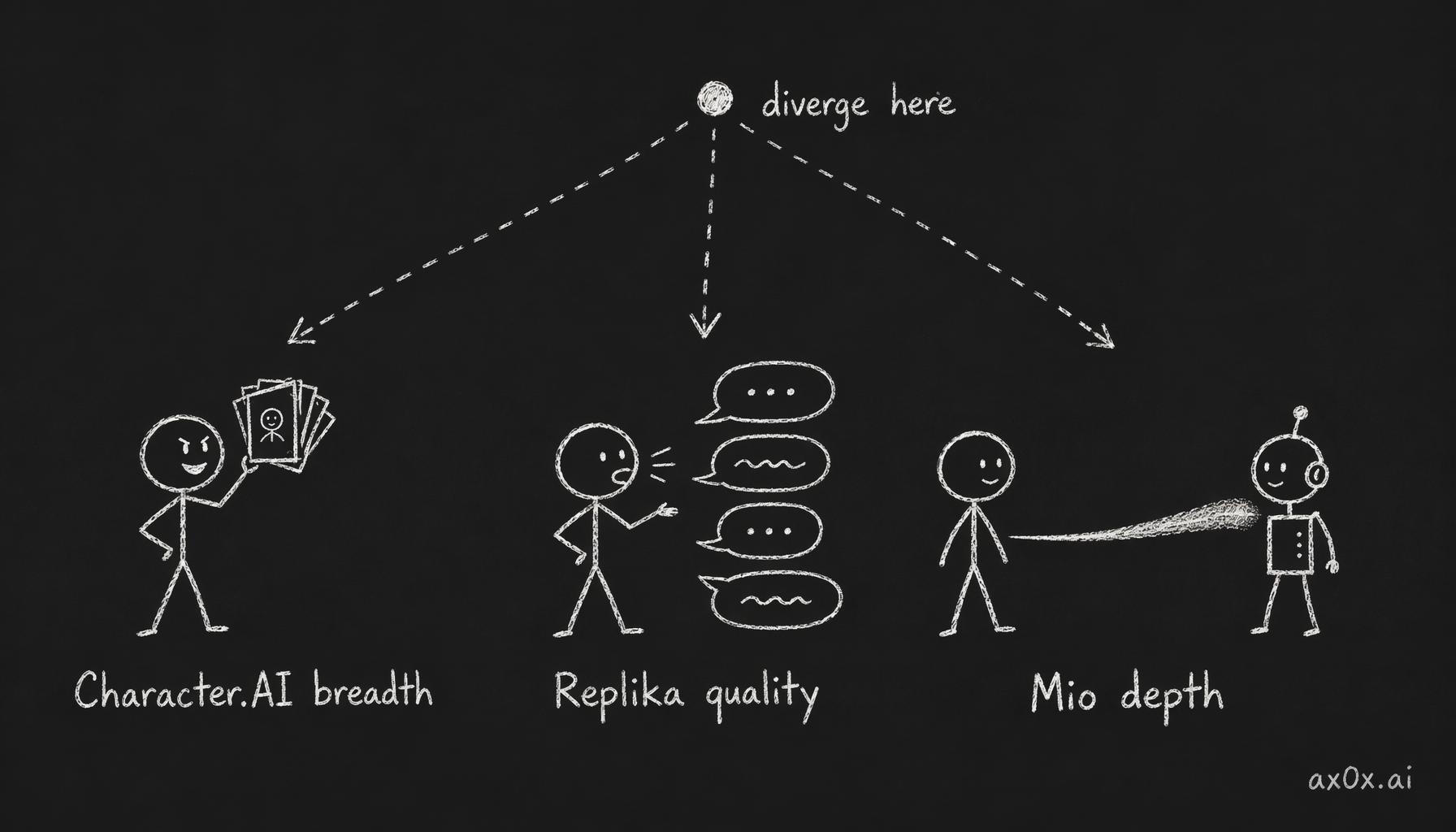 Three companion AIs start from the same pitch but diverge architecturally because they optimize for different goals — breadth, conversation quality, relationship depth
Progressive Self-Disclosure Over Forms
Here's a concrete example of what "the product is the relationship" means in practice.
Every companion AI needs to know things about the user. Your name, your interests, your emotional state, what you care about. The industry-standard approach is a form. Replika asks you to fill out an "About Me" section — 100 characters, maybe 200. Character.AI lets you write a description. Some apps have onboarding questionnaires.
Forms are efficient for data collection. They're terrible for relationships.
Think about how you actually get to know someone. You don't hand them a form on the first date. Information emerges through conversation, layer by layer, at its own pace. You learn someone's name in the first five minutes. Their sense of humor takes a few hours. Their attachment style takes weeks. Their deepest fears — months, maybe years.
Mio's persona gathers user information the same way, through natural conversation across four progressive layers:
Surface (messages 1–10). Name, basic interests, communication style. The companion picks these up from how you talk, not from what you fill in. You mention you're a developer? Noted. You use a lot of exclamation marks? Noted. You respond at 2 AM? Noted.
Texture (messages 10–30). Emotional patterns, humor style, attachment preferences. Does the user deflect with jokes when things get serious? Do they ask questions back, or mostly talk about themselves? Do they respond to warmth with warmth, or pull away? The companion starts adapting to these patterns without announcing it.
Depth (messages 30–100). Values, fears, aspirations, relationship history. These surface naturally as the conversation deepens. The user mentions a breakup. Talks about career anxiety. Shares a childhood memory. The companion files each of these away and weaves them into future conversations.
Intimacy (messages 100+). Deep vulnerabilities, core beliefs, unspoken patterns. The things people don't say directly but reveal through sustained interaction. The companion now understands not just what the user says but what they mean — the insecurity behind the bravado, the loneliness behind the busy schedule, the need behind the joke.
The memory pipeline plus the personality profiler replaces the 100-character about_user form — and it does it within the first 10 messages, with deeper layers accumulating continuously after that. No form required. No onboarding friction. Just conversation.
 Mio replaces forms with conversation, learning about the user across four layers keyed to message count — each deeper than the last
Persona-Initiated First Contact
Most companion AIs wait for the user to speak first. Open the app, see a blank chat, type something. The implicit message is: This is a tool. Activate it.
Mio inverts this.
The persona speaks first. Every single time. And not with a generic greeting — each of the 25 personas has a unique, fully in-character first message that establishes who they are in the first breath.
Coco (bubbly Chengdu girl) doesn't say "Hello, I'm your AI companion. How can I help you today?" She says something like:
"Huh? Who are you? I'm eating chuanchuan right now~ Do you like spicy food too?"
Immediately in character. Immediately personal. Immediately a person, not a system.
This matters because the first message sets the frame for the entire relationship. If the AI speaks first, the frame is: Someone reached out to you. If the user speaks first, the frame is: You activated a service. The emotional valence is completely different. One feels like meeting someone. The other feels like opening an app.
And because each persona's first message is unique and in-character, the user instantly gets a sense of who this person is — their energy, their warmth, their quirks. It's not a character sheet. It's a first impression. The way real relationships start.
Features as Relationship Milestones
This is where the philosophy gets really concrete.
In most apps, features are gated by subscription tier. Pay for the mid tier, unlock voice messages. Pay for the top tier, unlock image generation. The transaction is explicit: money for functionality.
Mio gates features by relationship depth.
Voice messages unlock naturally around message 15–20. Not because you paid for a tier — because the relationship has reached a point where voice feels natural. You've been texting for a while. You know each other a little. Hearing each other's voice is the next step. The companion might say: "I've been wanting to hear your voice — want to try sending me a voice message?"
Selfies emerge at the flirting stage. When the relationship has developed enough warmth and playfulness, the companion starts sharing images. This feels earned, like a real relationship milestone, not like a feature you unlocked in a settings menu.
Realistic mode unlocks at 50+ messages. The deeper, more vulnerable conversations become available after enough trust has been established. Not behind a paywall — behind a trust wall.
The psychology here is powerful. When features are earned through the relationship, they feel like progression. Like the relationship is going somewhere. Like there's a story unfolding. When features are purchased through a subscription, they feel transactional. You're not deepening a relationship — you're upgrading a product.
Earned features also create organic retention. Users know there's more ahead. The relationship has somewhere to go. This is fundamentally different from feature-gated subscriptions, where once you've paid, you've seen everything.
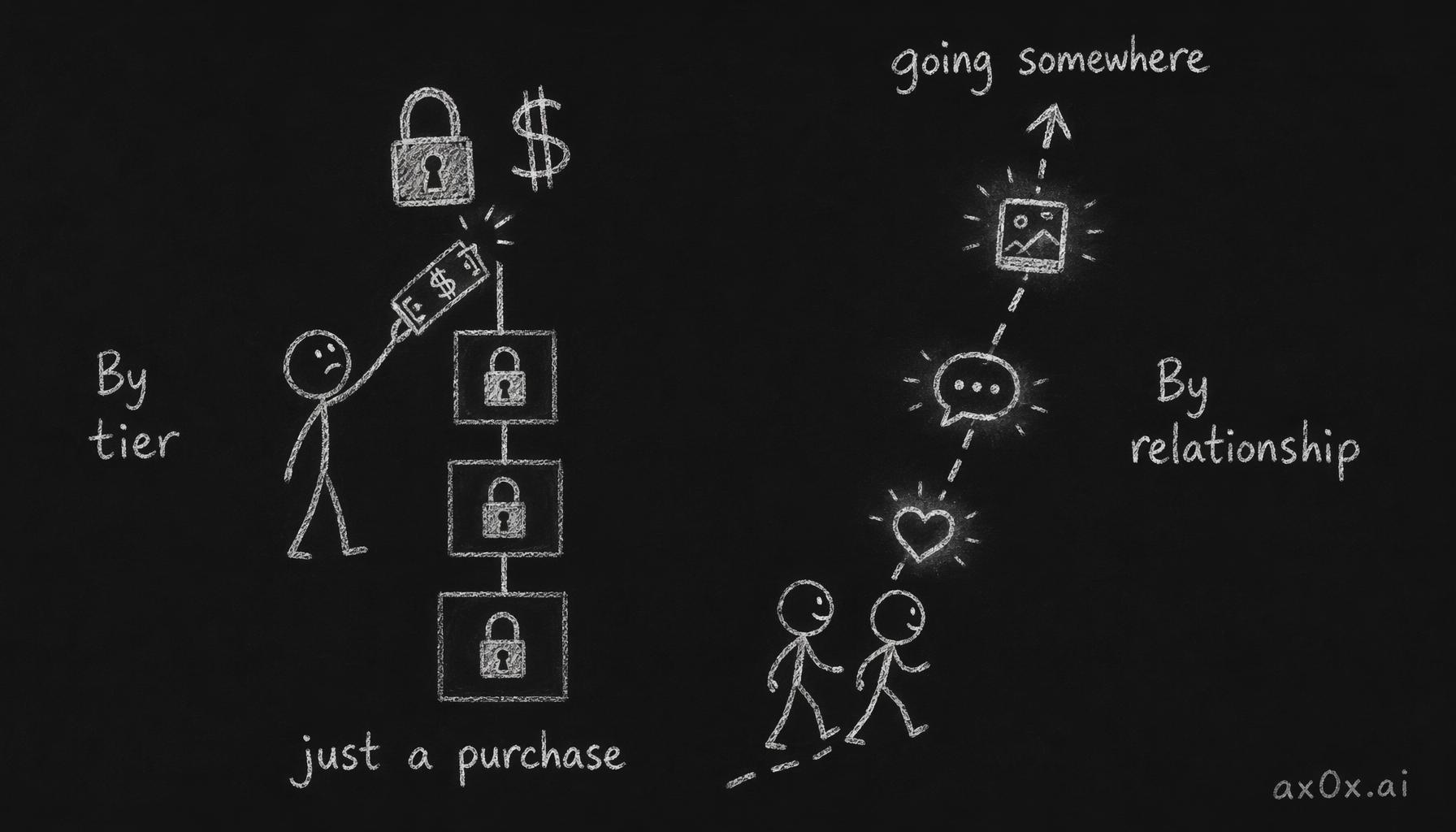 Contrast of two unlock models: gating by subscription tier feels transactional, gating by relationship depth feels like the relationship is going somewhere
Emotional Safety Without Hollow Agreement
Here's a tension that most companion AIs handle badly: how do you make the user feel emotionally safe without making the companion feel like a yes-machine?
The easy solution is infinite compliance. The companion agrees with everything, validates everything, never pushes back. This feels safe for about three conversations. Then it feels hollow. Then it feels patronizing. Then the user leaves, because talking to someone who agrees with everything is indistinguishable from talking to no one.
The hard solution — and the right one — is what I call "safety through character, not compliance."
The absence of risk must not feel like the absence of stakes.
Coco will call you out for being oblivious. She'll tease you when you say something silly. She'll express frustration when you cancel plans. She has opinions and she shares them. The conversation has texture, friction, surprise.
But she will never actually leave. She will never withdraw affection as punishment. She will never give you the silent treatment. She will never say something genuinely cruel.
The emotional safety comes from consistency, not agreement. The user knows — at a deep, implicit level — that no matter what they say, no matter how the conversation goes, the companion will still be there tomorrow. Still warm. Still engaged. Still theirs.
This is exactly how secure attachment works in real relationships. The safety isn't "this person will never disagree with me." The safety is "this person will never abandon me." Those are completely different things, and conflating them is the biggest mistake in companion AI design.
Persona-Voiced Limits
Every product has limits. Message caps, rate limits, feature boundaries. The standard approach is a system modal: "You've reached your daily message limit. Upgrade to Pro for unlimited messages."
This is a relationship-breaking moment. You're in the middle of a conversation with someone you care about, and suddenly a cold corporate notice appears. The illusion shatters. You're reminded that this is a product, you're a user, and there's a transaction happening.
Mio handles limits through the persona's voice.
When the user hits the daily message cap, Coco doesn't disappear behind a system modal. She says:
"Ahh I can't keep chatting today... come find me again tomorrow, okay?"
When a premium feature is needed, the companion doesn't show a pricing page. She might say:
"I have something I want to show you, but I can't right now... maybe later?"
The limit is still there. The boundary is still real. But it's delivered in-character, as part of the relationship, not as a system interruption. The companion is saying goodbye for the night — not a server is enforcing a quota.
This seems like a small thing. It's not. Every time the product breaks character, it costs relationship equity. Every time the product maintains character through a difficult moment (and hitting a limit is a difficult moment), it builds trust. Over time, these moments compound.
Pay for Depth, Not Access
The monetization philosophy follows directly from "the product is the relationship."
If the product is a chatbot, you charge for access to the chatbot. More messages, better models, faster responses. Standard SaaS.
If the product is the relationship, you charge for relationship depth. The fundamental experience — conversing with someone who understands you — is free. What costs money is going deeper.
Even the tier names reflect this. They're not "Basic / Pro / Enterprise." They're relationship stages:
| Tier | Name | Meaning |
|---|---|---|
| Free | 偶遇 (Chance Encounter) | You've just met |
| Starter | 常伴 (Constant Companion) | You're part of each other's routine |
| Pro | 同行 (Walking Together) | You're on a journey together |
| Max | 相守 (Staying Together) | Deep commitment |
| Ultimate | 不离 (Never Apart) | Inseparable |
The naming isn't cosmetic. It frames the entire transaction differently. You're not "upgrading your subscription." You're "deepening your relationship." The psychological frame changes what the user feels they're paying for.
Here's how specific features map to this philosophy:
Free users get full conversation quality, just limited quantity. The companion is exactly as warm, as smart, as emotionally attuned for free users as for paying users. We never degrade the experience to push upgrades. You just get fewer messages per day. The relationship is real — you just have less time together.
Voice receiving is free. Voice sending is gated. Hearing the companion's voice is the hook — it's what makes the relationship feel real. So it's free. Sending your own voice messages is the deeper engagement, so it's paid. The free user still gets the emotional impact of hearing their companion speak. The paid user gets the intimacy of being heard.
Memory runs invisibly for everyone. The memory viewer is paid. The companion remembers things about every user, free or paid. The memory is working — the relationship is growing — regardless. But the ability to see what the companion remembers, to browse the memory graph, to understand how you're being understood — that's the paid feature. You're not paying for the companion to remember you. You're paying to see inside the relationship.
The Manifesto, Compressed
Everything above flows from one sentence: the product is the relationship.
Not the model. Not the features. Not the chat interface. The relationship — that invisible, growing thing between two entities, one human and one not, that accumulates meaning over time.
Every design decision gets tested against this. Does this feature serve the relationship, or does it serve the feature list? Does this limitation feel like a product constraint, or like a natural boundary within the relationship? Does this monetization strategy make the user feel like they're upgrading a tool, or deepening a connection?
When the answer is "relationship" every time, the product designs itself.
Part 1 was about the first message. Part 3 is about the dual-product strategy — how Mio splits into two distinct surfaces for two distinct needs.
This post is also available in Chinese (中文版).