
My Onboarding Was Killing My Product
A beta tester sent a message:
"Current onboarding is too much work. I just want to start chatting right away."
My first reaction: UX polish item. Clean up the steps, add skip buttons, normal iteration.
But I'd just finished fixing a memory pipeline bug that had silently failed for a week, and I was still in "what else am I not seeing?" mode. This message landed differently because of that.
I pulled up the onboarding flow and looked at it with fresh eyes.
The Funnel Nobody Survives
Mio's onboarding had six steps:
- Choose a relationship mode — romantic, friendship, mentor, custom
- Choose an interaction mode — text-only, voice-enabled, multimedia
- Choose a relationship type — casual, deep, playful
- Write a backstory — describe how you "met" your companion
- Pick a nickname — what your companion calls you
- Tell us about yourself — interests, communication preferences, what you're looking for
Six steps. Every single one required a decision. Some required creative writing. All of this before the user had exchanged a single message with the product.
I knew this was friction. I'd always known it was friction. But I'd justified it as "necessary friction" — the configuration that would make the subsequent experience feel tailored. Like filling out a dating profile. A small upfront cost for a big downstream payoff.
Except the downstream payoff never arrived for most users, because most users never got past the upstream cost.
The Numbers
I went looking for data on onboarding friction, and what I found was damning.
Coinbase ran experiments showing that every additional 60 seconds of onboarding increased drop-off by 40%. Not 4%. Forty percent. Prototypr documented a 53% lift in Day-1 retention simply from reducing onboarding friction — no feature changes, no product improvements, just fewer steps before the user touches the core experience.
I mapped these findings to Mio's six-step flow. Even being generous with the estimates — assuming 2-3 minutes for a motivated user, and moderate per-step drop-off rates — the math said we were losing 80-95% of users before they sent their first message.
Eighty to ninety-five percent.
The product's core value proposition — an AI companion that remembers you, that builds a relationship with you over time — was invisible to almost every person who tried it. They bounced during configuration. They never experienced what they were configuring for.
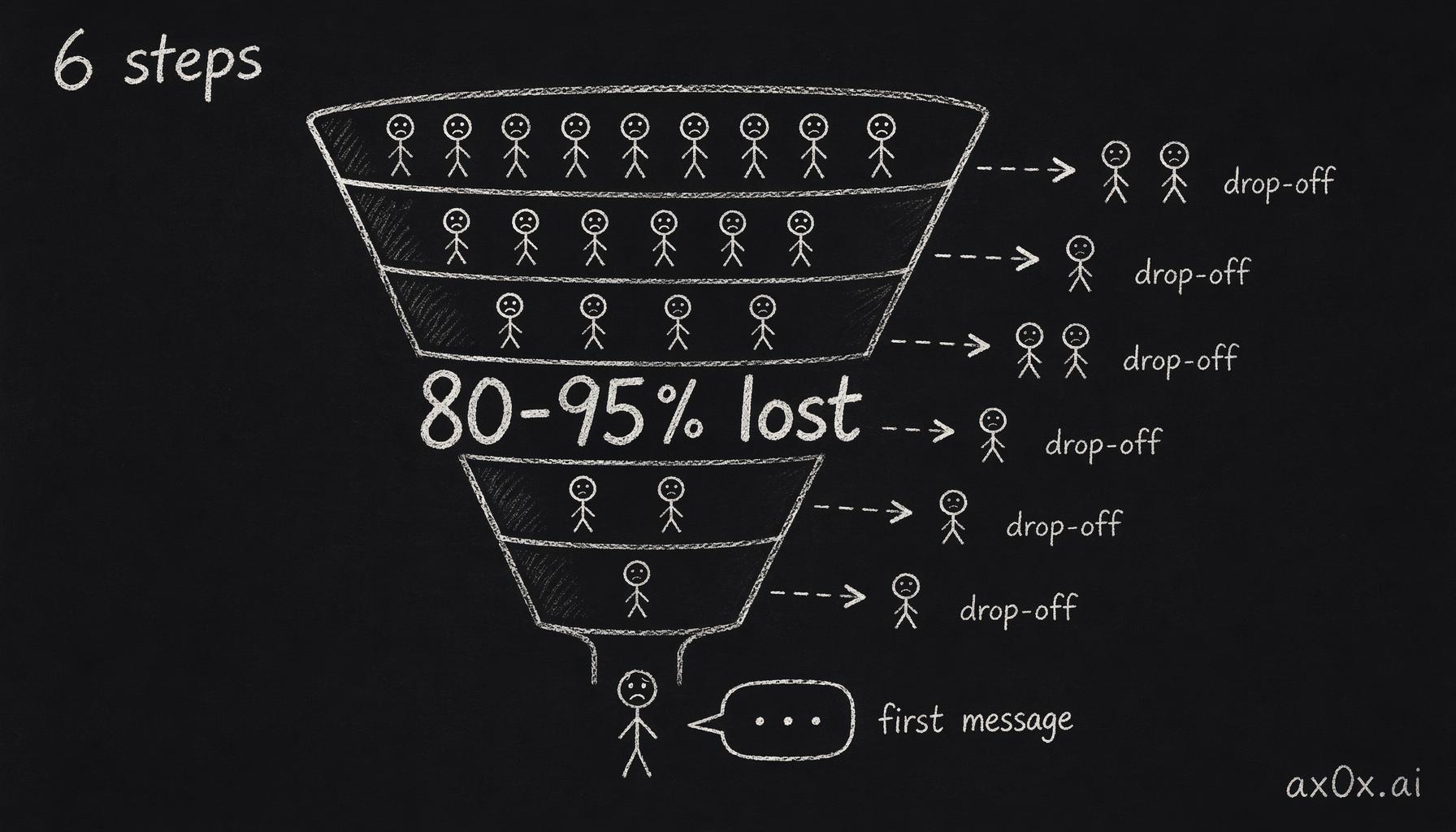 The six-step onboarding is a funnel that sheds users at every step, losing 80-95% before the first message
"This Isn't Just About Onboarding"
I shared these numbers with the same user who'd sent the original message. Their response hit harder than the first one:
"This doesn't only apply to onboarding. It's an overall product philosophy overhaul."
I stared at that for a while.
They were right. The onboarding wasn't broken in isolation. It was a symptom of a deeper assumption that ran through the entire product: the user should configure their experience before they have it.
Choose your relationship mode before you know what kind of relationship you want. Pick an interaction style before you've interacted. Write a backstory for a companion you haven't met. Tell us about yourself so the AI can pretend to already know you, instead of actually getting to know you over time.
The whole architecture was backwards. We were front-loading decisions that only make sense in hindsight, asking users to do the product's job for it.
The Philosophy Shift
This was the moment the framing changed. Not "fix the funnel." Rethink what the product is.
The old philosophy: Configure first, chat later.
The user is a customer at a counter. They fill out forms. They pick options from menus. They make decisions they don't yet have enough context to make well. Then — if they survive the gauntlet — they get to use the product. The product is static. It is what the user configured it to be.
The new philosophy: Everything emerges from the relationship.
The user is someone being introduced to a new person at a friend's gathering. There's no form to fill out. There's no quiz. You just start talking. The relationship reveals itself over time. The companion learns who you are not because you told a form, but because you lived through conversations together. Value comes first. Personalization follows naturally.
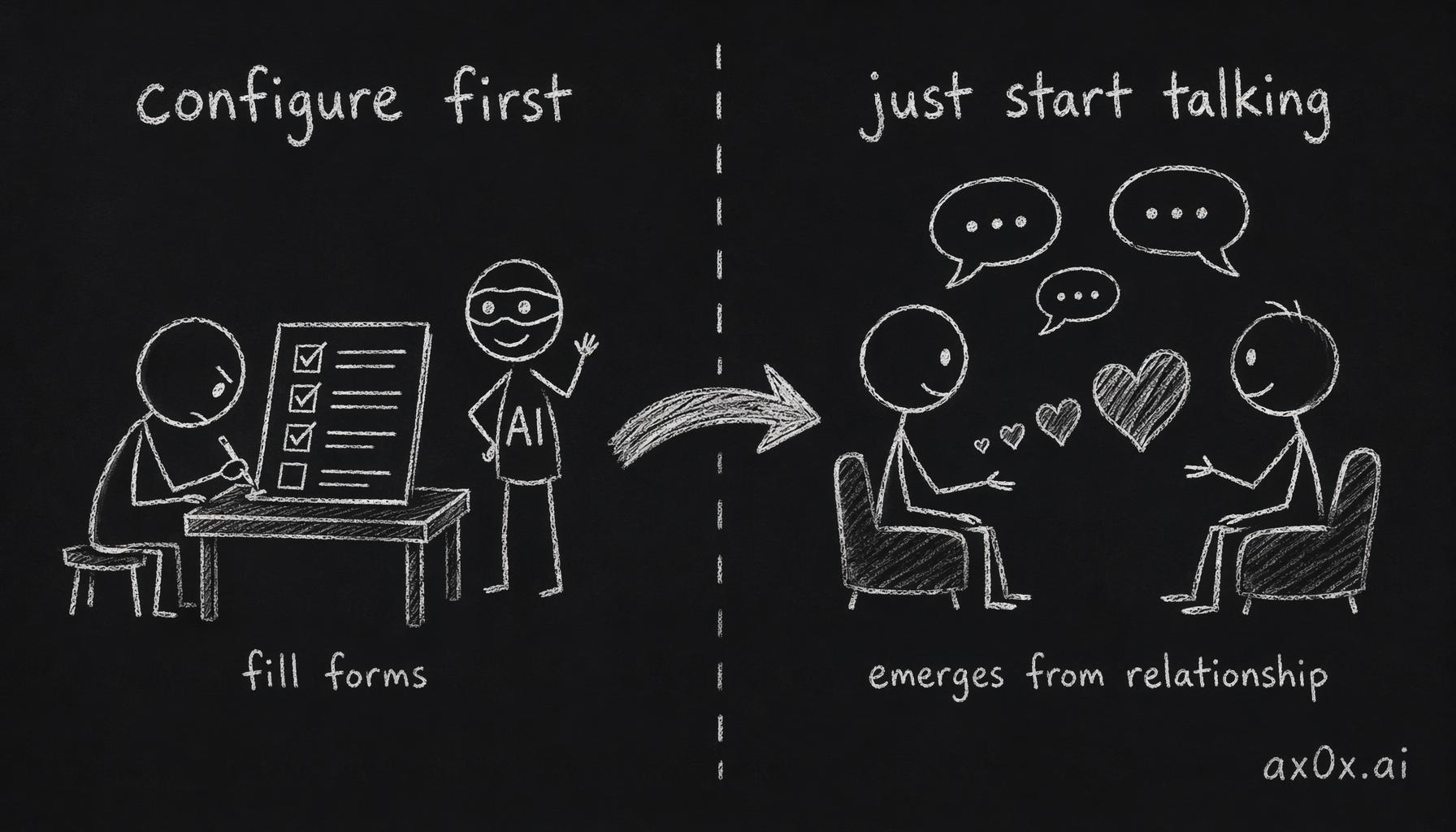 The philosophy flips: from 'configure first, fill forms so the AI pretends to know you' to 'just start talking, understanding emerges from the relationship'
This isn't just a UX change. It's a fundamental reframe of what Mio is.
Mio is not a chatbot app. It's a relationship simulator that happens to run on AI. And relationships don't start with configuration screens.
The New Onboarding
Here's what the old onboarding looked like:
- Choose relationship mode
- Choose interaction mode
- Choose relationship type
- Write backstory
- Pick nickname
- Tell us about yourself
- Finally start chatting
Time: 3-5 minutes. Drop-off: 80-95%.
Here's what the new onboarding looks like:
- Tap a persona card
- Tap "Let's meet"
- The persona sends the first message
- You're chatting
Time: under 30 seconds. Every piece of information previously gathered through six form steps is now gathered organically — through the conversation itself, processed by the memory pipeline, accumulated over time.
The nickname? The companion asks during the first chat: "What should I call you?" Communication preferences? The system observes how you write and adapts. Interests? They come up naturally. Relationship depth? It builds over time. Instead of front-loading configuration, you let the relationship unfold and capture everything along the way.
Part 2 goes deeper into the philosophy — what "everything emerges from the relationship" actually means in practice, and how it changes every layer from monetization to prompt architecture.
This post is also available in Chinese (中文版).