
The Spinoff: From Selfie App to Jewelry Content Engine in One Day
A friend saw ÉLAN and had an idea: "Cloud try-on for jewelry. Small merchants can't afford real photo shoots. Let customers see what pieces look like on them virtually. AR + AI. Huge market."
She'd written a full research report. Pricing model, competitive analysis, technical architecture, 7-day implementation plan. It was thorough.
It was also wrong.
Killing the Plan
Before writing a single line of code, I had Claude run deep research across four dimensions: competitive landscape, tech maturity, business model, and regulatory compliance.
The findings came back in 20 minutes. Three fatal flaws:
Giant platforms already offer this for free. Taobao and JD.com have built-in AR try-on for jewelry. Small merchants can't compete with free — and shouldn't have to.
The pricing doesn't work. The proposed 1,980 CNY/month subscription targets small jewelry merchants who average 30K CNY in monthly revenue. That's 6.6% of gross revenue for a single tool. No small merchant pays that.
Compliance is genuinely hard. China's 2025 Facial Recognition Management rules require device-side storage, separate consent forms, and impact assessments for any facial data processing. The report's claim of "zero compliance difficulty" was simply incorrect.
The plan was dead. But the underlying instinct — that small jewelry merchants need affordable visual content — was right. The question was: what form should that content take?
The Pivot: Content, Not Try-On
Small jewelry merchants have a very specific problem. They need professional product photos for Xiaohongshu, Taobao, and WeChat. The current supply chain for this:
| Role | Cost per set |
|---|---|
| Photographer | 800-2,000 CNY |
| Graphic designer | 200-800 CNY |
| Copywriter | 100-300 CNY |
| Total | 1,100-3,100 CNY |
For a merchant selling $50-200 pieces, that's ruinous. Most just take bad phone photos and wonder why they don't sell.
Here's what I realized: ÉLAN's Gemini pipeline already does 90% of what's needed. Upload a photo, inject a detailed prompt, get styled output. The difference is:
- ÉLAN input: selfie → output: glamour photos of the person
- Shichuan input: product photo → output: editorial content suite for the product
Same pipeline. Different prompts. Same day.
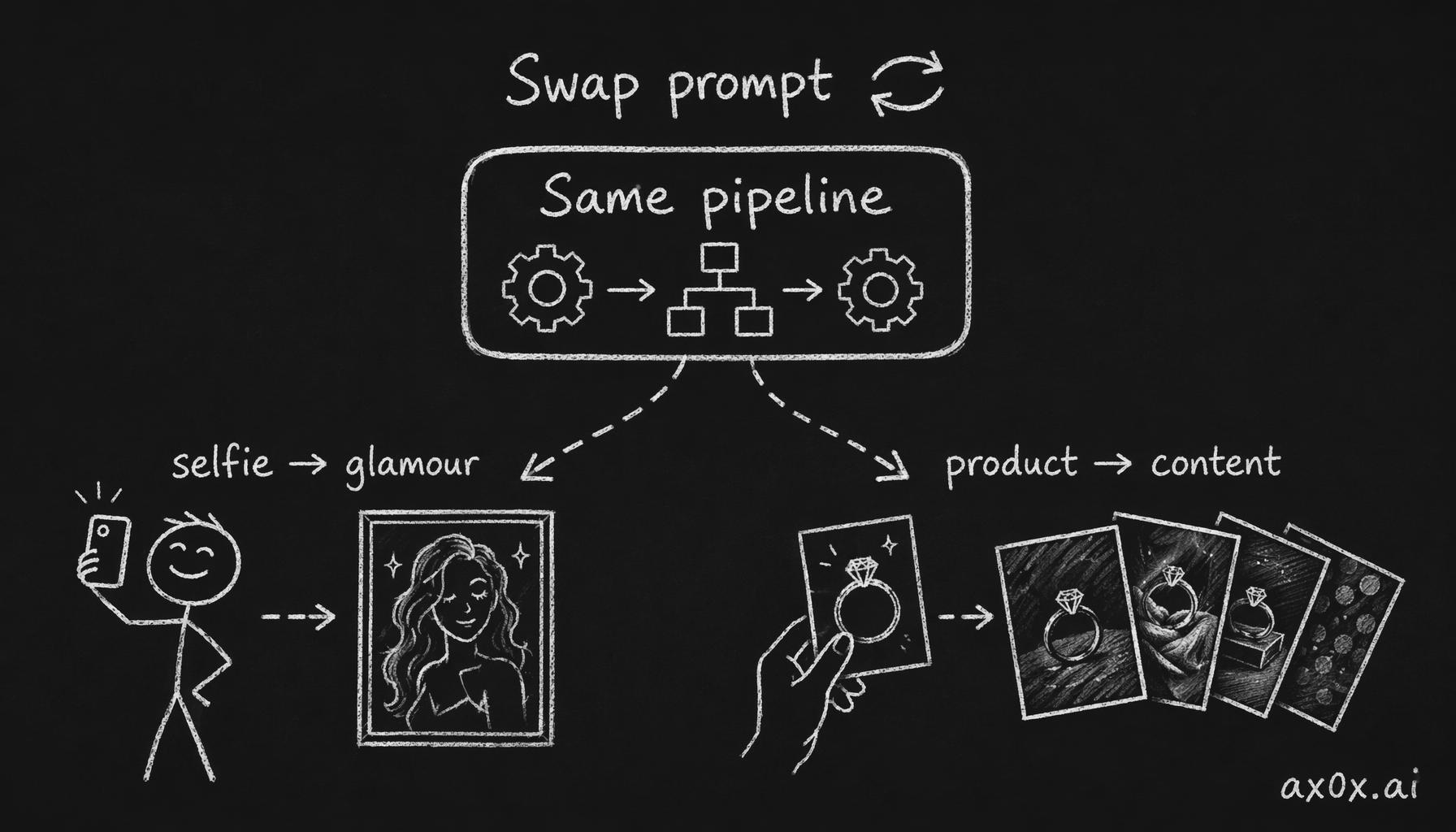 One Gemini pipeline, swap only the prompt, and a selfie-glamour product becomes a jewelry-content product — same tech, orthogonal value
Six Templates, One Photo
I built Shichuan (识川) around a two-step AI pipeline:
Step 1: Analysis. Gemini Flash analyzes the product photo plus any seller description. It outputs structured JSON: materials, gemstone details (cut, color, count, setting, special effects), craftsmanship techniques, color palette, selling points, and a complete Xiaohongshu post draft. This takes about 7 seconds.
Step 2: Generation. For each selected template, a specialized prompt injects the analysis data and generates an editorial-quality image. All templates run in parallel.
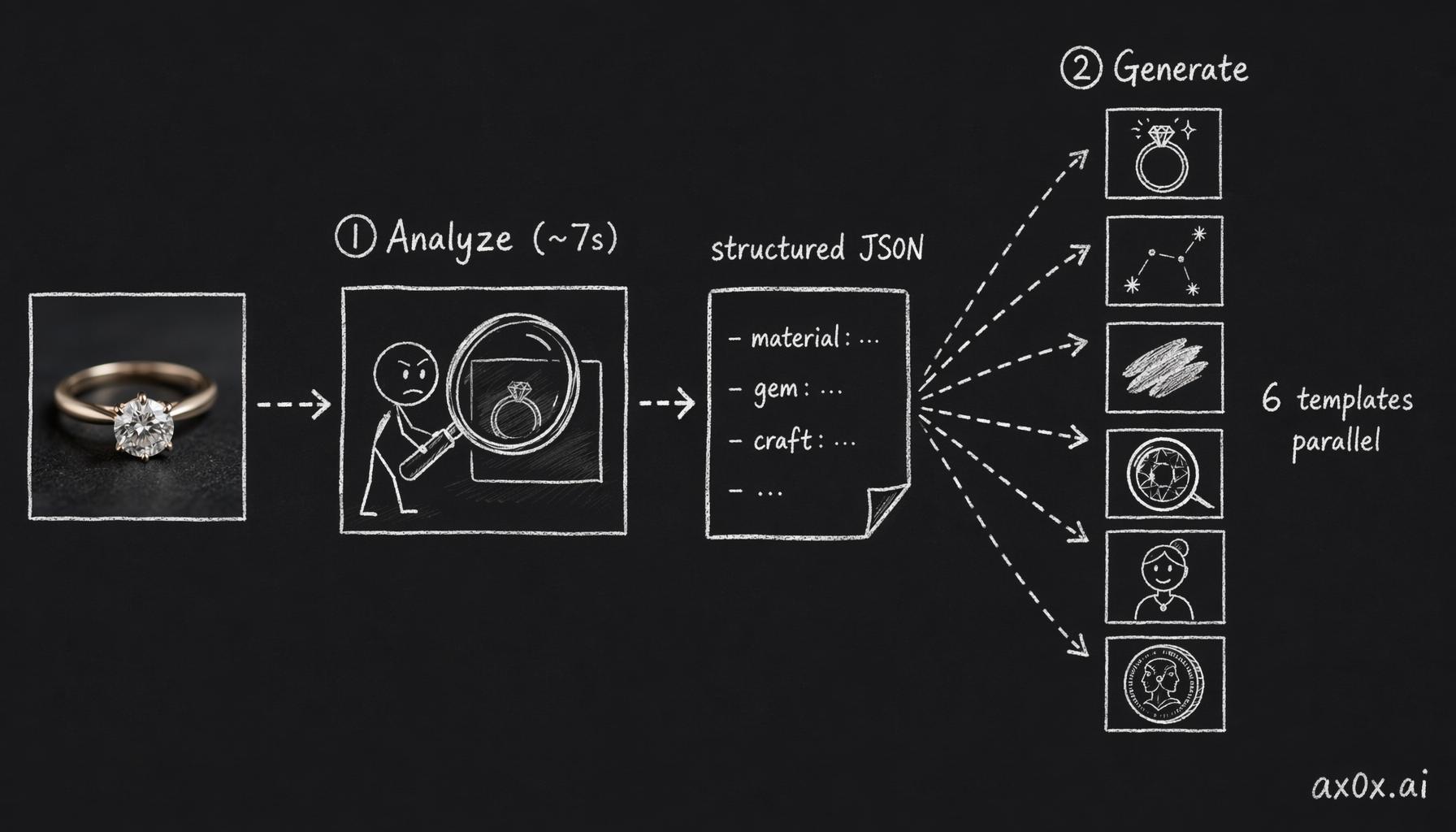 Shichuan's two-step pipeline: Gemini Flash first turns the product photo into structured JSON, then six templates generate editorial images in parallel
The six templates:
| Template | What it generates |
|---|---|
| Hero (产品主图) | Studio-lit product shot with material-specific lighting |
| Constellation (宝石星图) | Museum vitrine layout — gems extracted as specimens in a loose constellation on dark background |
| Color DNA (色彩基因) | Jewelry on fabric with watercolor swatches deconstructing its palette |
| Craft Detail (工艺微距) | Extreme macro of craftsmanship details |
| Lifestyle (佩戴场景) | Xiaohongshu-aesthetic wearing shot |
| Size Reference (尺寸参考) | Clean flat lay with coin for scale |
The merchant uploads one product photo, optionally adds a description like "akoya 7-7.5mm, uncolored, good luster, near-round, 925 silver clasp," and gets back six images plus copywriting. Total cost per set: less than a Mixue drink.
The Aesthetic Breakthrough
The first version of the material breakdown images looked like engineering drawings. White background, arrows, technical labels. Accurate but lifeless. Nobody wants to post that on Xiaohongshu.
This was the moment I realized the product's real differentiator isn't AI image generation — every competitor has that. It's editorial aesthetic.
The Constellation template reimagines material breakdown as a museum exhibit — each gem placed like a specimen in a vitrine, loosely arranged in a constellation pattern on deep charcoal. It feels like a page from a jewelry exhibition catalog, not a product spec sheet.
The Color DNA template deconstructs the piece's palette as organic watercolor washes flowing across textured paper. The jewelry sits on natural linen while its colors bleed outward as artistic swatches. It looks like a page from a designer's sketchbook.
These templates don't exist in any competitor's offering. 绘蛙 (Huiwa) and WeShop generate model-on-product photos — useful but commoditized. Nobody generates editorial content that makes a $50 silver bracelet look like it belongs in Vogue Jewelry.
The Second Feature: Raw Stone Design Proposals
Late in the session, a second use case emerged that I hadn't planned for.
Jewelry merchants often have loose gemstones — raw sapphires, unmounted diamonds, rough jade — that they want to turn into finished pieces. The traditional process:
| Role | Cost |
|---|---|
| Gem appraiser | 200-500 CNY |
| Jewelry designer (sketches) | 800-3,000 CNY |
| CAD designer (3D render) | 500-2,000 CNY |
| Total | 1,500-5,500 CNY |
What if Shichuan could take a photo of loose stones and generate a complete design proposal?
The first attempt used photorealistic CAD renders. They looked generic — could have come from any rendering software. Rejected.
The second attempt used hand-drawn watercolor and pencil sketch on textured paper, matching how real jewelry designers present proposals. Plus a designer signature ("Xingfan Xia" in cursive with a red seal stamp "夏星帆印" in small seal script). This felt right — it looked like a proposal from a human designer, not an AI output.
The design proposal package includes: watercolor sketch, 3D concept render, lifestyle preview, material constellation, mood board, and color DNA page. Six images that tell a complete design story. 299 CNY per set, replacing thousands in design fees.
Flash vs. Pro: The AB Test
I tested both Gemini Flash and Pro on two products: an Akoya pearl bracelet (simple) and a Candeer multi-gem ring (complex).
Analysis speed: Flash-Lite 6.7s vs Flash 15.5s vs Pro 37.4s. Flash was good enough for structured analysis.
Image quality: Flash averaged 5.8-6.2/10. Pro averaged 8.3-8.4/10. Massive gap — Flash couldn't reproduce a tube clasp correctly, while Pro nailed material-specific details.
Decision for MVP: Flash for everything. Good enough to ship and validate. Pro available as a quality upgrade later. The cost difference between Flash and Pro per set is negligible — but the speed difference (parallel generation in ~30s vs ~90s) matters for UX.
One unexpected finding: Gemini successfully detected contradictions between seller descriptions and product images. A merchant describes "natural sapphire" but the photo shows synthetic? The analysis flags it. This could become a trust feature.
One Day, Zero to Deployed
The full build timeline:
- Hour 1-2: Deep research kills cloud try-on, identifies content generation opportunity
- Hour 3-4: Build analysis pipeline, test on Akoya pearl bracelet
- Hour 5-6: Build 6 content templates, iterate on aesthetic direction
- Hour 7-8: Build frontend (4-step flow: upload → analyze → select templates → generate)
- Hour 9-10: Deploy to Vercel, set up invite codes + credit system via Upstash Redis
- Hour 11-12: Discover and validate raw stone design proposal feature
- Hour 13: AB test Flash vs Pro, lock in architecture decisions
One person. One day. Reusing ~60% of ÉLAN's infrastructure (Gemini client, image preprocessing, Vercel Blob, SSE streaming, Zustand state management). The new code was primarily the analysis prompt, six template prompts with material-specific lighting, and the raw stone design prompt system.
This is what I meant in Part 3: The Super Individual about AI making the cost of trying near zero. The entire investment to validate this product was one day of time and a trivial amount in Gemini API calls.
What Shichuan Teaches About ÉLAN
Building a B2B spinoff from a C2C product clarified something about the underlying platform:
| Dimension | ÉLAN (C2C) | Shichuan (B2B) |
|---|---|---|
| Input | Selfie | Product photo |
| Core challenge | Face consistency | Material fidelity |
| Output | Personal glamour photos | Editorial content suite |
| Value anchor | "I look amazing" | "My product looks expensive" |
| Pricing | Consumer subscription | Per-set or monthly credits |
The pipeline is the same. The prompts are different. The value propositions are orthogonal. One makes people look good. The other makes products look good. Both use the same Gemini multimodal generation, the same SSE streaming, the same Vercel infrastructure.
The moat isn't the technology — it's the prompt engineering and aesthetic direction. The Constellation template, the Color DNA concept, the VANITY_DESIGN_INSTRUCTIONS from ÉLAN, the material-specific lighting functions — these are the accumulated craft that makes the output look editorial rather than generic.
Pricing: Anchor on Replacement
The pricing strategy follows a simple principle: anchor on what you're replacing, not what it costs to run.
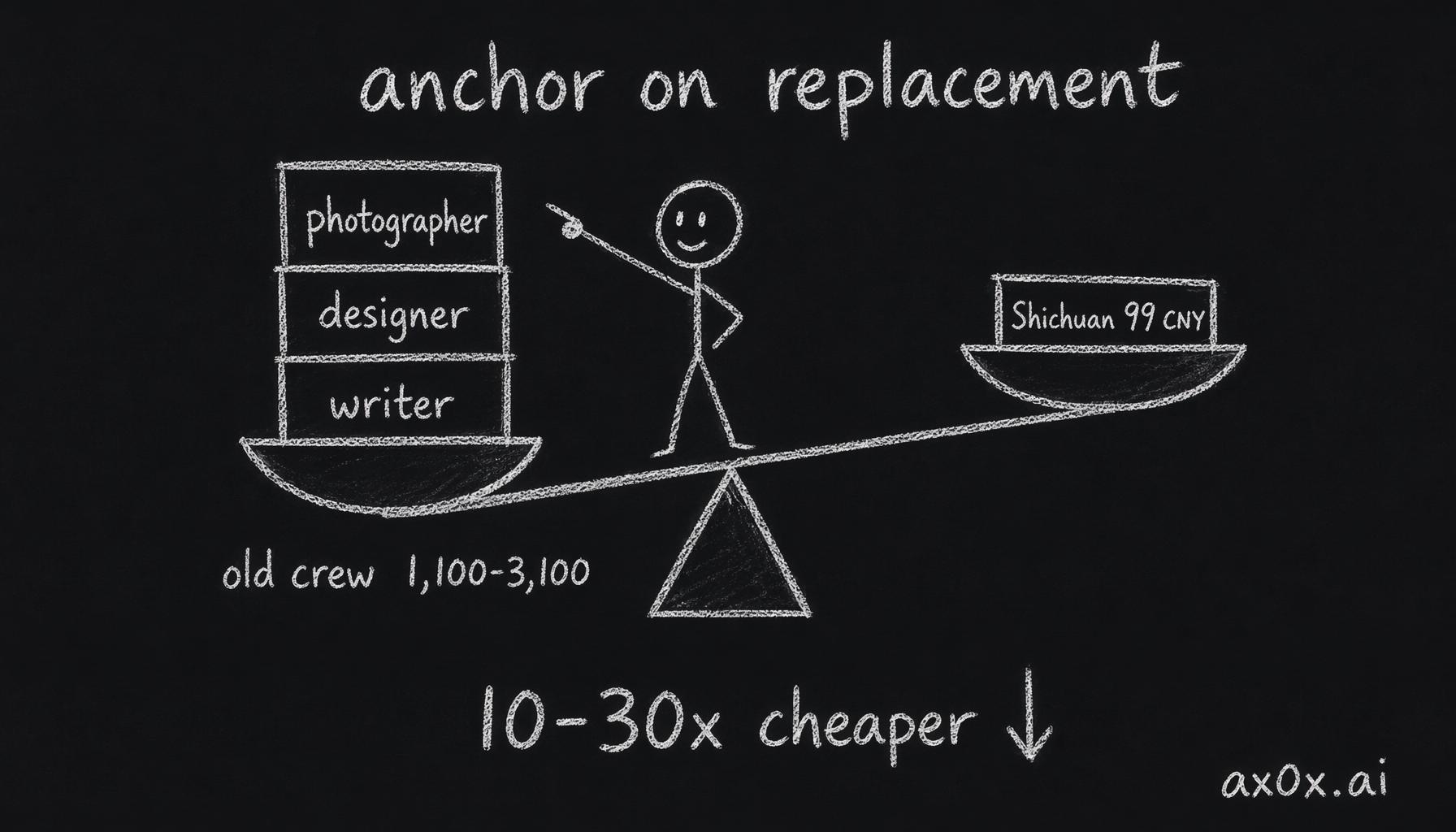 Price by anchoring on what you replace, not what you spend to run it: one 99 CNY set against the traditional photographer+designer+writer stack of 1,100-3,100 CNY
Content mode: 99 CNY per set (pay-as-you-go) or 399-699 CNY/month for 10-30 sets. Replaces 1,100-3,100 CNY worth of photographer + designer + copywriter work. 10-30x cheaper. API costs are a small fraction of the price — very healthy margins.
Design mode: 299 CNY per set. Replaces 1,500-5,500 CNY worth of appraiser + designer + CAD work. 5-18x cheaper. Same margin structure.
At these margins, the question isn't "can we afford to run this" — it's "how fast can we find merchants who need it."
This is Part 1 of the Building Shichuan series. It started as an ÉLAN spinoff — same Gemini pipeline, different prompts, different market.
Sometimes the best product idea comes from a bad business plan. Part 2 takes the jewelry MVP and scales it to every product category.
This post is also available in Chinese (中文版).