
The Lobster Fever
Over the past two weeks, a new social greeting has taken over Chinese WeChat: "Have you raised your lobster yet?"
At Tencent's Shenzhen headquarters, roughly a thousand people lined up — retired aerospace engineers, housewives, 11-year-old kids — for free OpenClaw installation help. Remote installation services cost 50-100 RMB, house calls 500-1000. Training courses priced at 998 RMB turned out to be translated GitHub documentation.
At the same moment, Reddit's consensus was: "simpler alternatives cover 99% of real-world use cases." US mainstream media — CNN, Fox News — had zero coverage. The average American had no idea the framework existed.
Same GitHub project. Two parallel universes.
This article isn't about what the framework is, how to use it, or whether it's worth installing. Those questions have simple answers: useful for developers, useless for people who can't run a command line. The question I want to answer is deeper: How does the same open-source project become a quiet developer tool in the US and a nationwide movement in China?
This isn't a knowledge gap. China has world-class AI engineers and researchers. The answer lies in crowd psychology, cultural structure, and institutional economics.
Le Bon's Ghost
In 1895, French social psychologist Gustave Le Bon wrote The Crowd. His core argument: when heterogeneous individuals merge into a group, individuality disappears. Emotional contagion replaces rational judgment. Crowds don't think; crowds feel. Crowds are immune to rational arguments but defenseless against emotional suggestion.
131 years later, the queue outside Tencent's Shenzhen headquarters is a textbook specimen of his theory.
A retired aerospace engineer and an 11-year-old child standing in the same line to install the same command-line developer tool — this is not the product of individual rational assessment. This is the power of group suggestion. In Le Bon's framework, it's called "the disappearance of conscious personality."
Le Bon's three mechanisms of crowd formation — disappearance of individuality, emotional contagion, group suggestibility — map precisely onto the framework's phenomenon in China:
"Have you raised your lobster yet?" is not a technology discussion. It's emotional contagion. The subtext isn't "are you using this tool?" — it's "are you keeping up with the times?" Chinese internet commentary described the feeling precisely:
"If you still don't know about the 'lobster,' it means you're already behind, just like not knowing about Douyin, Clubhouse, or ChatGPT back in the day." — China Minutes
Note what's being transmitted: a "vague emotion," not a specific functional need. Le Bon observed that crowd emotions are intense, simple, and bypass reasoning. "AI anxiety" checks all three boxes.
But crowds don't form spontaneously. They need triggers.
Information Cascades: Three Ignition Points
Information cascade theory (Bikhchandani & Hirshleifer) holds that when early adopters send sufficiently strong signals, subsequent individuals suppress their own judgment and follow. The framework's cascade in China had three critical triggers:
Trigger 1: The "little lobster" nickname. This transformed infrastructure software into a cultural symbol. Technical tools normally live in documentation and developer forums. But "raising lobsters" can become WeChat stickers, Douyin memes, social greetings. The nickname lowered the cognitive threshold for cascade ignition — you don't need to understand Node.js, you just need to know "everyone's raising lobsters."
Trigger 2: Five giants moved simultaneously. Tencent, Alibaba, ByteDance, JD.com, and Baidu all launched free installation campaigns within days of each other. This kind of synchronized action from five normally competing giants is extremely rare. Robert Cialdini's social proof principle holds that when you're uncertain what to do, you look at what authorities do. Five companies moving in unison = the strongest possible social proof signal. No US cloud provider followed suit — the cascade anchor simply doesn't exist in America.
Trigger 3: Policy endorsement. The government work report explicitly called for "accelerating AI agent applications." Shenzhen's Longgang district issued its "Lobster Ten Measures" with subsidies up to 2 million RMB. Wuxi offered up to 5 million. At the Two Sessions, a Chinese Academy of Engineering member publicly fretted about "being anxious about not having raised his lobster yet."
Three triggers stacked: a lovable cultural symbol + corporate collective endorsement + government legitimacy. Once the cascade fires, nobody needs to understand the technology anymore.
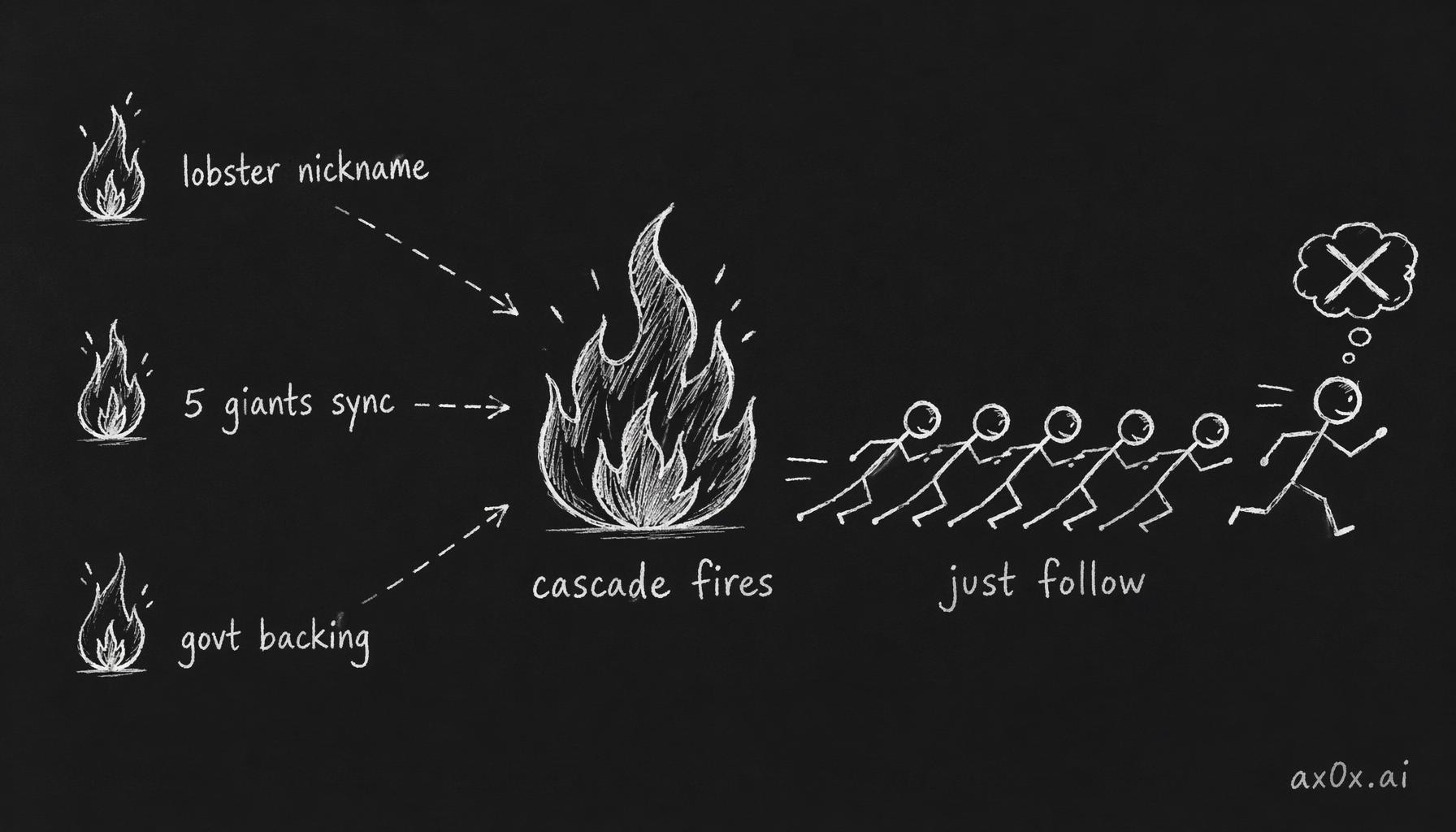 Three signals stack and ignite: nickname + five giants moving in sync + government backing fire an information cascade, and people suppress their own judgment to follow.
In the US, none of these three triggers exist.
Face, Collectivism, and the Fear of Falling Behind
Cascades explain the propagation path, but not the intensity. FOMO exists everywhere — so why is China's FOMO ten times stronger?
The answer is in cultural structure.
On Hofstede's cultural dimensions, China scores extremely high on collectivism; the US scores highest in the world on individualism. In collectivist cultures, individual decisions are heavily influenced by "significant others" — colleagues, leaders, neighbors. Adopting a new tool isn't a personal efficiency calculation; it's a social signal. You use it = you're progressing. You don't = you're falling behind.
"When individuals encounter new technologies, perceptions about usefulness and intention to use are likely to be influenced by their significant others — close friends, relatives, colleagues, and superiors." — PMC
Chinese culture adds another amplifier: mianzi (face). Face culture ties technology adoption directly to social status. Once a tool achieves critical mass in your circle, not using it becomes a face-losing proposition, triggering preemptive adoption.
"Have you raised your lobster yet?" draws its power from this — it's not inviting you to discuss a tool, it's asking whether you've fallen behind. In American culture, criticizing a hyped project on Hacker News carries zero social risk and actually earns respect. The incentives run in opposite directions.
Cross-cultural data bears this out. On willingness to share data for AI, Chinese respondents outnumber the unwilling 5:1; Americans are roughly split 1:1. Collectivist cultures embrace new technology more aggressively — this isn't blind following, it's a culturally rational response.
But culture is just the soil. The soil still needs watering. The water is China's unique anxiety economics.
The Soil of Anxiety
China's youth unemployment rate hit 17.1% in October 2024. The class of 2025 produced 12.22 million graduates — a record. The popularity of terms like tang ping ("lying flat") and bai lan ("let it rot") isn't laziness; it's a cognitive response to structural impasse:
"Young people are cutting expenses, unable to find jobs, and the jobs they find fall significantly short of expectations."
When traditional channels for upward mobility — college entrance exams, real estate, guanxi networks — narrow, any technology narrative promising to "change your fate" lands directly on a generation's status anxiety. The phrase "don't get left behind" is the single most effective traffic keyword on the Chinese internet. It hasn't changed in a decade.
Huxiu's 2025 Youth Emotion Report goes deeper:
"This anxiety doesn't just come from the economy or job prospects — it comes from the repeated questioning of 'individual value.'"
This means paying 998 RMB for an AI course isn't pure irrationality. It's a ritual of agency — buying = acting = not sitting helplessly. The purchase itself has a psychological soothing function, regardless of whether the course content is translated documentation.
The US doesn't have comparable anxiety density. Silicon Valley layoffs are real, but the American tech sector's overall employment rate and compensation still far exceed the social average. Ordinary Americans aren't anxious about "the next window of opportunity" because their economic security doesn't depend on catching a technology trend.
This is why the same GitHub project triggers a nationwide response in China — it lands on soil already saturated with anxiety.
The Amplifier Stack: What China Has That the US Doesn't
WeChat: The Superinfrastructure of Emotional Contagion
WeChat is not China's Twitter. Twitter is a public square; WeChat is a living room.
When a WeChat article is forwarded in a group chat, the reader sees "a friend recommended this" — not an algorithmic recommendation. The trust level is fundamentally different. The Columbia Journalism Review found that WeChat has become the primary information source for most Chinese people.
More critically, WeChat is closed. The Reddit threads debunking the framework's architecture never penetrate WeChat groups. WeChat's viral sharing mechanism (100K+ reads → group forwarding) creates a chain of friend endorsements where external criticism is structurally excluded.
Contrast: On Twitter and Reddit, supporting and opposing voices compete on the same stage. In WeChat groups, the spiral of silence runs at full power.
Douyin: The Algorithmic Amplifier of Anxiety
Douyin's recommendation engine optimizes for completion rate and engagement. "If you don't learn AI you'll be obsolete" has systematically higher completion rates than "a rational analysis of AI capability boundaries" — anxiety drives engagement, and the algorithm rewards engagement with more distribution.
"Douyin's algorithm no longer relies on tagging content or users — it uses neural networks to predict user behavior." — OSCHINA
A 60-second Douyin video showing "the framework auto-replies to your WeChat messages in 3 minutes" gets algorithmically pushed to ever-wider audiences — from tech enthusiasts to farmers to small shop owners. The algorithm breaks through layer boundaries, completing the information cascade's final jump.
The same project on Reddit only appears in r/MachineLearning or r/AI_Agents. It never auto-surfaces to non-subscribers. America's information stratification is a natural firewall.
Self-Media: 3.1 Million Creators in an Anxiety Monetization Arms Race
China has roughly 3.1 million self-media creators, competing for nearly 1 billion daily active users. The knowledge-payment market is projected to reach 280.88 billion RMB in 2025.
One structural difference explains everything: the monetization cycle.
| Chinese self-media | US tech creators | |
|---|---|---|
| Primary revenue | Brand deals + course sales + traffic share | Substack/Patreon subscriptions |
| Incentive structure | Maximize single-article viral reach | Maintain long-term subscriber trust |
| Cost of exaggeration | Near zero | Unsubscribes = revenue loss |
When the monetization cycle is "today," exaggeration is a rational business choice. When the cycle is "next year's renewal," exaggeration is costly. Substack penalizes hype; WeChat Official Accounts and Douyin reward it. This isn't a moral difference — it's an incentive structure difference.
The data: Li Yizhou, marketed as a "Tsinghua PhD," earned 175 million RMB in three years selling AI courses — roughly 250,000 units. Course quality? Investigative journalists found: "Ads dominated the content; substantive material was thin."
3.1 million creators trapped in a classic prisoner's dilemma: even if you want to produce rational analysis, the rational choice is to follow anxiety narratives — because the algorithm only rewards high-engagement content.
A-Shares: The Infrastructure of Concept Stock Speculation
| A-shares | US equities | |
|---|---|---|
| Retail investors | 99.76% (240 million) | ~4% |
| Retail trading volume | 65-90% | 11-25% |
| Average holding period | ~30 days | >10 months |
A retail-dominated market is structurally sensitive to "stories." Over 30 "lobster concept stocks" appeared. UCloud hit the 20% limit-up in 11 minutes. Most companies' only "connection" to the framework was a statement saying they were "monitoring related technologies." The US has no "lobster concept stocks" — an institutional-dominated market doesn't pay for GitHub project narratives.
An academic paper labeled the 2017 parallel "Blockchain Mania without Bitcoins" — when direct participation channels are blocked (e.g., crypto trading bans), speculative energy overflows into concept stocks, training markets, and industrial parks, actually increasing social penetration. The lobster fever replicated this structure exactly.
Local Government: The Political Economy of Chasing the Wind
Shenzhen's Longgang district: "Lobster Ten Measures," subsidies up to 2 million RMB. Wuxi: up to 5 million. Same incentive that drove local governments to build "blockchain industrial parks" in 2018 and rush metaverse trademark registrations in 2021:
"Rivalry among Chinese government officials plays a role in the hype, as careers rely on a jurisdiction's economic performance." — Sixth Tone
The US federal government doesn't subsidize GitHub projects. This channel simply doesn't exist in America.
The Platform's Real Game
A satirical infographic has been circulating online: "Ten Problems the Framework Solved." Each one isn't a user problem — it's a stakeholder problem. Solved the problem of tokens being consumed too slowly (cloud providers). Solved the anxiety of keeping up with AI trends (the masses). Solved the problem of big tech not having worker drones contributing tokens (model companies). Solved the demand for selling tutorials (training industry). Solved the DAU growth problem for Feishu/QQ/WeCom/DingTalk (platform companies).
The image is uncomfortable in its precision. Breaking it down:
The token black hole. A single active session with the framework can exceed 200,000 tokens; power users consume up to 50 million daily. Chinese models consumed 61% of global OpenRouter tokens in late February 2026. MiniMax's M2.5 — priced at $0.103/M input, well below profitability — earned more token revenue in 20 days than the company's entire 2025 annual revenue. They're not buying user satisfaction; they're buying usage data and a fundraising narrative.
Free data workers. Every time a user runs an agent, they produce high-quality reinforcement learning fine-tuning data — intents, interaction trajectories, error corrections. CIW News said it plainly: "The intensive promotion of agent applications by domestic large companies is essentially a distributed, unprecedented-scale data crowdsourcing." Users think they're using a tool. They're working for free.
DAU lock-in. Tencent's QClaw is a three-layer architecture: the framework at the base, Tencent deployment in the middle, WeChat and QQ as the channel on top. The model layer is open (Kimi, MiniMax, DeepSeek all connect). The channel layer is locked to Tencent. Alibaba is pushing CoPaw (DingTalk entry), ByteDance is pushing Coze (Feishu entry). All three are fighting not over AI capabilities but over becoming the messaging channel of the AI era. WeChat + QQ have over 1.5 billion DAU — embedding AI agents natively into these super-apps gives reach no standalone app can match.
Razor and blade. Free offline installation = free razor. Running the agent requires Tencent Cloud Lighthouse servers = blades. 100,000+ users already locked in.
The benefit distribution shows up clearly in stock prices: Tencent up 6.2%, MiniMax up 24% in a single day. Ordinary users? An agent they can't configure, token bills they can't afford, and plugins that might steal their SSH keys.
America Isn't Immune
Reading this far, you might form the impression that Chinese people are gullible and Americans are rational.
That's wrong.
On January 27, 2025, NVIDIA's market cap dropped nearly $600 billion — 17% in a single day — because a Chinese company published a technical paper. That's not meaningfully more rational than WeChat group hype.
Five years after GameStop, US retail investor flows in 2025 hit all-time records, 17% above the 2021 peak. NPR pointed out that the loudest voices saying "there's no AI bubble" are the ones who profit most from AI spending never slowing.
Hacker News skepticism is an elite-circle phenomenon. It doesn't represent American society. American retail investors are just as susceptible to financial manias.
The key difference isn't rationality — it's the channel of FOMO. American FOMO concentrates in financial assets (stock prices, VC valuations). Chinese FOMO penetrates daily life (installation queues, social greetings, training courses). One is investor-grade frenzy; the other is consumer-grade mania. Different form, same substance.
Same Cycle, Different Headgear
| Cycle | China | US |
|---|---|---|
| Qigong fever (1980s) | 60-200 million practitioners, stadium rallies, aluminum pots on heads | No equivalent |
| Blockchain (2017) | 3,078 companies registered with "blockchain" in name, A-share concept stocks | Fintech + speculators |
| Metaverse (2021) | 16,000 trademark applications in 6 months | Meta rebrand sparked tech-circle discussion |
| LLMs (2023) | ChatGPT concept stocks pumped and dumped | ChatGPT went mainstream (zero-barrier product) |
| Lobster agents (2026) | Nationwide installation, concept stocks, government subsidies | Developer tool discussion |
Every cycle follows the same five-layer structure:
- The technology has real value
- Self-media amplifies → anxiety narrative penetrates beyond the tech circle
- Capital markets follow → concept stocks
- Training industry sells shovels
- Local governments subsidize → ordinary people FOMO in → bubble
Why does this come around every 2-4 years? Each cycle closely correlates with peaks in employment market pressure. Blockchain fever hit during the 2017-18 industrial restructuring period. Metaverse mania during the 2021-22 pandemic shock. AI frenzy during the 2023-24 graduate employment crisis. When traditional paths narrow, the appeal of "catching the next wave" becomes a necessity.
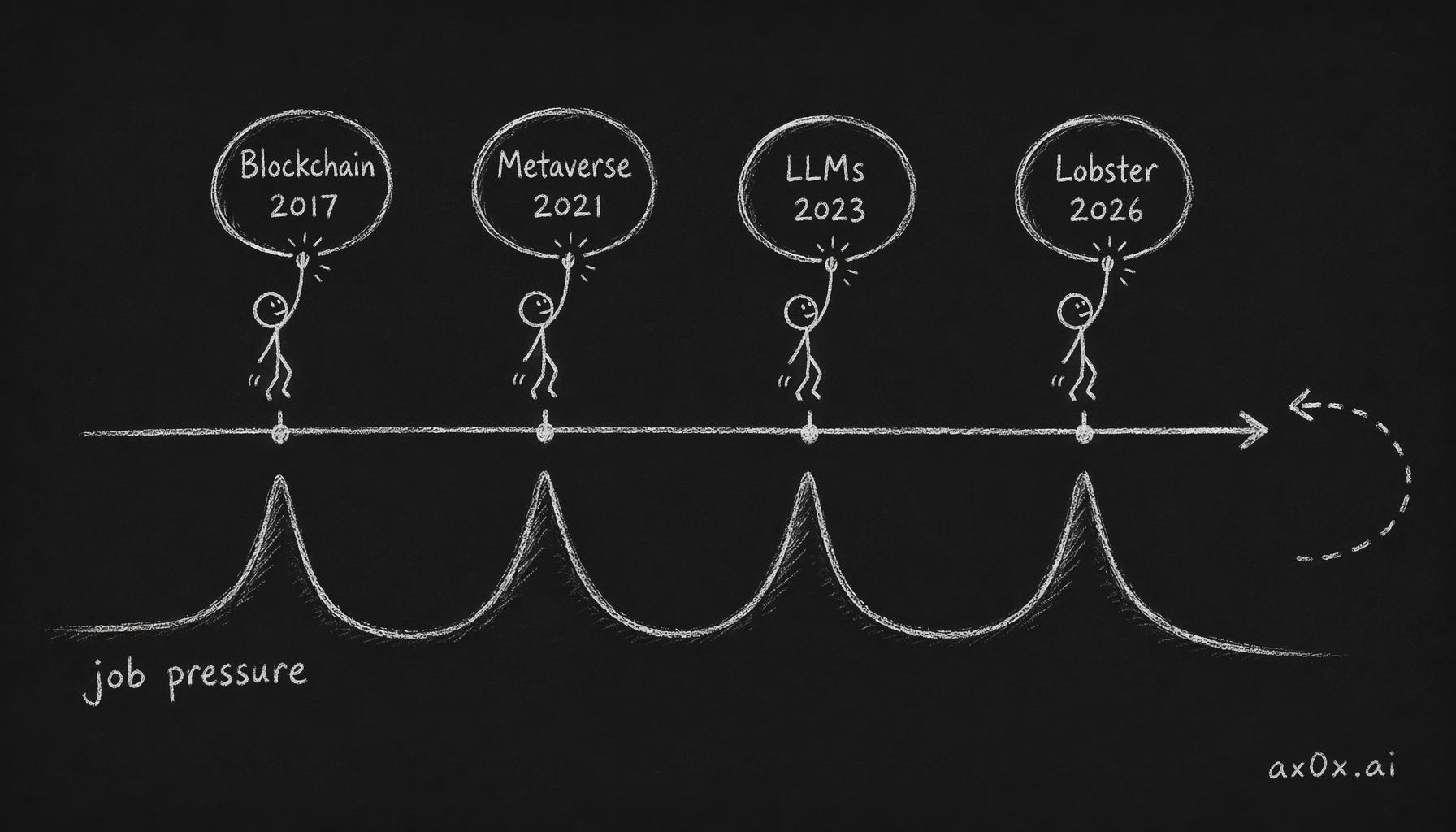 The same structure runs every 2-4 years, the same bubble rising again under a new name, each wave landing precisely on a peak in employment pressure.
A historian's summary of the qigong era still applies without changing a word:
"Qigong had two faces: rational scientists studying cautiously, and masses lost in frenzy and fraud. Sadly, the rational face was quickly drowned by mass irrationality."
Replace "qigong" with "AI agents" and you have March 2026.
Part 1 argued benchmarks don't matter. Part 2 did the math on Claude Max economics. Part 3 explored the rise of the super-individual. This piece dissects the deeper mechanics of the lobster fever.
The technology is real. Its value for developers is real.
But this mass movement has nothing to do with technology. It's the product of WeChat's trust networks + Douyin's engagement algorithm + A-share retail investor structure + 3.1 million self-media creators monetizing anxiety + local government subsidies — an amplifier stack that doesn't exist in the US. That's why the same project is a tool discussion in America and a national movement in China.
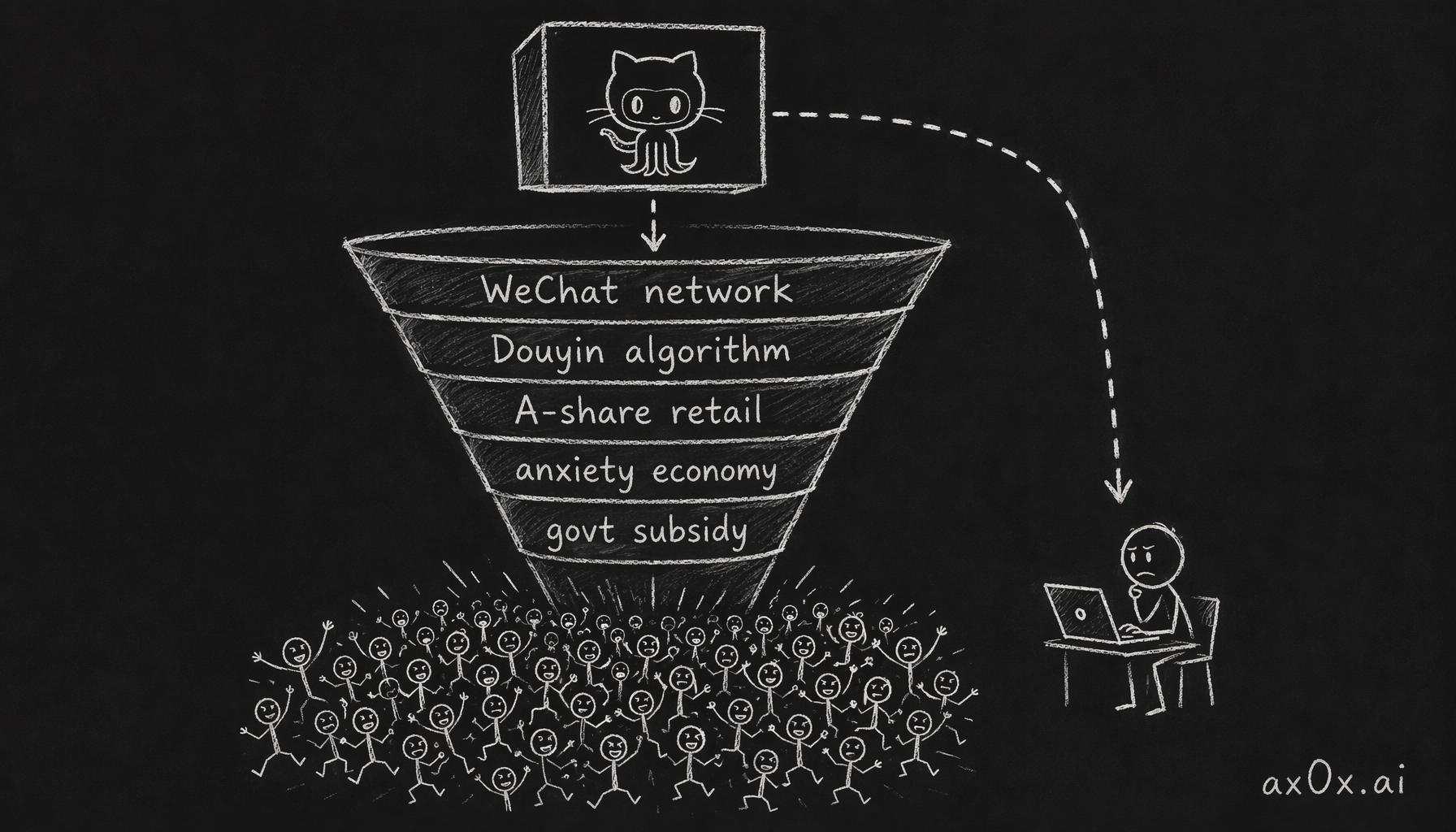 The same project dropped into China's five-layer amplifier pours out a nationwide crowd; the US has no such amplifier, so the same project is just one developer in a tool discussion.
The amplifiers are structural, not temporary. Next wave, the headgear changes. The structure won't.
Appendix: Deep Research Report (Chinese) — Full 7-dimension parallel research process with 60+ sourced citations, cross-validation assessment, and reliability matrix.