
CopyStyle: Give Me Any Article, I'll Clone Its Voice
The Ceiling of a Style Library
Last time, I described how we expanded from a single 435-line style guide into a multi-style library — six curated profiles covering everything from irreverent social commentary to data-driven business analysis. Users pick a style, AI rewrites their draft accordingly.
It works. But after real usage, we hit a wall:
Users kept wanting styles that weren't in the library.
One user loved an author we hadn't profiled. Another wanted the voice of a tech blog we'd never heard of. And the trickiest case: someone who couldn't name a style at all — they'd just read an article that morning and thought, "I want mine to feel like this."
Ask them to pick a label from six options? They can't. What they want isn't a category. It's the specific texture of one specific piece of writing.
You can scale the library — go from six profiles to sixty. But maintenance costs explode, and you're still playing whack-a-mole. Style has infinite granularity. The same author writes differently across topics and years. A "half-buddha style" profile is really an average across a dozen articles — it loses the unique rhythm and voice of any individual piece.
The core tension: pre-built styles are abstractions, but users want something concrete.
The "Copy Someone's Homework" Insight
The breakthrough came from a conversation with a friend who runs a WeChat public account. He said something that reframed the whole problem:
"How do I improve my writing? When I read something great, I rewrite my own piece following its structure and rhythm. Basically what my teacher taught me in elementary school — copy the homework."
Copy the homework. Not the content — the craft.
Your ideas stay yours. Your data stays yours. But the narrative pacing, paragraph rhythm, where the turns land, how dense the punch-lines are — you borrow those from the reference article.
Once that clicked, the product logic was obvious:
The user doesn't pick from a menu. They bring one article they admire, the AI extracts its writing DNA in real-time, and uses that DNA to rewrite their draft.
The style library is ordering from a menu. CopyStyle is bringing a dish and saying, "Make mine taste like this."
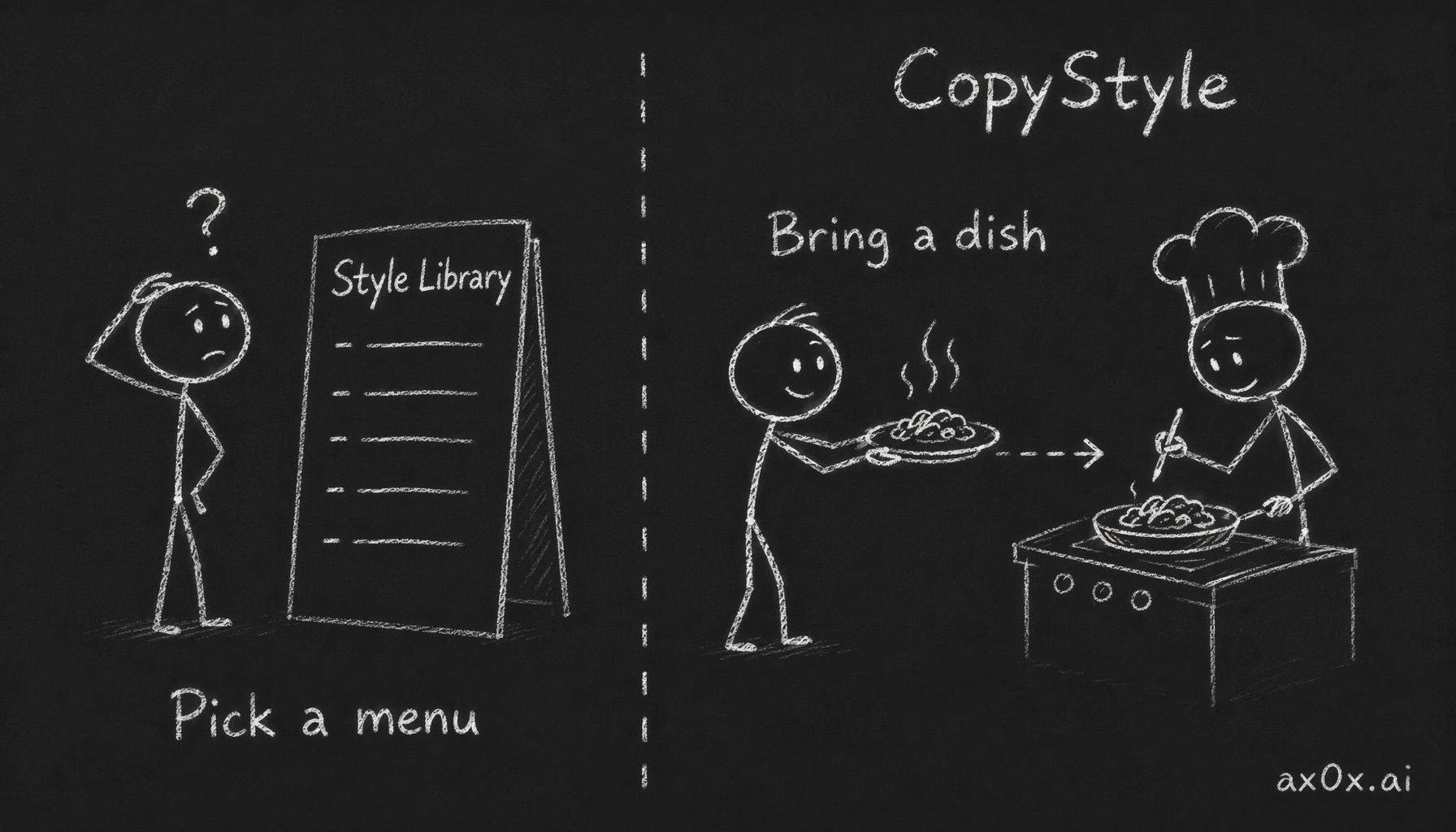 The style library is ordering abstract averaged styles off a menu, while CopyStyle is bringing one concrete dish and asking the AI to make yours taste like it
How It Works
The concept is simple. The execution has layers.
Step 1: Extract the Writing DNA
The user pastes a reference article — any article, on any topic. The AI ignores what the article says and focuses entirely on how it's written.
It analyzes:
- Narrative structure — How does it open? Scene immersion? Counterintuitive claim? Provocative question?
- Paragraph rhythm — How long are the paragraphs? How often do turns (转折) appear? How do short and long paragraphs alternate?
- Language register — How colloquial is it? What modal particles does it favor? Does it address the reader directly?
- Punch-line patterns — What do the 金句 (quotable one-liners) look like? Redefinition format ("X isn't Y, it's Z")? Staccato rhythm ("Short. Short. Long sentence with emotional payoff.")?
- Emotional pacing — How does analysis alternate with emotion? How many paragraphs between emotional anchors?
The output is a temporary Style Profile — a structured recipe of writing patterns.
Step 2: Rewrite Using the Extracted DNA
The AI takes this recipe as its operating instructions, reads the user's draft, and rewrites it following the reference article's rhythm and voice.
Content, arguments, and data are all kept. The main change is the expression layer — how the piece opens, how it builds momentum, where it places turns, how it earns its closing line.
Step 3: Deliver the Rewrite + a Style Report
Beyond the rewritten article, the system produces a report showing what the AI extracted from the reference. The user can see: "Oh, that article's rhythm works because it places a turn every three paragraphs and saves the punch-line for right after the turn."
The report itself is a writing lesson.
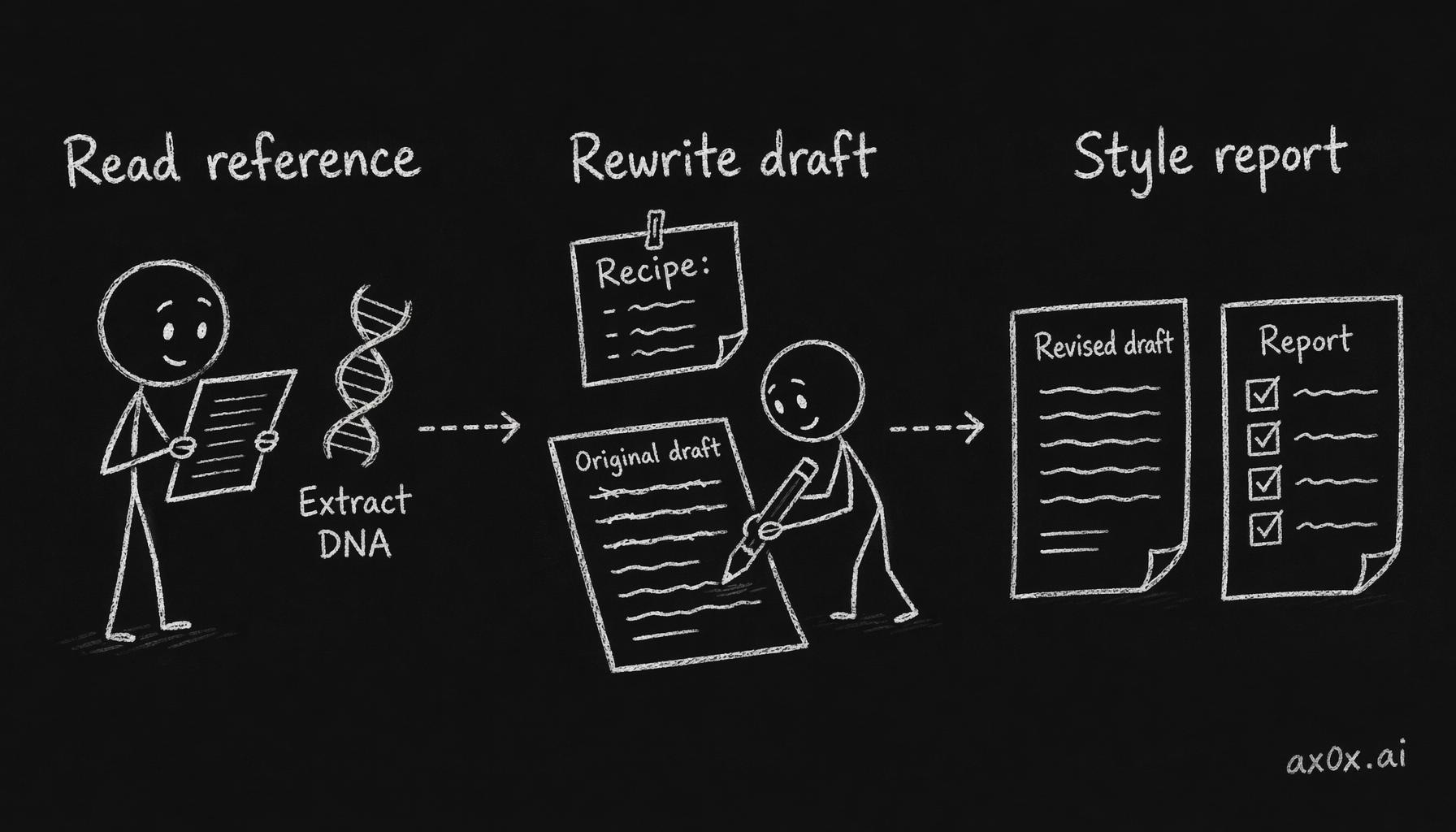 The three-step CopyStyle pipeline: read the reference and extract the writing DNA, rewrite the user's draft with that recipe, then deliver the rewrite plus a style report
A Concrete Before/After
Let me show rather than tell.
User's draft (standard tech analysis, heavy translation-ese):
In recent years, artificial intelligence technology has achieved significant advances in the field of natural language processing. The emergence of large language models has substantially improved the processing efficiency of tasks such as text generation, translation, and analysis. This article will explore the limitations of current AI writing tools and propose directions for improvement. It is worth noting that existing tools still face fundamental challenges in style control.
Reference article: A piece by 半佛仙人 (a popular Chinese commentator) about a completely unrelated topic. Extracted DNA: scene-immersion opening, 1-2 sentence paragraphs, high-density turns, dry humor with self-deprecation, mid-high colloquial register, punch-lines placed after turns.
Rewritten output:
Here's something ironic.
All these AI writing tools claim they can write for you. But use one, and you'll notice — the output reads like a translated textbook.
The AI that's supposed to help you write Chinese can barely write natural Chinese itself.
This isn't a model-size problem. GPT, Claude, whatever — the parameter counts are more than sufficient. The issue is more embarrassing than that: in these models' training data, formal Chinese text vastly outnumbers casual web writing. News, encyclopedias, academic papers, translations — that's the Chinese they've seen the most.
So when you ask it to "write an article," it gives you a Wikipedia entry. Not because it can't write — but because it doesn't know what other Chinese looks like.
And that's not even the worst part.
Completely different reading experience. Every user argument preserved, and the rewrite even fills in a few explanations the draft never spelled out. The article went from "paper" to "conversation" — from "existing tools still face fundamental challenges in style control" to "the AI that's supposed to help you write Chinese can barely write natural Chinese itself."
Why This Is the Hardest Problem
A lot of people think style transfer is just vocabulary replacement. Swap "it is worth noting" for "here's the interesting part," replace "in conclusion" with "so here's the thing," done.
Vocabulary swaps do work — in Part 1, I showed how a banned-phrase table eliminated 80% of translation-ese in one shot.
But the remaining 20% is where the real difficulty lives. Because style isn't just vocabulary. It's architecture.
A well-crafted article has deliberate structure — where the setup is buried, where the turn lands, where the reader gets a breath, where the pace suddenly accelerates to push emotion to a peak. This is structural, not cosmetic.
You can swap all the furniture in a house. It's still the same house. What you need to change is the load-bearing walls, the ceiling height, the flow between rooms.
Specifically, style transfer requires the AI to understand at least three layers:
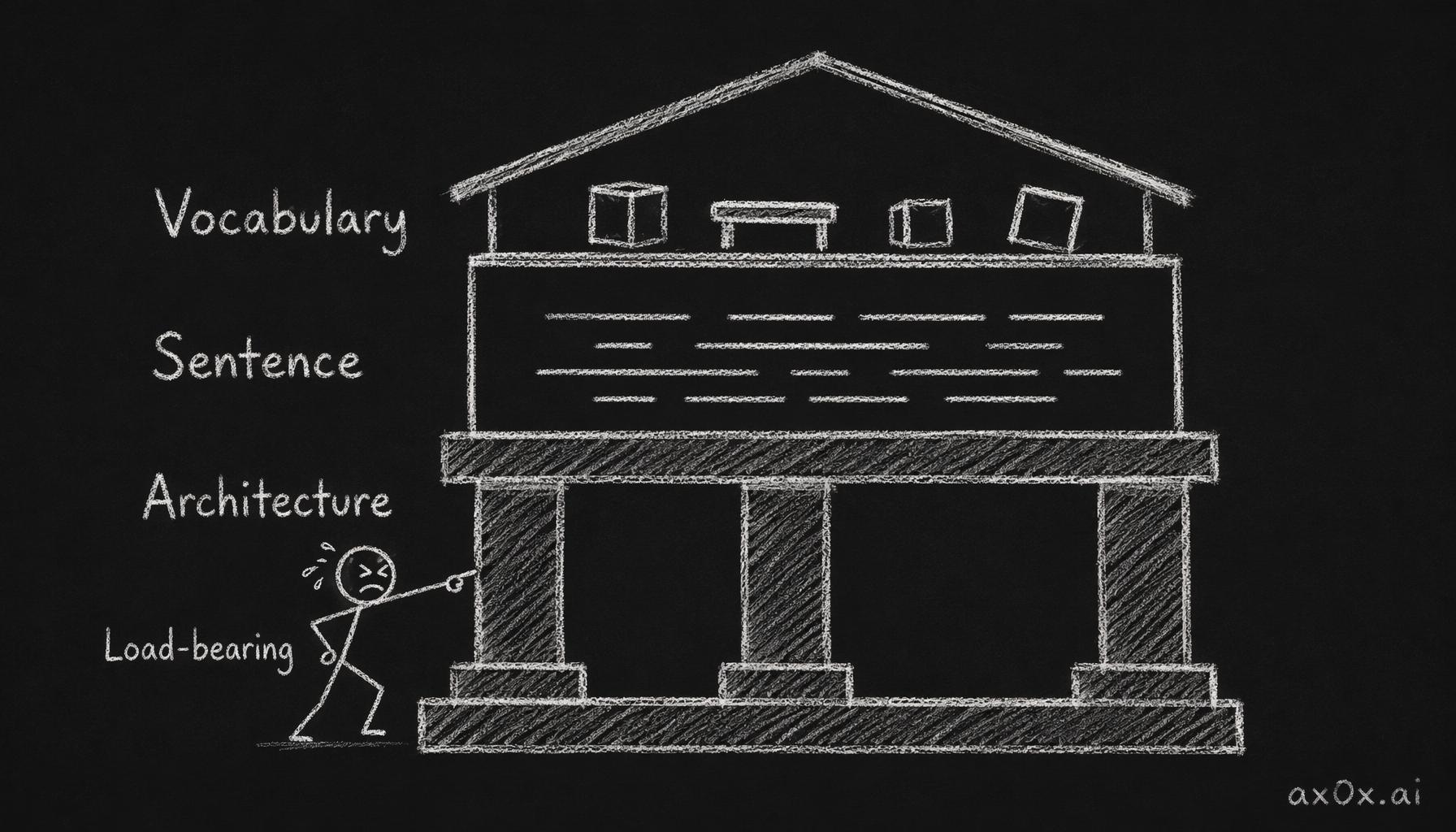 Style transfer needs three layers understood: the vocabulary layer is easiest, the sentence layer harder, and the architecture layer is the load-bearing wall that is hardest, since swapping words only touches the surface
Vocabulary layer — what words to use and avoid. This is the easiest. A kill list handles it.
Sentence layer — sentence length, where to break, where modal particles go, how to create rhythm. "Short. Short. Long sentence with emotional payoff." — that's sentence-layer design.
Architecture layer — how the whole piece unfolds. Scene first or judgment first? How often does a turn appear? Where in the article do punch-lines land for maximum impact? How are emotional peaks and valleys distributed?
Pre-built style profiles naturally contain all three layers because they're distilled from multiple articles. But CopyStyle has only one reference — the AI needs to read all three layers from a single sample.
This is why extraction quality is everything. It's not enough for the AI to say "this article has a casual tone" — that's obvious. It needs to say: "This article opens with scene immersion, the first paragraph ends with a deliberate suspense hook; paragraphs average 50-80 characters, turns appear every 2-3 paragraphs using 'but' and 'the problem is' rather than 'however' and 'nevertheless'; punch-lines appear at the end of each section in a 'X isn't Y, it's Z' redefinition format."
At that level of specificity, the AI can actually follow the recipe.
The Full Product Vision
With CopyStyle, Ghost Writer now stands on three legs:
Style Library — six curated, validated writing profiles. For users who think: "I don't know what I want, recommend something."
CopyStyle — user brings a reference article, AI extracts the style on the fly. For users who think: "I want mine to read like this article."
Personal Style Training — user provides 3-5 articles they've written and are happy with, AI distills a custom profile. For users who think: "I have my own voice, help me stay consistent."
Three modes covering three needs. From blank-slate to specific-reference to maintaining personal identity. Each one built on the same underlying capability: teaching AI to read writing not for what it says, but for how it says it.
What "Teaching AI to Write Chinese" Really Means
This series covered three stages: a 435-line style guide, a multi-style library, and now real-time style extraction. The surface kept getting more complex, but underneath, every post was answering the same question:
The hard part of AI writing Chinese isn't the "writing." It's the "Chinese."
Every large language model can generate Chinese text. Grammar, information accuracy, logical flow — these are solved problems.
The unsolved problem is the wall between "correct Chinese" and "good Chinese." The gap between translation-ese and native web writing isn't a vocabulary gap. It's a worldview gap. Are you stating facts or creating resonance? Are you persuading the reader's brain or moving the reader's emotions? Is your article a report or a conversation?
Style isn't the skin of language. It's the skeleton.
This post is also available in Chinese (中文版).