
I Wrote a 435-Line Chinese Writing Guide for AI
Here's a paragraph:
The company's business model faces a fundamental challenge. With the proliferation of AI Agent technology, traditional SaaS subscription models are being replaced by usage-based consumption models. This means the company needs to rethink its pricing strategy and customer acquisition approach.
Grammatically correct. Logically sound. Informationally complete.
Now the same information, rewritten:
This company's business model is, to put it bluntly, running out of road.
The reason is simple: they used to sell SaaS. Customers paid monthly whether they used it or not. Now? Customers say: I have an Agent, I pay for what I use, and I don't pay when I don't.
Think about what that means for a company that lives on annual subscriptions. Your revenue just went from "guaranteed rain or shine" to "depends on the weather."
Same information. Completely different reading experience.
The first version is what AI produces when you ask it to write in Chinese. The second is what actual Chinese readers want to read.
My blog had 83 Chinese articles. Every single one of them read like the first version.
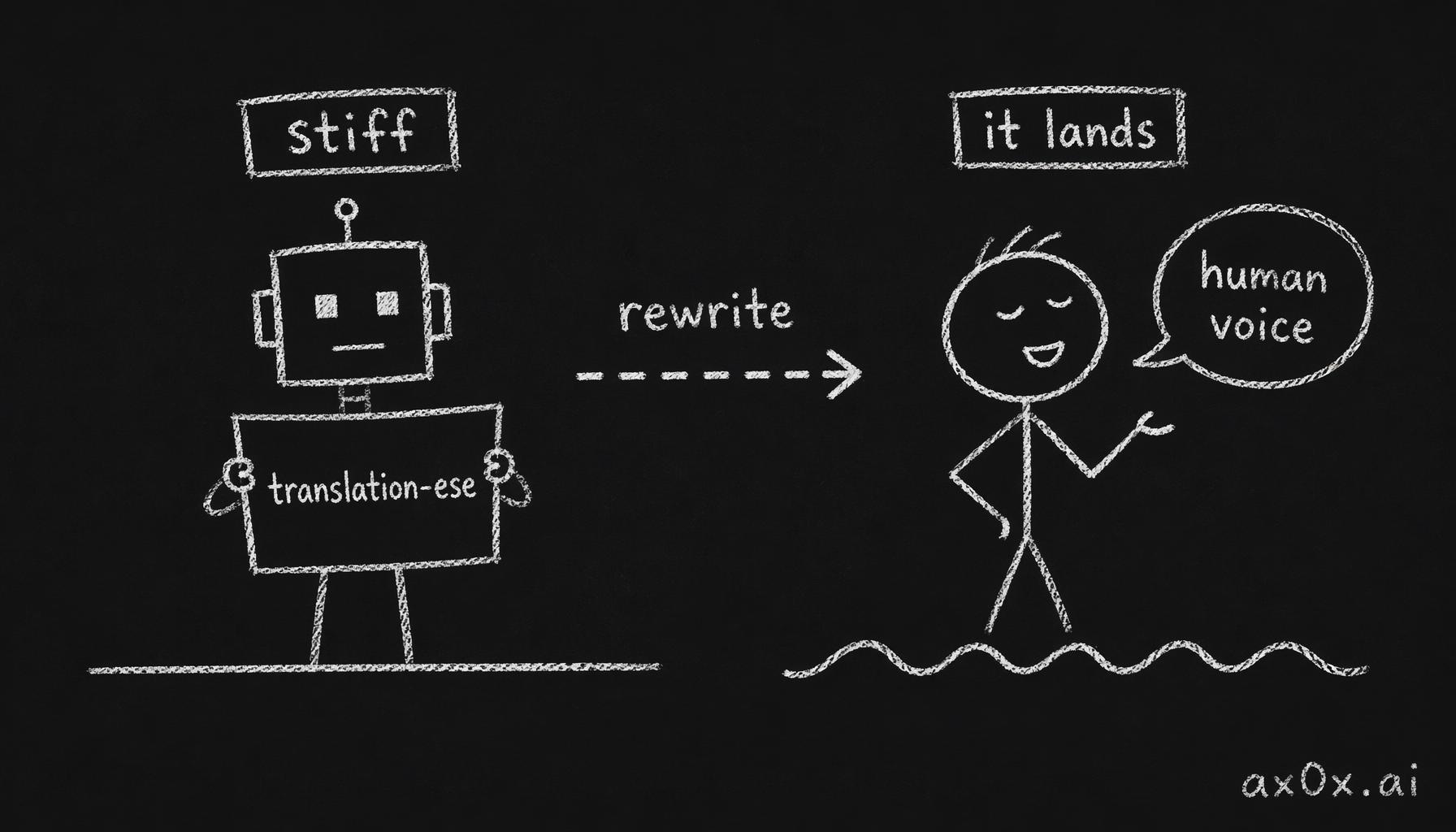 The same information reads stiff in translation-ese and lands once rewritten the way people talk — one message, two reading experiences
The Original Sin of AI Chinese Writing
I run a bilingual blog. English version, Chinese version. The English posts I write myself. The Chinese ones? I let Claude handle them — translate from English, adapt where needed, ship.
Efficient. Also terrible.
83 Chinese articles, and every one of them read like a translated English tech blog. A friend told me: "The content's good, but the writing is stiff."
I brushed it off at first. Then I actually sat down and read through my own posts:
"It is worth noting that this technology has demonstrated significant advantages in practical applications."
"As a practitioner who has been deeply engaged in the AI field for many years, I believe..."
"In summary, the rise of the Agent economy will fundamentally reshape the business logic of the software industry."
Each sentence, individually, is fine. Together, they read like Chinese wearing an English costume.
This is 翻译腔 — "translation-ese." And it's the original sin of AI-generated Chinese content.
The issue isn't that AI can't write Chinese. The issue is that AI's Chinese training data is saturated with translated content — Wikipedia, academic papers, news wire copy. The model learned "correct" Chinese, but not "good" Chinese. There's a difference, and native readers feel it immediately.
Studying the Masters
Problem identified. Now where's the fix?
I spent several days doing close reads of China's best WeChat public account (公众号) writers. Not reading for content — reading for craft. Deconstructing every paragraph, asking: why does this section make me feel something? Why does this opening make me want to keep reading? Why would someone screenshot this sentence and share it?
The writers I studied: 半佛仙人 (Banfo), 九边 (Jiubian), 虎嗅 (Huxiu), 36氪 (36Kr). These aren't obscure literary figures — they're the most-read Chinese tech and commentary writers on WeChat, each with millions of followers.
Patterns started to emerge.
Discovery 1: Structure Is Spiral, Not Linear
English writing follows thesis-first logic: state your claim, present evidence, conclude. The reader follows your logical chain from A to Z.
Top Chinese 公众号 writing doesn't work this way. It follows a spiral: start with a scene — an image, a story, a moment the reader has experienced — pull them in emotionally, let them feel something, then let the insight emerge from the feeling.
English persuades through logic. Chinese 公众号 persuades through resonance (共鸣).
"Here is what I think, and here is why" vs. "Let me show you something interesting, and by the end you'll feel what I feel."
Discovery 2: Short Paragraphs Are Rhythm, Not Laziness
Top 公众号 articles almost never have paragraphs longer than three sentences. Many paragraphs are a single sentence.
I initially thought this was a mobile optimization — long paragraphs are hard to read on small screens. That's part of it. But the deeper function is rhetorical: each period is a breath. A single sentence standing alone on its own line is like an accent note in music.
You've just processed a dense paragraph. Your brain is working. Then suddenly, one short sentence. Its own line. Its own space.
It lands.
That's rhythm.
Discovery 3: Turns Are the Engine
Good 公众号 articles have a "but" every two or three paragraphs.
Not because the author loves contradicting themselves — but because each "but" is an emotional gear shift. Reader attention has inertia. Three paragraphs of straight analysis and they start drifting. Hit them with "but here's the problem" and you've pulled them back.
In 半佛仙人's articles, I counted: a single 3,000-character piece can have seven or eight turns. Each one pushes you in a new direction. You never get a chance to zone out.
Discovery 4: 金句 Are Social Currency
You're scrolling through your WeChat Moments feed. You see a shared article with the line: "Speed is the moat."
You think: that's sharp. You share it. Not because you read the full analysis. Because that one sentence articulated something you felt but hadn't said, and sharing it makes you look insightful.
These shareable sentences — 金句, literally "golden sentences" — have formulas. The most common: "X is not Y, X is Z." As in: "AI isn't coming for your job. It's coming for the best part of your job."
Another formula: the ultra-compact judgment. Four or five characters. One decisive statement. "Speed is the moat."
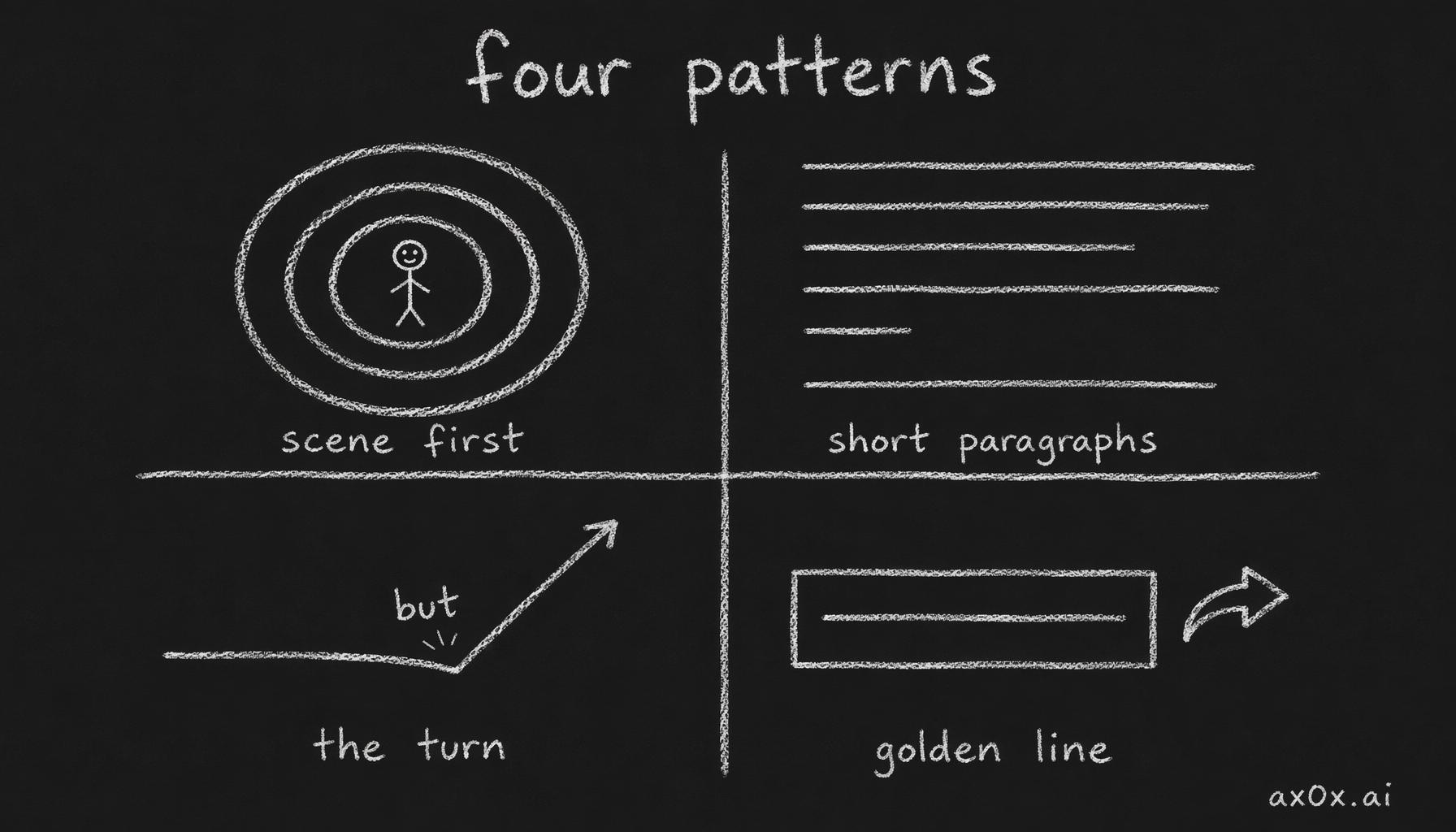 The four craft patterns pulled from the best writers — scene first, short paragraphs for rhythm, turns to reclaim attention, golden lines as social currency
435 Lines: A Complete Writing System
I compiled everything into a single writing guide.
Not vague advice — "be emotional," "be vivid," "be down-to-earth." That kind of guidance is useless to a machine (and honestly, to most humans too).
I wrote rules. Explicit, executable, machine-interpretable rules.
7 core principles: Story before theory. Write how you talk. Emotion is the engine. Short paragraphs rule. Turns create rhythm. 金句 are social currency. Write for the person who shares, not just the person who reads.
Translation-ese kill list: A lookup table. Left column: the expression to kill. Right column: the replacement. "As a..." → just state the identity. "It is worth noting that" → "What's interesting is." "In summary" → "So here's the thing." "Conducted an analysis of" → "analyzed."
Banned phrase list: "However" (然而), "furthermore" (此外), "this article will analyze" (本文将分析), "as is well known" (众所周知) — these words in a 公众号 article are like showing up to a BBQ in a three-piece suit.
Opening pattern library: Scene immersion, counterintuitive shock, contrast gap, question hook, power statement — five opening modes with examples.
Pre-publish checklist: Does the opening have a scene? Does "I" appear with opinions? Enough turns? Any translation-ese survivors? Read it aloud — does it sound like a person talking?
Before/after samples: Translation-ese version vs. 公众号 version, same information, two treatments, so the AI can viscerally understand what "rewrite" means.
435 lines. One .md file.
Feeding It to Claude: 83 Rewrites
The guide was done. The next step was simple — load it as a system prompt into Claude Opus.
Then feed it my 83 Chinese articles, one by one.
The results surprised even me.
Before title: "The Evolution of Business Models in the Agent Economy — A Paradigm Shift from Subscription to Consumption"
After: "Is SaaS Dead?"
Before opening: "This article will explore how AI Agent technology is reshaping the business logic of the traditional software industry."
After: "Last month, a SaaS founder who'd been at it for five years told me something: 'My biggest fear isn't competitors anymore. It's customers learning to use Agents.'"
Before paragraph structure: Six or seven sentences per paragraph, definition to argument to summary, like a miniature thesis.
After: One or two sentences per paragraph. Short paragraphs for emphasis. Long paragraphs for narrative. A "but" every three paragraphs.
I'm not claiming every rewritten post became a viral hit. But at minimum, they read like Chinese now. Like a person talking to you, not a machine outputting information at you.
83 articles. From "stiff" to "readable." One 435-line guide was all it took.
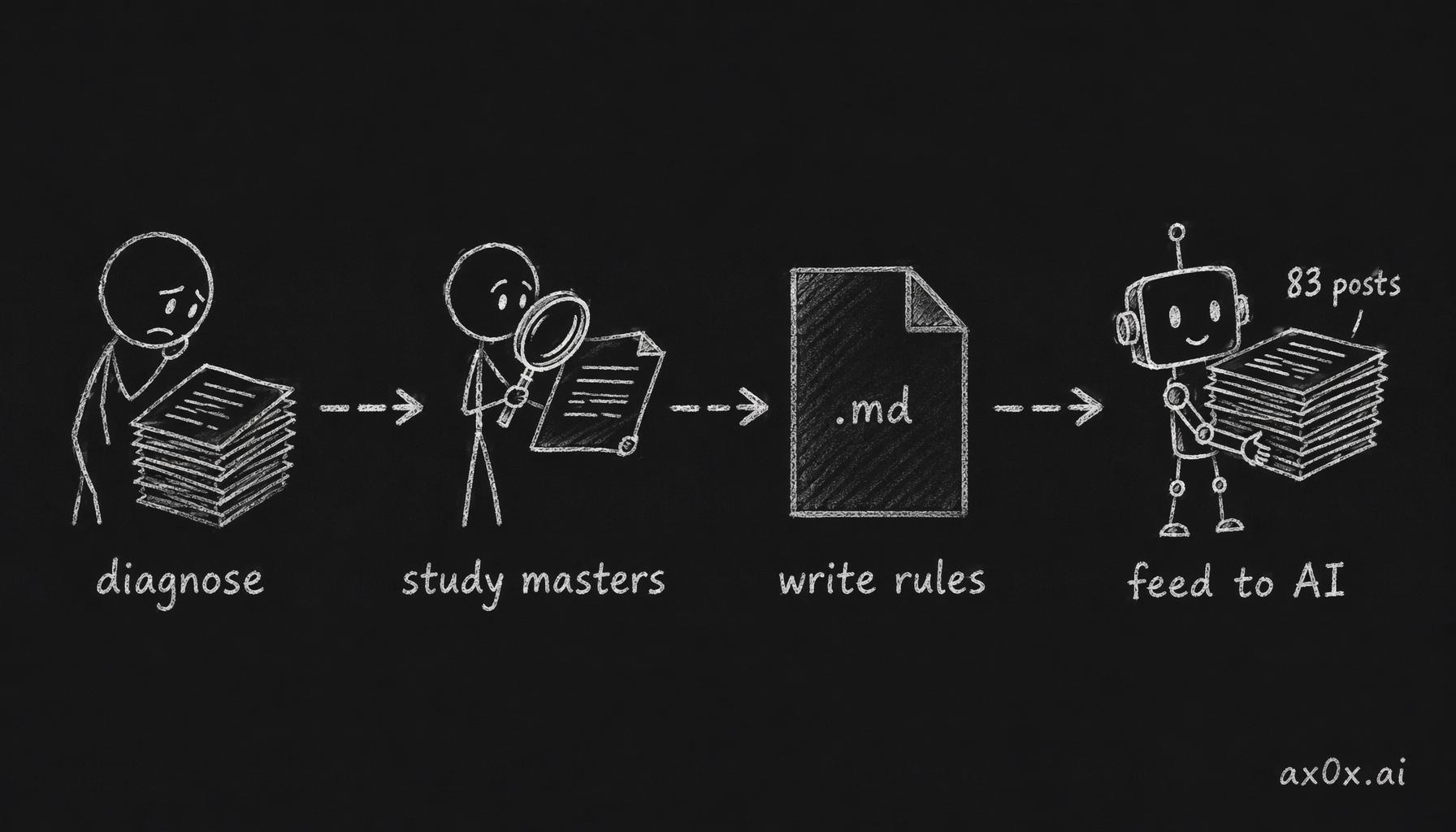 The four-step pipeline for killing translation-ese — diagnose it, study the masters, write the rules, feed everything to the AI to rewrite
Wait — This Isn't Just My Problem
After finishing my own blog, I started thinking about a bigger question.
How many people in China are using AI to write Chinese content right now? 公众号 authors, corporate social media teams, knowledge bloggers, independent creators — conservatively, millions.
They all face the exact same problem: AI outputs Chinese that's grammatically correct, informationally complete, and utterly soulless. Translation-ese. Long paragraphs. Academic tone. They publish and nobody reads it, because it's exhausting to read.
What they need is exactly what I built: an explicit set of rules that tells AI what to write, what not to write, how to structure rhythm, and how to create emotional resonance.
My 435-line guide solved the problem for one style — commentary, social analysis, tech opinion pieces. The 半佛仙人 / 九边 school of writing.
But Chinese writing isn't one style.
What's Next
AI tech reviews have their own style — the 卡兹克 (Kazike) and 量子位 (QbitAI) school of colloquial tech explainers with dry humor.
Business analysis has its own style — the 虎嗅 / 36氪 school of data-driven, high-density, opinionated analysis.
Personal essays have their own style. Career advice has its own style. Emotional storytelling has its own style.
One guide to rule them all? Not realistic.
But what if I built a guide for each style? A style library. User submits a draft, the system identifies — is this a tech review or a business analysis? — then matches the right style template and rewrites according to those rules.
Or even better: you like a specific author's style? Paste one of their articles. AI extracts their writing patterns and rewrites your draft to match.
That's the multi-style engine behind Ghost Writer. Next post: how it's designed.