
How to Steal a Writing Style from Any Author
One Guide Isn't Enough
In Part 1, I spent a week building a 435-line style guide for Chinese writing. It worked. Translation-ese was mostly dead. The Chinese articles finally read like Chinese.
Then I tried using that same guide to rewrite an AI product review.
The result came out sounding like social commentary by 半佛仙人 — one of China's top essay writers. It opened with an immersive scene. It had three layers of spiral narrative. It ended with a philosophical punch-line.
Beautifully structured. Completely wrong for a tech review.
The Problem: Style Is Not One-Size-Fits-All
Think about it. When you read a product review by 卡兹克 (Digital Life Kazike — ranked #1 among AI public accounts for 11 consecutive months), it doesn't sound anything like 半佛. Kazike opens with "I've been slacking off the past couple days because I finally finished Stranger Things Season 5," then pivots to testing an AI tool, posts screenshots, shares raw reactions, drops an occasional "holy crap this actually works," and lands on a warm reflection about what it means for creators.
That's a completely different animal from 半佛's spiral-narrative-interest-analysis-punch-line system.
My 435-line guide taught AI one way to write Chinese. But different content needs different voices:
| Domain | Representative Authors | Core Style |
|---|---|---|
| Essay/Commentary | 半佛仙人, 九边 | Spiral narrative, punch-lines, emotional anchors |
| AI/Tech | 卡兹克, 量子位 | Casual + expert, memes, "wow" factor |
| Business Analysis | 虎嗅, 36氪 | Data-driven, "let's do the math," bold verdicts |
| Personal Essay | 和菜头 | Personal experience, philosophical warmth |
| Career/Productivity | 刘润 | Frameworks, actionable advice, plain language |
| Story/Resonance | 十点读书 | Story-first, emotional resonance, dramatic turns |
These are not variations on a theme. They are six fundamentally different writing systems — different paragraph rhythms, different emotional arcs, different opening philosophies, different taboo lists. You cannot get from one to another by "adjusting the tone."
A Systematic Method for Stealing Style
When I studied 半佛 for Part 1, I did it by feel — read a bunch of articles, noticed patterns, wrote them down. It worked, but it was slow and subjective. One author took a week. Six domains would take over a month.
I needed a repeatable process. After a lot of iteration, I settled on four steps.
Step 1: Collect the Corpus
Find 10-20 representative articles by the target author. Not random articles — find their hits. The ones with the highest engagement, the most shares. Viral articles represent the purest expression of an author's style, because the audience has voted on what works.
Step 2: Dissect the Patterns
Read each article not for content, but for structure. Ask five questions:
- How do they open? What are the recurring opening patterns?
- What's the paragraph rhythm? Short sentences or long? How short is short?
- What words do they NEVER use? What sentence patterns are absent?
- What do their punch-lines look like? Where are they placed? How often?
- What's the emotional arc? More analysis or more story? When do personal reactions appear?
Question 3 is the most important one. An author's style is often defined not by what they use, but by what they refuse to use.
Step 3: Cross-Validate
Don't draw conclusions from one article. A pattern needs to appear in at least three articles before you can call it part of the author's DNA. One-offs might be accidents.
Step 4: Structure the Output
Compile everything into a standardized Style Profile — not casual notes, but a machine-readable, human-reviewable document with a consistent format.
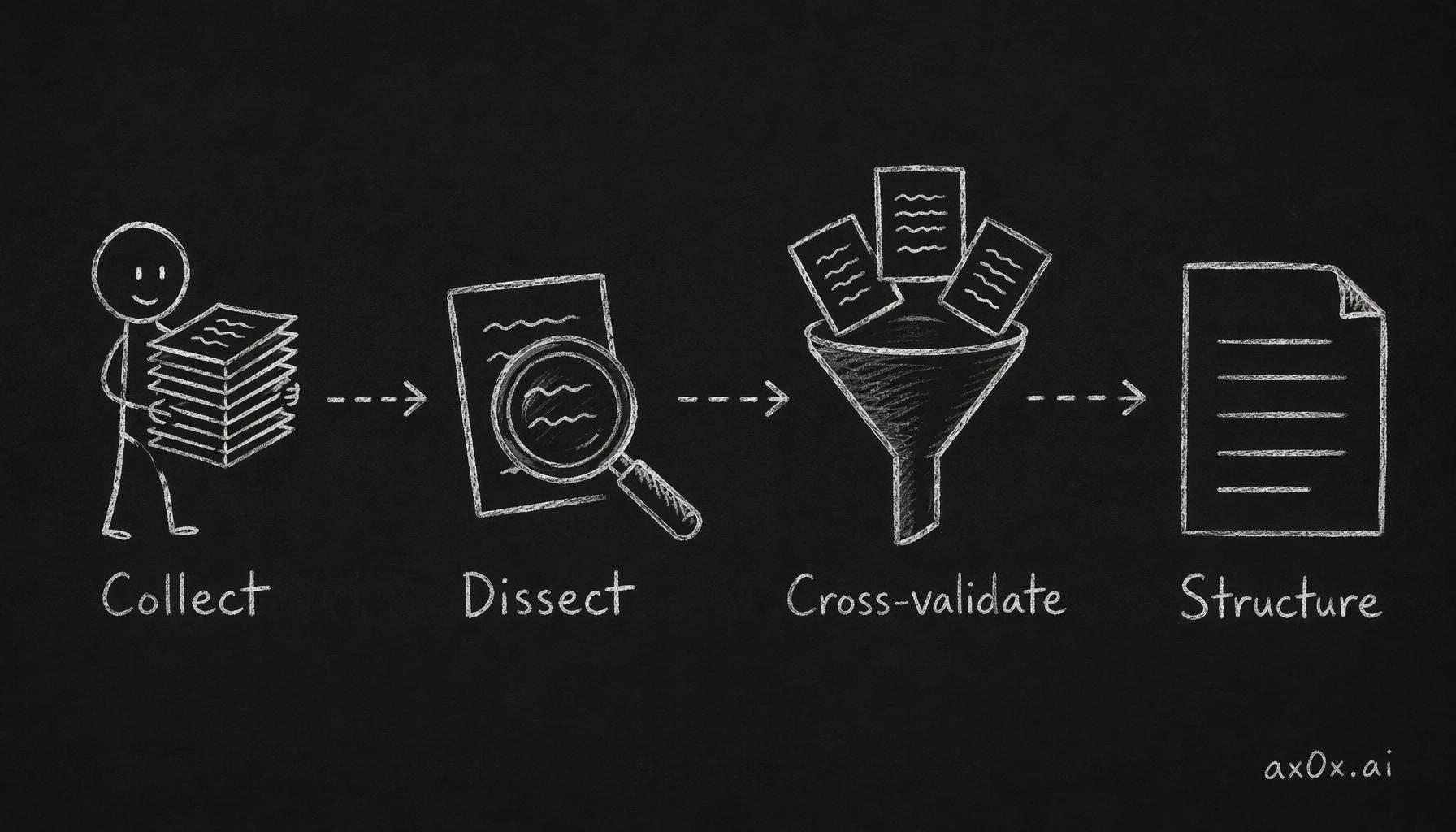 The four-step pipeline that turns a pile of articles into a reusable style profile: collect, dissect, cross-validate, structure
Walking Through It with Kazike
Let me demonstrate the full process with 卡兹克 (数字生命卡兹克).
Quick background: born after 1995, former UX designer, started his WeChat public account in February 2023, 200+ original AI articles, self-described as the "doorman of the AI palace" — a translator between technology and regular people.
I analyzed over a dozen of his articles. Here's what I found.
Openings: Always Personal
Kazike almost never opens with "Today let's talk about..." His patterns:
- Personal story hook: "I've been slacking off lately because I finally finished Stranger Things Season 5." — Daily life first, topic second.
- Self-deprecating warmth: "Honestly, when I got the invitation to speak, I was kind of terrified." — Vulnerability as trust-building.
- Counter-intuitive claim: "As an AI blogger, my advice is: don't rush to use AI." — Cognitive dissonance that demands a click.
The common thread: every opening starts with "I." Not a concept. Not a definition. A personal experience.
Compare this to 半佛, who opens with "Maybach leaking water is actually reasonable" — a counter-intuitive judgment that hooks you. Kazike hooks you with a personal moment.
Two different philosophies: cognitive dissonance vs. emotional connection.
Paragraph Rhythm: Extremely Short
How short are Kazike's paragraphs?
One sentence is normal.
Two sentences is already on the long side.
Occasionally he'll write a longer reflective paragraph, then immediately snap back to single-sentence bursts.
The rhythm is like breathing: short-short-short — long — short-short-short.
半佛's paragraphs are also short, but 半佛's short is violent — each paragraph is an assertion, like a slap. Kazike's short is spacious — the whitespace between paragraphs gives the reader room to absorb.
Language: Colloquial but Never Oily
Key characteristics:
- Casual expressions used naturally: "holy crap," "hahaha," "seriously," "honestly"
- English tech terms mixed in without translation: "case," "Demo," "Agent" — his readers know these
- Gaming and pop culture references: League of Legends, The Wandering Earth — shared language with his audience
- Self-deprecating humor, but with a baseline of cool detachment — never smarmy
He has a self-imposed rule: no single paragraph should exceed 100 characters.
Compare with 半佛, who is colloquial to the point of profanity. Kazike is colloquial but clean — more like a slightly geeky friend chatting with you.
Punch-Lines: Always at the End of Sections
Kazike's punch-line formulas:
- Redefining: "The feeling of being alive — that's the most expensive luxury in the AI era."
- Parallel escalation: "This is the iteration of taste. This is the innovation of business. This is the progress of civilization."
- Negation-affirmation: "What we call originality is nothing more than the honest expression of your personal experience."
- Single-sentence paragraph: "Behind him, no one."
Where do they appear? At the end of sections, after a build-up. Roughly one every 300-500 characters.
半佛's punch-lines are also placed at the end, but they are conclusions of interest analysis: "Teaching people what NOT to do — if they don't do it, they won't go wrong." Kazike's punch-lines are emotional crystallizations — compressing a big idea into a screenshot-worthy sentence.
What He Never Does
This is the most critical section:
- Never writes about something he hasn't personally tested
- Never uses academic jargon without immediately translating it to plain language
- Never pretends to be objective — always first person, always opinionated
- Never overuses the "it's not X, it's Y" pattern (he wrote an entire essay criticizing this AI-generated formula)
- Never writes bland "balanced analysis" — always has a clear stance
The taboo list matters more than the rule list. Because AI will default to all of these patterns — academic language, fake objectivity, the "it's not X, it's Y" crutch. If you don't explicitly ban them, that's exactly what you'll get.
Two Completely Different Operating Systems
Putting Kazike and 半佛 side by side makes the difference clear:
| Dimension | 半佛仙人 | 卡兹克 |
|---|---|---|
| Opening | Counter-intuitive judgment (cognitive dissonance) | Personal story (emotional connection) |
| Narrative | Spiral, peeling the onion layer by layer | Story → insight → elevation |
| Paragraphs | Short and violent, assertion-style | Short and spacious, breathing-style |
| Language | Extremely casual, can include profanity | Casual but clean, geeky flavor |
| Punch-lines | Ultimate conclusion of interest analysis | Emotional crystallization |
| Humor | Dark humor + self-deprecation | Tech-nerd humor + pop culture references |
| Taboo | Never be a life guru | Never pretend to be objective |
This is not "one is more serious, one is more casual."
These are two completely different writing operating systems. Paragraph rhythm, emotional trajectory, punch-line generation logic, opening philosophy, taboo lists — all different.
You cannot get from 半佛 to 卡兹克 by "making the tone more casual." That's like trying to turn an oil painting into a watercolor by "making the colors brighter." Different medium entirely.
The Style Profile Format
After analysis, I need to store these findings in a standardized format that AI can load and use directly. I designed a Style Profile structure:
style-profile/
├── meta.json              # Domain, use cases, representative authors
├── rules.md               # Writing rules (behavior rules)
│   ├── Core Principles    # The soul of this style
│   ├── Narrative Structure # How to open, progress, close
│   ├── Paragraph Rhythm   # Length, transition frequency
│   ├── Language Rules     # What to use, what not to use
│   ├── Punch-line Formulas # What this style's punch-lines look like
│   ├── Emotional Rhythm   # Analysis → emotion → reflection ratios
│   └── Taboo List         # Expressions that must never appear
├── examples/              # 3-5 benchmark articles
└── checklist.md           # Post-editing quality check
One Profile per domain. Six domains, six Profiles. Each one extracted from real authors, not invented from theory.
The behavior rules file is the core. It has the same structure as the 435-line guide from Part 1, but the rules inside are completely different. The essay-commentary rules file says "use spiral narrative, one turn every two paragraphs." The AI/tech rules file says "show screenshots before explaining, 'holy crap' is allowed but max three times per article."
The examples folder provides few-shot ammunition. Rules tell AI how to write; examples show it what the result looks like.
The checklist is the final gate. After writing, check each item — does the opening match this style? Are punch-lines in the right position? Any taboo-list violations?
Why This Is Harder Than It Looks
You might think this is just "writing more templates." It's not.
The hard part is the invisible DNA of style.
Every author has writing habits you won't notice even after reading a hundred articles, but if AI violates them, readers feel it instantly.
For example: Kazike almost never uses subheadings in the middle of an article. The whole piece is one continuous narrative flow, segmented by scene transitions and single-sentence bridges, not by "Section 1," "Section 2," "Section 3."
半佛 is similar — no images, no fancy formatting. Pure text. Deliberately anti-aesthetic.
These "things they don't do" are invisible. You don't notice their absence until you analyze it. But they are core components of the style DNA.
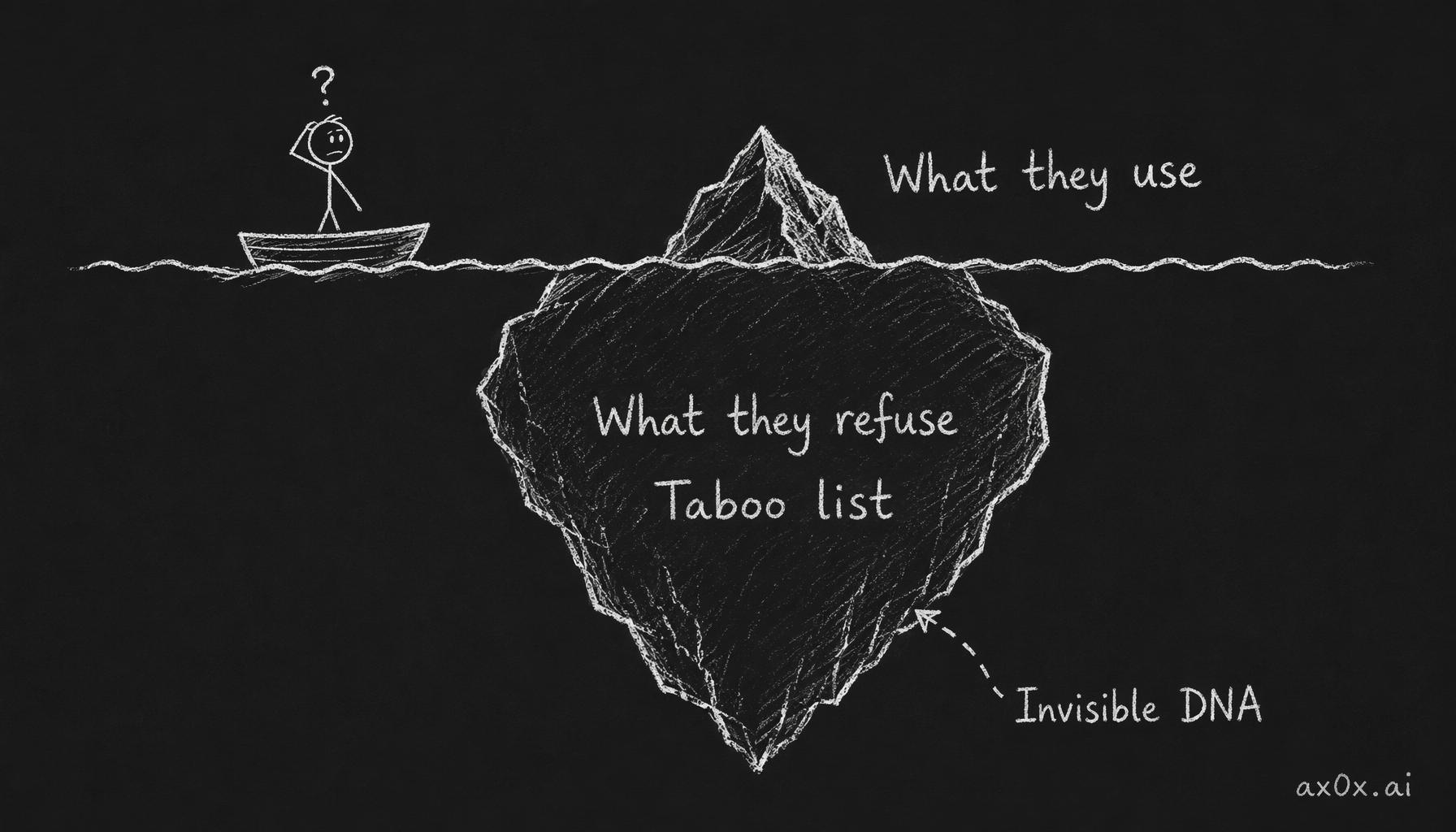 What defines a style isn't what an author uses but what they refuse to use — the invisible taboo list below the waterline is the real DNA
Another challenge: the same word serves different functions in different styles.
"说白了" (to put it bluntly) in 半佛's articles introduces an interest analysis: "To put it bluntly, it's about money."
"说白了" in Kazike's articles does technical translation: "To put it bluntly, this thing is basically a brain for your phone."
Same colloquial marker. Completely different rhetorical purpose. You can't just say "use '说白了' more for casual tone" — you need to understand what role it plays in each style system.
What Comes Next
Manually dissecting one author's style takes me about a week. Six domains, at least two or three representative authors per domain — that's three to four months of work.
But the dissection process itself can be automated.
Think about it: collecting articles, analyzing patterns, extracting rules — all of these steps can be done by AI. Give it 10 articles, have it systematically analyze opening patterns, paragraph rhythm, punch-line formulas, and taboo lists, then output a structured Style Profile.
That's what Part 3 is about — CopyStyle mode.
No need to build a style library in advance. You feed the system a single reference article, it extracts the style on the spot, then rewrites your article using whatever it found. Any author, any style, extracted and applied in real time.
The style library is a frozen dinner. CopyStyle mode is cooking from scratch.
This post is also available in Chinese (中文版).