
Teaching AI to Write Like a Chinese Internet Native
The Complaint
A few weeks ago, a reader sent me a message about the Chinese versions of my blog posts:
"blog现在的中文版的阅读体验不是很好, 用语很生硬"
Translation: The reading experience of the Chinese blog isn't great. The language is stiff.
I went back and re-read the Chinese articles. They were correct. Every sentence was grammatically valid. The information was accurate. But the reader was right — they were lifeless. They read like what they were: English blog posts wearing Chinese characters as a costume.
The diagnosis had a name: 翻译腔 (translation-ese).
What Translation-ese Looks Like
Here is a sentence from one of our early Chinese posts, paraphrased:
该系统的核心特征在于其能够在无需人类持续干预的情况下,独立执行一系列复杂任务。
This is technically correct Chinese. It is also something no Chinese person would ever write in a blog post. It has all the tells:
- Long subordinate clauses nested inside the sentence, English-style
- Passive voice ("在无需...的情况下") where Chinese would use active
- Academic connectors — the kind of language you see in translated textbooks
- Thesis-first structure — stating the abstract principle before any concrete example
The same idea written natively:
Agent和普通AI助手有什么区别?打个比方:AI助手像一个听话的员工——你说什么它干什么。Agent呢?更像一个靠谱的合伙人。你说"帮我把这个项目搞定",它自己拆任务、自己干活、干完了还给你写个总结。
Same information. Completely different reading experience. The first sounds like a Wikipedia article. The second sounds like a friend explaining something over coffee.
The Fundamental Insight
English and Chinese web writing don't just differ in language — they differ in rhetorical structure.
English non-fiction follows a deductive pattern: thesis, then evidence, then conclusion. State your claim. Support it with data. Wrap up. This is the structure drilled into every American college student.
Chinese 自媒体 (self-media / content creator) writing follows an inductive, spiral pattern: scene, then feeling, then insight. Drop the reader into a concrete moment. Share your emotional reaction. Let the lesson emerge. Then spiral deeper.
| Dimension | English Tech Blog | Chinese 自媒体 |
|---|---|---|
| Opening | Thesis statement or summary | Scene, story, or provocative question |
| Structure | Linear: claim → evidence → conclusion | Spiral: scene → tension → insight → deeper insight |
| Tone | Authoritative, measured | Conversational, opinionated, emotionally present |
| Reader relationship | Expert teaching student | Friend telling friend over drinks |
| Ending | Summary of key points | Punch-line, rhetorical question, or attitude statement |
The core difference in one sentence: English persuades through logic. Chinese 自媒体 persuades through resonance (共鸣).
This is not a quality judgment — both traditions produce brilliant writing. But when you write Chinese content using English rhetorical structure, the result is uncanny valley text. Correct but wrong. Readable but unreadable.
The Research
Once I understood the structural gap, I went deep. I studied the writers who dominate Chinese tech content:
- 半佛仙人 — wraps serious financial analysis in irreverent humor ("骚话式科普")
- 九边 — oral, logical, accessible, like a smart friend explaining geopolitics
- 卢克文 — story-first narrative, always starts with history and spirals to the present
- 差评 — tech made fun, sharp titles, visual humor
- 虎嗅 / 36氪 — data-heavy but well-paced, mixing authority with accessibility
I analyzed hook patterns, emotional pacing, paragraph structure, sentence rhythm, rhetorical devices, and the psychology of sharing on WeChat. What makes someone screenshot a sentence and post it to 朋友圈 (Moments)? What makes them close the tab after two paragraphs?
The output was a 435-line style reference document covering:
- The structural difference between English and Chinese web writing
- Emotional pacing patterns (张弛交替 — tension-release alternation)
- Five hook patterns for openings
- The "scene → feeling → insight" atomic unit
- Rhetorical devices: 设问, 反问, 排比, 对比, 转折, 类比
- The 口语化 (colloquial) spectrum — finding the sweet spot between academic and internet slang
- Before/after examples of the same idea in translation-ese vs native style
- Sharing psychology (why Chinese readers forward articles)
- Four structural templates for different article types
- Sentence-level craft: rhythm, punctuation, 金句 (quotable punch-lines) formulas
- A "翻译腔 kill list" — specific find-and-replace patterns
- A pre-publish checklist
What Didn't Work: Abstract Rules
My first attempt at fixing the problem was naive. I added rules to the AI's instructions:
- "Use short paragraphs"
- "Be conversational"
- "Write like you're talking to a friend"
The AI read these rules, acknowledged them, and then proceeded to write the exact same academic Chinese. The rules were in the prompt but not in the output.
Why? Because "be conversational" is not actionable. The AI doesn't know what conversational Chinese sounds like. It has a model of Chinese that's trained heavily on formal text — news articles, Wikipedia, textbooks, translated content. Telling it to "be conversational" is like telling someone who has only read legal briefs to "write casually." They don't have the reference frame.
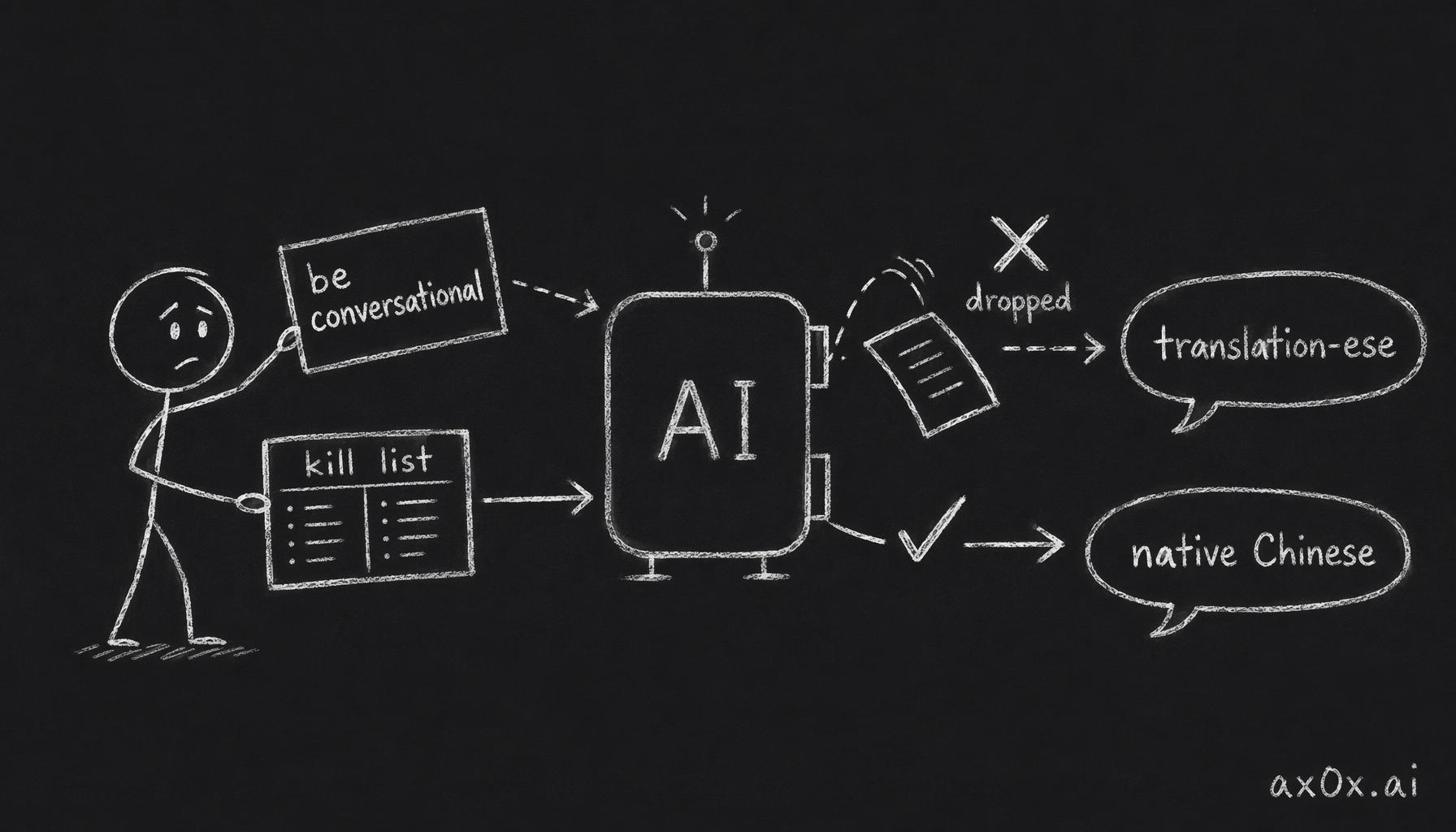 The abstract rule 'be conversational' gets dropped at generation and the output stays translation-ese; only a regex-level kill list actually executes and yields native Chinese.
What Actually Works: Concrete Patterns
The breakthrough came from making every rule concrete and demonstrable.
1. Banned Phrase Lists
Instead of "don't use academic language," I gave an explicit kill list:
| Kill This | Replace With |
|---|---|
| 值得注意的是 | 有意思的是 / 但你可能没注意到 |
| 综上所述 | 所以你看 / 说到底 |
| 首先...其次...再次...最后 | 第一个 / 更重要的是 / 但最狠的是 |
| 作为一个... | 直接说身份 — "他是工程师" not "作为一个工程师" |
| 进行了...分析 | 直接说 — "分析了" not "对此进行了分析" |
| 本文将... | Just start. Never announce what you're about to do. |
This worked immediately. Concrete find-and-replace patterns are something an AI can actually execute.
2. Before/After Examples
The most effective technique was showing the same idea written two ways:
Translation-ese:
该公司的商业模式面临着一个根本性的挑战。随着AI Agent技术的普及,传统的SaaS订阅模式正在被按使用量计费的消费模式所取代。
Native style:
这家公司的商业模式,说难听点,快走不下去了。原因很简单:以前你卖SaaS,客户按月付费,管你用不用,钱照收。现在呢?客户说,我有Agent了,用多少付多少,不用就不付。
The AI could see the transformation — what changed and why. Single-sentence paragraphs for emphasis. "说难听点" instead of "面临根本性挑战." Concrete dialogue ("客户说...") instead of abstract description. Metaphor ("旱涝保收" → "看天吃饭") making the abstract tangible.
3. Structural Templates
Instead of "use spiral structure," I provided four concrete templates with numbered steps:
Template A: 现象拆解 (Phenomenon Breakdown)
1. Hook: counterintuitive or scene immersion (1 paragraph)
2. "你可能觉得...但其实..." (set up contrast)
3. Layer 1: surface cause (scene + insight)
4. "但这还不是最关键的" (deepen with a turn)
5. Layer 2: underlying logic (scene + insight)
6. "所以你看..." (connect to reader's reality)
7. 金句 ending or action advice
This gave the AI a scaffold to build on, not just a vibe to aim for.
4. The 口语化 Spectrum
I defined the exact register — not academic, not internet slang, but "a smart friend talking over dinner":
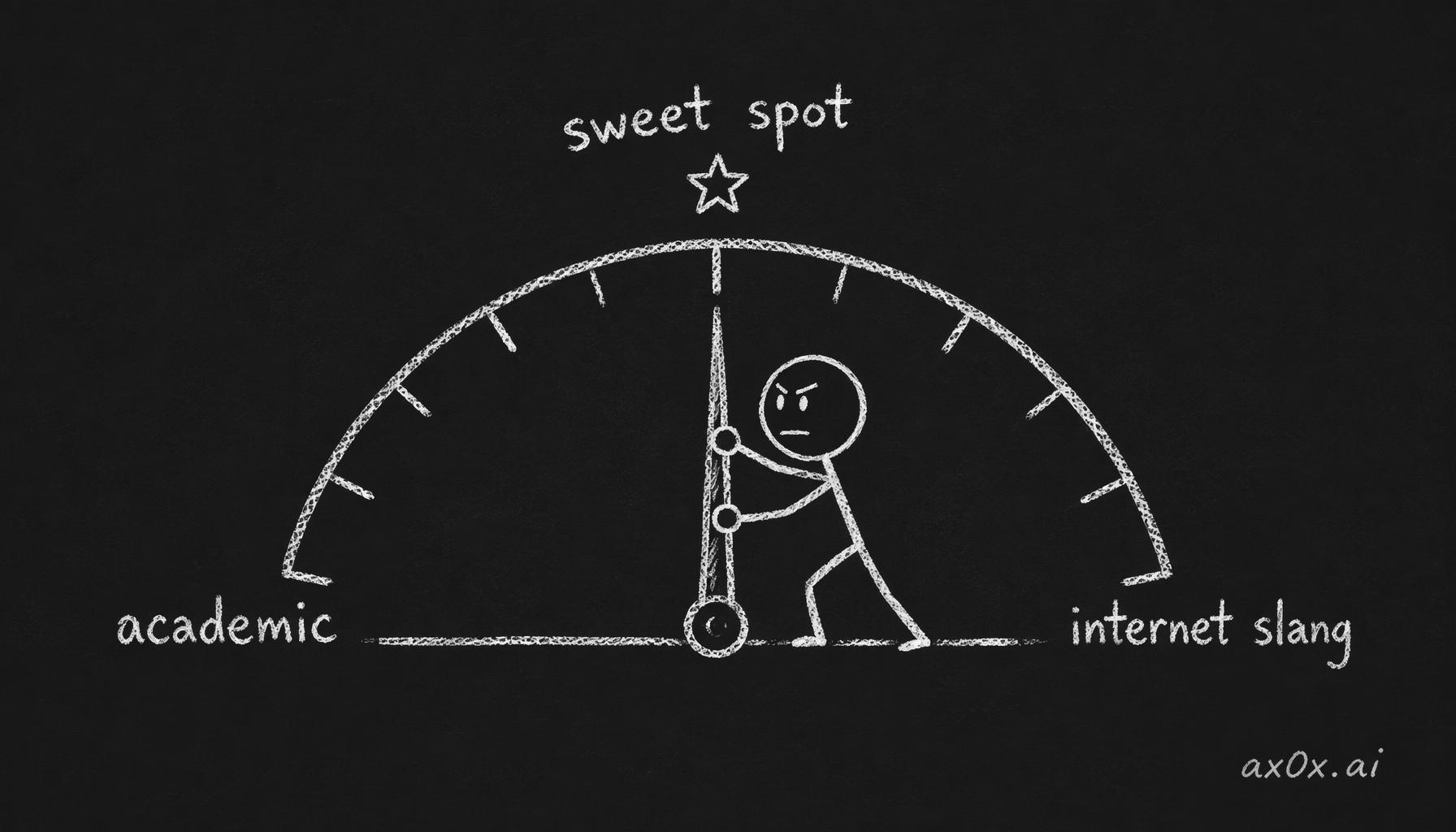 Colloquial tone is a dial: academic at one end, internet slang at the other, and you aim for the sweet spot in the middle.
Academic ←————— Sweet Spot ———————→ Internet Slang
"基于上述分析"    "说白了"              "笑死,绷不住了"
"值得注意的是"    "这事儿有意思的地方在于"   "家人们谁懂啊"
"综上所述"       "所以你看"             "绝绝子"
5. The Proofreader Pass
Even with all these rules, the first draft still has translation-ese leaking through. So I added a mandatory proofreader pass: after writing, scan for "作为" "之一" "进行" "综上" "值得注意" and kill or replace each one. Then read the whole thing aloud — if a sentence sounds weird spoken, it reads weird written.
The Meta-Lesson
Teaching AI to write in a culturally specific style is significantly harder than teaching it to write code.
Code has clear right/wrong signals. Tests pass or fail. Linters catch errors. The feedback loop is tight and objective. But writing style exists on a spectrum of "feels native" to "feels translated," and the gap between them is enormous yet hard to articulate.
The challenge is that translation-ese is not wrong. Every sentence is grammatically valid. Every idea is accurately conveyed. A grammar checker would give it a perfect score. The problem is entirely one of cultural register — the text pattern-matches to "translated textbook" rather than "native web content," and Chinese readers feel this instantly, even if they can't explain why.
What I learned:
-
Abstract style rules don't survive contact with generation. "Be conversational" is not a rule — it's a wish. Rules need to be concrete enough that a regex could partially enforce them.
-
Examples beat descriptions. Showing the same idea in two styles teaches more than any amount of prose about what "good Chinese writing" means.
-
Cultural writing patterns are invisible to monolinguals. I didn't notice the translation-ese because I was reading with English-trained eyes. The spiral structure, the emotional pacing, the 金句 endings — these are patterns you only see when you study Chinese-native content intentionally.
-
The kill list is the highest-leverage intervention. A simple banned-phrase table with replacements eliminated 80% of the translation-ese in one shot. Everything else — structure, pacing, tone — required iteration.
-
Style is a pipeline, not a prompt. You can't fix cultural register with a single instruction. You need research, a reference document, explicit rules, examples, structural templates, and a proofreading pass. It's a system, not a setting.
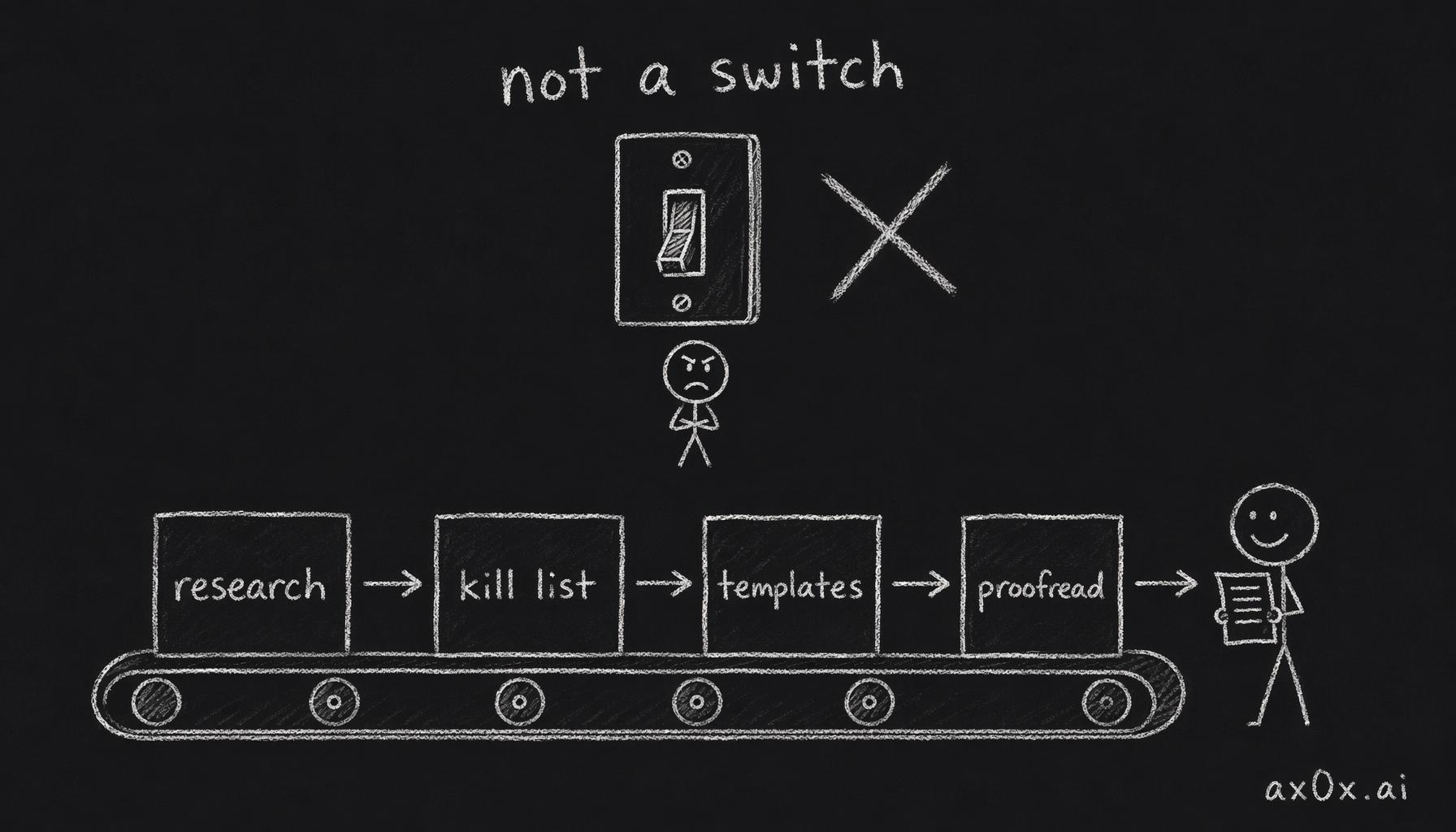 Style is a pipeline, not a switch: it takes staged research, kill list, templates and a proofread pass to make the Chinese read native.
The Test Case
The Chinese version of this very post is the test case. If an article about writing good Chinese reads like translated English, the system has failed. Go read it and judge for yourself: 中文版.
That's the thing about eating your own cooking — there's nowhere to hide.
This post is also available in Chinese (中文版).