The Last 72 Hours on a Dead Person's Phone
Three things this article is about:
One, Dead Signal is fundamentally different from Inside Job. Inside Job is a closed system with five suspects. Dead Signal is an open investigation where phone data points to the outside world.
Two, the core mechanic is time. Every app has its own timeline. The player's job is to reconstruct the victim's last 72 hours, hour by hour, from fragmented data.
Three, the horror comes from data, not visuals. When a photo's geolocation matches another victim's last known position, or when a dead person's phone number shows an active call — that's the kind of fear only data can create.
A Phone Arrives at Your Desk
Last time, I talked about why I'm making three games with AI and how Inside Job's concept evolved from V1 to V2.
This is the second game.
Dead Signal opens with a package arriving at your office. You're an investigative journalist. A serial murder case has gone cold — three victims, no leads. Someone anonymous mailed you the third victim's phone with a note: "72 hours."
Your job: reconstruct what happened in the last 72 hours of this person's life.
On the surface, this sounds like Inside Job — dig through a device, find clues. But the design philosophy is completely different.
Inside Job is a closed system. All evidence lives inside one company's network. Five suspects, bounded evidence chains. The tension comes from moral ambiguity — the truth makes you uncomfortable.
Dead Signal is an open system. The phone's data points outward — to locations, to other victims, to a world beyond the screen. A photo's geolocation leads to an abandoned warehouse. A frequently called number belongs to the first victim. A text conversation suggests the victim sensed danger but didn't go to the police.
The evidence doesn't stay inside the phone. It reaches into reality.
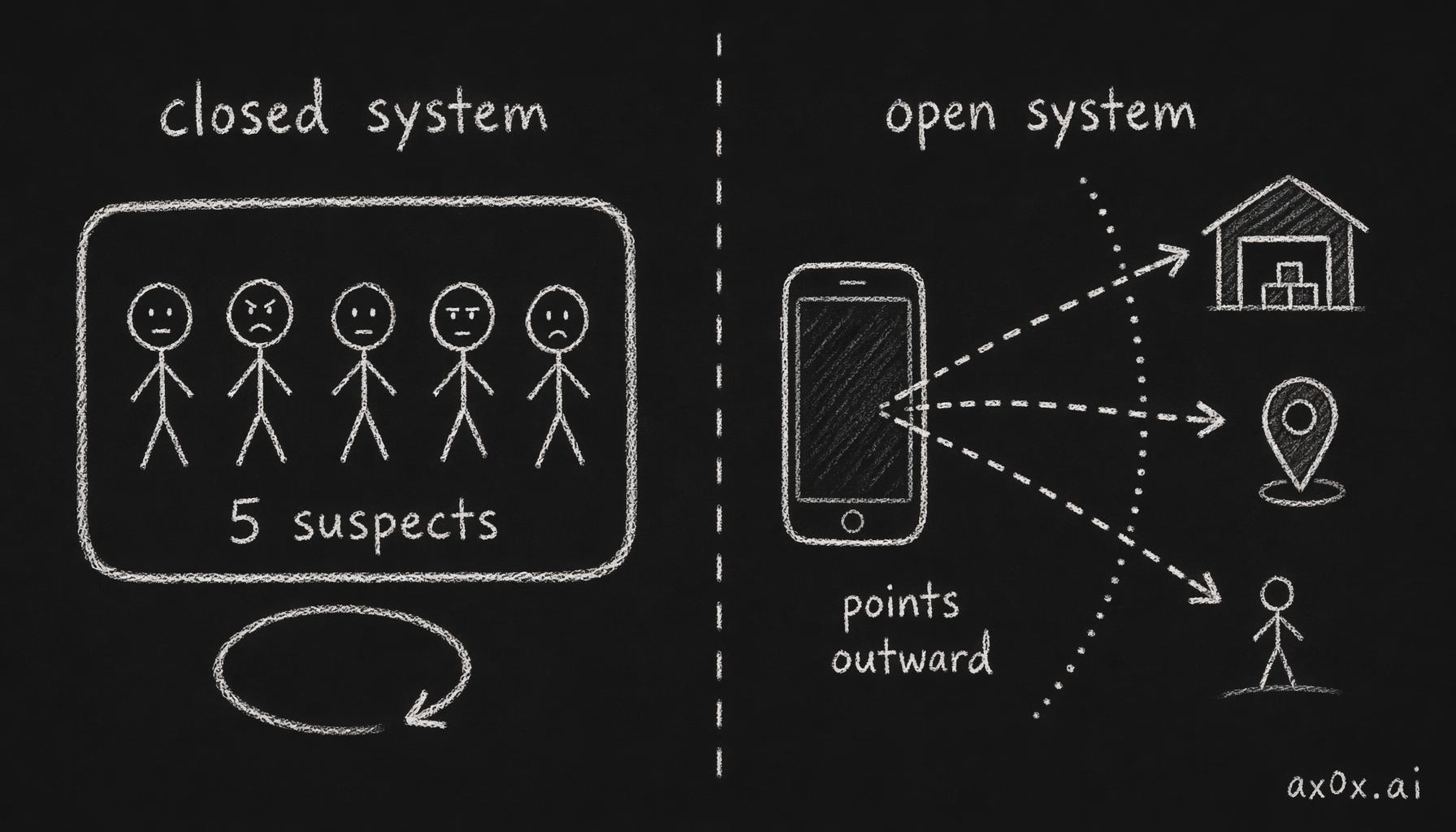 Two designs contrasted: Inside Job's closed system of bounded clues vs Dead Signal's open system pointing outward.
Time Is the Core Mechanic
When you unlock the phone, information is scattered across apps with different temporal logic. Messages grouped by conversation. Call logs sorted chronologically. Photos sorted by date. Notes sorted by last modified.
The player's job is to cross-reference these fragments and rebuild a 72-hour timeline, hour by hour.
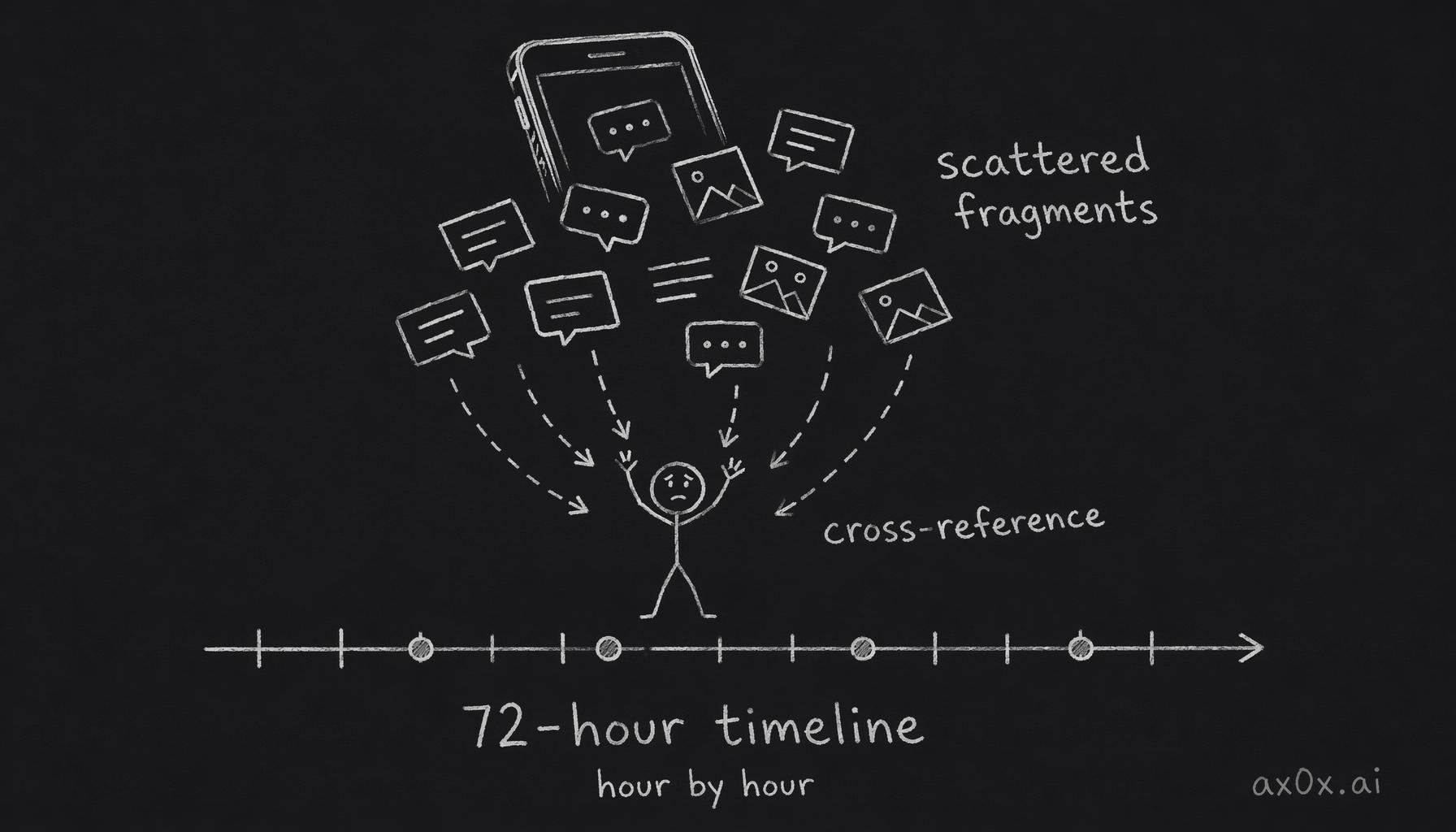 Fragmented phone data scattered by different time logics gets cross-referenced into one 72-hour timeline.
Wednesday, 11 PM — the victim texted an unknown number: "I know."
Thursday, 2 AM — a new photo in the gallery. Darkness. An open window. Geolocation: a warehouse on the city's outskirts.
Thursday afternoon — the call log shows a 47-minute call to the first victim's number. That person died three weeks ago.
Someone is answering a dead person's phone.
Horror Through Data
Dead Signal's fear doesn't come from jump scares or graphic content. It comes from data.
From swiping through the photo gallery, glancing at a location tag, and realizing it matches the coordinates where another victim was last seen. From finding an encrypted note, decrypting it, and discovering a name — a name that appears in all three victims' contact lists.
Someone trusted by everyone.
The visual theme reinforces this: Android phone interface, deep black with cold blue accents. At key discovery moments, the screen shows subtle glitch effects — signal interference. Because this phone is a signal. The last signal from someone who can no longer speak.
That's why it's called Dead Signal.
The Design Challenge
Compared to Inside Job, the biggest challenge isn't technical — it's emotional pacing.
Inside Job moves from professional responsibility to moral dilemma — a slow reveal of gray areas.
Dead Signal needs something darker. Curiosity → pattern recognition → the realization that the killer was close to the victim → and then a more terrifying question: does the killer know the phone is now in your hands?
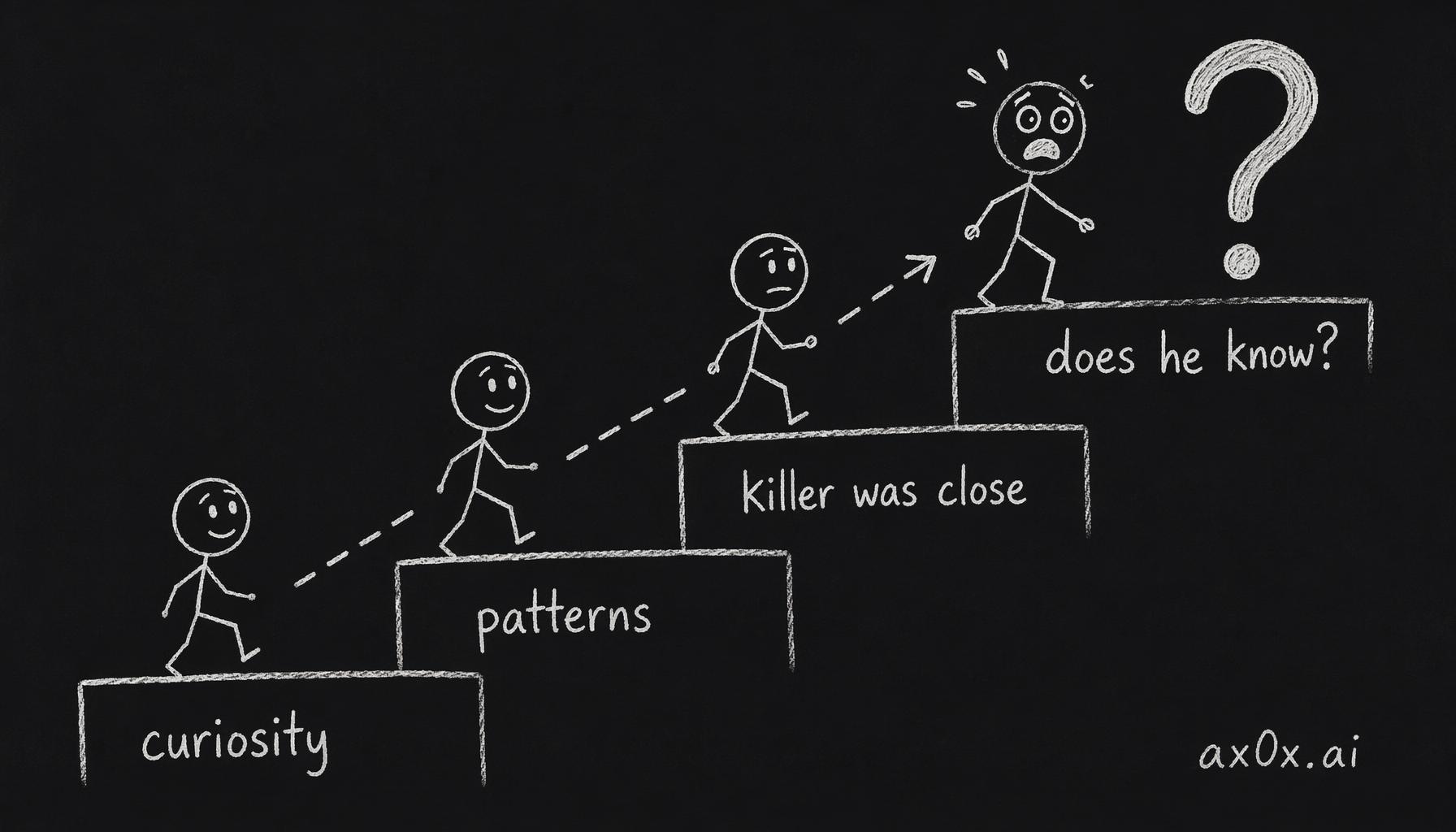 Fear escalates step by step: curiosity, pattern recognition, the killer was close, and finally does the killer know?
Late in the game, the phone might start receiving new messages.
I haven't started the full system design with Claude Code yet. But even at the concept stage, this one makes me want to start building immediately.
Next: Shadow Access. The weirdest of the three. You're not searching someone else's phone — you're searching your own.