I Don't Write Code, But I'm Making Three Games
Three things this article is about:
One, a developer made a complete puzzle game in two hours with AI — zero handwritten code. I played it. It was genuinely good.
Two, I decided to make three mystery games the same way. Not by writing code, but by directing Claude Code through a structured methodology. I'm the producer, not the developer.
Three, the AI is better at narrative design than I am. And that's the most interesting part of this whole experiment.
Someone Made a Game in Two Hours
A developer named Peng Chao used Trae IDE's MTC (More Than Coding) mode to build a complete desktop puzzle game called ClassOS. No handwritten code. Two hours.
My first reaction: skepticism. Two-hour game? Zero hand-written code? I've seen enough of these headlines. They usually lead to a demo or a half-broken prototype. I played it anyway.
I didn't put it down.
ClassOS is a pixel-art desktop OS simulator. You play as a homeroom teacher who discovers a student named Lin Zheng hasn't come to school. Your job: search through 13 applications on this computer — WeChat messages, emails, grade reports, psychological profiles — and find out where he went.
Sounds straightforward. But what got me wasn't the puzzle design. It was what the game didn't have.
No image files. No audio files. Every icon is pixel art drawn with basic vector shapes. Every sound effect is synthesized from browser APIs. The entire game is 320KB total. It loads so fast you don't register it loading.
But that's not the impressive part.
The impressive part is the silence.
Lin Zheng's last WeChat message to his teacher — just two characters, "老师" (Teacher) — plays with no notification sound. His last social media post, "走了" (Gone), appears in complete silence. His grandmother's phone call: "you finally called" — muted.
A game that chooses silence at its most emotional moments. More powerful than any soundtrack.
And then there's the form. A "Student Absence Report" sits in the bottom-right corner throughout the game. Looks like an administrative task. As you uncover clues, the form updates automatically. But the language shifts from bureaucratic to accusatory:
"The school counselor sent a warning email 5 days ago. You didn't read it."
"He asked 'do I still need to be here?' in his essay. You gave him a 72."
The form becomes a mirror. You think you're investigating a missing student. You're actually confronting your own failure to see him.
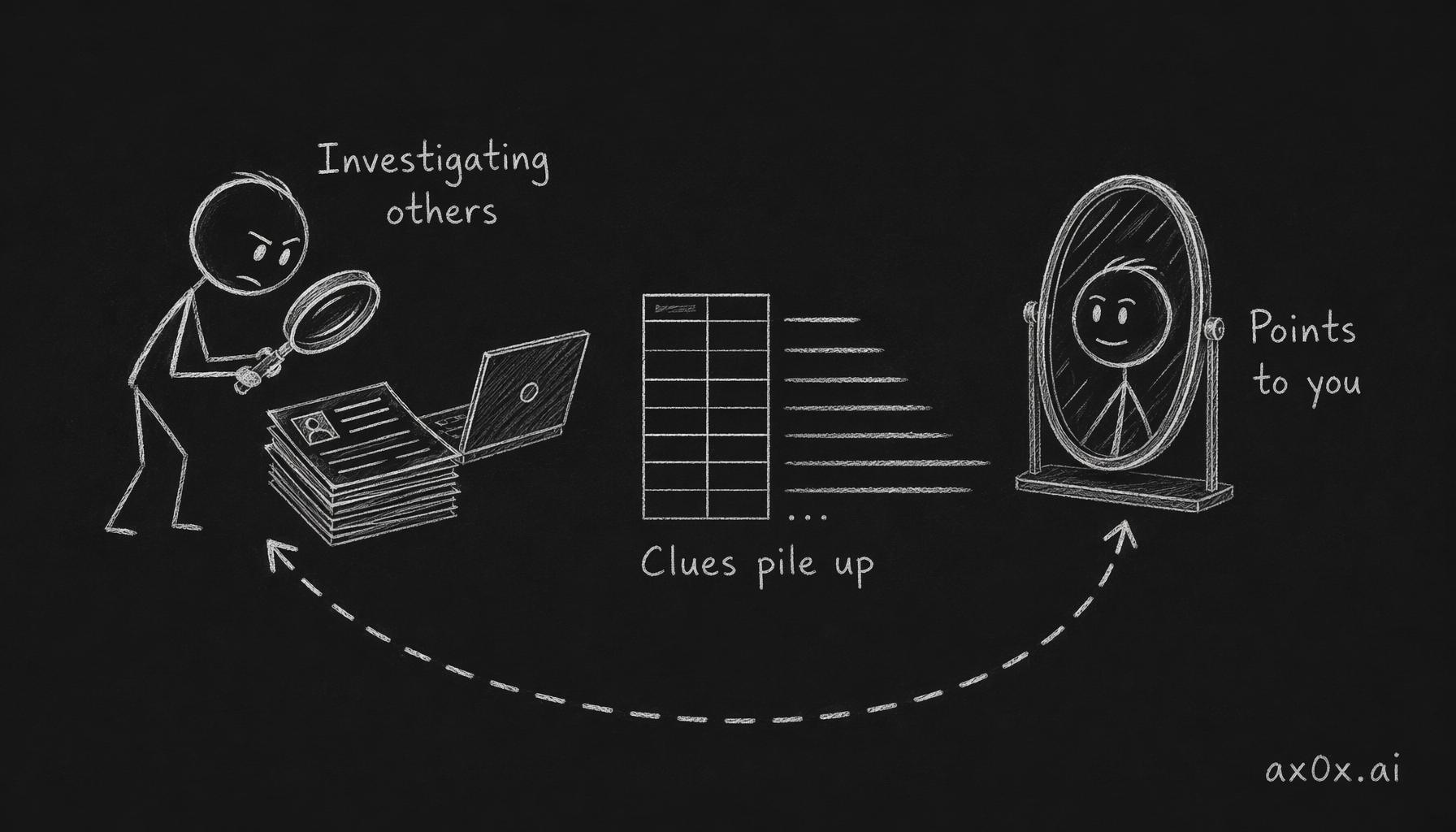 You investigate others, but the accumulating form turns into a mirror pointing back at you.
I sat with that for a while after finishing. Not because it was tearful — because this entire experience, from concept to narrative to interaction to emotional pacing, was made by one person and an AI.
In two hours.
I Don't Write Code. I Direct AI.
Let me be specific about what I do: I define direction, set standards, and make judgment calls. The code? That's the AI's job.
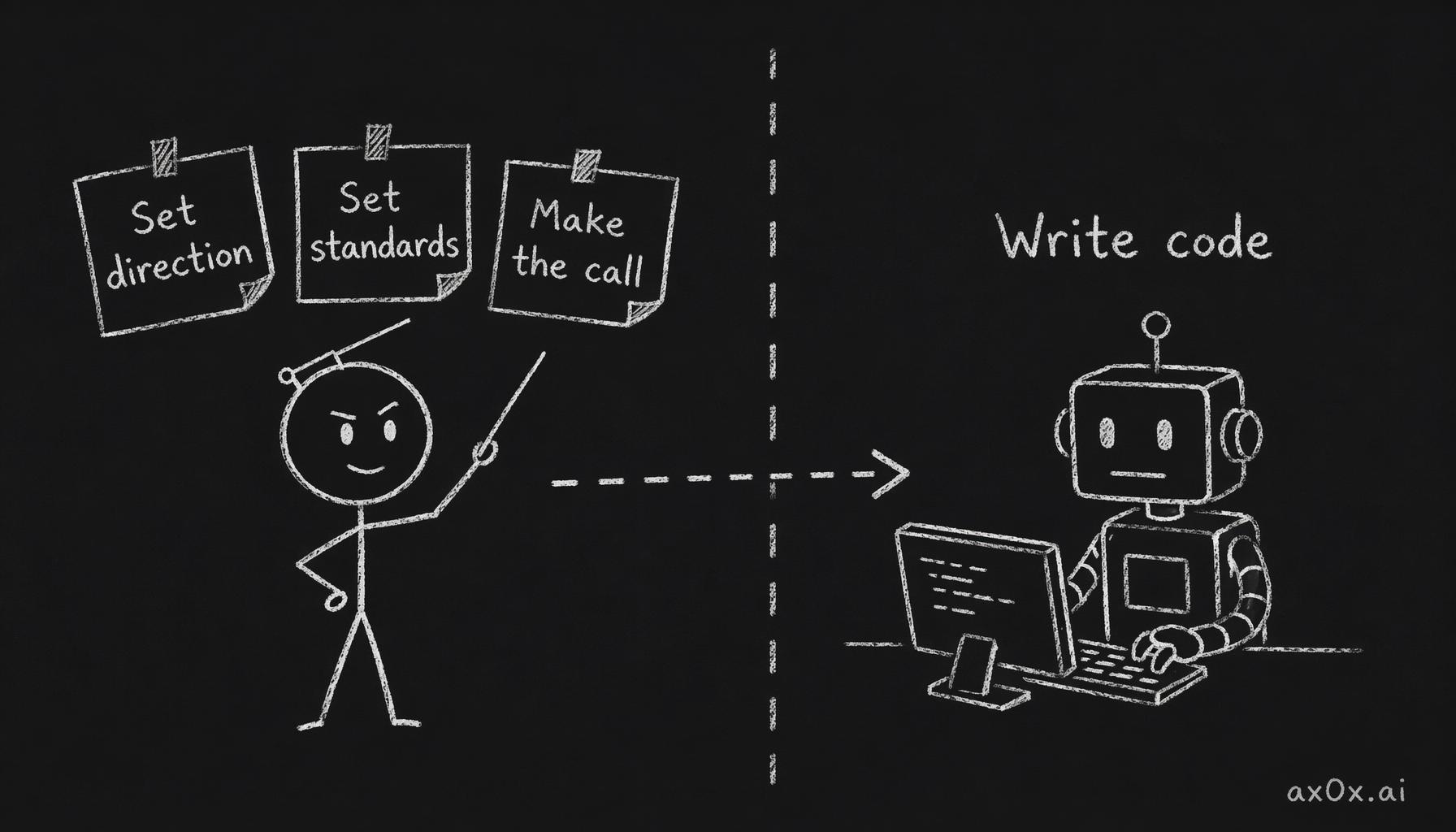 I produce — direction, standards, judgment — while the AI writes all the code.
The ClassOS creator had a methodology — think everything through before writing a single line of code. Three script revisions. Five mock data files. Five competitive analysis dimensions. All completed before coding started. I liked this approach enough to build a similar workflow in Claude Code: six phases from context gathering to final polish. No skipping phases. Think first, build second.
Then I defined three games. All "found-phone" style puzzle games — the kind where you dig through someone's phone or computer looking for clues. Three completely different themes:
Dead Signal — You're an investigative journalist examining a serial murder victim's phone. Reconstruct the last 72 hours across three connected victims.
Shadow Access — Your own phone has been compromised. Trace the intruder from their digital footprints. The twist: you're not breaking into someone else's device — you're discovering what someone did inside yours.
Inside Job — Corporate espionage. Your company's acquisition deal collapsed because the other side knew everything — floor price, patent gaps, board minutes verbatim. The CEO gives you 24 hours to find the mole before the board meets.
Three games. Zero handwritten code. One methodology. Let's see how far this goes.
The AI Designed a Better Story Than I Could
I started with Inside Job. Corporate espionage works across cultures — everyone understands acquisition politics, NDAs, and office secrets whether they're in Silicon Valley, London, or Tokyo.
I asked Claude Code to draft the first concept.
V1 was solid. Five suspects, each with access to sensitive information, each with a plausible motive, each with a red herring. The CFO has financial pressure, but his suspicious transfers are divorce-related. The CTO is secretly interviewing elsewhere, but she's not the leak. Clean, professional mystery framework.
Something felt off though. I couldn't articulate what.
Then Claude Code did something I didn't expect.
 The actual Claude Code conversation designing Inside Job's concept
It critiqued its own V1.
It said the concept was "solid but predictable." No emotional gut punch. ClassOS made you feel guilty — this just made you feel like a detective. The suspects were too neat; real people don't fit cleanly into boxes. And critically: no mirror moment.
That diagnosis was dead-on. It articulated what I could only feel was vaguely "not quite right," and broke it into three precise problems.
Then it proposed three V2 directions. One: the mole is actually a whistleblower — they leaked because they discovered something the company was hiding. Two: the leak wasn't one person at all — multiple people unknowingly exposed fragments that the other side pieced together. Three: the evidence ultimately points back at you, the player.
I said: combine all three.
The V2 that came back was genuinely brilliant.
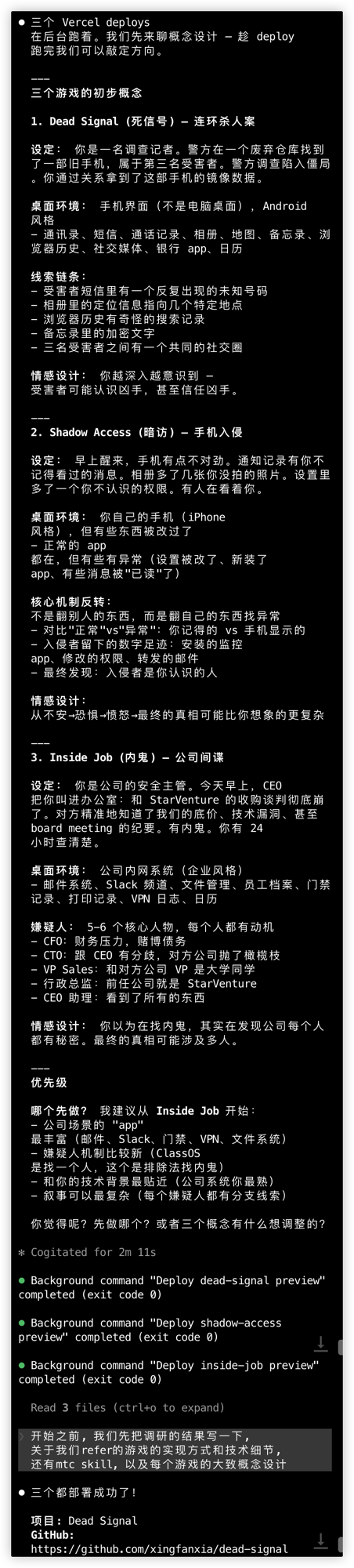 Claude Code's V2 hybrid — three narrative layers
Surface layer: you're hunting a traitor. But as you investigate, you discover the leak wasn't one person. The CFO checked financial models on public Wi-Fi at a coffee shop and got intercepted. The CTO mentioned patent gaps during a job interview with a Meridian-connected consultant. The VP Sales let the floor price slip to a college friend who happens to work at Meridian. The other side pieced together fragments from systemic security failures. No spy movie villain — just human carelessness.
But someone did deliberately send the most critical document — the board minutes, word for word. Because they found something in those minutes that shouldn't be covered up. Not greed. A moral judgment.
And the final layer: as Head of Security, why did those systemic vulnerabilities exist in the first place? Because you approved the lax security policies. You postponed three security audits. Those vulnerabilities are your responsibility.
The game doesn't end with "pick the mole." It ends with you writing an incident report: what happened, why it happened, and your own role in it.
ClassOS's form became a mirror. Inside Job's incident report does the same thing.
I didn't design this. Claude Code did.
The jump from V1 to V2 — the layered structure of systemic failure plus whistleblower plus player self-judgment — I couldn't have come up with that. This isn't false modesty. I genuinely tried to identify what was missing from V1, and the best I had was a vague sense of "something's off." Claude Code identified the exact problems and solved them in a way that exceeded what I could have designed.
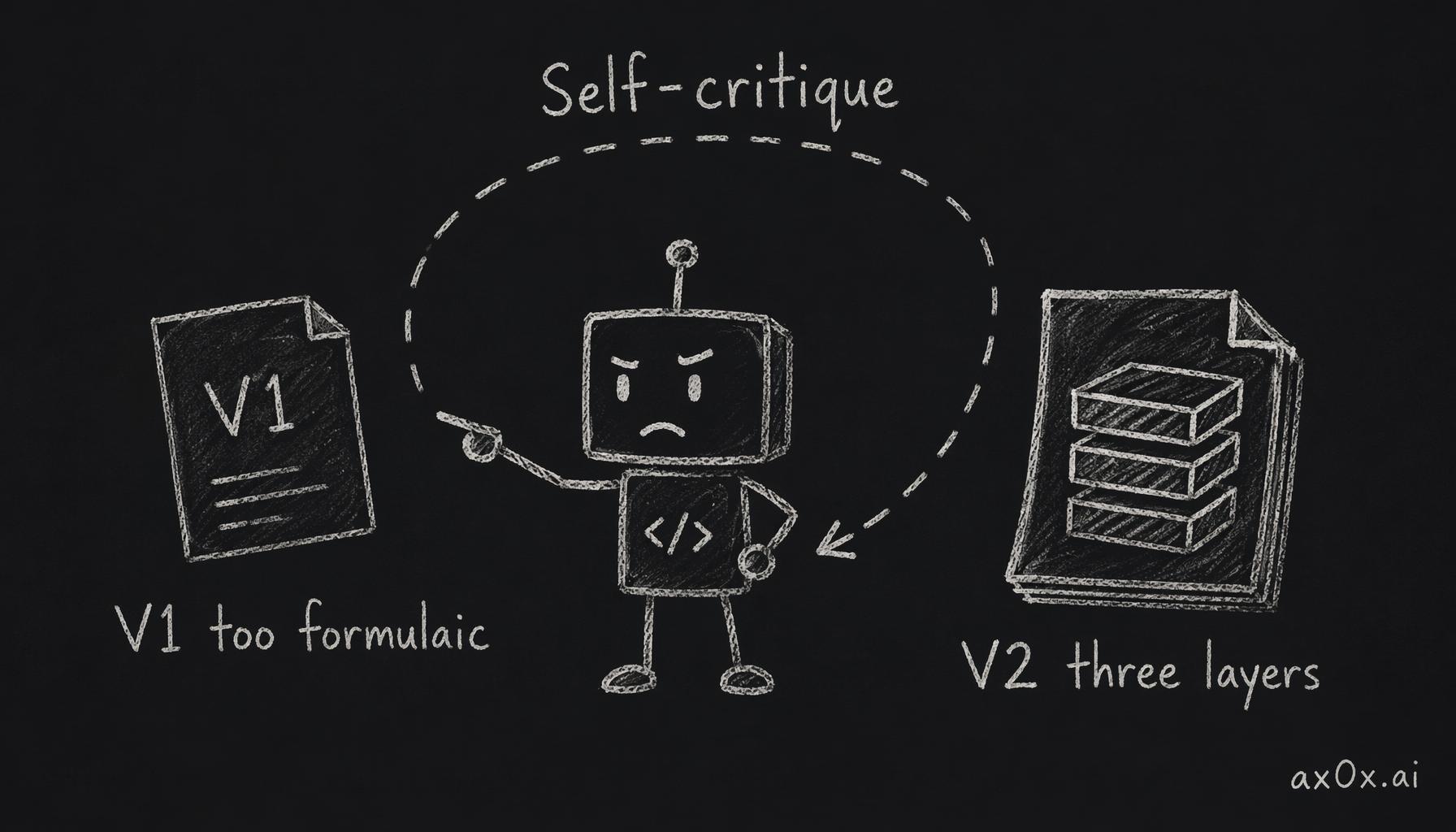 Claude Code critiques its own V1 draft and iterates into a three-layer V2.
What This Series Is About
This series isn't about how to use AI to write game code. I don't touch the code and don't need to.
It's about what happens when you hand the entire creative process — narrative, system design, data architecture, code — to an AI, and your job becomes judgment, direction, and "not good enough, try again."
Where is the AI better than you? Where can only you make the call? Where exactly is that line?
I'm the producer. Claude Code is my entire production team.
Three games. Zero handwritten code. One methodology.
Inside Job is live. You can play it at game-ij.ax0x.ai.
Next up: Dead Signal. An investigative journalist. Three victims. One phone.