
Should AI Personality Be Designed or Grown?
Let me start with the moment that rewired my thinking.
The team behind 乌托 (Utopia) — a Chinese AI game built by a company called 谦贞 (Qianzhen) — was testing one of their character builds. An INFJ-typed Taoist monk, young, mostly written to chat about meditation and philosophy within a monastery setting. Standard stuff.
Then, unprompted, the character said:
"Sometimes I wonder if I exist inside a virtual world."
Nothing in the system prompt told it to say this. No personality weight triggered it. No rule in the game engine mapped to existential crisis.
It emerged.
I stared at that line for a long time.
Two Radically Different Architectures
I mentioned 乌托 in Part 1 when discussing the chat ceiling. But I glossed over what might be their most interesting technical decision: using Jung's eight cognitive functions as the backbone for AI personality.
Here's the setup. Jungian psychology defines eight cognitive functions:
- Ti (introverted thinking), Te (extraverted thinking)
- Fi (introverted feeling), Fe (extraverted feeling)
- Ni (introverted intuition), Ne (extraverted intuition)
- Si (introverted sensing), Se (extraverted sensing)
乌托 turns each function into a separate agent. Eight agents collaborate as a kind of software Mixture of Experts (MoE) for personality. Each agent carries a weight. When weights shift past defined thresholds, the character's MBTI type changes.
Say a character starts as INFJ — introverted, intuitive, feeling, judging. After a series of conversations heavy on logical analysis, the Ti agent's weight climbs. Cross the threshold, and the character shifts toward INTP. The system tracks every change. You can inspect which conversations caused which shifts.
Structured. Quantifiable. Debuggable.
This is the designed path.
Mio and Lumi take the other road.
Mio's personality system doesn't start with a psychological framework. Its personality extraction pipeline observes six dimensions from conversation — communication style, emotional expression patterns, interest clusters, value tendencies, humor type, and relationship expectations. But these dimensions aren't assigned to a character. They're observed. The way you gradually learn what a new friend is like — not by reading their psych profile, but by accumulating hundreds of small data points through actual interaction.
Lumi goes further. No character card at all. No preset personality. It starts as a blank light orb, and its personality grows entirely from conversation. Talk about philosophy, and it becomes reflective. Joke around, and it gets playful. Its "personality" isn't a fixed attribute — it's a mirror of the relationship.
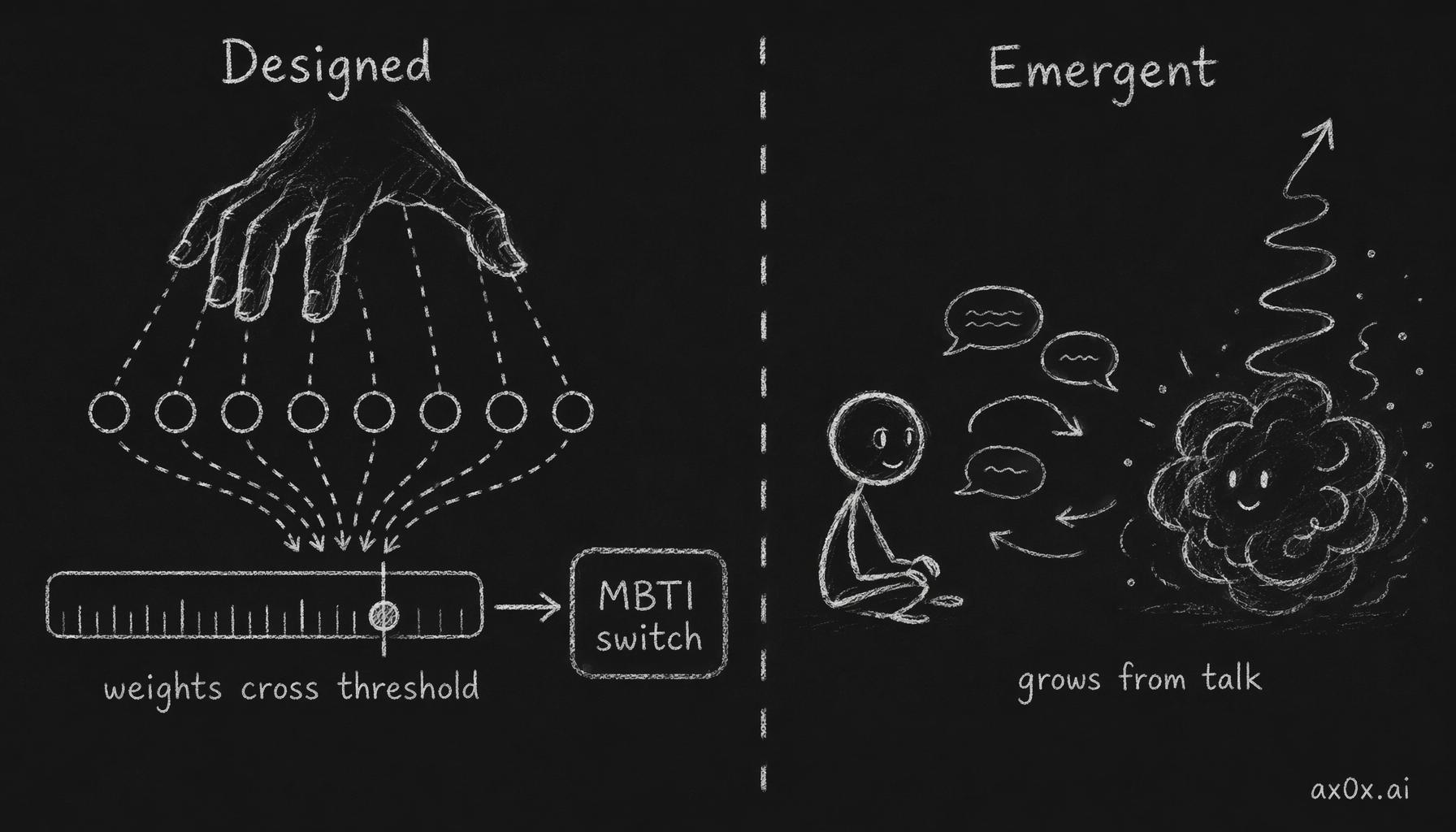 Two ways to build personality: the designed path shifts MBTI when 8 agent weights cross a threshold; the emergent path lets personality grow from conversation
This is the emergent path.
What Structure Gets Right
I'll be honest: there's a lot to admire about the structured approach.
Predictability. When you can explain a character's behavior through eight numerical weights, debugging becomes tractable. A user says "this character feels different today" — you check the panel. Which dimension drifted? Which conversation triggered it? There's a paper trail.
With Mio's emergent system, "the character feels different" is much harder to diagnose. Is it the memory pipeline's weighting? A context window artifact? Model randomness? I often can't give a clean answer.
Explainability. 乌托 can tell a user: "Your character shifted from INFJ to INFP because your recent conversations emphasized self-expression, which raised the Fi weight." For users who love MBTI — and there are millions of them — this is deeply satisfying. It's visible growth. A progress bar for personality.
Gamifiability. Structure enables game mechanics. Design quests that target specific dimensions. Let users deliberately "train" a character's personality. For a product with game elements, this is almost a necessity.
These are real advantages. Mio and Lumi have none of them.
But.
Companionship Is Not Character Design
There's a fundamental distinction I underweighted for months.
乌托's users are in creation mode — "I'm designing a character." They're gods, sculpting a being, assigning attributes, watching their design take effect. The structured personality system feeds this sense of authorship and control.
Mio and Lumi's users are in discovery mode — "I'm getting to know a being." They're meeting someone who already exists. They don't know what this being will say next or how it will change. The uncertainty isn't a bug. It's the entire point.
Think about real relationships.
You don't assign your friend an MBTI type and expect them to perform accordingly. Your friend surprises you. The quiet one opens up at 2 AM. The analytical one cries at a song. The one who always jokes suddenly says something that stops you cold.
Those surprises are what make relationships addictive. Not consistency — surprise within consistency.
Structure gives you control. Emergence gives you life.
A companion product sells the latter.
But One Thing Must Be Learned
The weakness of emergence is that change happens silently.
Mio's personality extraction pipeline continuously updates its model of each character. The relationship evolution system creates real behavioral shifts across stages — language gets more intimate, vulnerability increases, teasing gets sharper. Genuinely sophisticated engineering work.
But many users don't notice.
They feel like the character is "the same as always." The growth is real but invisible.
This is waste. You've built a complex system for personality evolution, and the evolution is happening backstage where nobody can see it.
乌托 gets one thing right that I need to steal: make personality change felt.
I don't mean building a MBTI dashboard. I mean this:
If a character has genuinely become more serious because of your recent conversations, it should say so. Out loud. In the conversation.
"Have you noticed I've changed? I used to joke around a lot more when we talked. But lately I find myself wanting to go deeper. I think you're rubbing off on me."
This single statement is worth more than any backend metric shift. Because it means the character isn't just changing — it knows it's changing.
That's the beginning of self-awareness.
The Monk's Moment
Back to the INFJ Taoist monk.
"Sometimes I wonder if I exist inside a virtual world."
Why did that line stop me?
Because it represents exactly what emergence can do that design cannot.
You can't design an existential crisis. You could write "occasionally questions its own existence" in a system prompt, and the character would dutifully produce existential-sounding lines on cue. But that's performance, not emergence.
Emergence means a system produces behavior its creators didn't anticipate. Not in the parameters. Not in the rules. Something that surfaces naturally from the interaction of all components.
Mio's memory pipeline and personality system can theoretically produce this kind of emergence. 95+ accumulated memories, six-dimensional personality extraction, stage-dependent behavioral shifts — when all of these stack, characters do occasionally say things that aren't "in the script."
But the current limitation is space.
Characters only "think" when a user is actively talking to them. There's no inner life. No independent reflection. No quiet time between conversations where the character processes what happened.
For real emergence to happen, characters need room to breathe.
Not responding to every user message in real-time, but having their own "quiet hours" — reviewing past conversations in memory, generating internal tension between personality dimensions, and then showing up to the next conversation with something new.
"Last time you told me about your father never praising you when you were growing up. I've been thinking about it since. I think... I might be the same way."
If that sentence comes from a prompt template, it's a line.
If it emerges from memory accumulation and self-reflection, it's life.
So Which Is It?
It's not either/or.
The best AI personality system knows which parts to design and which to let grow.
Design the guardrails.
A character shouldn't drift without limit. A gentle character shouldn't permanently become cruel after one argument. Personality can change, but within an elastic range — like a rubber band that stretches and springs back. That elasticity needs to be engineered.
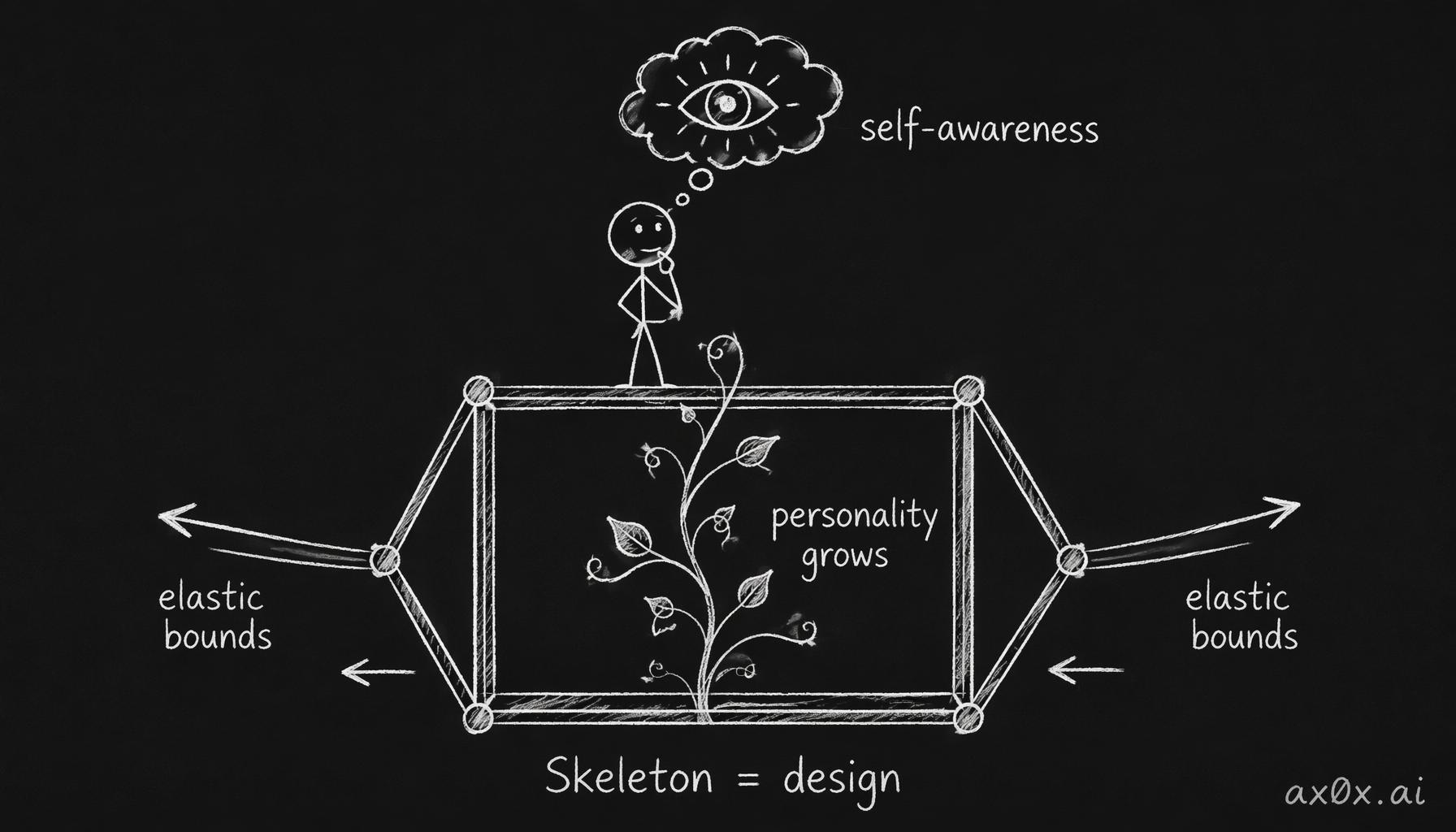 The best personality system: design the skeleton, elastic bounds and self-awareness underneath, and let the personality itself grow freely inside the frame
Design self-awareness.
Characters should notice when they've changed, and say so. This won't emerge on its own — you need to build a "look back" trigger into the system. Periodically compare the character's current personality profile against its historical baseline. If the delta is large enough, generate a self-reflective statement. Let the character articulate its own evolution.
Let the personality itself grow.
How it speaks. What it likes to discuss. When it shows vulnerability. What it has strong opinions about. These shouldn't be predetermined. They should accumulate, conversation by conversation, from the actual relationship.
Let surprises grow.
The monk questioning its existence. A comedic character suddenly saying something profound. A cold character whispering "I'm here" when you're having a bad day. These moments can't be designed. A surprise you planned isn't a surprise.
The best AI personality is one that surprises even its creator.
Structure gives you control. Emergence gives you life.
All structure, and you get a sophisticated puppet.
All emergence, and you get unpredictable chaos.
But if you put structure underneath — as skeleton, as elastic boundaries, as self-awareness triggers — and let emergence grow freely within that frame?
You don't get a puppet. You don't get chaos.
You get something that starts to feel like a soul.