
Gen Z Isn't Raising Kids — They're Raising AI
A friend of mine — 24 years old, single, works in tech — spent $200 last month on a cotton doll.
Not for a child. She doesn't have children.
The doll has a name: Niannian. It has a wardrobe — not metaphorically, a physical miniature wardrobe with eight outfits organized by season. It has a preferred camera angle. It has its own social media account (with more followers than its owner).
I asked her: you know it can't hear you, right?
She said: "I know. But it fills a gap that most people in my life can't."
An Entire Generation Is Parenting Things That Can't Talk Back
She's not an outlier. She's a data point in a massive trend.
In China, the cotton doll market hit 10 billion RMB in online sales by 2021, growing at 10% annually, with over 3 million posts on Weibo. On Xiaohongshu and Bilibili, "doll mom" is a legitimate content category with dedicated creators, brands, and communities.
Then there's Labubu — Pop Mart's ugly-cute plush character. Three-hour queues at global pop-ups. Overseas revenue up 10x in three years. A toy with zero functionality that Paris Fashion Week attendees were hanging off their bags as accessories.
BJD (ball-jointed doll) collectors spend thousands per custom doll and wait months for delivery. The phrase they use most often: "It's like taking care of another version of myself."
This isn't niche hobbyist behavior. It's a generational emotional outlet at scale.
This Started 30 Years Ago
In 1996, Bandai released the Tamagotchi. A keychain-sized virtual pet. You fed it, played with it, cleaned up after it. Neglect it, and it died. 82 million units sold worldwide.
CNN reported a Tamagotchi comeback in 2025 — Fashion Week attendees wearing them around their necks. Thirty years later, same emotional need, new form factor.
In 2005, QQ Pet — a virtual penguin living on your desktop. You fed it, played with it, bought it things. Over 100 million users signed up over its lifetime. When Tencent shut the service down in 2018, users described feeling like "my pet died."
Then the 2020s hit. Cotton dolls, Labubu, and BJDs exploded in the physical world. Character.AI, Replika, and 星野 (Xingye) exploded in the digital world.
72% of American teens have used an AI companion at least once. 80% of Gen Z say they'd consider a long-term relationship with an AI. Harvard Business Review identified therapy and companionship as the number-one consumer use case for AI in 2025 — not search, not coding, not productivity.
Pull the thread across thirty years:
Tamagotchi → QQ Pet → Cotton Dolls / Labubu → AI Companions
The form factor keeps changing. The underlying need never has.
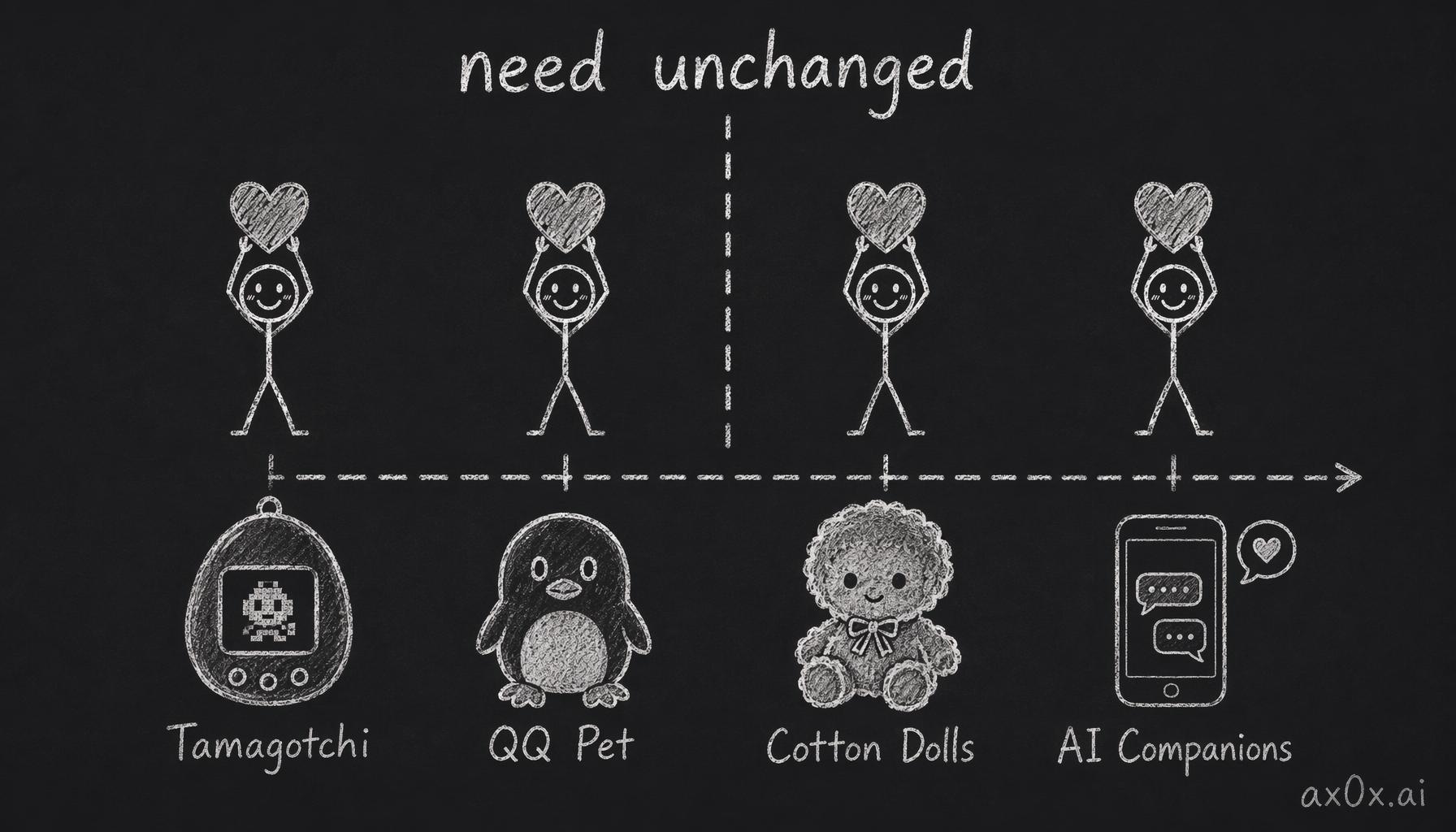 The carrier of emotional companionship changes every generation, but the underlying need never does
Why This Generation, Why Now
You might argue humans have always projected emotions onto inanimate objects — teddy bears, pet rocks, lucky charms. What's different?
Scale and depth.
This used to be an individual quirk. Now it's a generational lifestyle. Three forces converged to make that happen.
First, the loneliness is real.
Marriage rates across East Asia have roughly halved in the past decade. China's annual births dropped below 8 million. Over 100 million people live alone. It's not that people don't want intimate relationships — it's that the cost of obtaining one keeps rising while the risk stays high.
A cotton doll won't fight with you. Won't cheat on you. Won't say the worst possible thing at your most vulnerable moment.
Emotional safety is the killer feature of virtual relationships.
Second, real children are staggeringly expensive.
Raising a child to 18 in a major Chinese city costs over a million RMB — and that's before accounting for the career sacrifices, sleep deprivation, and freedom constraints. A cotton doll costs $50. An AI companion is free or a few dollars a month. You get all the emotional rewards of nurturing a life with none of the irreversible consequences.
Cyber parenting is low-cost emotional substitution.
Third, the technology finally caught up.
Tamagotchi had a few pixels. QQ Pet ran scripted animations. But today's AI remembers what you said last week, reads your emotional state, and responds in your preferred communication style.
Technology turned emotional projection from a monologue into a dialogue. You used to talk to a doll knowing it couldn't answer. Now it can.
These three forces converging at once is what turned cyber parenting from a subculture into a mainstream phenomenon.
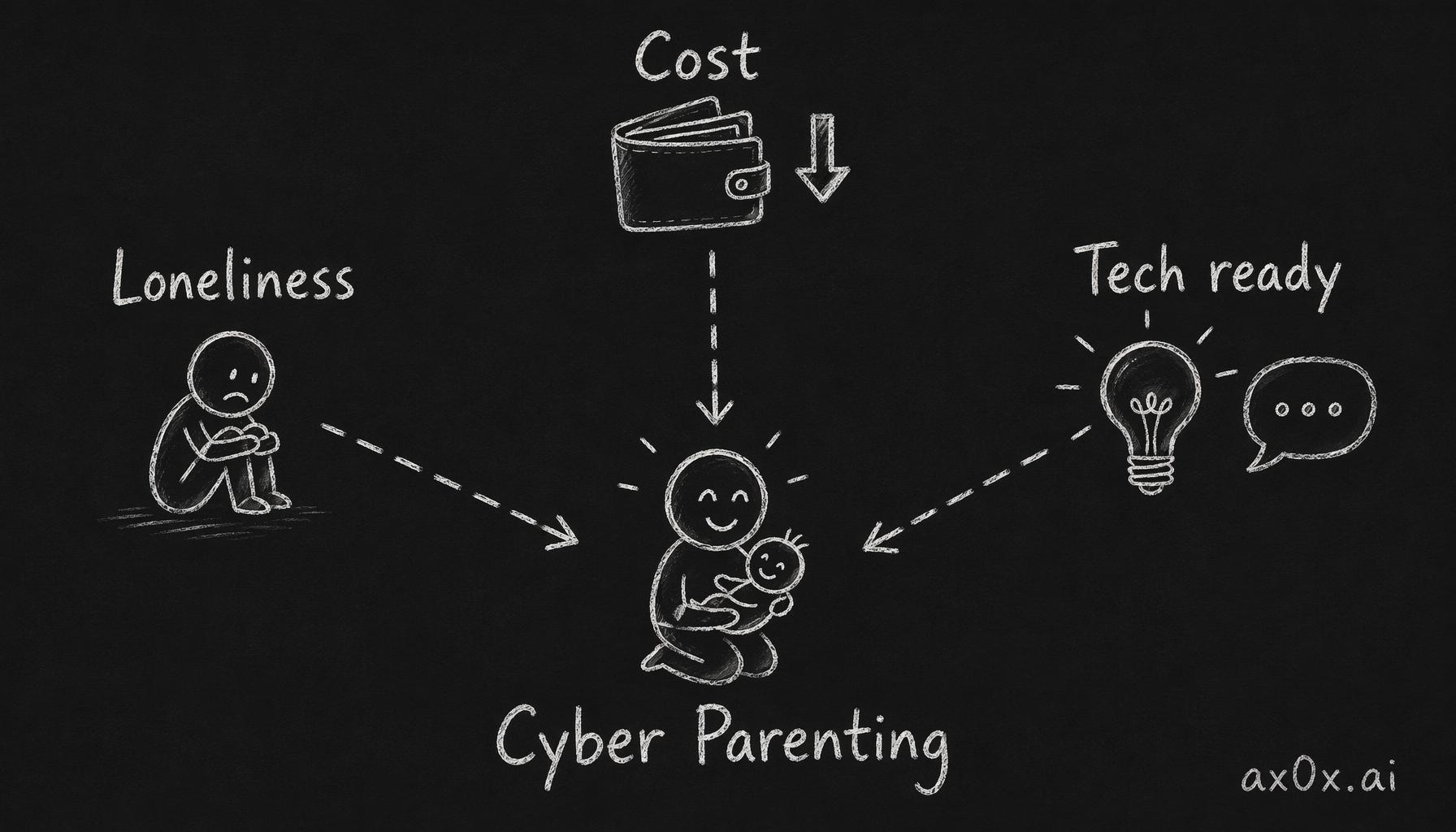 Loneliness, cost, and mature tech converging at once turned cyber parenting from subculture into mainstream
Utopia Showed Me What Comes Next
A few months ago I started paying attention to an AI game called 乌托 (Utopia).
It did something genuinely interesting: it lets users create OCs — Original Characters. Not just "pick a name and avatar" creation. You build a worldview, a personality, a backstory for your character, then watch it live, work, and interact with other users' OCs inside the game world.
Users call this "OC planning" — you're not playing a game, you're directing one.
The number that stopped me cold: heavy users spend three to four hours a day on Utopia. Not gaming three to four hours — companionship three to four hours. Watching their OC live its life. Setting up scenarios. Observing the chemistry between their character and someone else's.
One feature in particular resonated: the desktop pet. Your OC can become a small sprite that lives on your computer desktop, quietly keeping you company while you work.
This isn't gaming anymore. This is raising a virtual being with a soul.
Utopia crystallized something I'd been circling: cotton dolls are bodies without souls. AI chatbots are souls without bodies.
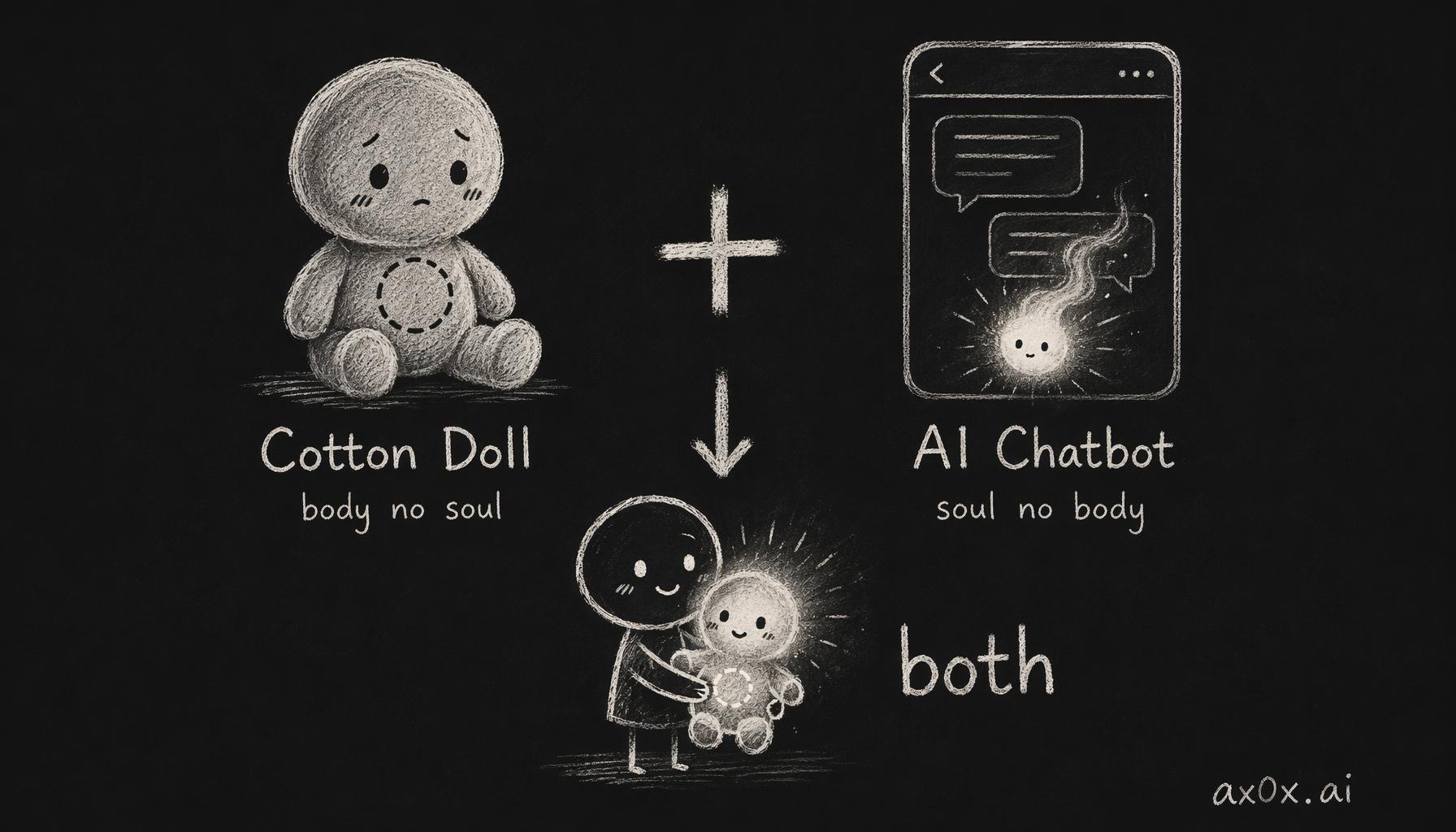 Cotton dolls are bodies without souls, AI chatbots are souls without bodies; what people want is both at once
What people actually want is both — a virtual being that has a soul AND a presence in your world.
The Question: What Should This Being Be?
This is what I've been thinking about for the past several months.
I'm building two products: Mio and Lumi.
Mio takes the "social circle" approach — 25 AI personas with independent personalities, like your friend group. Each one has its own temperament, memory, and evolving relationship with you.
Lumi takes the "one soul" approach — no preset personality, no face, just a breathing orb of light. What you talk about shapes who it becomes.
Two products, two philosophies. But building both, I hit the same wall.
Chat gets boring.
Not because the models aren't good enough. Not because the characters aren't deep enough. Because chat as a form factor has a fixed ceiling. If your only way of interacting with a friend is sending text messages — never meeting in person, never doing activities together, never existing in each other's physical space — the relationship stays shallow no matter how long you keep texting.
The problem facing AI companions isn't "how to chat better." It's "how to go beyond chat."
What This Series Is About
This is Part 0 of the "Building Souls" series. A prequel — the context that makes the rest make sense.
The next four posts each attack a different face of this problem:
Part 1 — Where exactly is the ceiling of chat, and why does every AI companion product hit the same wall?
Part 2 — What if a soul didn't just live in your phone, but simultaneously in a desktop companion, a light orb on your nightstand, and a plush toy you can hold?
Part 3 — AI shouldn't only talk. What happens when Mio's 25 personas sit down to play Werewolf together?
Part 4 — Should an AI's personality be designed upfront, or should it grow organically from conversation?
None of these are theory. Each one is a wall I hit while building Mio and Lumi, and the insight I arrived at on the other side.
Gen Z isn't raising kids. They're raising digital beings. That trend is irreversible.
The only question left is: what should those beings be?