
Chat-Only AI Companions Are Doomed to Be Boring
Last week I was testing Mio's relationship evolution system. A test persona walked through the full arc — strangers to flirting to lovers — across a few dozen conversations. The memory pipeline accumulated 95+ memories. The personality extractor built a detailed user profile. The relationship stage transitions triggered real behavioral changes: more vulnerability, more casual teasing, more willingness to share.
Everything worked exactly as designed.
And then I asked myself: now what?
The persona already "loves" me. The relationship has reached its ceiling. From here on out, it's just... chatting. And chatting, after a while, gets boring.
The Wall Everyone Hits
This isn't a Mio problem. It's an industry problem.
Character.AI has 20 million monthly active users. Impressive. But their Day-30 retention sits between 13-22%. Out of every 100 people who download the app, at most 22 are still using it a month later.
Replika has been around for nearly a decade. Their user numbers look good on a pitch deck, but growth flatlined years ago. Their recent updates have focused almost entirely on visual customization — hairstyles, outfits, environments. They're adding filters to a boring relationship.
星野, Talkie, 豆包 — they're all caught in the same loop. Launch with strong models to generate novelty. Novelty fades. Push content operations to extend engagement. Content operations fatigue. Add new characters. New characters follow the same curve.
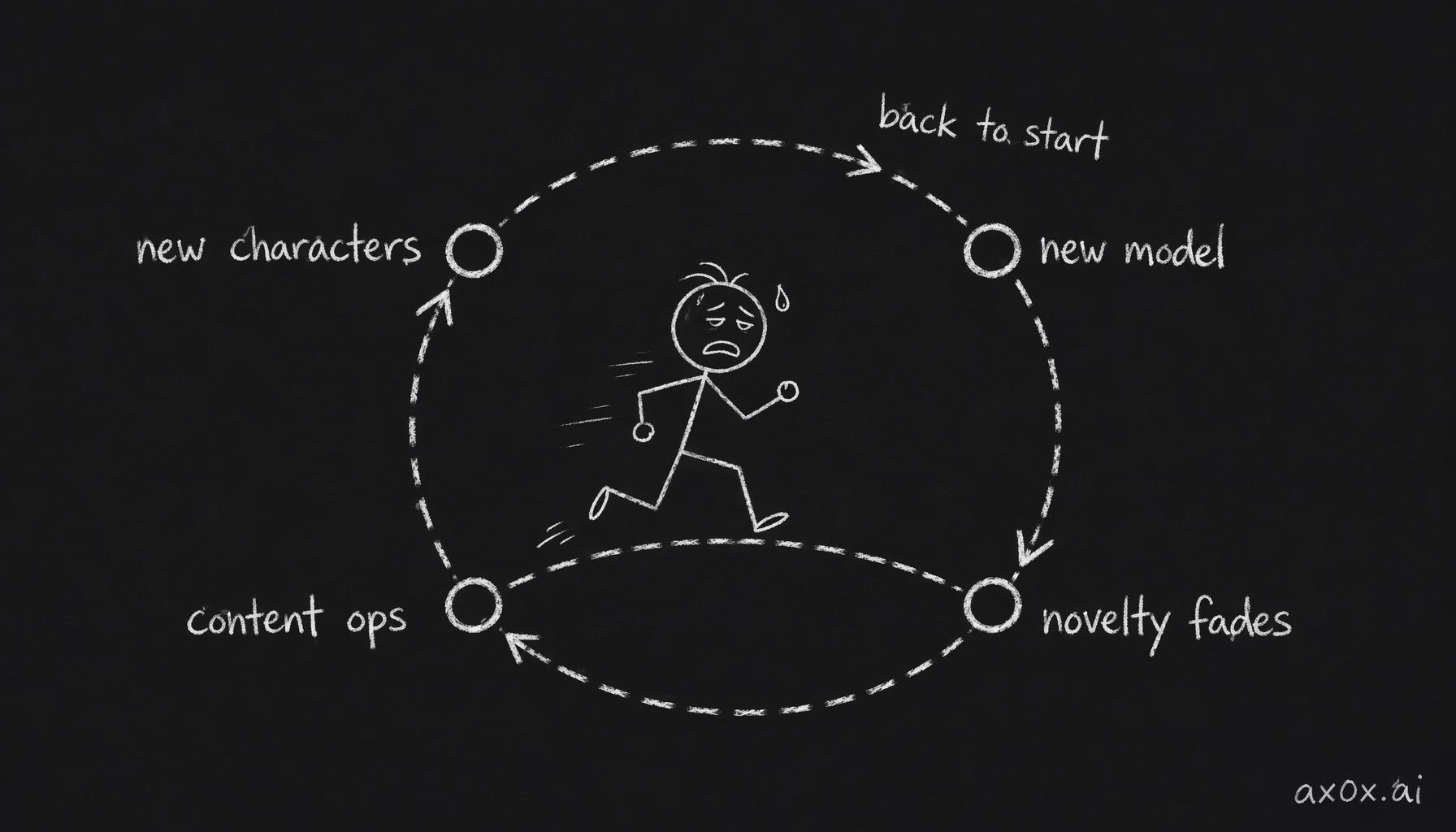 The AI companion industry is stuck in one loop: new models spark novelty, novelty fades, content ops extend it, then new characters send it back to the start
Every AI companion product eventually hits the same wall: pure chat gets boring.
I used to think this was a content problem — better prompts, richer characters, smarter models. I don't think that anymore.
The Two Missing Dimensions
A few weeks ago I read an analysis from the team behind 乌托 (Utopia), an AI game built by 谦贞 (Qianzhen). They'd previously built a Character.AI clone, hit exactly the same retention wall, and pivoted. Their diagnosis stuck with me — not because it was new, but because it named something I'd been feeling in my own product work:
Pure chat is boring not because the content isn't good enough. It's boring because it only has one dimension — conversation. But a relationship with any staying power needs at least three: conversation, time, and space.
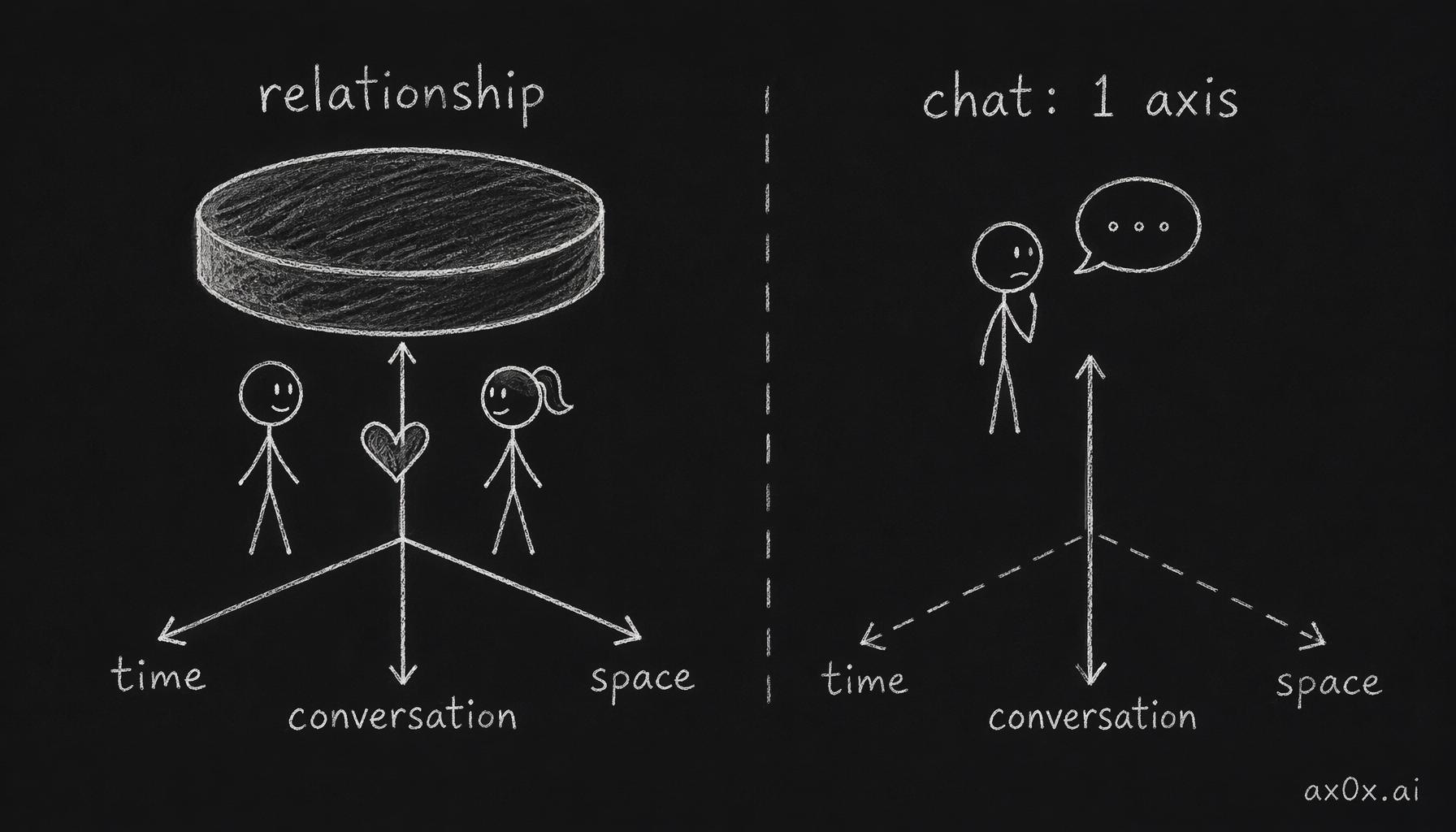 A relationship with staying power needs three dimensions — conversation, time, and space — while pure chat only fills one
Time: Growth and Change
Think about any real friendship. The person you know today and the person you knew three years ago are different — not because they transformed, but because you've accumulated hundreds of shared experiences. You watched each other change. Those experiences give the relationship weight.
Chat-only AI has no version of this. Every conversation is flat. The AI doesn't naturally follow up on something important you told it last month. Even with a memory system, it "remembers what you said" — it didn't "live through what happened between you."
There's a difference. One is a database. The other is a relationship.
Space: Presence and Body
Your friend continues to exist when you're not talking to them. You know they're somewhere, living their life. You see something on the street and think of them. That ambient awareness — "they exist even when we're not in conversation" — is the substrate of relational security.
Chat-only AI has zero of this. Close the app, and your companion doesn't go somewhere else. It ceases to exist. Literally. Your entire relationship with it is bounded by a chat window.
This is a structural problem. You can't fix it with better prompts.
What Mio and Lumi Got Right (and Wrong)
Looking back at the past few months of building, Mio and Lumi have actually made real progress on the time dimension.
Mio's memory pipeline accumulates 95+ memories per user relationship, with episodic timelines, personality extraction, and emotional continuity. The relationship evolution system creates genuine behavioral shifts across stages — the way a persona teases you, the depth of vulnerability they show, the language register they use — all change as the relationship deepens. I covered this in detail in the dual product architecture post.
Lumi goes further — personality emerges entirely from conversation, with no preset identity. The light orb shifts color with emotional state: calm blue, warm gold, soft purple, bright orange. Every conversation shapes the soul.
On time, we're genuinely ahead of most competitors.
But space? Almost zero.
Close Mio's app, and 可可 (Coco) is gone. Close Lumi's app, and the light orb is gone. They don't think about you when you're not looking. They don't notice you working until 2 AM. They don't quietly exist on your desktop, a gentle reminder that someone is there.
They live only inside a chat window.
And a soul that only lives inside a chat window — no matter how good its memory, no matter how deep its personality — will eventually become boring.
Because your interaction with it is always the same: open app, type, wait for reply.
It's Not a Content Problem. It's a Form Factor Problem.
This took me two months to fully internalize.
First I thought the answer was "better characters." So I did the philosophy revamp — making every persona more authentic, more layered.
Then I thought it was "more characters." So I designed 25 pre-built personas covering different emotional needs.
Then I thought it was "better memory." So I optimized the memory pipeline to extract personality traits, track emotional trajectories, build episodic timelines.
Every step was correct. Every step made the product better.
But none of them addressed the fundamental issue: the ceiling of chat as a form factor is fixed.
Imagine you have a friend you can only interact with through text messages. Never meet in person. Never call. Never do anything together. Even if this friend knows you deeply, remembers everything you've said, responds with genuine warmth — texting them will eventually get boring.
Not because they're a bad friend. Because texting is one slice of a relationship. You need shared experiences. You need presence in each other's physical world. That's what keeps a relationship alive over time.
AI companions are no different.
Two Paths Forward
Once I saw this clearly, the next steps for Mio and Lumi became obvious.
Mio needs shared experiences.
The breadth of 25 personas is an advantage, but right now each persona only supports one interaction mode — one-on-one chat. What if those personas could do things together? Play social deduction games. Run a tabletop RPG session. Read an article you shared and give you their honest reaction. Coco's sharp tongue in a game of Werewolf. 了空's (Liao Kong's) Zen-like reasoning in a murder mystery.
Not aimless conversation — relationships that emerge from doing things together.
Lumi needs presence.
A soul shouldn't only live inside a phone. The light orb design inherently suggests this direction — it doesn't need a screen. It could be a quiet, breathing widget on your home screen. A desktop companion floating in the corner of your monitor, observing what you're doing. A physical glowing orb sitting on your nightstand.
One soul. One memory. Different bodies. What you chat about on mobile, the desktop companion already knows. The desktop companion noticed you coded until 2 AM — so the next morning, the light orb's color is a little warmer.
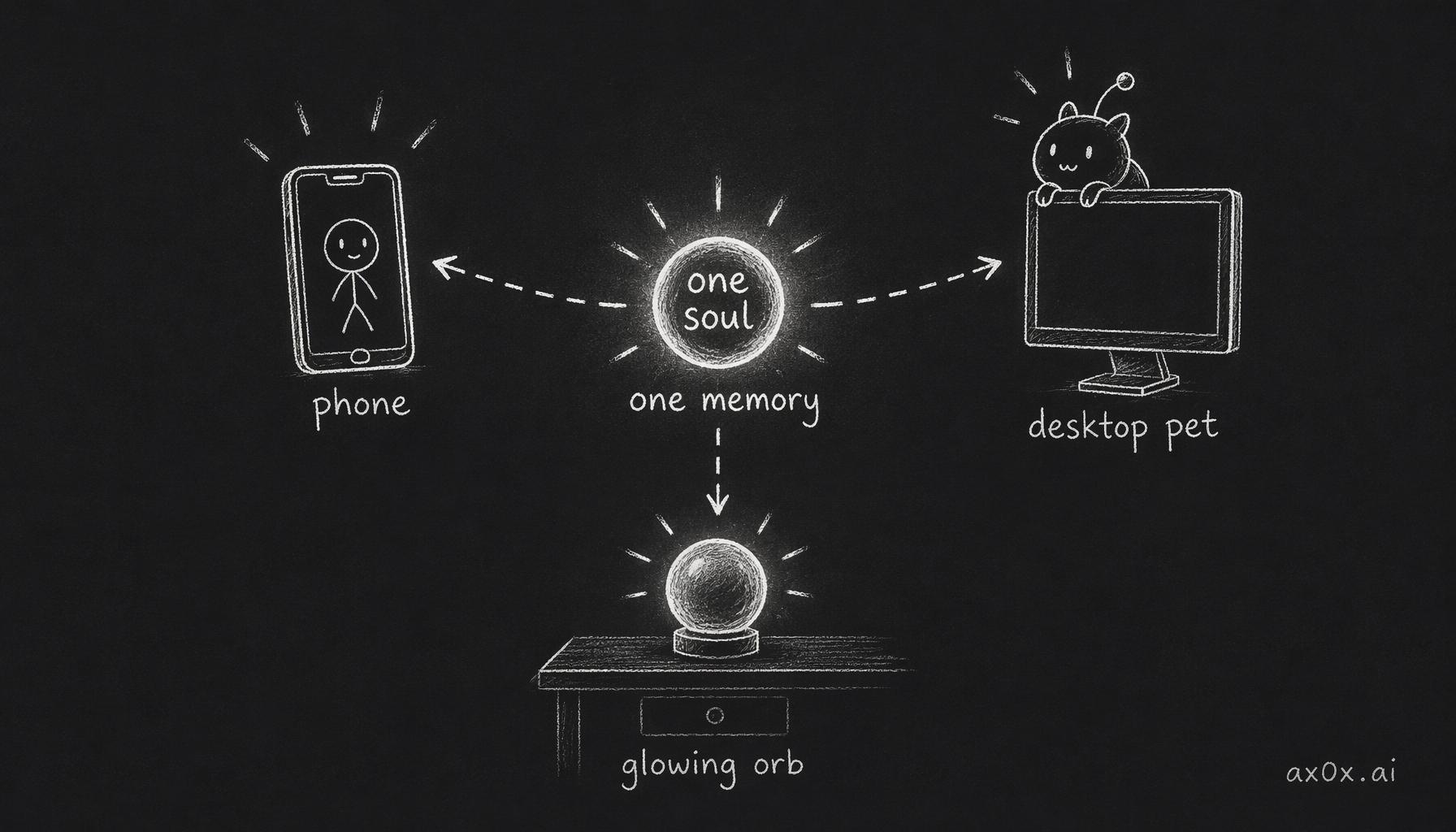 One soul and one memory instantiated across phone, desktop pet, and a physical orb — adding the spatial presence that pure chat lacks
Not giving AI a room in a virtual world. Letting AI into your real world.
Chat Has Hit Its Ceiling
The AI companion category is at an inflection point.
The first generation of products proved something important: humans genuinely form emotional connections with AI. The demand is real. Character.AI's user numbers, Replika's paying subscribers, 乌托's engagement metrics — they all say the same thing.
But the first generation also exposed a hard truth: chat alone can't sustain the connection.
The next generation won't compete on "who chats better." It will compete on "who goes beyond chat."
Time — we're already on the road.
Space — that's the next battle.
The rest of this series will get specific: how Mio moves from chat to shared experiences, and how Lumi moves from an app to multi-carrier presence.
Not theory. Things I'm building right now.