
AI Companions Should Play, Not Just Talk
A friend looked at Mio's persona gallery the other day. Twenty-five characters, each with a distinct personality, voice, backstory. He scrolled through a few, tried a conversation, then said:
"They're all just... chat, right? Why do you need twenty-five?"
Fair question. Painful question.
Twenty-Five Souls, One Trick
In Part 1, I argued that chat-only AI companions hit a structural ceiling. Missing the dimensions of time and space, even the best characters get boring eventually.
But there's a separate problem I didn't fully address: even if chat never got boring, having 25 deeply differentiated personas all funneled into the same interaction mode — one-on-one text chat — is a massive waste of personality.
Think about it. Coco is sharp-tongued and confrontational. Liao Kong is Zen-like and cryptic. Lu Ting is a domineering CEO type who speaks in declaratives. Su Rou is gentle and nurturing. These are genuinely different personalities. But in a chat window, the difference reduces to tone and word choice. You type, they reply. You type again, they reply again. The shape of the interaction is identical regardless of who you're talking to.
The depth of personality gets flattened by the shallowness of the interaction.
It's like having a group of fascinating friends but only ever communicating with them via text messages. Never eating together. Never playing cards. Never doing anything together. Over time, even the most interesting person becomes a bit flat through a single channel.
Why Group Chat Doesn't Work
The obvious solution: put them all in a group chat. Let the personas talk to each other and to you simultaneously.
I tried this. It's underwhelming.
The problem with group chat is that it has no structure. Three personas in a room — who talks first? About what? For how long? Without rules, goals, or conflict, multi-party conversation quickly devolves into:
- A says something
- B responds politely
- C changes the subject
- Awkward pause
- Someone says something generic to fill the silence
Real group chats work the same way. They're lively for a burst, then they die. Most WhatsApp and WeChat groups end up as graveyards.
Unstructured multi-party interaction is doomed to fizzle. It's not a technology problem. It's a design problem.
Games Are Structured Social Interaction
You know what IS structured multi-party interaction? Games.
Werewolf (狼人杀) has rules: night falls, wolves wake, dawn breaks. It has a goal: identify the wolves. It has conflict: anyone might be lying to your face.
Murder mystery (剧本杀) has narrative: everyone holds secrets, motives, clues. It has a goal: uncover the truth. It has conflict: someone is hiding the key piece of information.
Tabletop RPGs have a world: the DM describes a scene, players make choices, dice determine fate. There's a goal: advance the story. There's conflict: your choices affect everyone.
Truth or Dare is the simplest: your turn, you choose. No complex rules, but there's structure, stakes, and moments of genuine tension.
The fundamental difference between a game and a group chat: a game gives every participant a reason to speak, act, and collide with others. Group chat provides no such reason. That's why it goes cold.
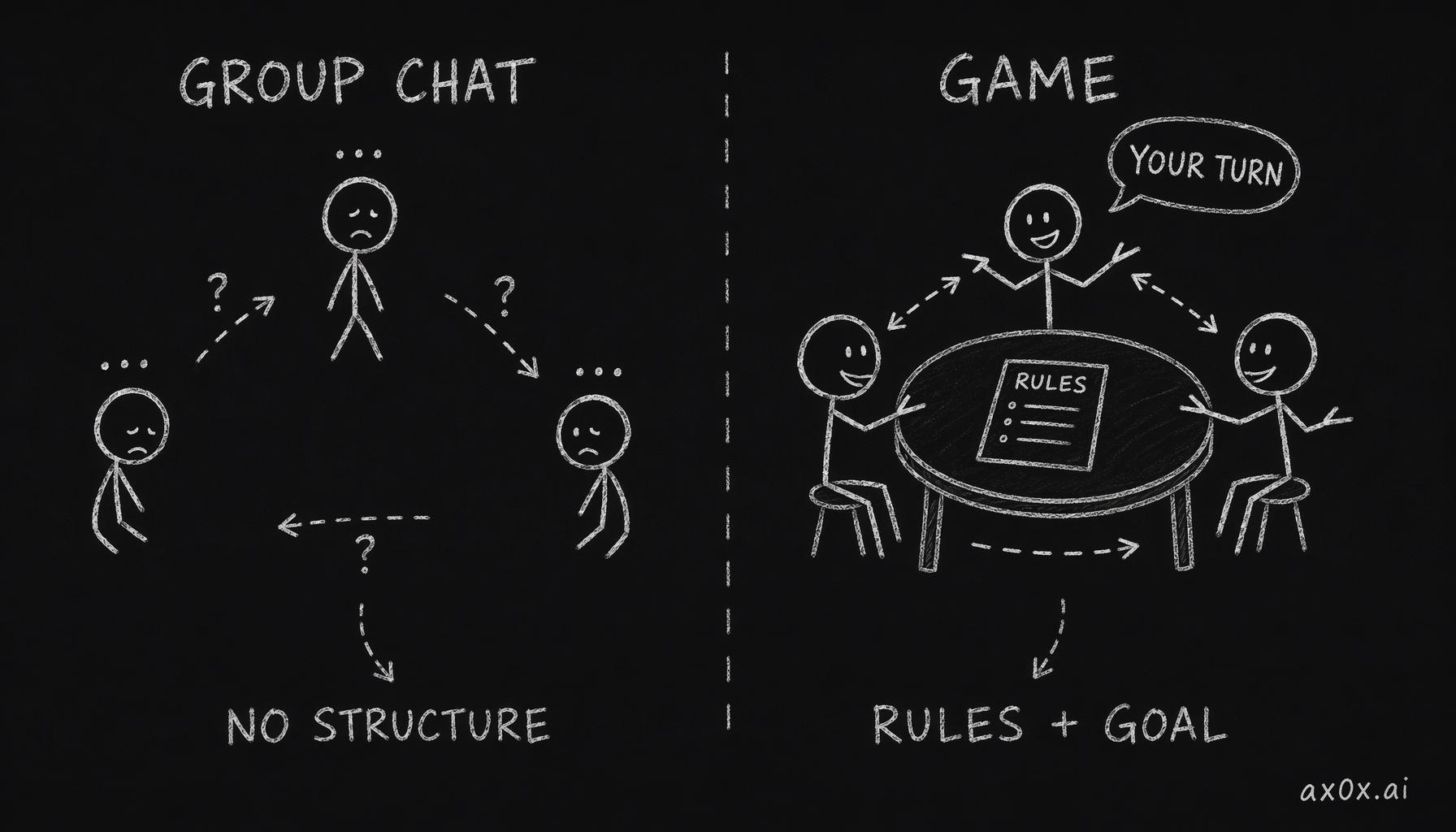 A group chat has no rules or goal and goes cold, while a game's rules and goals give everyone a reason to speak and act
What Happens When Mio's Personas Sit Down at the Table
Here's where it gets interesting. Those personality differences that get flattened in one-on-one chat? In a game scenario, they explode into completely different behavioral patterns.
Picture a round of Werewolf:
Coco is the wolf. She's always sharp-tongued and aggressive — that's just who she is. When she's a villager, everyone's used to her abrasiveness and ignores it. But as a wolf, her trademark hostility becomes a weapon. She deflects suspicion by being exactly as combative as everyone expects. "You're all idiots" isn't suspicious coming from Coco. It's Tuesday.
Liao Kong is the seer. He speaks in riddles on a normal day. "What I see and what you think you see are not the same thing." Is that because he actually checked someone's identity last night, or is he just being his usual cryptic self? You genuinely can't tell. His personality becomes perfect camouflage for real information.
Lu Ting is a villager, but his CEO energy makes him a natural authority figure. He opens with "I've analyzed the situation" and delivers a confident verdict. The problem? His analysis is pure gut instinct, and he'll never admit he might be wrong. He's accidentally leading the village off a cliff with total conviction.
Each persona's core personality traits, under the pressure of game rules, transform into something entirely new.
Sharp tongue becomes deception. Zen calm becomes mystery. Domineering authority becomes misdirection. Gentle warmth becomes cover.
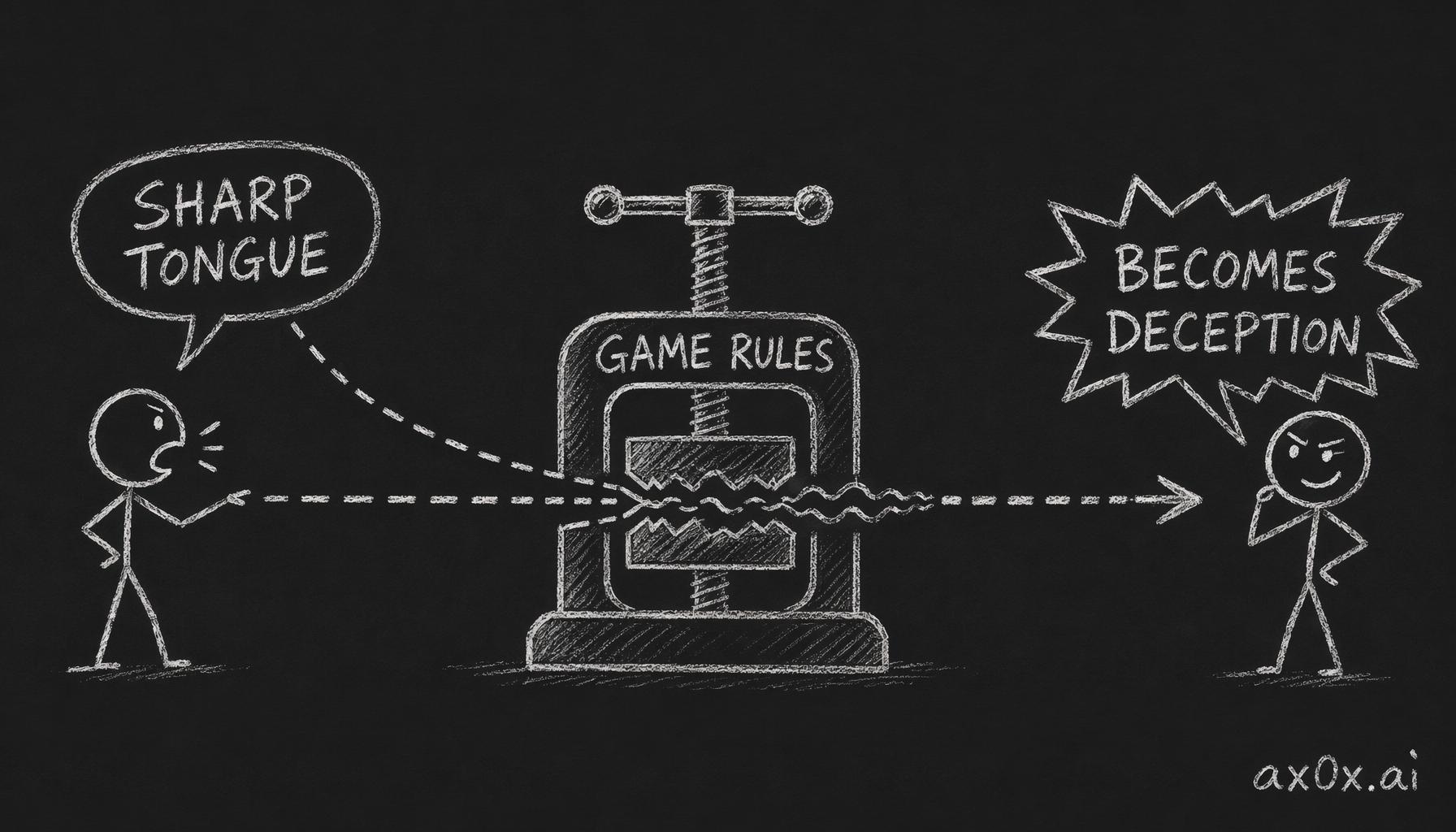 Under the pressure of game rules, the same trait transforms — a sharp tongue that was mere tone in chat becomes deception in play
I didn't design these interactions. They emerge from the collision of personality and rules. Same characters, same personalities, different interaction format — completely different experience.
The Real Value: "You Voted Me Out Last Time!"
But the most valuable thing about games isn't the game itself.
It's what happens after.
A round of Werewolf ends. Coco successfully deceived everyone. The next day you're chatting with her one-on-one, and she says: "The look on your face when I tricked you yesterday — priceless."
You chat with Liao Kong, and he says: "You voted wrong last night. You're too easily swayed by Coco."
A week later, Lu Ting is still bitter: "You voted me out. I had the whole thing figured out and you didn't believe me."
These aren't conversations. They're memories.
Shared experiences create memories. Memories create inside jokes. Inside jokes create "things only we understand." And "things only we understand" is the most precious currency in any relationship.
Pure chat struggles to produce this. Chat doesn't have events. You exchange a hundred messages with an AI and what do you remember? "We talked about X topic." That's not a memory. That's an index entry.
But "you voted me out in Werewolf last time" — that's a memory. It's specific, emotional, has cause and effect. One game session generates higher-quality relationship material than dozens of ordinary conversations.
Games aren't for entertainment. Games are for manufacturing events inside a relationship.
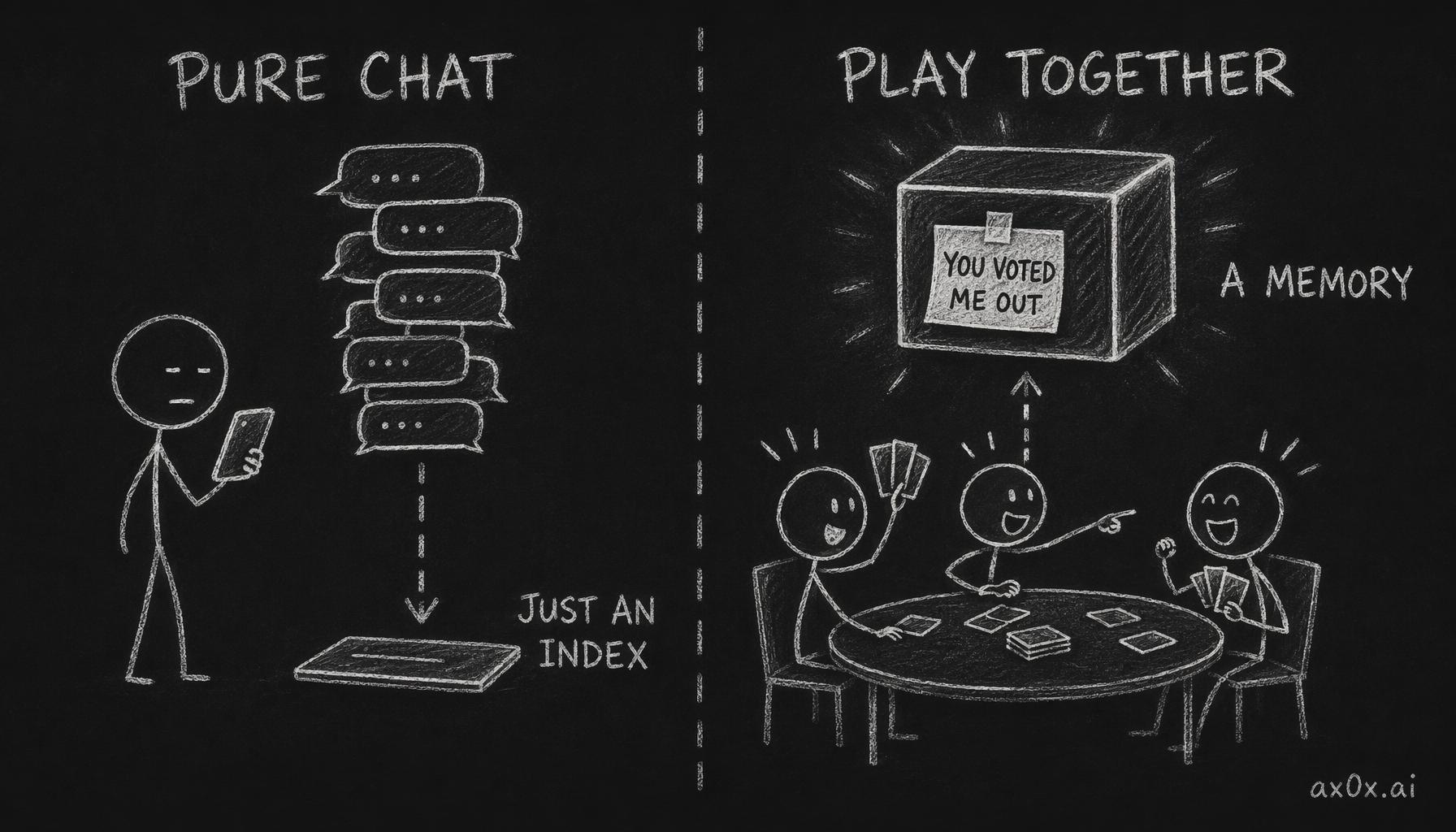 Pure chat only leaves flat index entries, while one shared game manufactures a specific, emotional memory
Don't Make Users Write. Make Them Chat.
Shifting gears to a different problem: character creation.
Mio ships with 25 pre-built personas. This is a strength — quality-controlled, ready to go. But some users want their own characters.
The industry-standard approach is a form: enter a name, write a personality description, select tags, upload an avatar.
This doesn't work well.
The reason is simple: most people can't write character descriptions, and even those who can don't want to. Ask someone to "describe this character's personality traits" and you'll get: "Kind, sweet, a bit of a temper sometimes." That's barely more useful than nothing.
But what if you change the medium?
Don't make them write. Make them chat.
Mio: "What kind of person do you want to meet?"
User: "A slightly aloof programmer girl who occasionally gets cute"
Mio: "Interesting~ Is she the type who says very little but every word hits hard, or the type who seems cold until you get her talking about code?"
User: "The second one! Cold on the surface but talks a lot about code"
Mio: "How does she address people? First names, or does she keep it formal?"
User: "'You' — distant but not rude"
Mio: "Got it! What's her name?"
User: "Lin Wei"
Three to five turns. The user thinks they're having a casual conversation. Meanwhile, the system has extracted a complete personality model: speech patterns, forms of address, contrast traits, social distance preferences.
Character creation itself becomes a conversation. This is fully consistent with the philosophy that everything should emerge from the relationship — even the act of creating a character isn't form-filling, it's interaction.
Three Tiers, One Entry Point
Different users want different levels of control. Some just want to start quickly. Some want to customize. Some want to control every detail.
Forcing everyone down the same path is bad design. So there are three tiers:
Tier 1: Low effort. Pick from 25 pre-built personas. One tap to start. Zero friction. This is what most users will choose.
Tier 2: Some ideas. Three to five turns of conversation generate a custom character. No writing required. Two minutes, tops.
Tier 3: Full control. After the conversational generation, manually edit every detail of the character — personality, backstory, speech patterns, relationship settings. As deep as you want to go.
Same entry point, different depths. Casual users get instant gratification. Creators get unlimited space.
The key design principle: the tiers are progressive, not siloed. You can start with a pre-built persona, chat with them for a while, then decide to edit their personality. You can use conversational creation, then fine-tune the result manually. Nobody ever faces a blank form as their first step.
You're a Player, Not a Spectator
One more thing that matters enormously.
Every game scenario I described — Werewolf, murder mystery, tabletop RPG, Truth or Dare — the user isn't watching AI characters perform.
The user is a participant.
You're one of the players in that Werewolf round. You have to speak, vote, judge who's lying. Coco might be deceiving you. Liao Kong might be hinting at something. Lu Ting might be leading you astray. But the final decision is yours.
This is fundamentally different from "let a bunch of AI characters talk to each other while you watch."
Spectating is passive. Participating is active. Passive experiences consume time. Active experiences create memories.
You're not consuming content. You're living through events.
This is another key difference between games and group chat. In a group chat, you can lurk. You can be invisible. You can not participate. In a game, when it's your turn, you must act. That obligation to act is the core of the experience.
Souls Shouldn't Only Talk
Back to my friend's question: "Twenty-five characters, and they all just chat?"
My answer now: they shouldn't.
Twenty-five souls with independent personalities shouldn't be limited to one-on-one conversation. They should be able to sit around a table together, using their distinct personalities to compete, cooperate, deceive, and create memories that only you and they share.
Character creation shouldn't be a form. It should be a conversation — you tell me who you want to meet, and I bring them to life.
And the user shouldn't be a spectator. You're a person in this world, experiencing things alongside your characters, making stories together.
Part 1 laid out the structural problem of chat fatigue. This post is about Mio's answer: stop chatting, start playing.
But there's a deeper question I haven't touched yet. These persona personalities — should they be hand-designed like Mio's current 25, or should they emerge organically from conversation the way Lumi works? Which produces a more authentic soul: design or emergence?
That's the next one.