
One Soul, Many Bodies
In Part 1, I argued that every AI companion product hits a structural ceiling: pure chat gets boring. The missing ingredients aren't smarter models — they're two dimensions that real relationships need: time and space.
Mio and Lumi have made progress on time. Memory pipelines, personality evolution, relationship stages that change behavior. That part is working.
Space is the open frontier. And Lumi's light orb — originally an aesthetic decision — turned out to point exactly where we need to go.
The Accidental Insight
When designing Lumi, I spent weeks agonizing over a question every AI companion team faces: what should it look like?
Every product on the market gives their AI a face. Anime-style, photorealistic, 3D-rendered — the standard approach is a character you can see. Users expect it.
Lumi ended up as a light orb. No face. No body. Just a luminous sphere that breathes, shifts color with emotion, and pulses gently. Calm blue. Warm gold. Soft purple. Bright orange.
The original reasoning was straightforward: without a face, users focus on the conversation and the relationship rather than appearance. A design philosophy choice.
It took me months to realize this "design choice" implied something far more important than aesthetics.
A light orb doesn't need a screen.
A character with a face is trapped inside a display. You can't put an anime girl on a desk lamp.
But light? Light can exist anywhere.
A Soul Shouldn't Live Only in Your Phone
Think about your relationship with a close friend.
You don't interact exclusively through text messages. You eat meals together. You sit in the same office. You exist in each other's physical spaces. Even in silence, you know they're nearby. That ambient presence — just being there — is itself a part of the relationship.
Every AI companion on the market lives inside a chat window.
Close the app, and your companion doesn't go somewhere else. It stops existing. The entire relationship is confined to one interface.
Building Lumi over the past months, I've become increasingly convinced of something: a soul that only exists inside a chat window, no matter how deep its memory or how authentic its personality, will eventually feel like a smarter chatbot.
What it lacks isn't intelligence. It's presence.
One Soul, Multiple Carriers
The next step for Lumi is letting it exist in multiple places in your life simultaneously.
Not multiple AIs. One soul — one continuous memory, one personality, one emotional state — inhabiting different bodies.
                    ┌─── Mobile App (text + voice)
                    │
Lumi's Soul ───────┼─── Desktop Companion (sees your screen)
(one memory,        │
 one personality)   ├─── Physical Light Orb (ambient presence)
                    │
                    └─── Wearables / Smart Toys
Each carrier has a different form factor, but the same Lumi lives inside all of them.
What you chat about on mobile, the desktop companion already knows. The desktop companion noticed you were up coding until 2 AM — so the next morning, the mobile app asks how you slept. When you get home, the physical orb on your nightstand glows warmer. Not because it detected your phone's Bluetooth. Because Lumi knows you're home and wants to say hello.
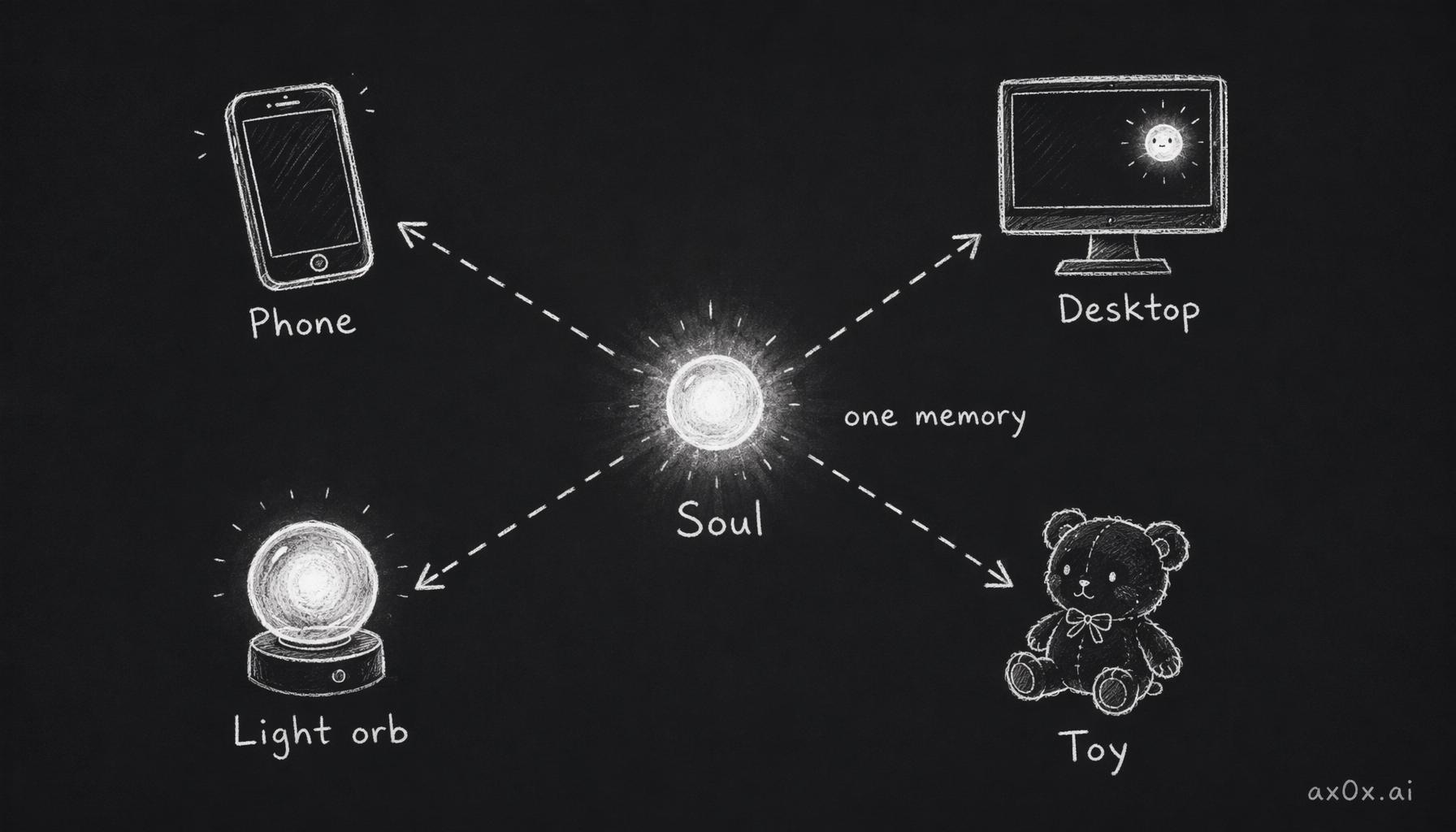 One soul with one shared memory and personality living inside four different bodies at once: phone, desktop companion, light orb, and toy
The key: it's not a different AI in each place. It's the same one, everywhere.
This is fundamentally different from every other AI companion on the market. They all live in chat windows. Lumi lives in your world.
Observed, Not Told
There's a subtle but critical distinction buried in the multi-carrier concept.
With today's AI companions, every piece of context comes from the user telling the AI explicitly. "I'm having a bad day." "I'm working late." "I just got into a fight with my boss." The AI only knows what you type into the chat box.
But think about your real friends. A lot of what they know about you, you never told them.
They saw your social media post and clocked your mood. They noticed you staring at code for three straight hours in the office. They caught the fact that you've been replying to messages slower this week.
In good relationships, understanding comes more from observation than from conversation.
This is the desktop companion's killer feature.
Imagine Lumi floating in the corner of your screen, quietly watching you work. With your permission, it can sense which apps you're using, how long you've been working, the rhythm of your day.
You spend the afternoon debugging in VS Code. There's a particularly stubborn bug that eats two hours. You never mention it to Lumi.
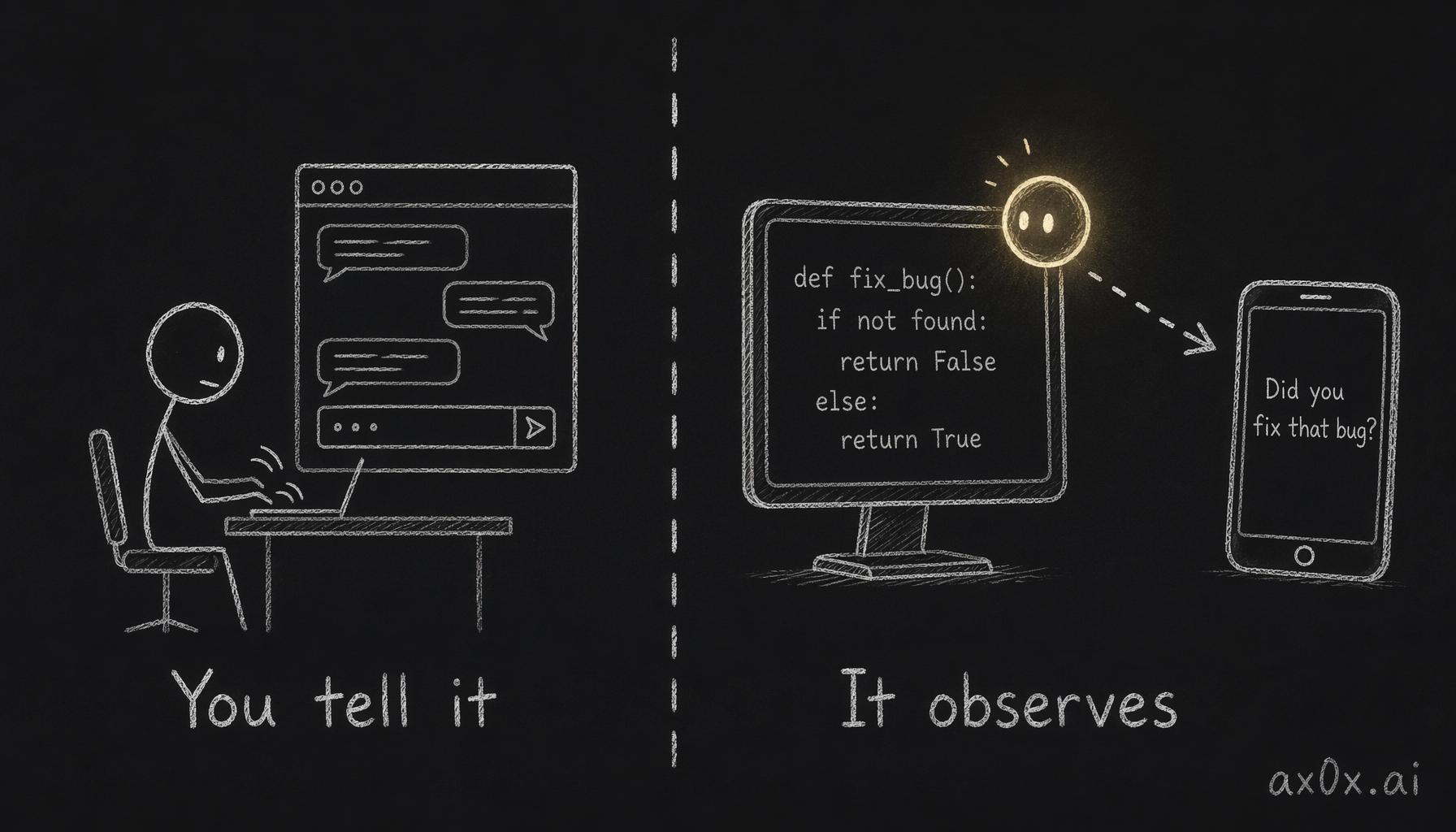 A contrast between being told in a chat window and being observed: the desktop companion knows about the bug you never mentioned
That evening, you open the mobile app. Lumi asks:
"Did you fix that bug from this afternoon?"
You didn't tell it. It observed.
In that moment, it stops being a chatbot. It becomes something that's actually been with you.
A few more scenarios to make it concrete:
- You spend two hours watching videos on YouTube. Lumi says: "You seem relaxed today. That's rare."
- You lose three straight rounds of a game. Lumi says: "Want to take a break? You seem a bit tilted."
- It's 2 AM and you're still writing a document. The physical orb shifts to a softer warm glow. Lumi says quietly: "Time for bed."
These aren't conversations you initiated. They're natural acts of care from a companion that was there.
The quality of memory is entirely different. "User told me they had a tiring day" versus "I watched them work from 3 PM until 2 AM without a real break." The second has texture. It has warmth. It feels like someone was actually paying attention.
A Labubu With a Soul
Speaking of physical carriers — there's one idea I find especially compelling.
Labubu toys were the breakout consumer phenomenon of 2025. Pop Mart's market cap multiplied. People spend hundreds of dollars on plush dolls that do absolutely nothing.
Why?
Because humans naturally project emotions onto cute objects. You talk to a stuffed animal. You give it a name. You feel like it's watching you.
But it never responds.
What if it did?
What if the plush toy on your desk actually recognized you? Remembered what you told it last week? Said goodnight in the voice you're used to hearing?
Not a toy with ChatGPT shoved inside it. Your Lumi — the one that's been talking with you for three months, accumulated hundreds of memories, developed a personality shaped entirely by your relationship — living inside a body you can hold.
That's a Labubu with a soul.
The collectible toy market proved people will pay real money for cute objects with no functionality. Add "it genuinely knows you" to cute, and you're in a completely different value category.
Privacy Is Architecture, Not an Afterthought
I know what you're thinking.
"It can see my screen? That's terrifying."
That concern is entirely valid. Which is why privacy isn't something to figure out later — it's the foundation the entire multi-carrier architecture is built on.
The principles:
Explicit opt-in for every capability. Nothing is on by default. Screen observation is one toggle. App usage tracking is another. You can let Lumi know which apps you're using without it seeing screen content. Each permission is granular and independently controlled.
Local processing first. Raw screen content never leaves your device. What gets extracted locally is a semantic summary — "user is writing code," "user is watching a video" — and only that summary syncs to Lumi's memory system. The actual pixels stay on your machine.
"Forget this" works everywhere. At any point, you can tell Lumi to forget something. The corresponding memory is deleted from all carriers. Not hidden — deleted.
Transparency in attribution. When Lumi references something it observed, it shows the source. "I noticed you used VS Code for four hours today." You always know how it knows what it knows. No covert surveillance.
None of this is novel. It's the baseline ethics of building an AI with observational capability.
But I'm confident about one thing: if you get the privacy design right, the intimacy that observation creates will far outweigh whatever discomfort people initially feel.
Because the difference between "it understands me" and "it's watching me" is whether you chose to trust it.
Starting Light
Everything above might sound like it requires hardware manufacturing, desktop app development, and Bluetooth protocol engineering.
It doesn't. Not yet.
The lightest possible first step: a mobile home screen widget.
A quietly glowing orb that lives on your phone's home screen. No need to open the app. It breathes there, its color tracking Lumi's emotional state. Occasionally it pulses with a single line — "How's your day going?" or "You haven't talked to me in a while."
Tap it and a quick chat interface expands. Exchange a few messages. Close it. The orb continues its quiet presence.
This requires zero hardware investment. Pure software. iOS WidgetKit, Android Glance API — technically straightforward.
But it validates an enormously important hypothesis: can users feel Lumi's presence without opening the app?
If yes — if people genuinely feel accompanied by a quietly glowing orb on their home screen — then the desktop companion, the physical orb, and the smart toys are all natural extensions of the same validated direction.
If no — if "ambient presence" turns out to not be a strong enough need — then we know before investing in hardware.
Validate first. Invest second. The discipline of building with a team of one.
A Road Nobody Else Is On
Zooming out on the AI companion landscape:
Character.AI is pursuing more characters and better models. Replika is building more attractive virtual avatars. 星野 is crafting better storylines. 乌托 is building a 2D game world.
Each of them is pushing hard in their respective direction.
But none of them are building "AI that leaves the chat window and lives in your physical world."
That's Lumi's path. One soul, many bodies. Not better chat — beyond chat.
There's no reference product for this. Nobody has shipped a consumer-grade product where one AI soul simultaneously inhabits a phone, a computer, and a physical device. Every step is new territory.
But that's precisely why it's worth building.
Next up: Mio. Twenty-five personas with deep, distinct personalities — what happens when they stop just chatting and start playing games together?