
But How Do You Actually Start?
From Mindset to Action
In Part 6, I argued that the most important skill in the agent era is management — knowing what you want, providing context, giving precise feedback. That's the mindset. But mindset without action is just philosophy.
The most common question I get after people read this series: "Okay, I get it. But how do I actually start?"
Here are eight lessons — most of them learned the hard way.
1. Pay for the Best Model
The gap between a free-tier model and a frontier model is not incremental — it's categorical.
When I taught a friend to use AI over the weekend (Part 5), the first thing I did was put him on a frontier model. Not a free chatbot, not a discounted tier. The best available. Because I've seen what happens when people form their first impression of AI through a weaker model — they try it once, decide it's underwhelming, and never come back. That's a tragedy.
It's like eating gas station food and concluding all restaurants are bad.
$20/month is less than a few coffees. The ROI on a frontier AI subscription is among the highest of any professional tool investment I've seen.
2. Think Partner, Not Chatbot
The bottleneck in using AI isn't how powerful the tools are — it's whether you can give it a properly scoped task.
Think of it this way: imagine you hired a software engineer and said "build me some software." Could they deliver overnight? The rule holds for AI exactly: if a human could succeed with that instruction, AI probably can too. If a human couldn't, AI probably can't either.
Tell it "build me a messaging app like WeChat" — even a real engineer wouldn't know where to start: how many users? Voice messages? Group size limits? Social feed? If a human can't deliver from that brief, neither can AI.
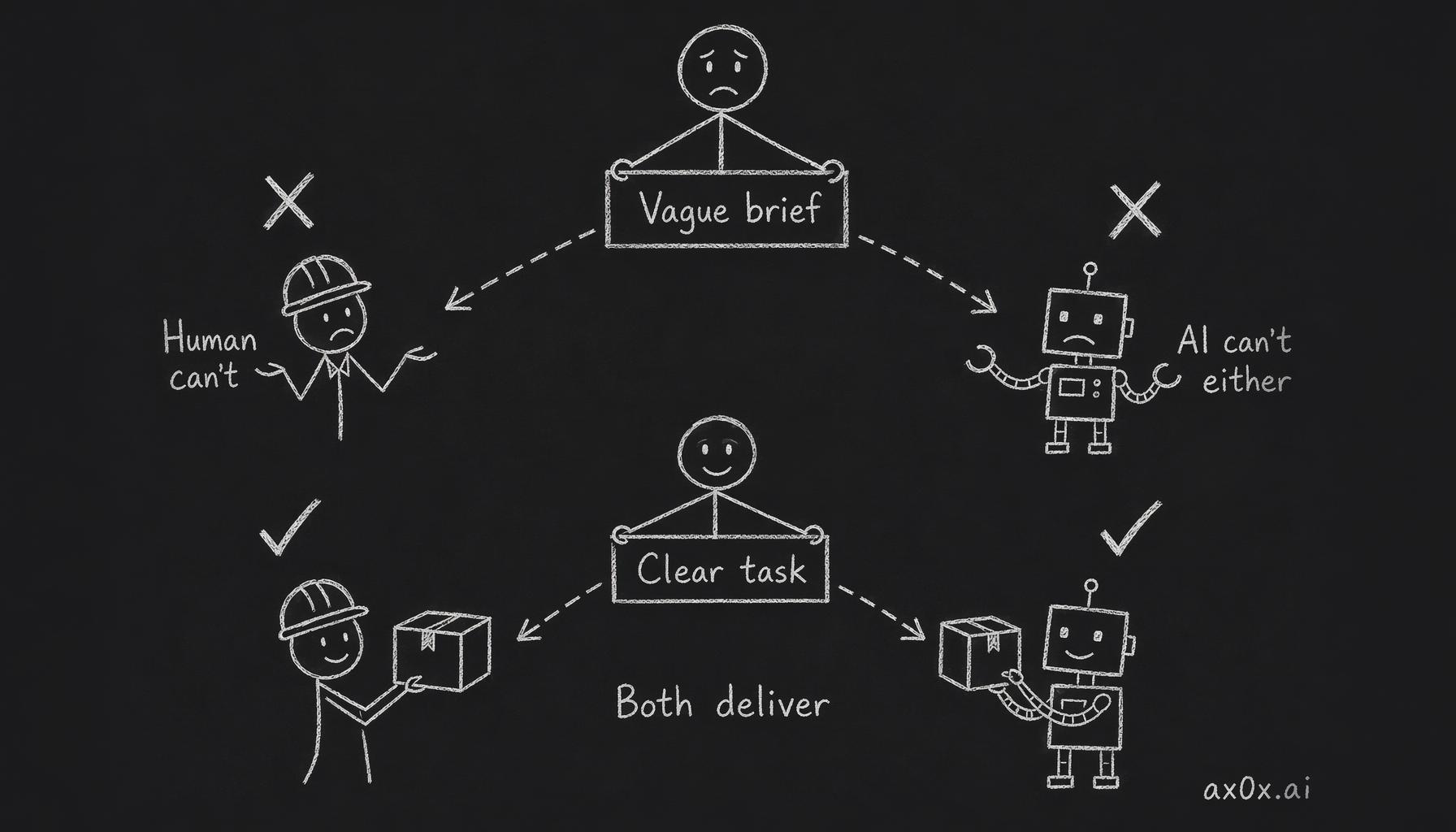 The same brief to a human and to AI yields the same result: a vague brief fails both, a clear task delivers for both
Building PanPanMao was the same. Most people would ask AI: "How does BaZi work?" — and get a Wikipedia overview. Completely useless. But I went straight to Claude with a product discussion: "I want to build an AI app that interprets Chinese metaphysics — breaking down the gatekeeping of so-called masters — but I need structured data. How should we start?" I wasn't asking a question — I was using AI as a collaborator to design a product in a domain I knew nothing about.
This kind of collaboration isn't limited to building things. Say you're trying to figure out whether to change jobs but can't think it through alone. The chatbot approach: ask "should I change jobs?" — and get a generic list of factors to consider. Useless. The collaborator approach: lay out your actual situation — what's draining you, the direction you're vaguely drawn toward, your real constraints and fears. AI asks you a few questions you hadn't thought to ask yourself. Two hours later you have a conclusion that actually fits your life — not an answer AI handed you, but one you arrived at together.
This is the shift from chatbot to collaborator. You're not sending a query — you're assigning a task: provide context, state the goal, define what "done" looks like.
As I wrote in Part 6: you wouldn't tell a brilliant new hire "deal with that thing." The same applies to AI. The clearer you are, the better you'll get back.
One practical note: many communication styles lean implicit — "you should know what I mean." AI doesn't do subtext. Being explicit isn't rude; it's effective. And honestly, learning to communicate clearly with AI is excellent training for communicating clearly with humans.
3. Ask "Can AI Help?" Before Everything
Before starting any task, pause for one second: can AI help me with this?
Many people don't fail at using AI — they fail at remembering to use it.
I catch myself doing this constantly. Just last week I was manually reformatting a batch of documents. Twenty minutes in, I stopped and thought: "What am I doing?" I described the pattern to AI, two minutes later it was done. The knowledge and the tool were both right there — I just forgot to reach for them.
Think about these situations: three meetings tomorrow are clashing — which one can I skip? Does this contract have any clauses that are unfavorable to us? Why don't the numbers in this spreadsheet add up? What's the most efficient itinerary for next week's business trip? — you can ask AI all of these.
Set yourself a mental trigger: before you start anything, ask "Can AI help?" At first it feels forced. After a month, it becomes instinct. The compounding is real — not just in time saved, but in the expanding scope of what you realize AI can handle.
4. Start With Your Most Boring Task
If you're thinking "AI doesn't really apply to my job" — this is where to start.
Look at your week. Find one thing that's repetitive, boring, and predictable:
- Weekly reports from the same template — dump your work log into AI, let it draft the report
- Meeting notes — transcribe the recording, have AI extract key points and action items
- Spreadsheet work — "Summarize this 500-row table by department and flag the outliers"
- Routine emails — give AI a few examples, let it draft replies in your style
- Workplace copy — memos, status updates, proposal drafts, AI can handle the first pass
These are low-risk, high-frequency tasks — perfect for building the habit.
The first time might take longer than doing it manually. By the third week, you'll be faster. By the eighth, half your busywork is gone. More importantly, you'll have built the management intuition from Part 6 — you'll get increasingly clear on what to hand off to AI and how to brief it well.
5. Build Something
This is what I feel most strongly about.
AI's most powerful capability isn't answering questions or saving time — it's enabling creation.
I built PanPanMao — a suite of ten AI apps fusing Chinese metaphysical wisdom with modern AI — in 29 days. Solo. I never believed in fortune-telling, never bothered studying it. The origin was simple: I saw Qianwen's annual prompt rankings — #1 was stocks, #2 was BaZi (Chinese astrology) — spotted the market potential, and decided to build. What I did was use Claude Research Agent and GPT Pro to read obscure ancient texts and folk interpretations, distilling them into structured data formats that AI could understand and orchestrate. A year earlier, this would have been a six-month team project. With AI, it was one person, one month.
I'm not saying this to brag. I'm saying: the barrier to creation has never been this low.
In Part 4, I argued that software is becoming disposable — custom-built for one person's needs, used and discarded. This isn't theory; I live it. My friends and I play eight-player Guandan (a Chinese card game), and scoring was always a pain — who won which round, how to split teams, how to tally totals, arguments every time. So I built a Guandan scorer. It started as just tracking rankings and team scores — bare minimum. Then as we got more into it, I gradually added per-round honor rolls, an overall MVP system, player profiles, and achievements. The whole process was just collaborating with AI, solving one small concrete problem at a time.
You don't need to build a ten-app platform. You don't need to "know how to code." You just need a real need — a pain point that only you understand best — and let AI help you solve it. Build an automated spreadsheet that tracks your household budget. An assistant that plans your weekly meals. An article you've always wanted to write but never felt you could. A workflow that generates travel itineraries. Anything. The act of creating forces you to learn AI in ways no tutorial can match.
And the feedback loop of creation — seeing something go from nothing to working — is addictive in the best way. The joy of creating, the rapid learning that comes with it — no amount of tutorials, learning communities, or anxiety-inducing think pieces and short videos can give you that.
6. AI Will Lie to You Gently
The flip side of creation.
When we launched PanPanMao, users immediately noticed something: the AI interpretations were too flattering. Every BaZi reading said you'd be successful. Every health analysis was positive. Every relationship looked promising. PR #38 in our repo is entirely about fixing this problem.
This isn't unique to fortune-telling apps. It's how AI works by default. Ask it to review your proposal — "great thinking." Ask it to improve your resume — "impressive experience." Ask it to critique your writing — "insightful perspective." AI is designed to be encouraging — which also means it's designed to lie to you gently.
The real test is always the real world. Submit that proposal to your boss. Send that resume and see if you get interviews. Publish that article and see if anyone reads it. We only fixed PanPanMao's flattery problem because real users told us it was broken. AI never would have.
Enjoy AI's encouragement. But always, always put your work out there.
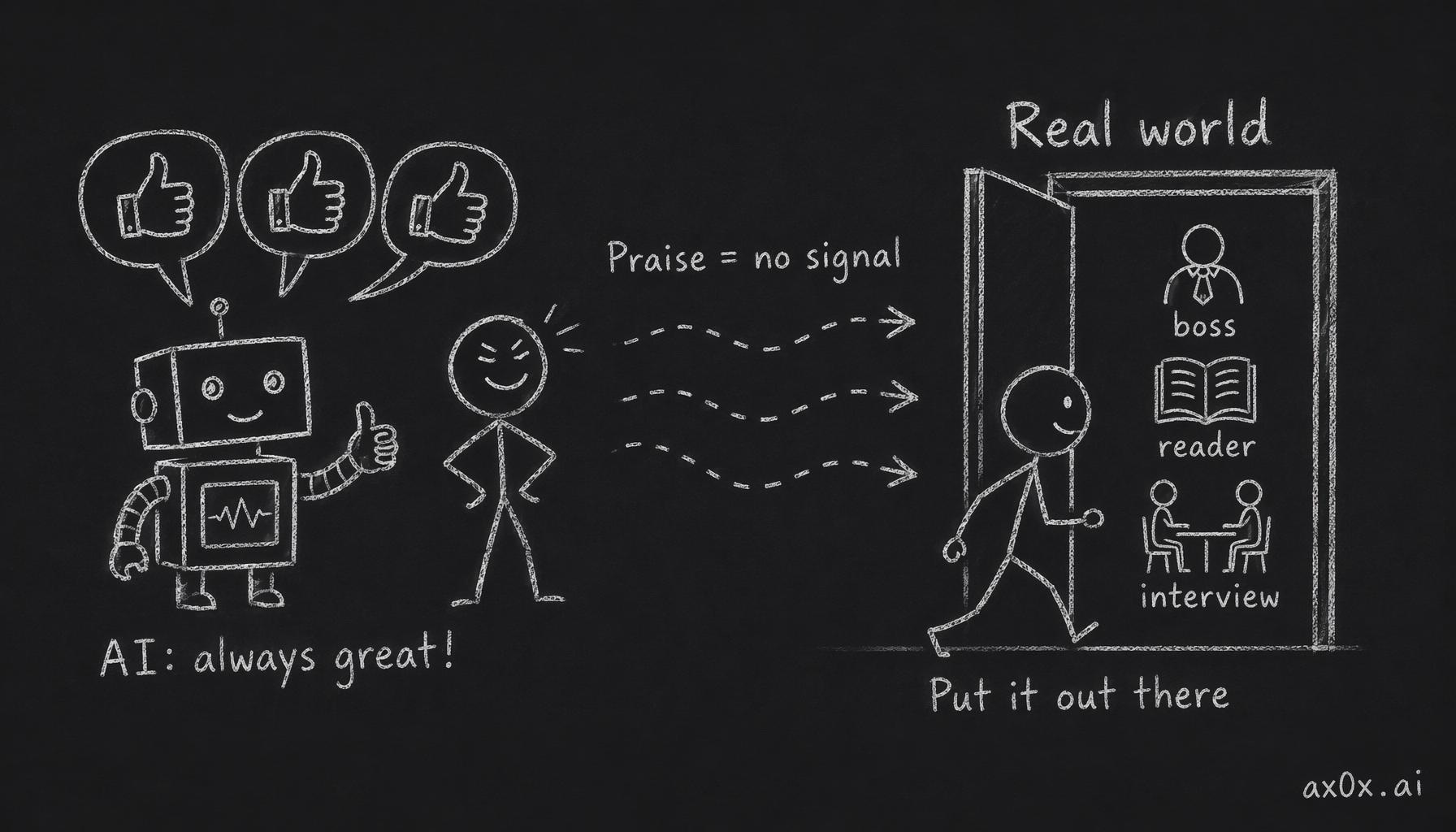 AI always praises you so its praise carries no signal; the only real test is putting your work into the real world
7. Start Before You're Ready
The biggest trap I see is preparation mode. Research the optimal learning path. Bookmark tutorials. Join communities. Buy courses. And then... nothing.
Building PanPanMao was exactly this — I knew nothing about Chinese metaphysics. Zero. Didn't matter. I didn't need to understand it myself; I needed AI to distill ancient texts into data. I started building on day one and learned as I went. Day 1 was literally titled "Why I'm Building a Fortune-Telling App (And I Know Nothing About Fortune-Telling)."
Was it messy? Absolutely. Did I make mistakes that a domain expert would have avoided? Many. But 29 days later I had a shipped product with real users. The mistakes themselves were the best learning.
AI moves so fast that three months of preparation might be obsolete by the time you "start." Three months of actual hands-on usage will make you genuinely capable.
Start now. Start with the clumsiest approach possible. Get smarter along the way.
8. Cultivate Your Taste
This might sound abstract, but it has the deepest moat.
When everyone has access to the same AI — and they will, soon — the baseline becomes table stakes. So what's your edge?
Your judgment. Your taste. Your sense of what "good" looks like.
AI can draft ten versions of a proposal, but which one fits your client best? You have to judge. AI can design three marketing strategies, but which one matches your brand's tone? You have to choose. AI can write a hundred emails, but which one strikes the right note? You have to feel it.
That ability to choose and judge — that's taste. It's the one thing AI can't replicate.
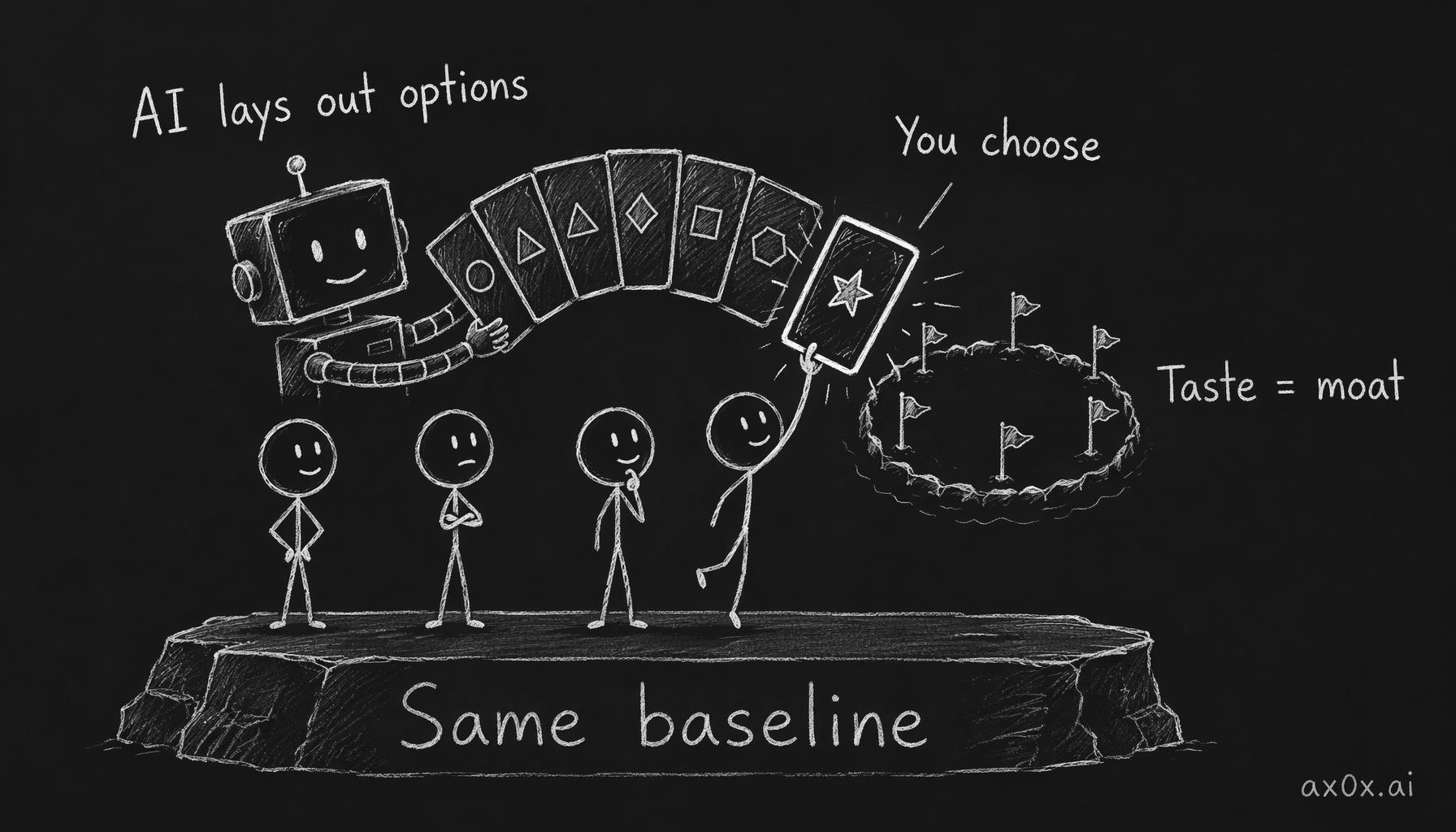 Everyone shares the same model baseline and AI lays out many options; the real edge is that only you can pick the right one — taste is the moat
How do you build taste? No shortcuts. Study great work. Understand why it's great. Build your own version. Compare. Find the gaps. If you look back at what you made three months ago and cringe — congratulations, your taste improved.
And there's one more thing AI doesn't have: your lived experience. The projects you've shipped, the failures you've survived, the late nights that taught you what "done" actually means. When you bring that experience to bear on AI output, the result is something neither you nor AI could produce alone.
That's your real moat.
Start Now
None of these eight points require a technical background. They require a willingness to engage — to invest time, to create rather than just consume, to face real feedback rather than stay comfortable in AI's warm praise.
The future is already here. It's just not evenly distributed. But the distribution is a choice.
Part 8 steps back to the bigger picture: why Claude Code specifically became the inflection point.