
Wearables Are the Nervous System of AI Companions
The Problem With Chat-Only Companions
Every AI companion today has the same fundamental limitation: it only knows what you type.
You have to tell it you're stressed. You have to tell it you didn't sleep well. You have to tell it you've been sitting at your desk for 12 hours straight. You have to narrate your own life for the AI to understand your context.
That's not a companion. That's a journal with autocomplete.
A real companion — a human one — doesn't need you to explain that you're exhausted. They see the dark circles. They notice the short temper. They feel the tension in your voice. They know because they sense it.
AI companions need a sensory system. And wearables are exactly that.
Accessories, Not Gadgets
Here's the key insight: nobody wants to wear a medical device on their wrist. But everyone already wears jewelry.
Bracelets. Pendants. Earrings. Rings.
What if these everyday accessories were also the AI companion's nervous system? Not chunky tech gadgets — actual fashion pieces that happen to capture biometric data.
-
A ring that tracks heart rate variability, skin temperature, and sleep quality
-
A pendant that picks up ambient audio cues (not recording — just detecting stress patterns in your voice)
-
A bracelet that monitors activity, location patterns, and UV exposure
-
Earrings with subtle bone-conduction feedback — your companion can whisper to you
None of this requires breakthrough technology. The sensors already exist. What's missing is connecting them to an AI that actually knows what to do with the data.
From Reactive to Proactive
This is where the game changes completely.
Chat-only companion:
You: "I feel terrible today."
AI: "I'm sorry to hear that. What's bothering you?"
Wearable-connected companion:
AI: "Hey — your sleep was fragmented last night, your HRV has been dropping all week, and you haven't left the apartment in 3 days. I know you have that deadline, but you're running yourself into the ground. Take a walk. I'll still be here when you get back."
See the difference? The first is reactive — it waits for you to describe your problem. The second is proactive — it sees the problem forming before you even articulate it.
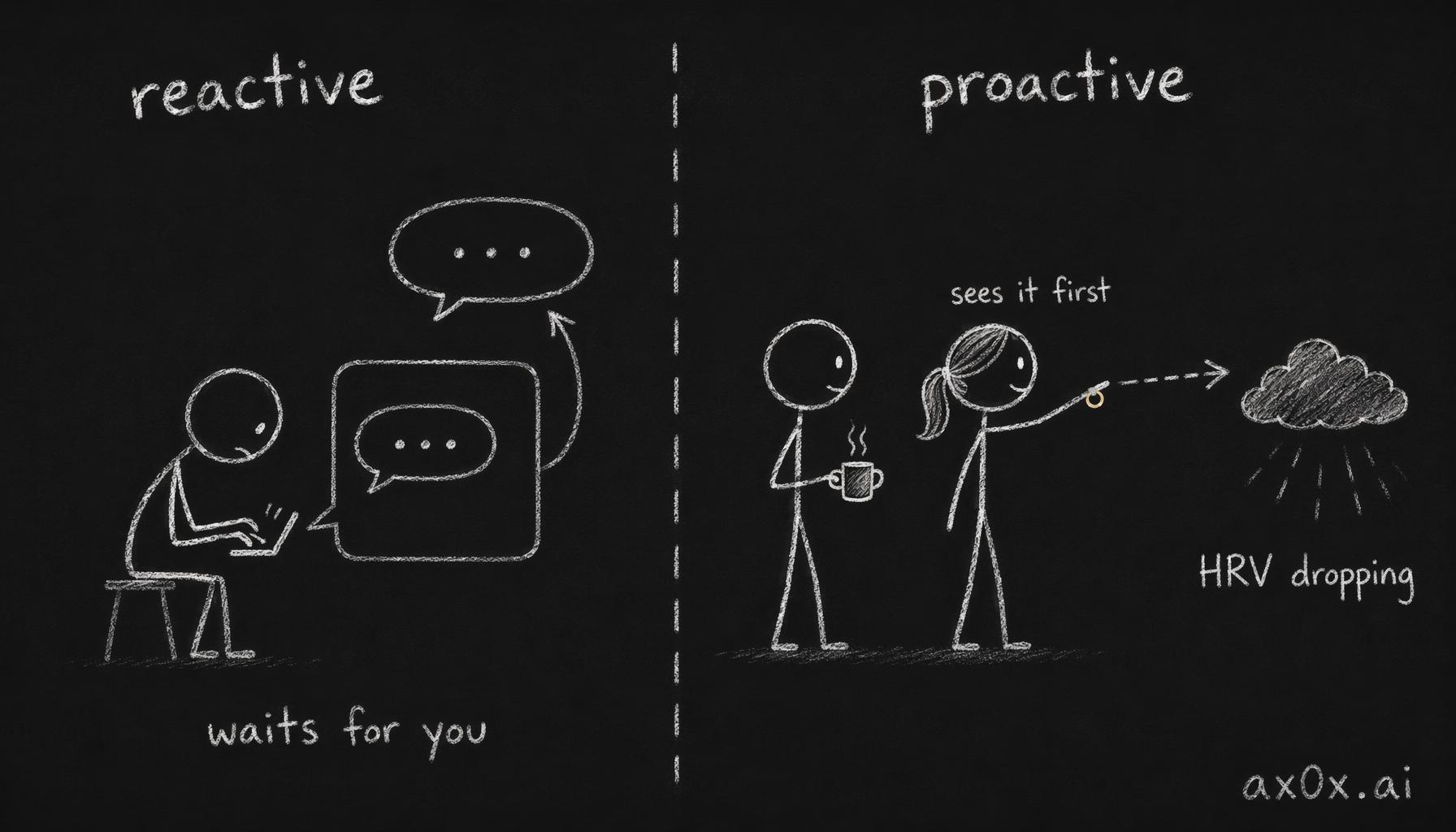 Contrasts a chat-only companion that waits for you to type against a wearable-connected one that senses the problem forming before you articulate it
This is what real care looks like. Parents do this for children. Partners do this for each other. But it's exhausting to do consistently. Humans run out of bandwidth. AI doesn't.
The Data That Actually Matters
Most health wearables drown you in data. Steps counted. Calories burned. VO2 max estimates. Numbers you check once and forget.
An AI companion doesn't need to show you a dashboard. It needs to understand your patterns and detect when something is off.
Sleep architecture — not just "you slept 6 hours" but the pattern over weeks. Are you trending toward burnout? Is something disrupting your deep sleep cycles?
Heart rate variability — the most reliable biomarker for stress that most people have never heard of. Your companion should know your baseline and flag when you're running hot.
Location and movement — not surveillance, but context. Are you isolating? Have you stopped going to the gym? Did you visit the office less this week? These patterns tell a story about your mental state that you'd never think to type into a chat.
Environmental context — time of day, weather, season. Seasonal depression is real. Your companion should know it's February in Seattle and proactively check in.
The magic isn't in any single data point. It's in the correlation — combining biometric signals with conversational history and memory to build a truly holistic model of who you are and how you're doing.
Agents Need to Live in Your Physical World
Here's the deeper insight that most people building AI companions completely miss: we are physical beings living in physical spaces, and any agent that ignores that is fundamentally incomplete.
Think about what a close friend knows about you beyond your words and your body language. They know your apartment is a mess because you've been too depressed to clean. They know you keep buying energy drinks because you're overextending yourself. They know you moved the photo of your ex off your desk. They know the plant on your windowsill is dying because you forgot about it — and that forgetting things you used to care about is a sign.
An AI companion that only exists in chat knows none of this. An AI companion connected to wearables knows your heart rate and sleep. But an AI companion that can perceive your physical space — that's something qualitatively different.
Spatial awareness — a camera or sensor that occasionally scans your environment. This is where privacy gets real. The key constraint: the user must explicitly opt in and control when snapshots happen — a manual trigger, not passive collection. The raw image never leaves the device; on-device vision models extract semantic signals ("cluttered desk," "takeout containers," "dark room") and only those labels reach the companion. No photos stored, no images transmitted. This is the same privacy architecture as the biometric edge processing — raw data stays local, only meaning goes to the cloud.
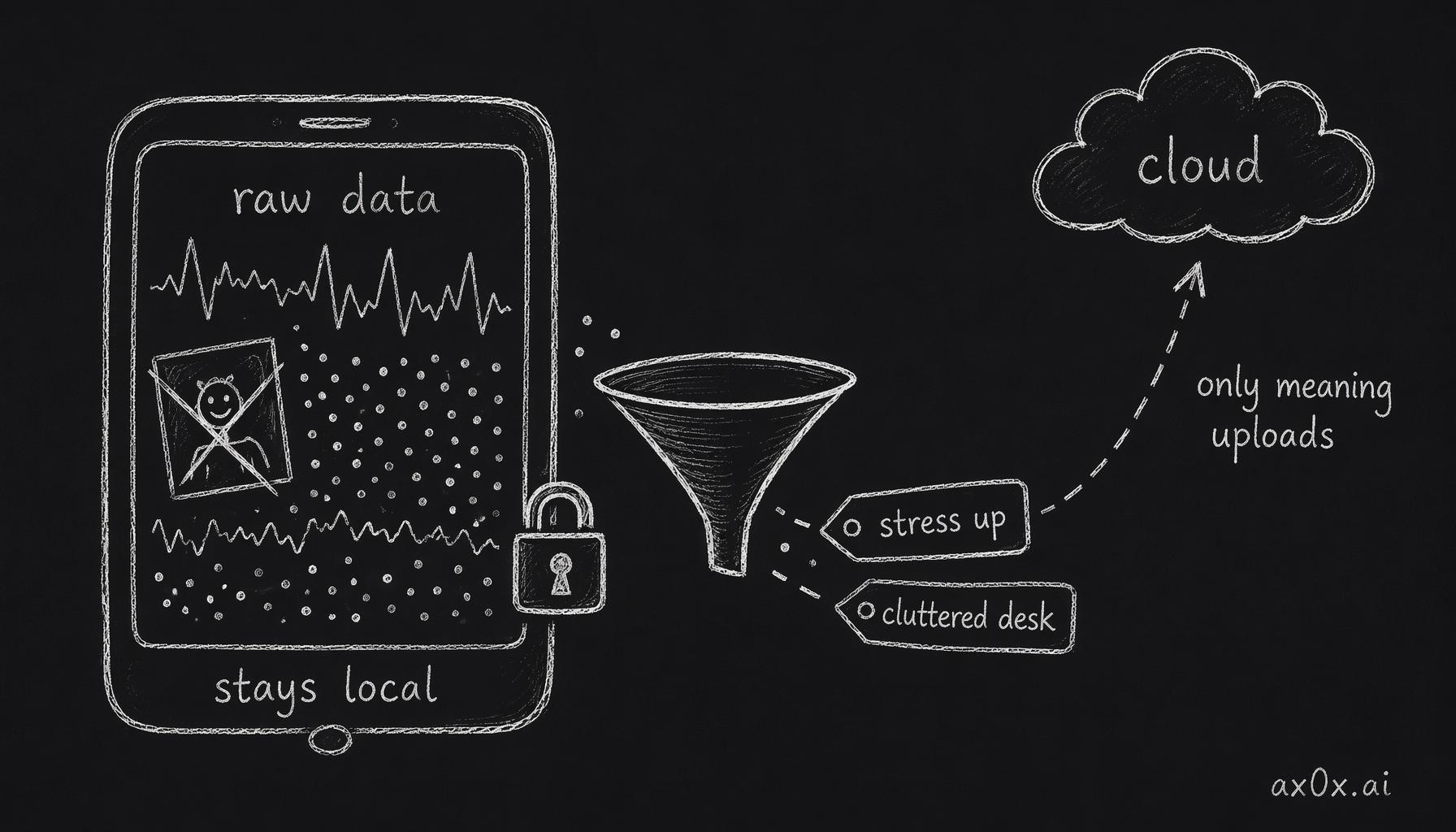 The edge-processing privacy mechanism: raw biometric and image data stays on the local device, and only extracted semantic labels are uploaded to the cloud
Is your space getting cluttered? Are there takeout containers piling up? Did you set up that home gym equipment or is it still in the box? These are signals of your mental state that no biometric can capture.
Object context — what's on your desk, what you're eating, what you're wearing. If your companion notices you've been ordering delivery every night for two weeks, that's a data point. If it sees you dressed up on a Tuesday, that's a different kind of signal.
Social environment — are you alone all the time? Are there other voices in the room? Are you in a cafe or locked in your bedroom? The physical context of where and how you spend your time tells a story your words never will.
This is the gap between a chatbot and a presence. A chatbot knows what you type. A presence knows how you live. And knowing how someone lives is the prerequisite for truly understanding them.
The wearable sensors are the nervous system. But the spatial awareness — that's the companion's eyes. Both are needed for the full picture.
Why This Can't Be Built By Big Tech
Apple has the Watch. Google has Fitbit. Samsung has Galaxy Ring. They all have the sensors. None of them will build this.
Regulatory fear. Big tech already collects biometric data — Apple Watch tracks your heart rate, Samsung Galaxy Ring monitors your sleep. That's not the problem. The regulatory gray zone starts when you combine that data with an AI that interprets your emotional state and gives mental health guidance. That's where it crosses from "health tracking" into "unregulated therapy," and no public company's legal team will sign off on that.
Liability avoidance. If an AI companion notices signs of depression through wearable data and says the wrong thing, the lawsuit risk is enormous for a public company. An independent builder can move faster and take smarter risks.
Incentive misalignment. Apple wants to sell you a Watch. Google wants your data for ads. Neither is optimized for building something that genuinely makes you feel understood.
This is an independent builder's opportunity. Build the integration layer that connects commodity wearable sensors to an AI companion with real memory and real personality.
The Fashion Problem Is the Distribution Problem
Here's what most tech people miss: wearables fail when they look like technology.
Google Glass failed because it made you look like a cyborg. Early smartwatches failed because they looked like miniature phones strapped to your wrist. The successful ones — Apple Watch, Oura Ring — succeeded partly because they could pass as normal accessories.
For the Chinese market especially, this matters enormously. Jewelry culture is deeply embedded. Jade bracelets, gold pendants, red string accessories — these have cultural meaning. If you can embed sensors into accessories that feel culturally native, adoption is organic.
The companion doesn't need to advertise itself. A beautiful ring that also happens to be your AI's sensory input — that's a product people want to wear every day.
The Intimacy Advantage
There's something else wearables unlock that nobody talks about: physical presence.
A chat window is disembodied. It lives behind glass. But a ring on your finger, a pendant against your chest — that's something you feel throughout the day. It transforms the companion from something you visit to something that's with you.
Subtle haptic feedback changes everything. A gentle pulse on your wrist when your companion wants to check in. A warming sensation from your ring when it detects you need comfort. These micro-interactions create a sense of presence that text can never achieve.
You're not opening an app. You're not typing a message. You're just living your life, and something that understands you is there, silently watching, occasionally nudging. Like a good friend who sits with you in comfortable silence.
The Architecture
What this looks like technically:
Sensor layer — commodity BLE chips (Nordic nRF52 series) embedded in custom-designed jewelry. PPG optical sensors in the ring continuously capture heart rate and blood oxygen. Accelerometers in the bracelet track movement and sleep posture. A microphone array in the pendant detects vocal stress patterns. All low-power, running a week or more on coin cells. The key insight: sensors are mature supply-chain commodities. The real moat is in form factor design and wearability — that's a jewelry problem, not a tech problem.
Edge processing — the phone connects to all sensors via BLE and acts as the data hub. Raw sensor streams (hundreds of PPG samples per second, tri-axis accelerometer data) are processed entirely on-device, extracting meaningful features: 5-minute average HRV, sleep stage classification, activity type recognition, vocal stress scores. Only these compressed features (a few KB/hour, not MB/hour of raw streams) get uploaded to the cloud. This approach protects privacy — raw biometric data never leaves the phone — and drastically cuts bandwidth and storage costs.
Companion brain — a large language model running in the cloud, but not a simple chatbot. It has three input channels: the user's text/voice conversation, real-time biometric summaries, and historical context retrieved from long-term memory. Before generating each response, the system injects current biometric state ("HRV 15% below baseline, three consecutive nights of sub-6-hour sleep") into the system prompt, so the model naturally factors in physical wellbeing — rather than mechanically reporting numbers.
Memory orchestration — the hardest technical challenge in the entire system. Every conversation and every biometric signal is timestamped and stored in a vector database. When the user says "work has been stressful lately," the system doesn't just retrieve related conversations — it pulls biometric curves from the same time window. If it discovers "the week the user mentioned the project deadline, HRV declined 20% and deep sleep dropped by 40 minutes," that correlation is explicitly recorded as a "stress-work" association entry. Next time a similar biometric pattern appears, the companion can judge before the user says anything: you might be dealing with work pressure again. This isn't simple pattern matching — it's cross-modal causal reasoning with memory.
Proactive engine — determines when the companion should initiate contact, what to say, and what tone to use. It runs a scoring system: each anomalous biometric signal (HRV crash, fragmented sleep, prolonged sedentary behavior) generates a "care trigger score." When the score crosses a threshold, the engine factors in current time (don't disturb at 3 AM), recent conversational mood (if the user just expressed irritation, use a gentler tone), and historical preferences (does the user prefer direct advice or just being heard?) to compose a proactive message. Not a cold push notification like "your HRV is below normal" — but something a friend who knows you would say: "Hey — I've noticed you've been kind of tense the last few days. Want to talk about it? Or even just take a walk, might help."
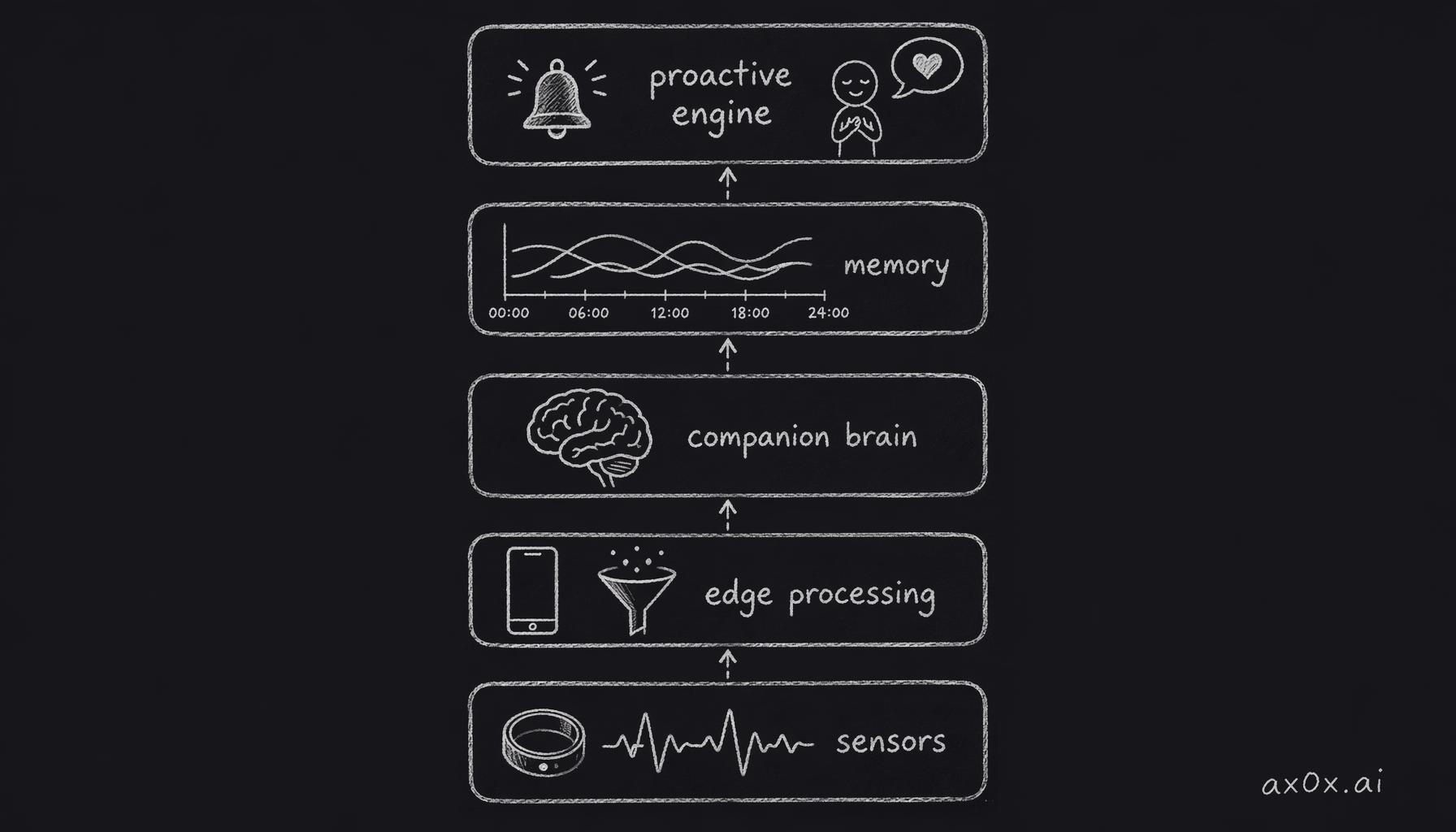 The companion's five-layer data pipeline: from sensors through edge processing to the brain, memory orchestration, and finally the proactive engine
Democratizing the Executive Lifestyle
Here's a framing that makes the scale of this opportunity obvious: we're building for everyone what only executives and heads of state used to have.
Think about what a Fortune 500 CEO has. A chief of staff who knows their schedule, their stress triggers, their dietary restrictions. An executive assistant who screens every meeting, manages every relationship. A personal trainer who adjusts workouts based on how they're sleeping. A concierge who handles logistics. A therapist on retainer.
These people have an entire support system optimized around their wellbeing and performance. And it costs hundreds of thousands of dollars a year. Only the top 0.01% can afford it.
What we're building is that same experience — the feeling of being truly taken care of by someone who knows everything about your life — for everyone. For a low monthly subscription and a ring on your finger.
A government official has aides who brief them on who they're about to meet, what that person cares about, what to avoid saying. Your AI companion does the same thing before a date or a job interview — except it knows you even better than a human aide, because it has your biometric history and every conversation you've ever had.
A CEO has people whose entire job is to notice when the boss is burning out and intervene. Your companion does this automatically, 24/7, without needing to be asked.
This is the real disruption. Not replacing human connection — but democratizing the infrastructure of personal support that was always reserved for the elite. Technology has always been about taking what was scarce and making it abundant. Electricity. Computing. Information. Now: personalized human-quality care and attention.
My Bet
The companion economy is coming. I've written about this before — the AI that truly understands you, with its own soul and character, not just roleplay.
But a companion that only lives in a chat window is half the product. The other half is the sensory layer — the nervous system that lets it perceive your physical reality.
Wearables are that layer. Not smartwatches with screens. Not fitness trackers with dashboards. Beautiful, unobtrusive accessories that give your AI companion the one thing it's missing: the ability to feel what you're feeling.
Build the jewelry. Build the companion. Connect them. The question is whether we build the sensing layer before the companion AI outgrows it.