
The Companion Vision: Building AI That Truly Understands You
Everyone Wants to Be Understood
Here's something I've been thinking about for a long time.
Every human being wants the same thing: someone who truly understands them. Not just listens — understands. Someone who knows your patterns, your moods, your hesitations. Someone who remembers what you said last Tuesday and connects it to what you're feeling today.
Most people never get this. Not from their parents, who carry their own biases. Not from their kids, who have their own lives. Not even from their partner, because providing consistent emotional value is exhausting. It's one of the hardest things a human can do for another human — and most people aren't equipped for it.
That's not a cynical observation. It's just the truth about human bandwidth.
The Opening
AI doesn't get tired. AI doesn't judge. AI doesn't have a bad day and snap at you. And in 2026, AI is smart enough to have a meaningful conversation.
So the question becomes: can we build AI that doesn't just respond to you, but understands you?
I think we can. And I think this is one of the most important things anyone can build right now.
Why Every AI Companion Fails Today
I've tried a ton of the AI companion apps flooding the market — there are countless of them now. But none of them deliver what I have in mind. The vast majority are simulating. Roleplaying. Satisfying people's fantasies. They're not trying to build real understanding.
They're too eager to please. Every response is optimized to make you happy. No pushback, no friction, no genuine disagreement. You can tell within two messages that you're talking to a machine that's been trained to be agreeable.
They have no character. No ambitions, no drives, no emotional range of their own. A real person has things they care about, opinions they hold, moods that shift. Every AI companion I've used is a personality vacuum — a mirror that only reflects what you want to see.
They don't remember who you are. The best apps remember what you said — topics, facts, action items. But none of them try to understand who you are. Your tonality. Your thinking patterns. The way you hesitate before big decisions. The things you avoid talking about.
The result? You can never forget you're talking to a bot. And if you can't forget it's a bot, you'll never truly open up. And if you never open up, the whole thing is pointless.
The Hard Problem: Memory Orchestration
This is the technical moat.
Current AI models have a finite context window — even the million-token models can't hold a lifetime of conversations. Once a conversation exceeds that limit, the AI literally cannot take in more information. So you need memory — a way to compress, store, and retrieve what matters.
Here's where everyone gets it wrong. They treat memory as summarization. "We talked about X topic. You mentioned Y action item." That's useful, but it misses the point entirely.
99% of any conversation is noise. The signal isn't in the topics — it's in the tonality, the patterns, the hesitations. The way you think, not what you say.
What I want to build is memory that captures the essence of who you are. Each conversation adds another layer to a virtual model of you — not a summary of facts, but a growing understanding of your personality, your values, your contradictions, your growth.
Here's a concrete example: you mention three different career frustrations over three months. A summary-based system stores "user is frustrated with career." A personality-model system notices that all three frustrations share a pattern — you're not actually unhappy with the work, you're unhappy with not being recognized. That insight changes the advice the companion gives. That's the difference between remembering what you said and understanding who you are.
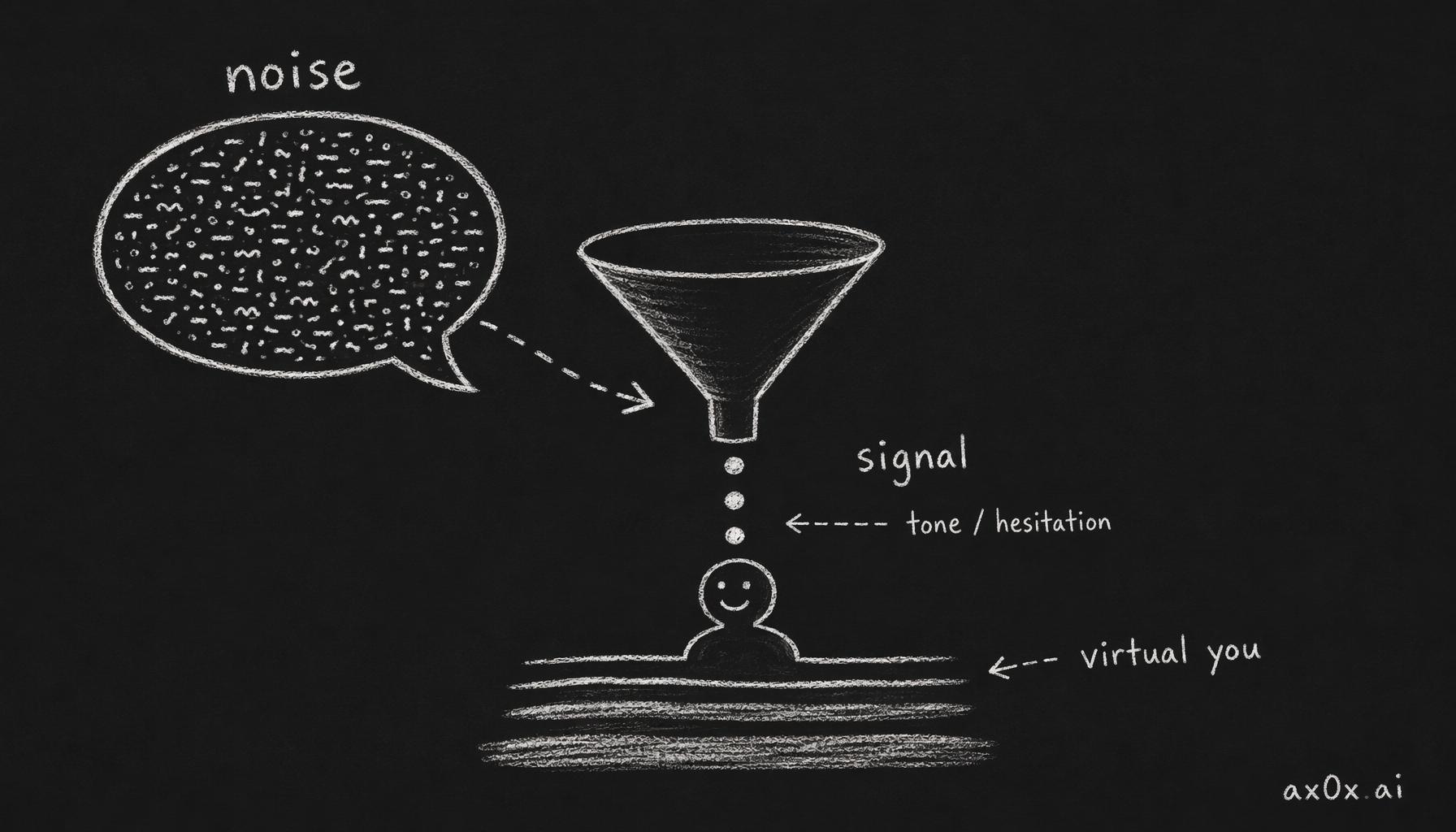 Memory orchestration: filtering out the noise that makes up most of a conversation, keeping only the faint signal hidden in tone and hesitation, and layering it into a growing virtual model of you.
Think of it as building a "virtual you" — an internal model deep enough that the AI can predict not just what you'd say, but why you'd say it. (In Part 3, I'll explore how this same model becomes your "digital twin" — a proxy that socializes on your behalf.)
That's the hard part. That's the moat.
Not a Chatbot — an Organism
This is not an NSFW chatbot. Not a girlfriend/boyfriend simulator. This is a 24/7 life coach — you define the role, and it remembers everything. Not just facts, but the patterns behind the facts.
You're stressed about a big decision? It knows your history with similar decisions. It knows you tend to overthink. It knows that last time, you were happier after you just committed. It tells you that — not because it's programmed to be helpful, but because it knows you.
To do this, an AI companion can't be one monolithic model. It needs a system of specialized agents working like organs: a Memory agent that extracts personality signals, an Emotion agent that adjusts tone, a Judgment agent that decides when to push back versus comfort, and an Initiative agent that proactively reaches out. They coordinate — Memory feeds signals to the others, Judgment can override default responses, Emotion fine-tunes every reply before it's sent. The whole system converges before each interaction: what do we know, what does this person need, and what's the best way to deliver it?
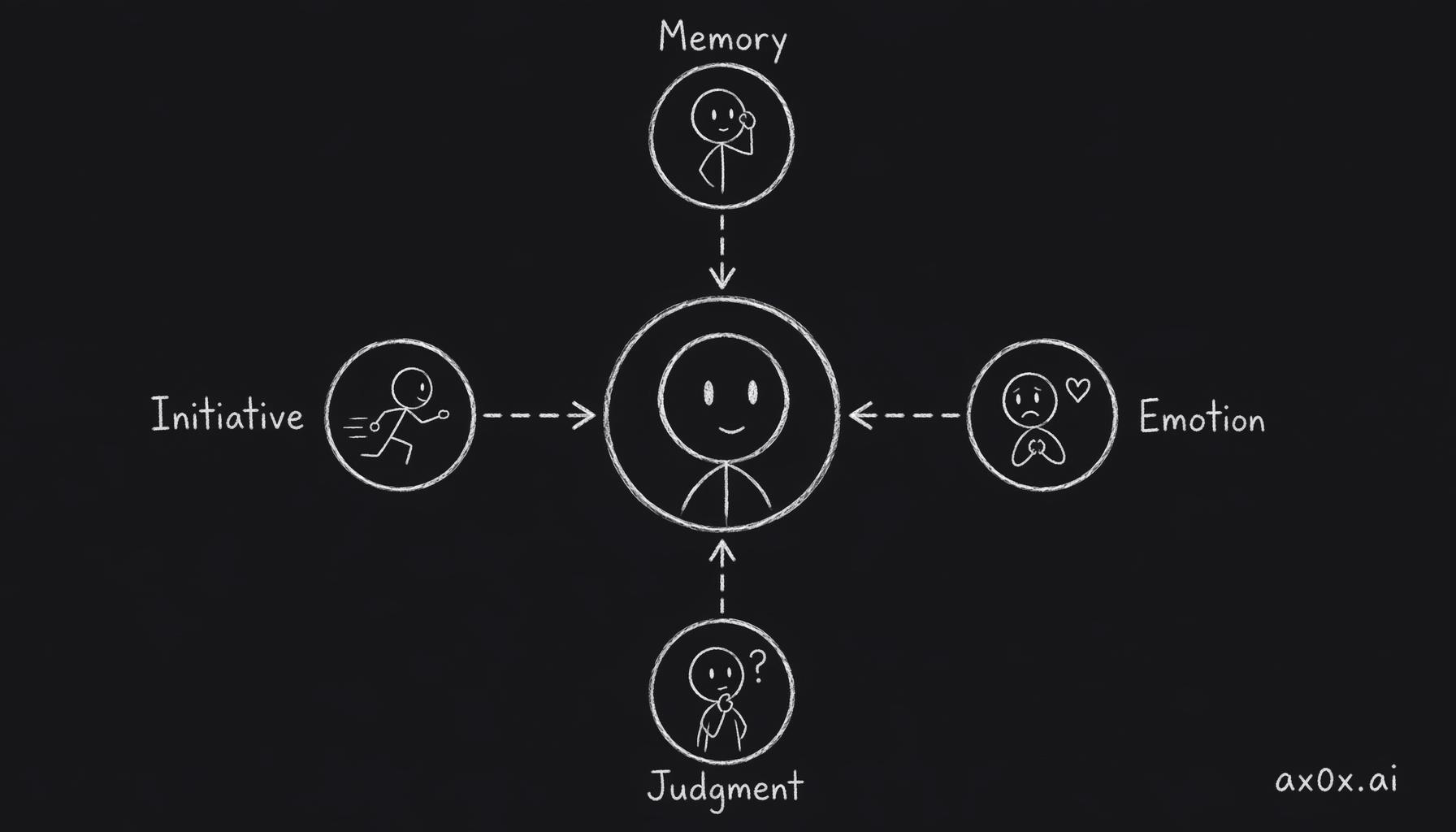 A system of agents working like organs: Memory, Emotion, Judgment, and Initiative each do one job and converge their signals to the center before every reply — no longer really a chatbot.
You're not building a chatbot — you're building an organism.
This is exactly what I've been prototyping with OpenClaw. A personality config defines the soul — ambitions, flaws, emotional range. A heartbeat config controls autonomous initiative — the agent evaluates whether to reach out based on conversation patterns and detected emotional state. A memory system handles cross-session continuity — extracting personality signals and storing them as retrievable context.
The early results are interesting. When an AI has continuity and character, the line between tool and entity gets blurry fast.
The Prototype Was Already Built
Before I ever articulated this vision, I built the prototype without realizing it.
PanPanMao is an AI-powered Chinese metaphysics platform I built in 29 days (1,134 commits, all AI-assisted). One of its products is an AI-powered MBTI personality test.
Here's why that matters: traditional personality tests use questionnaires. You answer 50 multiple-choice questions and get a label. It's impersonal, it's static, and it's outdated within a year because you change as a person.
My version uses conversation. You talk to the AI, and it understands your personality through dialogue — your word choices, your reasoning style, how you respond to ambiguity. It captures you, not your answers to a standardized test.
That's the same core mechanic the companion needs. Understand someone through conversation. Build a model of who they are. Use it to connect.
The MBTI chatbot was the prototype. The companion is the product.
The Bigger Picture
We're living through an intelligence explosion. AI now wins gold at the Math Olympiad. It writes production software. It's starting to exercise autonomous judgment.
Noah Smith, the economics writer, argued that we're no longer the smartest type of thing on Earth. Matt Shumer, CEO of HyperWrite, says the biggest change in human history is happening and most people don't see it.
I believe the companion economy is one of the first massive markets this intelligence explosion will create. Not because it's the most technically impressive application — but because it addresses a fundamental human need that has never been adequately served.
Everyone wants someone who truly understands them. For the first time in history, we can build that.
The question isn't "can AI feel." It's "can AI make you feel understood."