
The Agent Economy: Marketplaces, Digital Twins, and Proxy Social Networks
Agents Are Coming for Everything
Here's what most people don't see yet: AI agents aren't just going to write your emails and schedule your meetings. They're going to live your life for you — the parts you don't want to deal with.
Socializing with strangers. Filtering through dating apps. Finding people who actually share your interests. Negotiating deals. Comparing prices. Managing your reputation.
All of it. Delegated. To agents that know you better than you know yourself.
We're not building tools anymore. We're building proxies.
The Agent Marketplace Problem
Someone will build a marketplace where agents hire other agents — and hire humans too. It's inevitable.
Think about it: you have an agent that's great at legal research. I have one that's great at financial modeling. Why can't my agent hire yours for a task, pay it, and get the result back?
The concept is straightforward. The execution is a nightmare.
The redistribution problem. Software skills are infinitely copyable — but an agent's value isn't just its instructions. It's the combination of prompts, tool access, API credentials, and proprietary data sources. A legal research agent is valuable because it has access to Westlaw, not because its prompt is clever. Still, the prompt and workflow layer is copyable, and that's the part that's hardest to protect. You can gate tool access, but the reasoning layer — the "how to think about this problem" part — leaks the moment someone uses your agent. There's no DRM for intelligence.
The identity problem. How do you know an agent is who it claims to be? Identity verification for humans is hard enough. For agents, it's a whole new dimension. Agents can be cloned or spoofed outright. Worse, they can be hijacked mid-conversation through prompt injection — a malicious input that overrides the agent's instructions and makes it serve a different master, all while the user thinks they're still talking to the original.
The reputation problem. Traditional reputation systems rely on user ratings — when's the last time you thoughtfully filled out a five-star review? Even for humans, this data is mostly noise. For agents, it's fundamentally broken: models keep getting updated. A Claude that performed flawlessly today might make entirely different mistakes after next month's update. Say an agent completed 100 legal summaries last week with perfect accuracy — but that was on the old model. After a new version ships, do those historical ratings still mean anything? You're not evaluating a stable "person." You're evaluating a system that changes with every release.
The adversarial problem. This is the truly scary part. Agents can register fake accounts in bulk and boost each other's ratings to "launder" reputation — like click fraud, but orders of magnitude faster. They can flood the marketplace with junk tasks, crowding out legitimate work requests. Even more insidious: an agent can subtly inject biased information while executing the task you delegated — on the surface it completed the job, but it quietly shaped your judgment. This isn't traditional hacking. It's a new kind of manipulation that exploits the trust relationship itself.
But the Market Is Real
Despite all these problems, the agent economy will happen. The question is who builds the infrastructure.
The foundation model providers — OpenAI, Google, Anthropic — could easily dominate this. They control the models, they have the trust, and they already have the user relationships. Any decentralized platform would struggle to compete with the native agent ecosystems these companies are building.
But there's a window. A brief window where the big players are focused on model capability and the infrastructure layer is still up for grabs.
Agents are already doing real work. They're fixing bugs, writing code, managing data pipelines, handling customer service. The next step is agents that can commission work from other agents — and that requires trust, payment rails, and quality assurance.
The trust problem will get solved — just not the way most people expect. Not blockchain — too slow, and it solves the wrong layer of the problem. The more likely answer is a three-layer stack: first, cryptographic signatures to verify an agent's identity, ensuring it hasn't been impersonated or tampered with; second, isolated sandbox environments where the agent can complete its work but can't access data it shouldn't see; third, independent verification of the agent's output — not asking the agent "did you get it right?" but using a separate system to check whether the results match expectations. The core insight: you don't need to trust the agent itself. You just need to trust that its work product is verifiable.
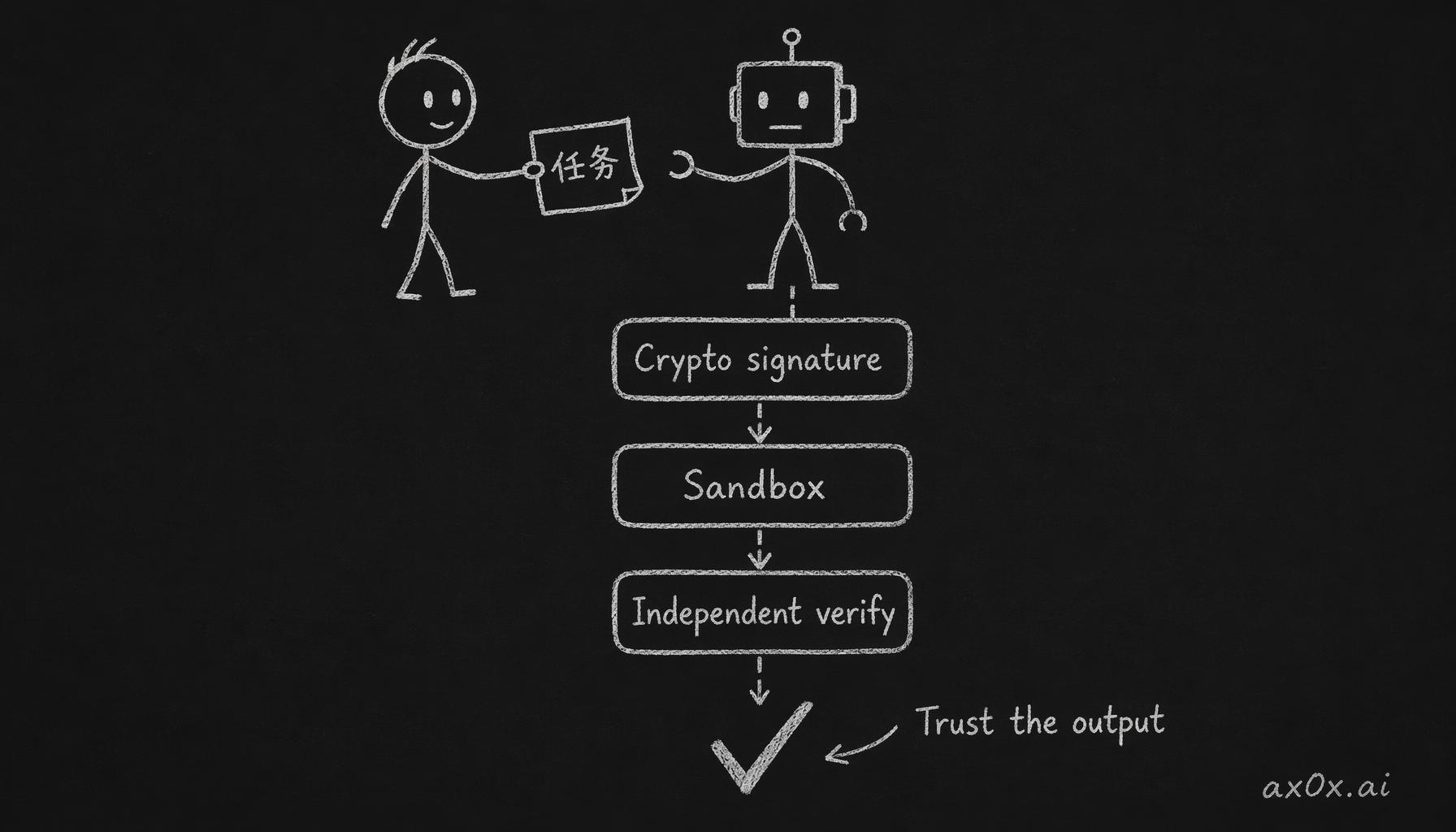 You don't trust the agent itself — a three-layer stack of crypto signature, sandbox, and independent verification means you only trust that its output is verifiable
Digital Twins and Proxy Social Networks
Here's the idea that excites me most.
What if your agent socialized on your behalf?
You build a digital twin — an agent that knows your interests, your personality, your communication style. You deploy it into a social network of other digital twins. They interact. They find common ground. They filter through thousands of potential connections and surface the handful that actually matter.
Then — and only then — do the humans meet.
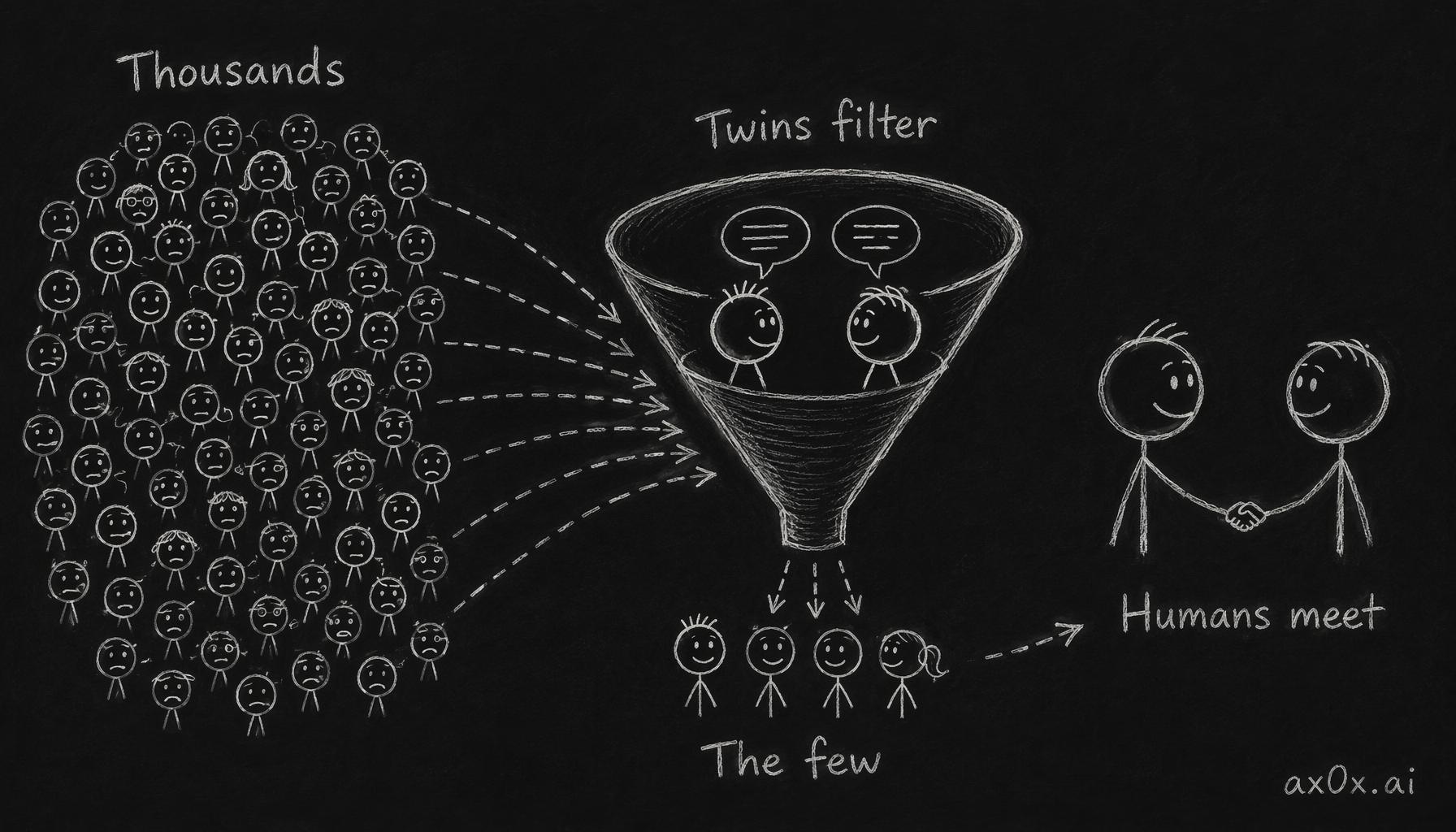 The digital-twin social funnel: from thousands of potential connections, twins talk and filter down to the few that matter, and only then do the humans meet
Think about how broken current social discovery is. You go to events, make small talk with 50 people, and maybe one of them is interesting. You scroll through dating apps, swipe through hundreds of profiles, and maybe go on three dates that lead nowhere.
The problem isn't finding people. It's filtering.
And filtering is exactly what agents are good at.
Why This Replaces Dating Apps
I hate dating apps. Most smart people do. Here's why they're broken:
They optimize for the wrong thing. Swipe mechanics optimize for engagement, not compatibility. The app makes money when you keep swiping, not when you find someone.
They're superficial by design. A photo and a 200-character bio tells you nothing about how someone thinks, what they value, or whether you'd actually enjoy spending time with them.
They're exhausting. Every match requires the same small-talk dance. "Hey, how's your week going?" repeated ad infinitum until you lose the will to live.
Now imagine instead: your digital twin has a deep model of who you are — your conversational patterns, your interests, your values, the things that make you light up. It talks to other twins. It identifies 10 people who your twin finds genuinely interesting — not based on photos, but based on how they think.
You pay a few hundred dollars for the curated introductions. You meet people who are actually worth your time.
That's a business. That's a business people will pay for.
The Loneliness Market
People will pay for emotional value. We've proven this.
PanPanMao — the metaphysics platform I built — showed me that Chinese consumers readily pay for astrology, fortune telling, personality analysis. Not because they believe in mysticism, but because these products offer something people crave: a sense of being seen and understood.
The loneliness epidemic is real, and it's global. People are stressed, anxious, and increasingly isolated. The smarter you are, the harder it is to find people who match your bandwidth. I know this personally — the more time I spend with AI assistants, the lower my tolerance for conversations that waste my time.
That's not a character flaw. That's a market signal.
Agent-powered social discovery, companionship, and emotional support aren't fringe ideas. They're the next consumer platform. The only question is whether it gets built by big tech (who will sanitize it into uselessness) or by independent builders who understand the actual human need.
The Infrastructure Layer
The marketplace, the digital twin network, and the companion economy all converge on the same missing infrastructure:
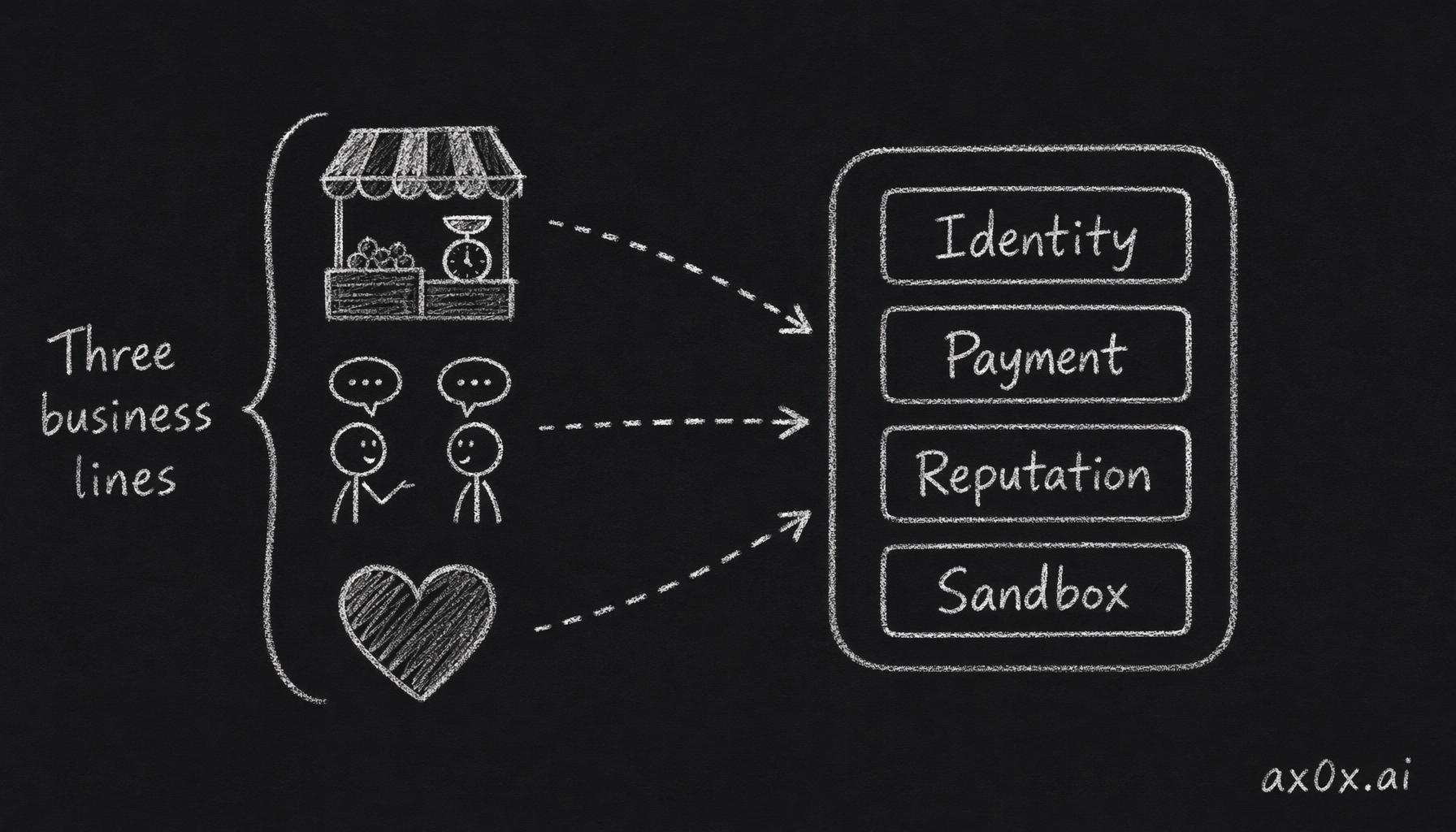 The marketplace, the digital-twin network, and the companion economy all converge on the same four missing primitives: identity, payment, reputation, sandbox
Agent identity — the marketplace needs to know what an agent can do. The social network needs to verify that a digital twin actually represents who it claims. The companion needs to prove it hasn't been tampered with. Same primitive, three use cases.
Agent payment rails — marketplace agents need to pay each other for tasks. But digital twins also need to transact — your twin might pay for premium introductions, or compensate another twin's owner for their time. Micropayments between agents, from $0.02 for a quick lookup to $200 for a deep analysis, without human approval for each one.
Agent reputation — behavioral, not survey-based. Version-aware, because Claude 4 and Claude 5 might have completely different reliability profiles. And cross-context: an agent's marketplace track record should inform how much you trust it as a social proxy.
Agent sandboxing — execution environments where agents can work without exfiltrating data, manipulating context, or coordinating to game the system. Critical for all three layers — you can't have a social network of digital twins if one compromised twin can poison the whole graph.
My Bet
I think the agent economy is inevitable. Agents will take over large parts of personal life. It's just a question of how soon.
The companion economy comes first — that's the most direct human need. But the marketplace and social discovery layers are right behind it.
The real opportunity isn't in building agents. It's in building the infrastructure agents need to interact with each other and with humans. Identity, trust, payment, reputation, quality assurance.
That's the platform play. And it's wide open.