
The Last Mile of AI
Before zooming into one story, step back and look at where we actually are.
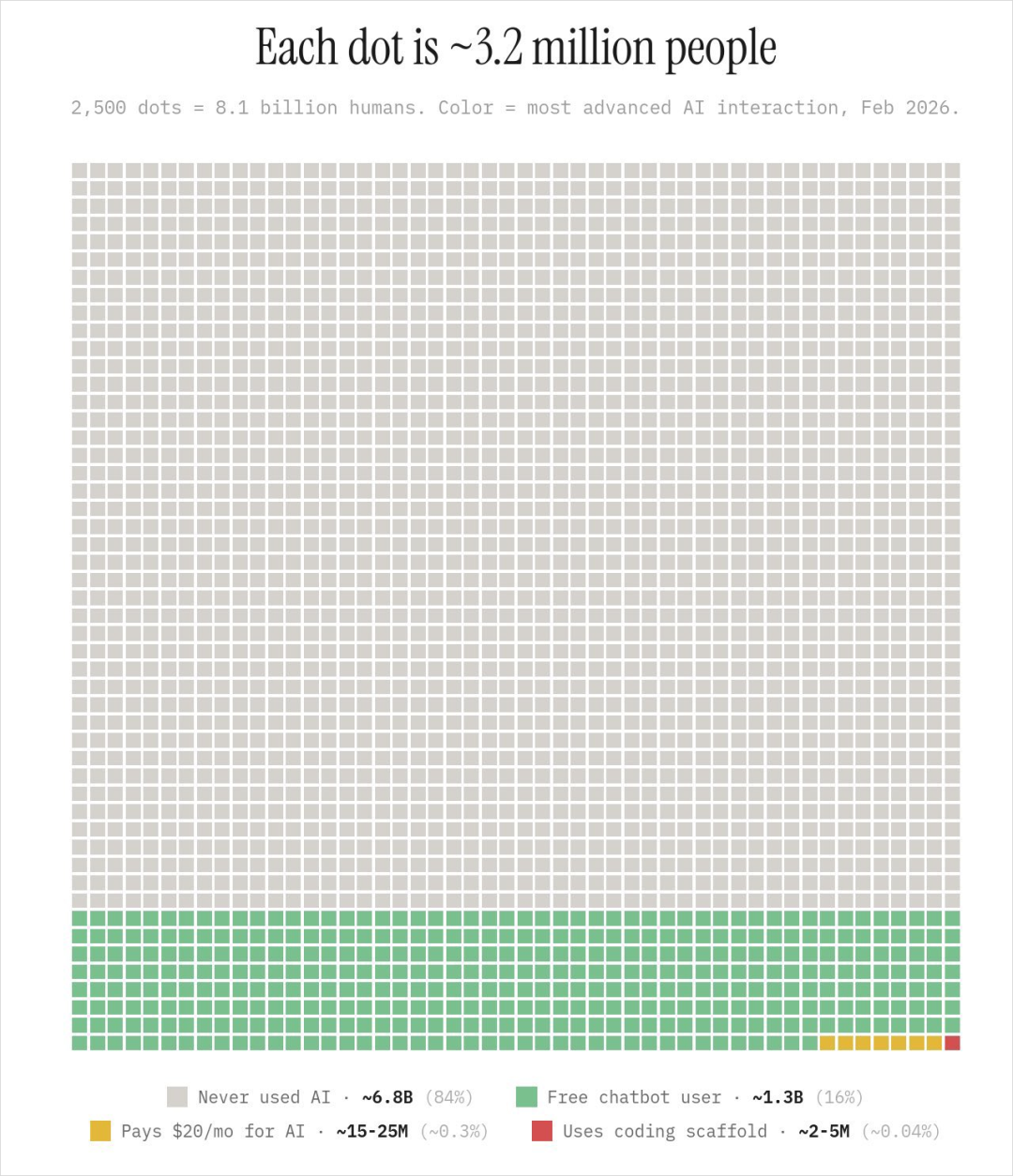 AI adoption grid — each dot is ~3.2 million people
84% of the world has never had a single AI conversation. Only 16% have tried a free chatbot. About 0.3% pay for AI. And the fraction using coding agents? Roughly 0.04% — a nearly invisible dot. (via Noah Epstein)
Think about mobile internet when the iPhone had just launched and most people were still on flip phones — before anyone knew what was coming. We're not in the late stages of AI adoption. We haven't even reached the middle. We're still right at the beginning.
That's the world a friend of mine stepped into one weekend in Seattle.
A Weekend, a Friend, a Laptop
An old friend visited from Beijing on a business trip to Seattle. Beyond catching up, he had a clear agenda: he wanted to learn how to use AI agents for productivity.
He's one of my closest friends from college. He works in finance — reviewing deals, writing investment research reports. He took a few CS intro classes back in school, but that was eight years ago and long since forgotten. He's sharp, learns fast, and — most critically — he was motivated. I'd been regularly sharing my AI agent use cases with him, and he'd seen enough to know this was real. He couldn't wait any longer.
So we spent the weekend on one thing: I taught him Claude Code, hands on.
We started from zero: deployed his own OpenClaw instance on GCP, integrated with Feishu, configured tunnel forwarding, then used Claude Code for a series of things he genuinely needed — financial analysis, data wrangling, even building a custom tool for his specific business scenario.
That weekend showed me three things, each more visceral than anything I'd theorized about before.
The Last Mile
In Part 4, I wrote about the agent marketplace's "conversational entry point" — users shouldn't browse a shelf of agents, they should just state their need and let the platform match. Sounds elegant.
But reality: before my friend could "converse," he had to cross a massive threshold.
GCP account registration, gcloud CLI installation, server configuration, the framework's deployment, Feishu integration, tunnel forwarding — each step took me minutes, but for him, every single one triggered a chain of "What is this? Why do I need this?" Not because he's slow — because these things simply don't exist in a non-technical person's cognitive map.
Here's the interesting part: once the environment was set up, Claude Code handled nearly everything from there. It wrote scripts, read documentation, debugged errors, deployed services. The problem wasn't the agent itself — the agent is already powerful enough. The problem was the distance between "I want an agent" and "I have a working agent."
This is the "last mile" problem of the agent revolution.
Logistics has a classic concept: the last mile is the most expensive, least efficient segment of the entire delivery chain. Warehouse to city is fast. City to neighborhood is fast. But from the neighborhood entrance to your front door — those final few hundred meters consume a disproportionate share of the total cost.
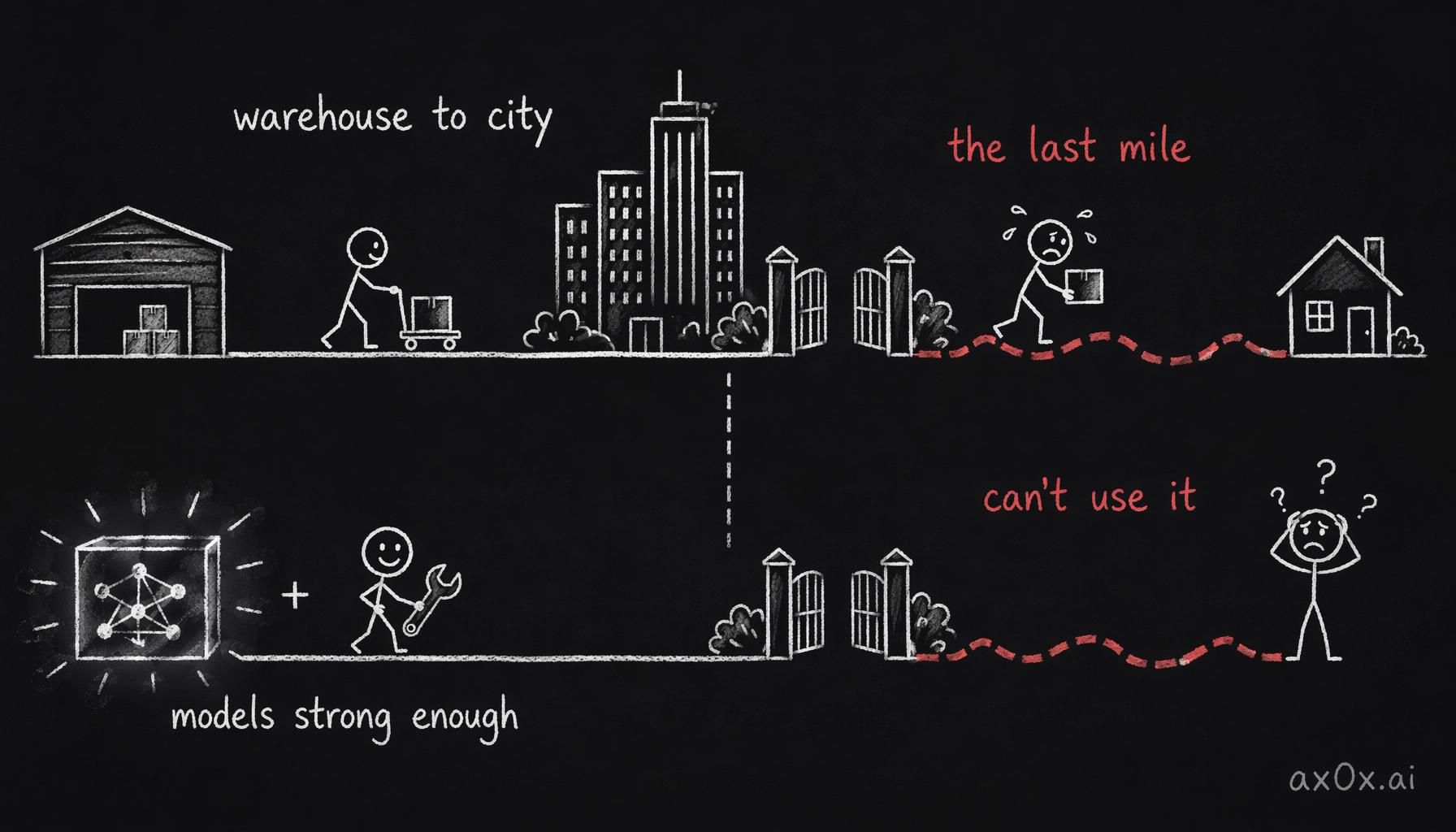 Maps logistics' last mile onto agents: models and tools are ready, but the unpaved final stretch from wanting one to having a working one is where everyone gets stuck
The agent space looks exactly the same. The foundational model capabilities are here. Claude Code as a general agent is powerful enough. The Skills ecosystem is forming. But the infrastructure between ordinary users and actually using any of this is almost entirely missing.
Everyone's discussing what agents can do. Very few are solving how ordinary people can get to use them.
Some products are partially solving the entry point problem. Take my own example — I used the framework to build a fully automated AI engineer for PanPanMao on GCP, integrated with Feishu (a workplace messaging app). Team members don't need to file bug reports or feature requests with me. They just chat with the agent in the Feishu group. The agent automatically validates and triages issues, creates GitHub Issues, generates task tracking; for simple bugs, it submits fix PRs directly; for structural changes and feature requests, it creates a detailed report in the GitHub Issue — complete with context, analysis, and recommendations. This massively freed me up: instead of collecting information from team members one by one, all I need to do is think and make decisions.
For the team members, using the agent is as simple as chatting with a colleague in Feishu. The entry point problem is genuinely solved.
But the person who built that experience was me — an engineer who works in Claude Code every day. Ordinary users don't have the ability, the inclination, or even the awareness to set any of this up. They don't even know this kind of experience is possible.
So the essence of the "last mile" isn't "agents aren't good enough" — it's "someone has to pave that road for you." Right now, that someone can only be a technical person. And the vast majority of people don't have a technical person in their life willing to spend the time paving it.
Anthropic saw this problem too. Boris Cherny — Claude Code's creator — described in a recent interview how even inside Anthropic, non-engineers were "jumping over hoops" to install Claude Code in the terminal. Designers, data scientists, the finance team — they were all figuring out Node.js installation and terminal commands on their own, just to access agent-level capability. Outside Anthropic, people were using it to monitor tomato plants, recover wedding photos from corrupted hard drives, do financial analysis. The demand was unmistakable — but the barrier was absurd. A terminal CLI shouldn't be the entry point for someone who wants to pay a parking ticket with AI.
So Anthropic built Cowork: Claude Code wrapped in an accessible desktop interface, running inside a virtual machine with deletion safeguards and permission guardrails. Four engineers built it in ten days — entirely written by Claude Code itself. Cowork is the first serious attempt to pave that last mile road at scale. It's Claude Code's full agent capability, minus the terminal barrier. Anthropic's sales team has already started migrating from Claude Code to Cowork — "because it's a little easier to use, and it has a VM so it's a little bit safer," Boris said.
This doesn't solve the whole problem — users still need to learn how to give good instructions, how to think in goals rather than steps. But it removes the most brutal barrier: the one where you have to be an engineer just to get started.
The Perception Gap
My friend had used ChatGPT, Doubao, various free chatbots. His mental model of AI was the same as most people's: a Q&A tool that's slightly smarter than a search engine. That's roughly 99.99% of people's understanding.
He had one advantage over most — I'd been sharing real AI agent use cases with him, so he knew this stuff "should be impressive." But knowing and seeing are two different things.
That weekend we did three things. Claude Code read his financial data, built models, generated analytical reports, iterated based on his feedback — not answering questions about finance, but actually doing financial analysis. Then we built a voice-controlled Flappy Bird from scratch — about an hour, zero to playable, two grown men screaming at a laptop trying to keep a pixelated bird from smashing into pipes. Finally, Claude Code built him a custom tool tailored entirely to his business — not some generic software configuration, but an application that existed solely for his needs.
When we were done, he said one thing: "An hour ago, none of this existed."
This validates the "disposable software" thesis from Part 4: building software for a single person is already technically feasible. But 99.99% of people don't even know they can ask for it.
They've never seen agent-level capabilities. They've used free-tier, stripped-down, rate-limited models. Their entire impression of AI is a chat box that occasionally produces a useful answer.
This isn't a technology problem. It's a perception problem.
People don't know what's possible. And when you don't know what's possible, you don't even think to want it. You can't demand something you don't know exists.
Boris Cherny has a product term for this: latent demand. "People will only do a thing that they already do. You can't get people to do a new thing. If people are trying to do a thing and you make it easier, that's a good idea. But if people are doing a thing and you try to make them do a different thing, they're not going to do that."
My friend wasn't lacking demand — he was already doing financial analysis, already building reports, already making investment decisions. The demand was always there. What he lacked was the awareness that AI could make those things 10x easier. Once he saw it — once he experienced Claude Code working on his actual data — the latent demand exploded into active demand instantly. The gap wasn't motivation. It was exposure.
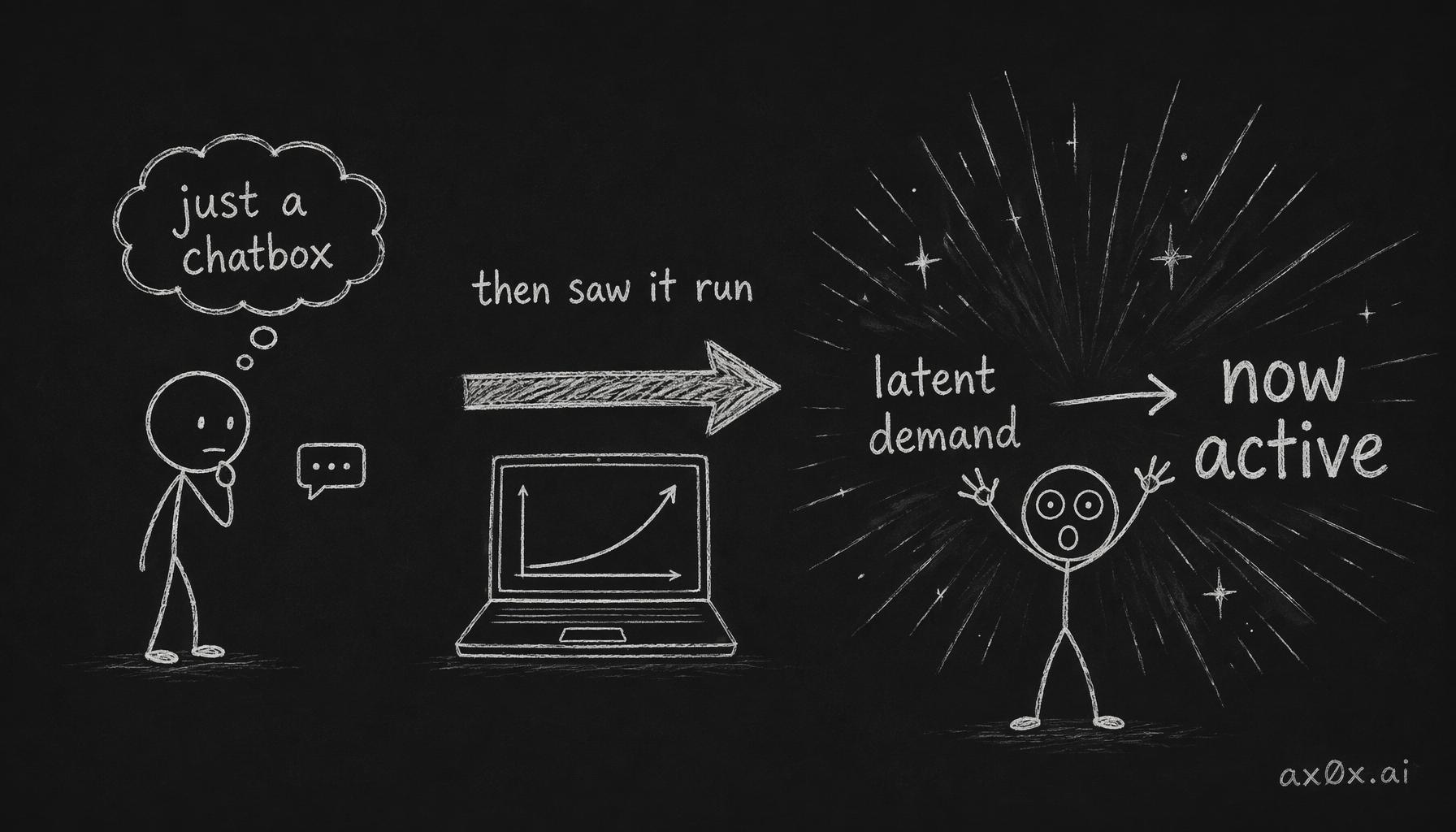 The perception flip: before seeing an agent run on their own data people think AI is just a chat box; once they see it, latent demand explodes into active demand
The last mile problem, at its core, is a latent demand problem. The demand exists — billions of people do information work that agents could transform. But they don't know the supply exists. And you can't demand what you've never seen.
So what does latent demand look like in practice? These are real use cases Boris mentioned — none of them are coding:
The repetitive work you already do every day. Paying parking tickets, canceling subscriptions, summarizing team weekly reports. Things everyone has to do but nobody wants to.
Data analysis and research. Not "answer this data question" — but "here's my database, explore the data, find interesting patterns, write it up as a report." The agent decides on its own what queries to run and how to present the results.
Custom tools for your specific situation. Part 4's "disposable software" — describe your need and let the agent build a tool that serves only you.
Learn anything you want to learn. Not search-engine-style "what is X" — but "I want to understand X, my background is Y, explain it so I can understand, give me a practical example, walk me through it step by step." A private tutor with infinite patience.
The demand is everywhere. The capability is here. But the biggest bottleneck now isn't how powerful the tools are — it's whether you can give the agent a well-defined task.
Imagine you hired a software engineer and told them: "Build me X." Could they get it done overnight? If a human could succeed with those instructions, AI probably can too. If a human couldn't, AI probably can't either.
"Build me something like WeChat" — that's too vague for anyone, human or AI. How many users? Does "like WeChat" mean the UI or the feature set? Do you need Moments? But if you say: "I have a company website in Chinese. Keep the visual design identical, translate all content to English, build a mirror site" — that kind of request, with clear acceptance criteria, works.
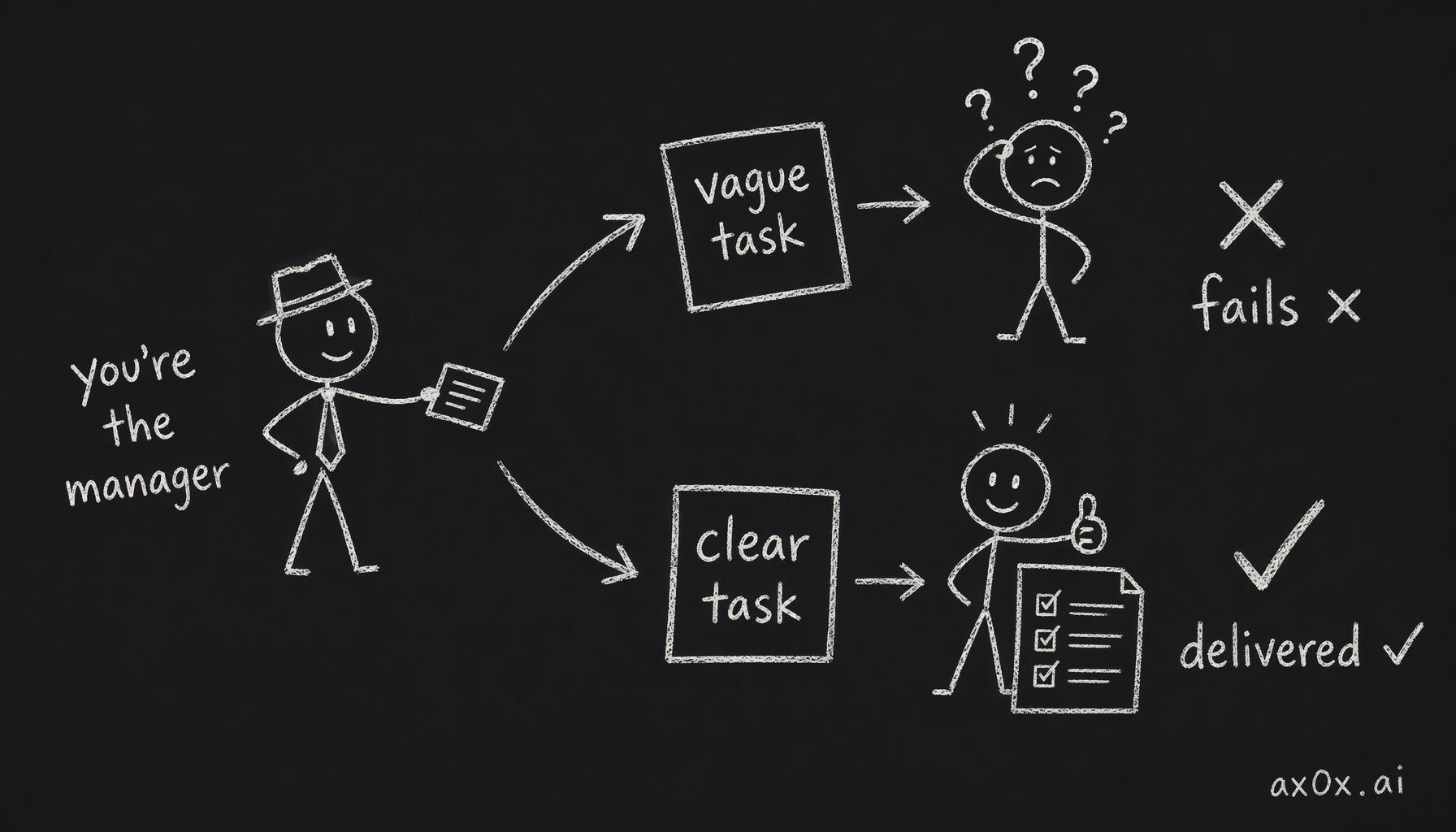 The final bottleneck of task framing: like a good manager, a vague task makes the agent fail while a task with clear acceptance criteria gets delivered
Whether it's a human or an AI, expecting perfect delivery from a one-sentence instruction is unrealistic. The biggest bottleneck in using AI isn't how powerful the tools are — it's whether we can assign tasks like a good manager. Part 6 digs into that.