How Light Pushed Copper Into the Rack
The last post was about the crossover point between copper and light, and how it slides toward shorter distances every time the line rate doubles. This one zooms out. On the episode, Kevin compressed the whole history of wired communication into three shifts — wireless versus wired, copper versus glass, long haul versus short reach — and I found the frame useful enough to keep. Follow it and you can watch that crossover point travel from the floor of the Atlantic to the edge of a server rack.
Start with something I had wrong for years. The popular picture of communication is a march toward wireless: telegraph on a wire, telephone on a wire, then cell phones, then Wi-Fi, and now a Starlink dish on the roof of an RV. I assumed wires were on their way out. At the backbone — the transoceanic, transcontinental layer that carries the bulk of the traffic — they never were.
Wireless never won the backbone
Wires came first. In 1837 Cooke and Wheatstone took out Britain's first telegraph patent, and the same year Morse demonstrated his own system in New York, neither side knowing about the other. Bell got the idea for the telephone in the summer of 1874 at his family's farm in Brantford, Ontario, and patented it — and made the first working call — in March 1876. Only then did wireless show up: on 12 December 1901, Marconi, standing in Newfoundland with an antenna hoisted by a kite, picked up the letter S — three dots — sent from Cornwall, roughly 3,440 km away. It was the first time a signal crossed the Atlantic without a cable. It was also one-way and experimental; a commercial wireless telegraph service didn't stabilize until around 1907.
From there the two sides traded blows, and the cleanest scorecard is the transatlantic telephone. The first commercial service opened in 1927 over radio. It had one circuit — a single conversation at a time, across the whole ocean. Three minutes cost about $75 (some sources say $45), which in today's money is over $1,000 for a short call. Thirty years later, in 1956, the first transatlantic telephone cable, TAT-1, went live with 36 channels: 35 voice plus one telegraph. On quality and capacity it simply buried radio. Then satellites had their turn — Telstar carried the first live transatlantic TV broadcast in 1962, and through the sixties and seventies the Intelsat system pulled a lot of the ocean-crossing voice and video traffic back into the sky.
1988 settled it. TAT-8, the first transatlantic fiber cable, came up at 280 Mbit/s, roughly 40,000 simultaneous calls and about ten times the last copper cable before it, TAT-7. Satellites never took the lead back. Today the overwhelming majority of intercontinental data rides submarine fiber. The number you hear is 99%; TeleGeography went looking for a source and couldn't find one, so the defensible statement is "more than 95%." Satellite is the supplement and the backup. The access layer keeps going wireless — phones, Wi-Fi, Starlink — while the backbone stays on wire, and Kevin's reason fits in one word: capacity. Wireless can cover the last hop. It cannot carry the backbone's volume. That's a claim I think holds up.
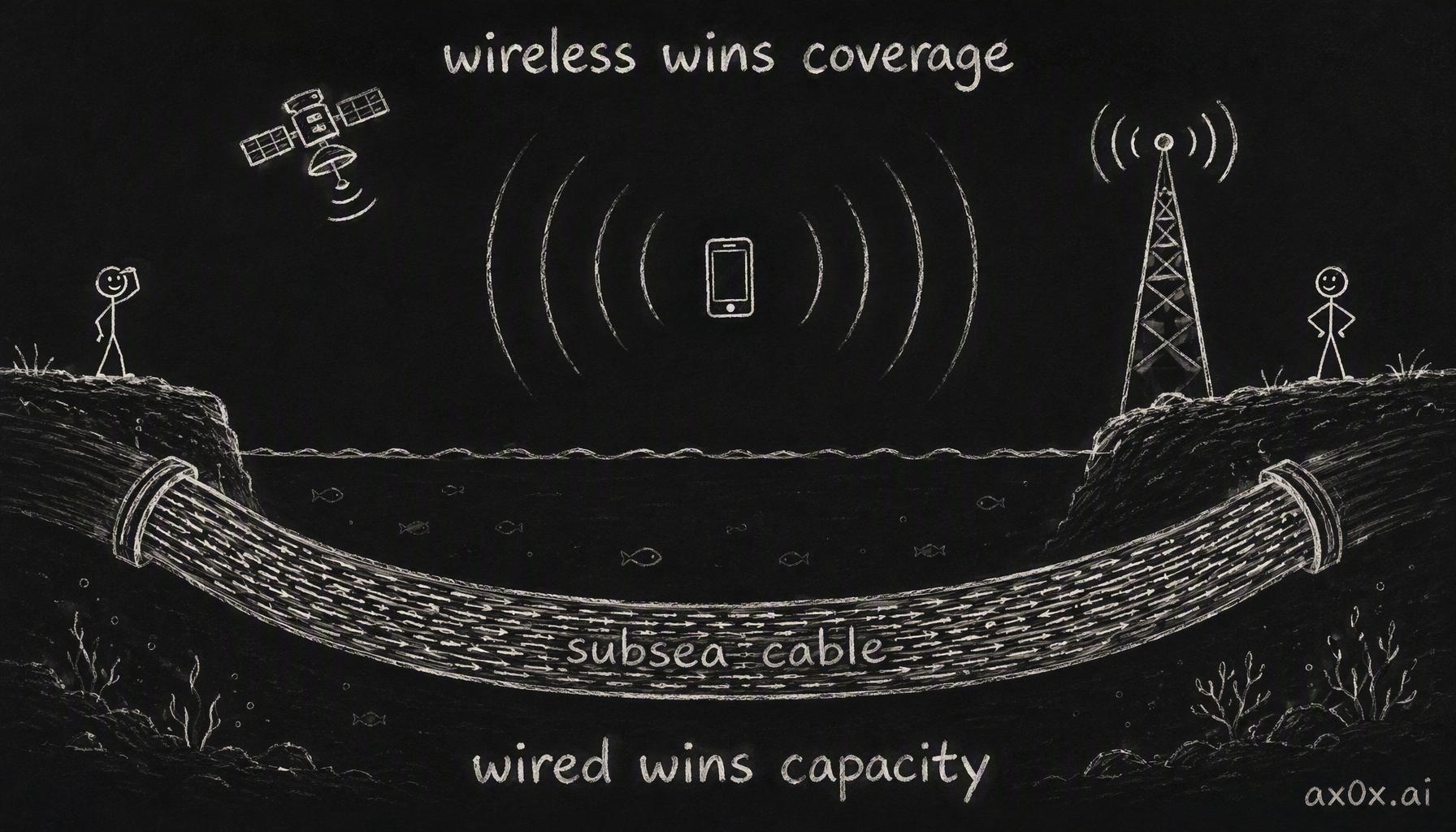 Communications history isn't wireless replacing wired: wireless competes on coverage, wired competes on capacity, and the vast majority of intercontinental data still travels over subsea fiber
What about Starlink, though — isn't that pure wireless? 敏姐 pressed on exactly this. Kevin's answer: what you buy is a transceiver for your balcony or roof. It talks to the satellite overhead; the satellite talks to the nearest ground station; and the ground stations talk to each other over fiber, like everything else. The radio link is the coverage at the edge. The bulk of the bytes still move on glass. It's a better example than a phone precisely because Starlink is the most wireless-looking thing anyone owns.
So among wired links, why did copper lose to glass? That's an accounting question, and the line item is the repeater.
Repeaters are what pushed copper to its limit
The last post covered copper's disease: skin effect plus dielectric loss, so attenuation climbs steeply with frequency. If you hold the wire count fixed and want more capacity, you raise the frequency; raise the frequency and the signal runs out of strength sooner — smaller amplitude, mushier edges. The fix is to build a station every so often along the route that catches the signal, amplifies and reshapes it, and sends it on for the next leg. That's a repeater. Kevin's comparison was a relay baton, or the fresh horse at a post station.
He also improvised a camping version. Three friends on three hilltops; a human voice carries about two kilometers. 敏姐 on the first hill wants to reach 石磊 on the third, so she shouts to Kevin in the middle, who hears it and shouts it on. Shout straight at 石磊 and he hears nothing. 敏姐 said it sounded like the kids' game where everyone lines up, a word gets whispered down the line, and you check what comes out the end.
That game turns out to be the better model, because it captures the cost. A repeater isn't a passive echo — it has to recover the signal before it can resend it, and it can only ever resend its best guess. The analog ones passed their own noise down the line; the digital ones can guess the bit wrong. More stations, more error either way. And every station has to be built, powered and maintained, and the ones on the seabed are the expensive kind — though those sat far apart, tens of kilometers. On land it was the opposite: by the 1970s the last generation of coaxial trunk systems had repeaters every kilometer or two; the L-5 system of 1974 spaced them about 1.6 km apart. Every capacity step packed the stations tighter, and the bill went up with them. The road was visibly ending.
In 1966 someone published a claim that looked absurd at the time. Charles Kao and George Hockham argued that glass could carry light for communication, provided the loss fell below 20 dB per kilometer. The best optical glass then sat around 1,000 dB per kilometer — fifty times too lossy — so most people filed it under science fiction. Kao's Nobel Prize came in 2009, 43 years after the paper.
Then 1970 delivered twice. In August, three people at Corning — Maurer, Keck, and Schultz — drew a titanium-doped silica fiber at 17 dB/km, the first to break the 20 dB line. The same year, a semiconductor laser that could run continuously at room temperature arrived, from two teams almost at once: Alferov at the Ioffe Institute in May, Hayashi and Panish at Bell Labs in June. The glass thread and the lamp to shine into it showed up within months of each other, and Kao's paper turned into an engineering project. (Corning still makes fiber; Kevin mentioned that in passing and I'll leave it there.)
The fifty years since have been a loss curve going down. Typical commercial fiber today attenuates 0.18–0.20 dB/km; ultra-low-loss grades reach 0.16–0.17; 0.14 is a laboratory record. Run 100 km and you lose around 20 dB, which sounds like a lot until you set it beside the copper link from the last post: a 224G electrical path measured chip-to-chip lands in the 40 dB range — twice the decibel figure of a hundred kilometers of glass, and because decibels are logarithmic that doubling means a hundred times less optical power reaching the far end. Physics wrote that outcome; no amount of manufacturing skill on the copper side changes it. Fiber's second advantage is bandwidth: one strand with wavelength-division multiplexing, different colors running side by side, carries orders of magnitude more than any copper pair, and the arithmetic is in the previous post. For comparison, the newest active copper cables in a data center top out at a few hundred gigabits to 1.6T per cable, and only across the few meters inside a rack or to its neighbor.
China joined this line late: in 1976 — some accounts say March 1977 — 赵梓森 drew the country's first practical optical fiber in Wuhan, and how the industry climbed from the bottom of the supply chain toward the top over the next fifty years is the fifth post. Wuhan's tech district is called 光谷 today. Kevin quizzed the hosts on its English name; 敏姐 answered "Optics Valley," correctly — the 光 there is the optical-components industry, not light in the physics sense. She added that Hebei also has a 光谷, and that one is photovoltaics, unrelated.
The third shift moved a boundary
The first two shifts swapped one technology for another. This one only moved a line: light stayed what it was, and the boundary between light and copper kept sliding. The Chinese industry has a stock phrase for it, 光进铜退 — light advances, copper retreats — and the timeline Kevin gave runs like this. In the 1980s light took the intercontinental submarine cables, TAT-8 and its siblings. In the 1990s, the interprovincial trunks. In the 2000s, metro networks. In the 2010s, fiber to the home, and the ONT ended up on your wall. After 2015, light entered the data center itself, taking over links of tens to hundreds of meters. Today, between racks, anything past one to three meters is fiber. The next stop is inside the rack and inside the chip package — CPO, which the fourth post is about. Fifty years, and copper has been squeezed down to that last meter or three.
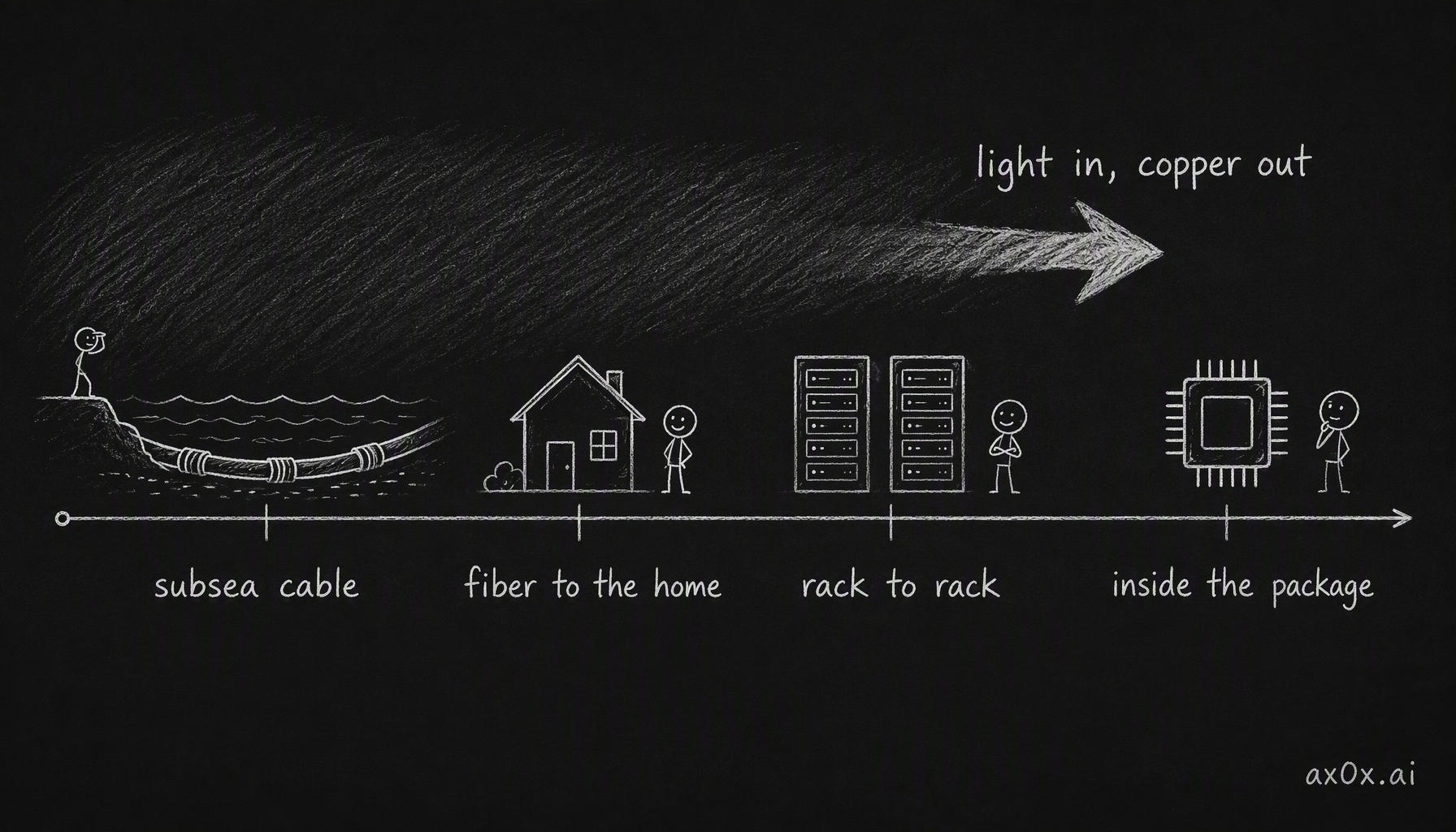 For fifty years the light-in, copper-out boundary has moved toward the chip: subsea cables, long-haul trunks, metro, fiber to the home, the machine room, rack to rack today — and next, inside the package
The market followed the boundary. Optical communication used to be a telecom business: long distances, small volumes, a new submarine cable every few years. Now the main arena is datacom — short distances, huge volumes, competition on cost. Kevin said a single AI cluster can take tens of thousands of modules in one go. That second kind of game happens to suit Chinese manufacturers, and the fifth post takes it up.
A natural question at this point: why did light win the far links first and work inward, rather than the other way round? It's the same ledger as the last post. Copper pays by distance — the longer the run, the more repeaters and the more expensive the shielded cable. Light pays by port — the electrical-to-optical conversion costs a fixed amount regardless of length. So the longer the link, the better light looks against copper, which means light naturally replaces copper from the farthest links inward. Then every generation doubles the line rate, copper's reach halves, and light takes another step in.
The computer world walked the same road
Everything above is the communications network. Over the same decades a parallel line ran through computing: chip to chip, host to peripheral, machine to machine all need to talk too. Kevin's summary of that line is one sentence — parallel gave way to serial, single-ended gave way to differential.
The 1960s RS-232 serial port put bits on one wire, single file, at a top rate Kevin gave as about 115 kb/s; at that speed a phone photo takes three or four minutes to send. In the 1970s the Centronics printer port went parallel: eight wires, one bit each, simultaneously, which Kevin put at one or two megabytes per second. The intuition was plain — eight wires, eight times faster.
So why was parallel abandoned? Kevin is clearer on this in the audio than in the episode's transcript. Eight wires have to run together in one cable, and no manufacturing process makes them identical. It's like eight running lanes of slightly different lengths. Launch the bits at the same instant and they arrive at slightly different instants, so the eight lanes' data no longer line up at the far end. At low speed the skew is smaller than a bit period and nobody cares. Push the speed up and one bit's time window becomes shorter than the lane-to-lane difference, and the whole word scrambles.
Around 2000 the entire industry turned at once and went serial. PCIe arrived in 2003 using differential signaling — two wires per signal, with the 0 or 1 read from the difference between them, which is far more immune to interference. Its single lane started at 2.5 GT/s; the seventh-generation spec, published in 2025, runs 128 GT/s — fifty times faster on one lane. USB climbed from 12 Mb/s in the late nineties to 80 Gb/s in USB4; on the disk side, serial SATA replaced parallel ATA. The strategy stopped being "keep many wires in step" and became "push one differential pair as fast as physics allows."
The circuit that does this is the SerDes — serializer plus deserializer. The transmit side packs a wide parallel word into one high-speed serial stream; the receive side unpacks it back into parallel. Kevin's picture: ten muddy country roads, each hauling goods, merge onto one wide flat highway, then split back into ten muddy roads at the destination. 敏姐 repeated it back — "oh, so all of these are SerDes" — and Kevin said yes. The Moore's law of communication from the last post, 10G to 25G to 56G to 112G to 224G, is the speed of that one lane.
The network line ran the same way. Ethernet started in 1980 at 10 Mb/s on shared coax, reached gigabit in 1998 and 10 gigabit in 2002. Ten gigabit has one exception: 10GBASE-T still runs the full 100 meters on Cat6a copper. From 25G up, or past 100 meters, fiber is essentially the only medium left. Inside data centers the ladder ran 25G, 100G, 400G, 800G, and now 1.6T.
Printer cables, USB, PCIe, Ethernet: underneath, one set of physics. Kevin's framing is that telecom's light and computing's electricity are two rivers that finally meet in the data center, and the device standing at the confluence is the optical module. I find that a lot easier to hold onto than "industry convergence."
Once the boundary is inside the rack, the next question gets concrete. Where should the electrical-to-optical conversion sit relative to the chip — plugged into the faceplate, mounted next to the switch ASIC, or sealed into the same package? That's the fourth post. And if you're curious about light being tamed for a different job — drawing transistors onto silicon — the sibling series has a post on lithography.
This series is compiled from episode 75 of the Chinese podcast 十分吸引, "光与电的游戏:有线通讯史的百年之争", with guest Kevin, a chip systems engineer, and hosts 石磊, 敏姐 and 孙悦. The framing is Kevin's; I reorganized it by theme and wrote it up, so any errors are mine. Neither the episode nor this post is investment advice — companies are named only as examples of where the supply chain sits.