Copper Pays by Distance, Light Pays by Port
The last post took an 800G module apart and ended on a question it didn't answer: why can't electrical signals just travel further? What exactly is copper's problem? That's this post. But the honest version of the answer starts one step earlier — with why everyone keeps pushing data rates up until copper gives out in the first place.
Networking has a Moore's law of its own
Everyone knows the CPU version: transistor density roughly doubles every two years. Networking has its own curve, and it isn't about transistors. It's about how fast a chip can talk to the outside world.
A chip talks to the outside through a specific kind of interface circuit. On the sending side it squeezes a wide bundle of parallel data into one very fast serial stream on a single wire pair; on the receiving side another circuit unpacks it. That pair is a SerDes — serializer plus deserializer. There's one in your USB cable, one on the PCIe slot your graphics card sits in, one behind the HDMI port on your TV. The link between a server and a switch in a data center is the same idea at higher speed.
One SerDes lane has gone 10G, 25G, 56G, 112G, and now 224G. Call it a doubling every few years, with the recent generations clearly speeding up: 10G to 25G took over a decade, then 25G to 56G to 112G ran at roughly three to five years a step. 224G is genuinely new — the first silicon demos were in 2024, and it only started shipping in volume in 2026, riding on 1.6T modules.
Switch chips are a second curve. A switch has to shuffle data among dozens of ports, sometimes five or six hundred, so its total capacity grows faster — about a doubling every two years. Broadcom's Tomahawk line is the usual yardstick: 3.2T in 2014, then 6.4T, 12.8T, 25.6T, 51.2T in 2023, and the 102.4T Tomahawk 6 announced last year, which Broadcom's March 2026 press release says is now shipping in production volume. (Tomahawk is 战斧 in Chinese; the hosts immediately drifted into tomahawk steaks.)
Optical modules ride both curves. 100G rolled out at scale in 2016, 400G in 2020–2021, 800G ramped in 2023, and 1.6T was introduced in 2025 with this year being its first real volume year.
AI changed the tempo
That cadence was fine. Doubling every few years is something a whole supply chain can plan around. Then AI arrived with a demand curve that's steeper than any of it.
How much steeper? Epoch AI tracks frontier models since 2020 and puts training compute at a doubling roughly every 5.2 months. Kevin's framing on the show was that AI demand compressed the two-to-three-year cycle the optical and chip industries used to run on by about half. Clusters went from a thousand GPUs to a hundred thousand in just a few years.
The awkward part is that the processor side of Moore's law is slowing down. The show had a nice concrete version of this: in the Pentium era twenty years ago, a CPU ran at two or three GHz. The i5 in your laptop today tops out around 4 GHz. Clock speed stopped following that curve around twenty years ago — the power density stopped cooperating — and we very plainly aren't at tens of GHz. When a single chip can't scale, the only remaining move is to wire many chips into a network.
The moment you do that, network bandwidth becomes part of the compute. Training splits work across GPUs — data parallel, model parallel, pipeline parallel — and every iteration all of them have to exchange intermediate results. The stronger each GPU, the more traffic between them. If the network can't keep up, GPUs sit idle waiting for data and utilization drops. That's the same shape as the memory wall: there the GPU waits on HBM, here it waits on the network. Either way the chip computes faster than it can be fed. People call this one the network wall.
There's a physical constraint on top. The last post ran the numbers: a hundred thousand GPUs is more than a thousand racks, an entire floor. You can't drag every chip that needs to talk into one small room. So chip-to-chip interconnect, something nobody used to think about, turned into the choke point of an AI cluster — the distances won't shrink and the data rates won't stop climbing. Which brings us back to the question: what is copper's problem?
Copper's problem is frequency
Send a signal down copper and it fades. The higher the frequency, the faster it fades — and not linearly, steeply. Two physical mechanisms are responsible.
The first: when a fast alternating signal travels through a copper conductor, the current crowds toward the surface of the wire. The middle of the conductor is barely used, which is the same as having a thinner wire with higher resistance. The higher the frequency, the thinner the effective skin. This is the skin effect.
The second: copper is wrapped in insulation, and the PCB it runs on is insulating material too. As a high-frequency signal passes, that material absorbs some of the energy and turns it into heat, and it absorbs more as frequency rises. That's dielectric loss. By the 224G generation, dielectric loss is actually the dominant term — you can polish the copper as smooth as you like and the skin effect still sits underneath it.
The numbers look like this. A lane carrying 224G PAM4 has a Nyquist frequency of about 56 GHz. Around that frequency, a 224G link measured chip to chip — connectors, packaging, and cable all included — can show insertion loss on the order of 40 dB. What 40 dB means in practice: the signal that leaves the transmitter arrives at the receiver with one percent of its amplitude.
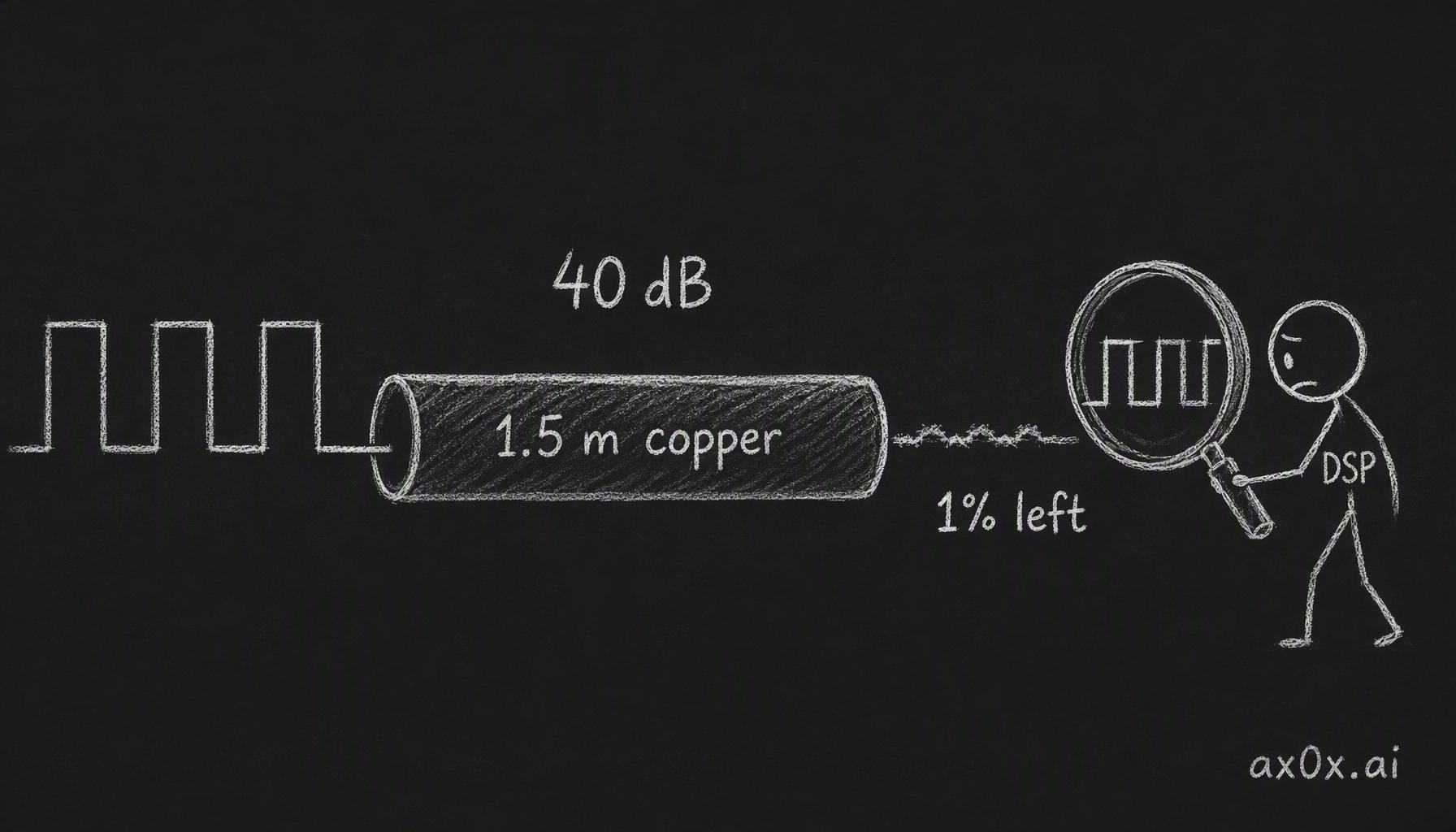 At 224G a signal crossing roughly 1.5 m of copper can lose 40 dB — one percent of its amplitude survives — and the receiver's DSP has to dig the rest back out with equalization
Can you still use a signal that's down to one percent?
When the number came up, a host asked exactly that: one percent, and you can still recover it? Yes — the chip does the recovering. The receiver runs a stack of equalization algorithms, FFE, DFE, MLSE, that pull a signal which has smeared into mush back out of the noise. MLSE in particular is usually implemented with the Viterbi algorithm, and that's all it's doing: fishing.
The fishing has a price, and it comes in three parts.
First, stronger equalization means a hungrier DSP. An 800G module draws around 16 W, and the DSP alone is 6 to 8 W of that — roughly half, the single largest consumer in the module. The DSP gets its own treatment in part four; the LPO approach discussed there exists precisely to remove it.
Second, the loss budget keeps tightening. The OIF's reach targets across three generations are 3 meters of passive copper at 56G per lane, 2 meters at 112G, 1 meter at 224G. 800G-era passive DACs are typically rated to 2 meters at most; the 1.6T passive DACs on sale today mostly say 0.5 to 1 meter. That's passive cable specifically — active copper with a retimer inside reaches further, but the retimer is another line on the power bill.
Third, crosstalk, reflections, connectors, and packaging each stack their own damage on top, and the error budget doesn't relax to compensate. The link is allowed a raw bit error rate on the order of 2×10⁻⁴ before correction, and after forward error correction it has to land at 10⁻¹² to 10⁻¹³, tighter the faster the rate. Kevin's words were that 40 dB is the limit of what SerDes receivers can recover today. The three requirements fight each other: cut power and you can't equalize as hard, yet the loss is still there and the error target hasn't moved an inch. One of the hosts summed it up as wanting everything at once — 既要又要还要.
Copper is not leaving the rack
Inside NVIDIA's NVL72 rack, the NVLink fabric between 72 Blackwell GPUs runs over copper cables on the backplane — NVIDIA's own term is direct-drive copper. Jensen Huang's number is 5,184 cables, about 3.2 kilometers in total, packed into one rack. NVIDIA has also said that replacing that copper with optical modules would add roughly 20 kW of power. Within a meter, copper is still the better deal — less power, and it basically never fails.
Copper was never the weak part here. What shrinks is how far it can go, one generation at a time. Kevin calls it copper's economic radius, and the phrase is apt: every time the data rate doubles, the radius copper can cover is cut in half. The OIF's three numbers are 3, 2, and 1 meters, and 1.6T passive cables are already at 0.5 to 1. So why doesn't light play by the same rule?
Why light doesn't care how fast you go
Light differs from copper on one point that changes everything: its loss doesn't depend on signal speed. Light travels through glass, and the attenuation is set by what the material absorbs and scatters. Standard single-mode fiber at 1550 nm loses about 0.2 dB per kilometer, and doubling the data rate leaves that number where it is. Higher rates do make the link more sensitive to dispersion and nonlinear effects, but those are a different category of problem — not a "can't get there" problem.
How little is 0.2 dB per kilometer? Over 100 km light loses about 20 dB and 1 to 2 percent of it comes out the far end — a little darker than the darkest sunglasses you can buy — and then a repeater sends it on. Set that next to copper: a 224G link is at 40 dB before it has left the board.
And there's more on light's side. No crosstalk, no electromagnetic interference, and a fiber is thin and light. On bandwidth, the conventional commercial C plus L bands give you roughly 8 to 10 THz of usable spectrum; tens of Tb/s on one fiber is routine in deployed networks, and labs have pushed a single fiber to hundreds of Tb/s and into the Pb/s range. You can also run wavelength-division multiplexing, many wavelengths in parallel through one fiber — part one touched on that with FR4.
Light's fixed toll
If light is this good, why does copper still hold so much ground? Because light charges a fixed fee for conversion, and you pay it before you've traveled a single meter.
Inside a chip, data is electrical. To get onto fiber it has to become light, and at the far end it has to become electrical again. That round trip costs something, and the cost has nothing to do with distance: 1 meter or 10 kilometers, you pay the same. Kevin's comparison on the show was a cargo ship passing through the Strait of Hormuz — however far the ship is going, it pays once at the strait.
A host followed up with the naive version: where does the money actually go? Three places — cost, power, and reliability. Cost first: everything the last post took apart — the laser, the driver, the TIA, the precision optical coupling — is bill-of-materials cost. The prices in part one put a module an order of magnitude or more above a passive DAC at the same speed. Power second: the conversion itself burns electricity, and that's where the 16 W above comes from. It's worse than it looks, because a data center's power bill isn't just what the equipment draws — cooling takes another bite. The figure given on the show was that equipment and cooling split the bill roughly in half, so every extra watt you burn costs you more than one watt. Reliability third: the laser in a module ages and eventually fails. Copper wire mostly doesn't.
The crossover moves left every generation
Put both sides on one chart and the whole thing gets obvious. Distance on the horizontal axis, cost on the vertical. Copper is a line that starts at the origin and slopes up: the further you go the more you pay, and the higher the data rate the steeper the slope. Light is a line that starts high but stays nearly flat: the starting height is the conversion toll, and after that distance barely moves it.
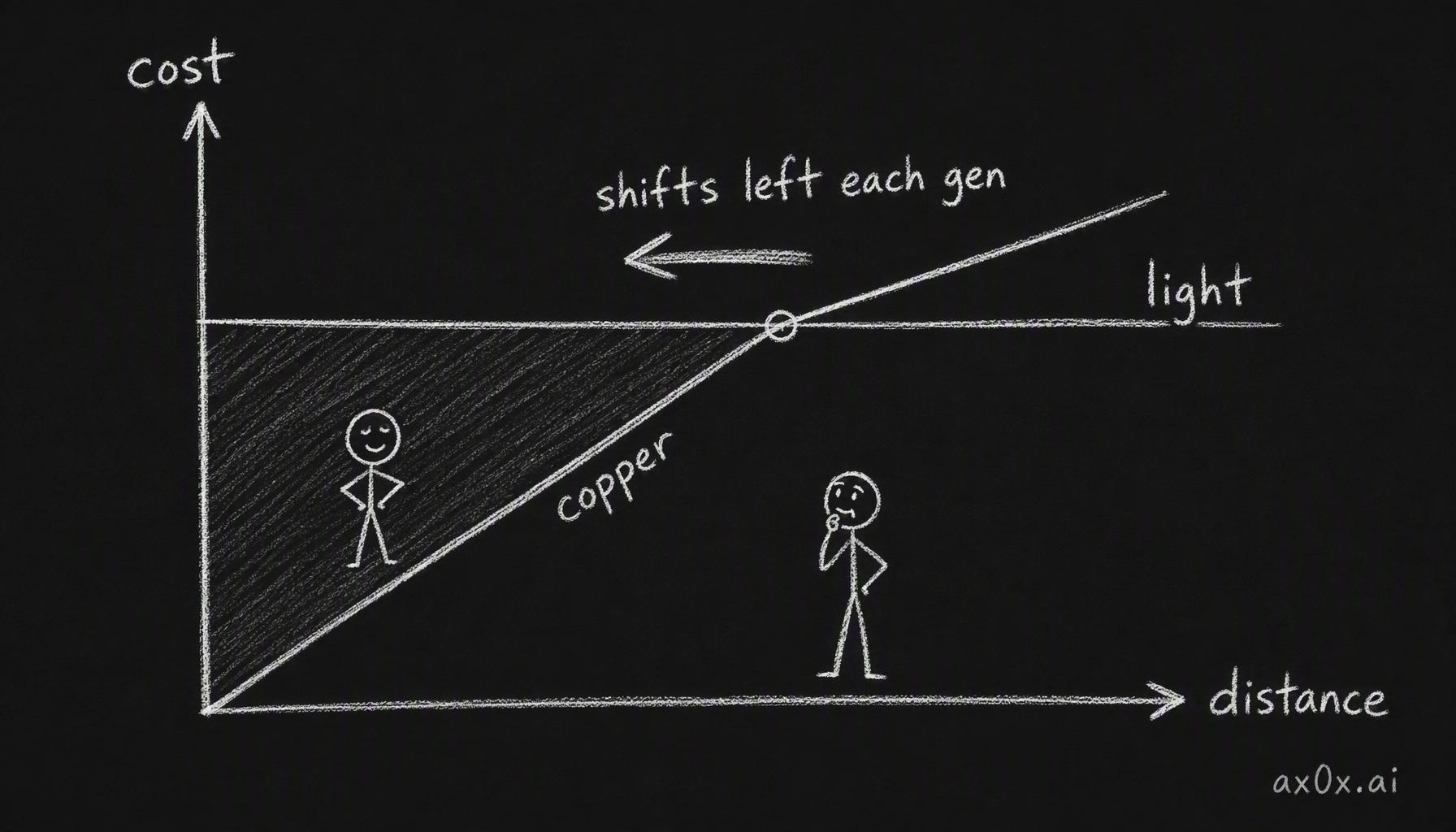 Copper pays by distance, light pays by port: copper's cost climbs with distance, light's starts high and stays flat, and the crossover point moves to a shorter distance every time the data rate doubles
At short distances and low rates, copper's line is still below light's, and the fixed toll isn't worth paying — inside a rack, in a USB cable, in the Ethernet cable behind your desk, copper owns the territory. Make the distance long and the rate high and copper's line shoots up; now light is the cheap option. Ethernet is the ready-made example: 10G runs the full 100 meters over Cat6a copper, but at 25G and above, or past 100 meters, fiber is essentially the only medium left. The show's written summary puts the whole accounting in one line — copper pays by distance, light pays by port — and I think that's exactly right.
But the crossover doesn't sit still. Every time the rate doubles, copper's line gets steeper and the crossing point slides left, toward shorter distances. It used to be that you switched to light kilometers out; today anything much beyond 1 to 3 meters between racks usually gets an optical module. Each step left converts a stretch that copper used to cover into a stretch that needs light. With processors unable to scale and bandwidth demand still climbing, the crossing point just keeps sliding left.
How did it travel that far — from the first transatlantic fiber cable in the 1980s all the way to the 1-to-3-meter line at the edge of a rack? That's part three.
This series is compiled from episode 75 of the Chinese podcast 十分吸引, "光与电的游戏:有线通讯史的百年之争", with guest Kevin, a chip systems engineer, and hosts 石磊, 敏姐 and 孙悦. The framing is Kevin's; I reorganized it by theme and wrote it up, so any errors are mine. Neither the episode nor this post is investment advice — companies are named only as examples of where the supply chain sits.