
China's Fifty Years in Fiber, Climbed from the Bottom Up
The last post ended on a question: in the fight over where the optical-electrical conversion point should sit, which square is China standing on? Answering it means walking back fifty years.
Today a 1.6T module moves about 200 GB every second, and the industry's daily argument is how close to the chip that conversion point should go. Rewind to 1976 — some sources say March 1977 — and you land in a makeshift lab next to a ground-floor toilet at the Wuhan Research Institute of Posts and Telecommunications, where Zhao Zisen heated glass over an alcohol burner and drew China's first usable optical fiber: 17 meters long, losing roughly 300 dB per kilometer. Commercial fiber today loses about 0.2 dB per kilometer.
China built the chain in reverse, from cable up to chips
Kevin's one-line summary is that China attacked this industry from the downstream end: fiber and cable first, then systems equipment, then modules, and now the optoelectronic chips at the top. A normal industry grows downward from the chips; this one grew the other way. He cuts it into five stages; I'll follow his cuts.
Stage one, 1976 to 1988, zero to one. The backdrop is Charles Kao and George Hockham's 1966 paper arguing that glass could carry signals if you got the loss down (part three traced that loss curve). Ten years later Zhao pulled his 17 meters in Wuhan. The landmark is "Project 82", live at the end of 1982: a 13.3-kilometer link between the Hankou and Wuchang telephone exchanges, running 8.448 Mb/s, enough for 120 phone calls.
Stage two, 1988 to 2000, trunk lines and absorbing imported know-how. The demand wave was the national long-distance backbone, the "eight vertical, eight horizontal" grid, built out over roughly a decade from the early 1990s into the early 2000s. Fiber supply at scale came from YOFC, founded in 1988 as a joint venture between the Wuhan institute, the Wuhan city government and Philips, with volume production from 1992. On the equipment side Huawei and ZTE broke through for the first time, and FiberHome inherited the Wuhan institute's mantle.
Stage three, 2000 to 2012, scale and substitution. The dot-com bust cleared the field and the survivors took what was left. Huawei's optical transport gear — the WDM and OTN boxes that stack wavelengths onto one fiber and frame the traffic riding those wavelengths across a country — took the number-one global share around 2009 and has held it since. The same year Accelink listed, the first Chinese optoelectronic component company to go public, with a lineage back to a research institute founded in 1976. YOFC worked its way to first place worldwide in preforms, fiber and cable, a run the Hubei provincial government now counts as ten straight years from 2016. The preform is the glass rod you draw the fiber from — the real upstream of this business.
Stage four, 2013 to 2019, Broadband China and the rise of datacom. FTTH rolled out nationwide; the State Council's 2013 Broadband China strategy accelerated it, though China had been the world's largest fiber-access market since about 2010. Overseas, cloud data centers came online and pulled demand for 40G and 100G modules. Innolight had a 40G QSFP+ out in 2012 and scaled up hard between 2016 and 2018 supplying Google; Eoptolink came later, pivoting from telecom to datacom around 2018–2019 and getting into Amazon and Microsoft. By the end of this stage China was a strong telecom-equipment country and the place where most of the world's optical modules were built.
Stage five, 2019 to now, the AI era and the chip push. The dividing line is May 2019, when Huawei went onto the Entity List and import dependence on high-end optoelectronic chips became impossible to ignore. Broker research from that year put domestic capability in 25G-and-above electrical chips at roughly 1%. The pressure sped up domestic work on DSPs, EML lasers, high-speed TIAs and drivers, but slowly: as of 2026, PAM4 ODSPs at 400G and below and TIAs at 10G and below are in decent shape, while the 800G and 1.6T tier is still early. On the demand side, AI clusters pushed modules to 800G and 1.6T, and Chinese vendors now hold most of the global top ten. The new battlegrounds are silicon photonics, LPO, CPO and hollow-core fiber. Kevin's read: on these new routes China is not behind this time, but the high-end chips at the top of the chain remain the weak spot.
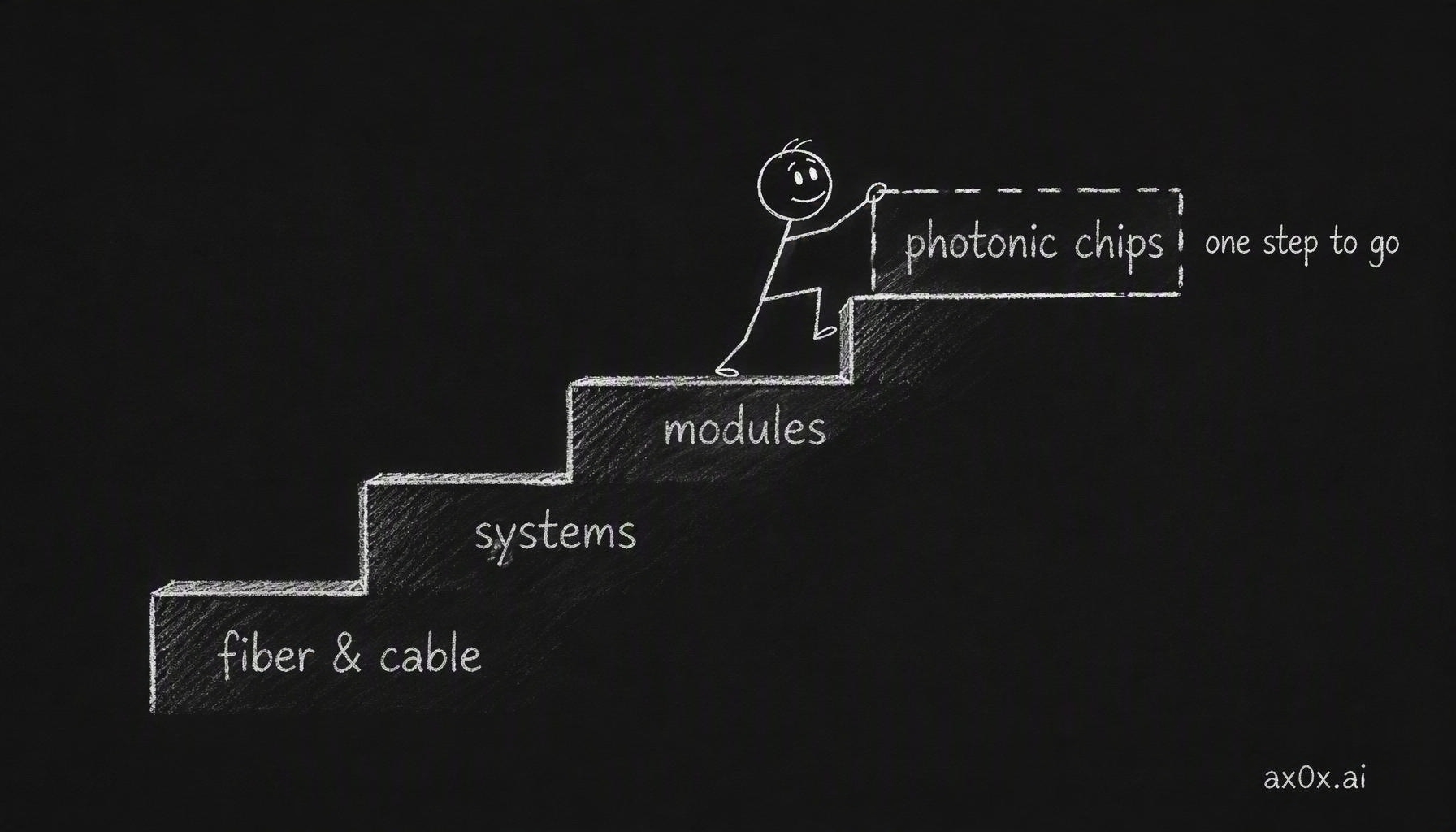 China climbed optical communications from the bottom up: fiber and cable first, then systems, then modules, and now the photonic chips at the very top — one step still to go
Take an 800G module apart and see where the money goes
Seven of the world's top ten module vendors are Chinese, which sounds like a lot. But which part of the money does the module business actually capture? Split an 800G module's bill of materials and the picture is lopsided: the optical chips plus optical components come to nearly half; the ODSP takes 20 to 40 percent (teardowns disagree; call these industry estimates); what remains is the PCB, the housing, the packaging. The ODSP market is essentially Marvell and Broadcom, with Marvell clearly ahead — a historical share around 60 to 80 percent — Broadcom the chaser, and Credo holding a slice. In high-end EML lasers the 2025 ranking has Lumentum, Broadcom, Mitsubishi and Sumitomo on top. High-speed TIAs and drivers are MACOM and Marvell. So the two most valuable pieces inside a module are, for now, not in Chinese hands.
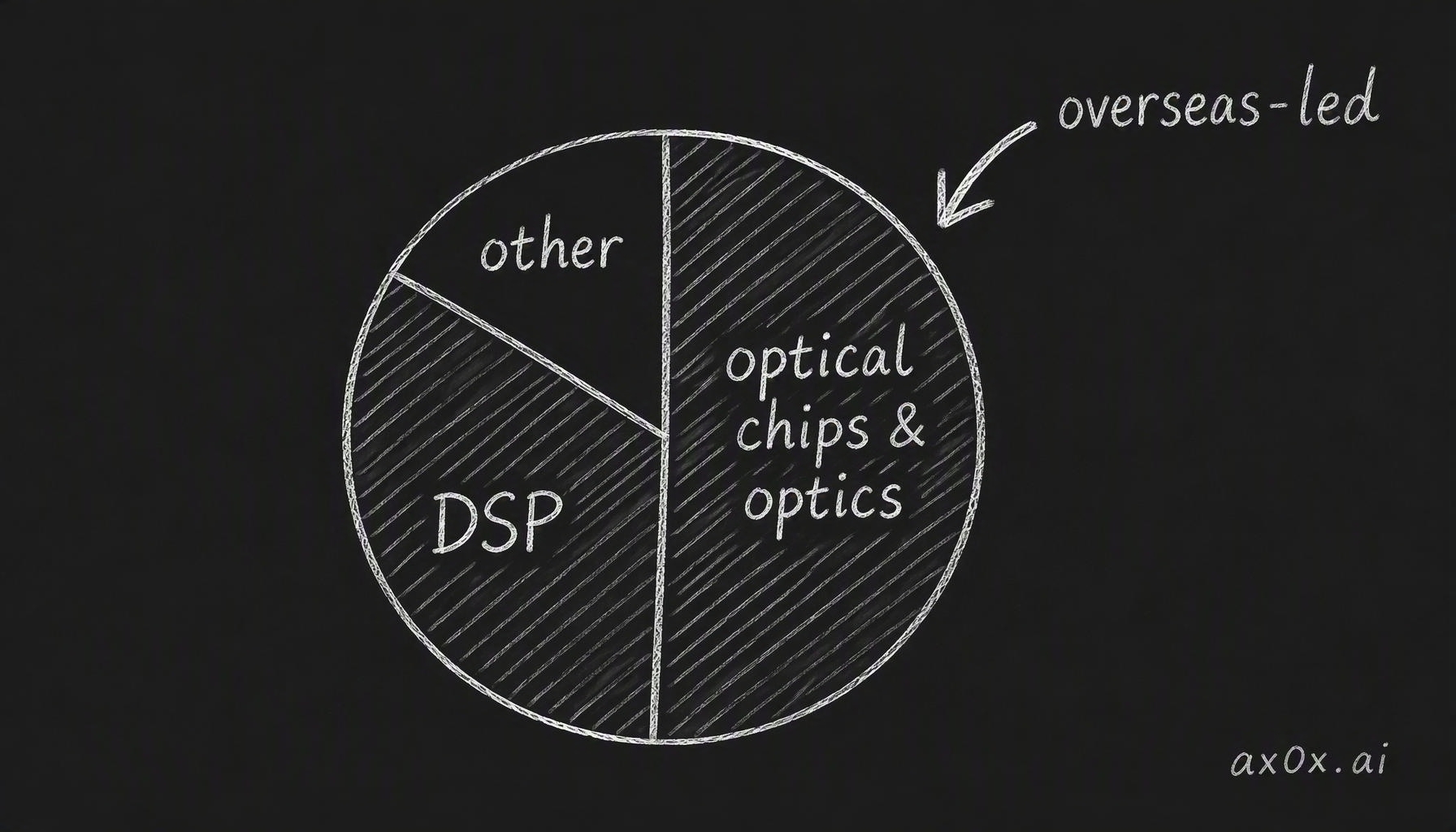 Tear down an 800G module's bill of materials: optical chips and optics are close to half, the DSP another two to four tenths — and those are exactly the pieces still made overseas
So what are the seven seats built on? 敏姐 asked the naive version: is it purely low cost? Kevin's comparison was Dell or Lenovo: a module vendor does system integration the way a PC maker does — the system is a module rather than a laptop, and the ODSP and optics get picked per customer and per volume like PC components. The technical bar is medium, but the efficiency bar is brutal. AI customers turn over a generation every quarter, and whoever climbs from sample to a million-unit ramp first takes the order. Precision packaging, fast engineering iteration and cost discipline are exactly what Chinese factories are best at. On LightCounting's rankings, Innolight has been first three years running from 2023 through 2025, Eoptolink passed Coherent for second in 2025, Accelink sits sixth and HG Genuine around eighth.
Why aren't the other three seats Chinese? 敏姐 pushed on that too. Kevin's answer: those are long-established vendors that started in optical components and make modules on the side, so the technology was theirs to begin with; and in a de-globalizing world, overseas customers need suppliers outside China for their own supply-chain diversification.
How many years is the gap upstream? Kevin answered directly, flagging it as personal judgment. Against Huawei alone, three to four years; against the new small players, probably seven to eight. Huawei was building 112G-class modules when nobody else could, which is why its gap is smaller. The difficulty: an ODSP design uses close to the entire frontier of analog and digital circuit design — part four walked through the power budget, under a watt per lane — and performance and power both have to be top-tier at once. 石磊's summary was that China has won the broad layer and not the critical node: the module packaging and manufacturing layer is won, the chip layer is not. Localization is climbing the ladder from 25G to 56G to 112G, but the 112G rung is thin; a June 2026 report put the domestic share of high-speed ODSPs at under 10%.
How much of the chain is actually at home
Start with completeness. The whole chain can be walked end to end inside the country: preform, fiber and cable at YOFC; components and modules with seven of the top ten; systems from Huawei, ZTE and FiberHome; the world's largest operator market at the end of it. 石磊's phrase was "from a grain of sand to a compute center." Most links are now self-sufficient, while the high-end ones — 800G and 1.6T optical chips, high-speed TIAs and drivers — are still catching up.
Beyond completeness, three things hold the chain up. Speed, covered above. The second is that the orders are at home: carriers, cloud providers and the national compute build-out are all domestic buyers. Why does that matter? For a domestic ODSP, it is the chance to be validated in a real box. A chip has to run real traffic in real equipment before its problems show up; the rule the show wanted listeners to remember is that a chip that never ships in a system never matures. When Marvell and Broadcom had the market locked, domestic vendors could not get a seat at that table. After AI demand exploded, both incumbents pushed their capacity toward 1.6T while the domestic mainstream is still 400G and 800G. Place an ODSP order and the first answer is no stock, the second is a higher price. That gap is the opening — reach the baseline spec and customers will take whatever you can make.
The third is that silicon photonics does not run through the advanced-node chokepoint. It uses mature 90 to 45 nm processes. 敏姐 asked how a silicon photonics chip differs from a CPU or GPU, and Kevin's answer was the clearest thing he said all episode. Compute chips live on transistor density: a newer node packs more switches into the same area. The waveguides, modulators and photodetectors on a photonic chip don't need that kind of density, so 90 nm or 45 nm is fine, but they demand very high fabrication precision. His comparison was an optics bench in a physics lab, where a laser tilted by a hair throws off the whole path; a module is that bench shrunk into a housing. The other big difference is packaging: a CPU or GPU is packaged for electrical signals only, while a photonic chip involves optical or mixed optical-electrical packaging, and in Kevin's view packaging matters as much as the design, maybe more.
Demand, manufacturing and validation are all domestic; what's missing is the design layer, and that is being filled in. The pattern is domestic module giants pairing with young ODSP companies: the module maker knows what real deployments look like, tests the chip, and hands over the first orders; the chip company answers fast and offers supply security; some module vendors have taken stakes in chip companies to iterate side by side. The show's number: an ODSP program needs at least a hundred people. Most are fabless, so the capital intensity is real, just not visible on a factory floor.
The Five-Year Plan named optoelectronics
The 15th Five-Year Plan outline came out in March 2026, and two of its sections touch this industry directly: technological self-reliance and Digital China. The closest passage is a column on advanced general-purpose components that lists optoelectronic devices alongside integrated circuits and foundational software. The compute passage reads "advance the East Data West Compute project and build a multi-tier compute infrastructure and a nationally integrated compute network," plus "build new infrastructure moderately ahead of demand." In this industry's terms — two of the hosts read the passage out on the show — the nodes of a compute network are data centers, and what connects them is light. That's as far as I'll take the policy detour.
Why this lane ends in winner-take-all
The American side of this business has already gone through several rounds. Avago announced the $6.6B LSI deal in 2013 and the $37B Broadcom Corp deal in 2015 — both closed the following year — then the $5.9B Brocade deal in 2016 — by then Avago had already taken the Broadcom name, and only Brocade's SAN switching and Fibre Channel business was kept. That run gathered switching, SerDes and ODSPs into one hand and became today's Broadcom. Marvell announced the Inphi acquisition in late 2020 and closed it in April 2021, roughly $10B for the ODSP throne. Alphawave, a pure SerDes IP company with two to three hundred million in revenue, was rolled up by Qualcomm for $2.4B in 2025.
Why? Kevin laid it out plainly. A tape-out on an advanced node costs tens of millions of dollars, SerDes IP takes years to accumulate, customer qualification is long, and a locked-in ecosystem won't move. Lead one generation and you win the large customers; volume spreads the R&D, and the next generation gets more money. So the second-place company usually ends up bought by the first — that is how Inphi and Alphawave went. 石磊's judgment is that the same physics and the same economics, stacked on the world's largest domestic module capacity and the national compute build-out, mean China will grow its own Marvell and Broadcom. He's sure there will be one; he doesn't know who or how fast. Then he added the caveat: the other face of winner-take-all is that most participants get shaken out, and more than one domestic team is working on high-speed SerDes and ODSPs.
Two questions the show left open
First: will this AI wave replay 2000? Plenty of analysts compare it to the telecom fiber bubble, when carrier capex peaked around $213B a year and, after the crash, reportedly over 90% of the fiber laid stayed dark. The show's framing: it comes down to whether the demand is real and how many years the depreciation gets spread over. The two assets differ in kind. Fiber was a demand-side problem — durable glass that sat unused. The GPU risk is depreciation speed: actual economic life may be three to five years while many hyperscalers amortize over five or six or longer. No conclusion drawn here.
Second: CPO, LPO or hollow-core fiber — which wins? LPO reworks the module's internals, dropping the ODSP for a linear driver; CPO rebuilds the system packaging, moving the conversion into the switch chip's package; hollow-core fiber swaps the medium, guiding light through air instead of solid glass. 石磊's view is that all three have enough performance headroom, so it comes down to whose cost curve bends first — or they relay each other, or run in parallel. On hollow-core, 敏姐 threw cold water: lower loss, but many times the cost, a bit like Blu-ray in its day. Still, Microsoft has already deployed over 1,280 km of it in Azure at a measured 0.091 dB/km (Nature Photonics, September 2025), below conventional fiber — the loss hurdle is cleared, and the contest now is deployment engineering and cost. The show's figure: the full optical kit runs 5 to 8 percent of an AI data center's total investment.
Back to my own seat
At the start of part one I said that, as someone who looks at GPU cluster bills every day, I only knew this chain in outline. After the whole episode, the network wall looks like the same thing as the memory wall: the GPU sits waiting for data and utilization falls off. On the HBM side the feed is too slow; on the switch side the interconnect is too thin. Either way, part of what you pay for GPUs goes to the network, and every switch port has a module in it.
That closes the series. One thing I'm still turning over. In NVIDIA's next-generation Rubin rack, scale-up inside the rack stays on a copper backplane; CPO arrives first on the switch side, and when GPU-to-GPU scale-up across racks goes optical is still open. So for this generation the copper-light line is still drawn at the rack's edge. Where the generation after that draws it, I don't know — inside the rack, or straight into the package.
This series is compiled from episode 75 of the Chinese podcast 十分吸引, "光与电的游戏:有线通讯史的百年之争", with guest Kevin, a chip systems engineer, and hosts 石磊, 敏姐 and 孙悦. The framing is Kevin's; I reorganized it by theme and wrote it up, so any errors are mine. Neither the episode nor this post is investment advice — companies are named only as examples of where the supply chain sits. The episode's last segment is 石磊 on how to research an industry you don't yet understand — not covered here, worth a listen.