
Speed to Power
Late last year, on the BG2 podcast with Sam Altman, Satya Nadella said something that sounds backwards coming from Microsoft's CEO: the company might have chips sitting in inventory that it couldn't plug in. What it lacked, he said, was "warm shells", meaning finished buildings close to power and ready to take racks. A GPU in a crate earns nothing.
That is the whole logic of this part, and Kian's course makes it in two chapters on site selection and power. Right now, being early beats being efficient. Electricity is a small line on the bill next to the GPUs, so builders will happily pay for power that is wasteful but fast, like gas turbines that throw away more than half their fuel, or transmission links that run hot because nobody wanted to wait for transformers. Meanwhile the official grid queue, the number often cited as proof that AI will need hundreds of gigawatts, is mostly paper by SemiAnalysis's count.
The last part worked out what a model demands from a building. This one is about getting electricity to that building before the chips go stale.
A rack that isn't plugged in is dead money
Kian frames site selection as when power can arrive, how you connect (grid or local, gas or renewables), and how you cover peaks and backup. His bottom line is that you pick a site that can supply each phase of the project by its deadline. Note the word "phase". Nobody waits for a gigawatt campus to be finished before turning it on.
Phased energization means building the campus in slices and switching each slice on as soon as it's ready, so revenue starts months before the last slice is done. Two examples from the course, with the facts corrected. In Ellendale, North Dakota, Applied Digital delivered the first 50 MW for its tenant CoreWeave, a GPU cloud, on October 27, 2025, and the next 50 MW on November 24, less than a month later. At Abilene, Texas, the Stargate campus that ends this series, Oracle said in September 2026 that 75% of the roughly 1.2 GW plan had been delivered, with the rest coming in later quarters. Kian estimates that's about 900 MW online, which is his multiplication, not a disclosed number.
Why the hurry? Kian's explanation is that energy is a small slice of what a data center costs. His illustrative numbers: if energy goes from 2% of the bill of materials to 3%, energy just got 1.5 times more expensive, and the total barely moved. Those percentages are a teaching device, not a measured share, and electricity is a bigger slice of lifetime operating cost than of the upfront build. The direction holds, though. The GPUs dominate, and part eight puts real numbers on how small the power bill is per GPU-hour. So when racks of GPUs sit idle waiting on electricity, paying extra for that electricity is usually the cheaper mistake.
The grid queue is mostly paper
To get power from a utility, you join an interconnection queue: the line you stand in while the grid operator studies whether it can actually deliver what you're asking for and what it would have to build to do so. Texas is the case Kian dwells on. Its grid operator is ERCOT, the Electric Reliability Council of Texas, and a "large load" there means 75 MW or more at a single site.
ERCOT's large-load queue stood at about 474 GW as of June 2026, roughly 90% of it data centers. It roughly doubled from about 233 GW in December 2025. For scale, ERCOT's all-time record peak demand is around 91 GW. So the queue asks for more than five times the most power ERCOT's grid has ever served at once. Against that, only single-digit gigawatts of large loads have actually been energized; ERCOT had approved about 9 GW to energize by mid-2026.
Kian shows ERCOT's June chart split by stage: 284.3 GW with no study submitted, 135.5 GW under review, 55 GW approved or further along. (Those three add up to the 474 GW total, so the total is not the "no study" bucket, despite how it gets described.) Kian calls the shape almost a power law: most of the volume sits at the earliest, cheapest stage, and each later stage holds less.
Why would anyone file for power they don't intend to use? Kian walks through the mechanism with a hypothetical. Joining the queue is cheap, and every candidate site needs its own study because grid upgrades differ by location. A developer who wants 1 GW and has three possible sites files three 1 GW requests, picks the best one, and withdraws the rest. The utility sees 3 GW of demand for 1 GW of intent. Multiply that across every developer chasing the same transmission lines and you get a queue bigger than the state.
How much of it is real? SemiAnalysis estimated in June 2026 that projects with physical sites behind them, meaning land and activity it could actually track, accounted for only about 45.4 GW of ERCOT's roughly 357 GW data-center queue. That's about 13%, or roughly one gigawatt in eight. Kian rounds it to one in ten; it's closer to one in seven real-to-phantom. His point stands either way: anyone citing the Texas queue as evidence of a bubble should look at that ratio first.
Virginia shows the same gap with a different structure. In PJM, the grid operator covering 13 states plus DC, data centers don't contract with PJM itself. They sign with the local utility, Dominion Energy Virginia, through stages that rise in commitment. An engineering study letter carries no obligation to build. A construction letter means the customer covers costs the utility has already incurred if it walks away. An electric service agreement is binding. As of July 2026, Dominion counted about 53.8 GW of data-center capacity under contract across those stages: 32.4 GW of engineering letters, 9.4 GW of construction letters and 12 GW of signed service agreements. Its actual data-center draw was about 4 GW at the 2025 peak and a 4.8 GW billing peak as of August 2026. That's roughly one deployed gigawatt for every eleven to thirteen in the pipeline.
Texas is now trying to clean up its queue. Under Senate Bill 6, the Public Utility Commission of Texas (PUCT, not ERCOT) adopted a rule that took effect October 8, 2026. Requests of 75 MW or more pay a flat $100,000 study fee and post $50,000 per megawatt of security before ERCOT studies them, so a 1 GW request needs $50 million up front. Applicants also have to disclose any substantially similar request elsewhere whose approval would change or withdraw this one, and show proof of site control. That goes straight at the three-sites trick. Kian's read is that it isn't a silver bullet, because much of the security is refundable for projects that aren't far along, and he guessed there would be a rush of filings before the deadline and a shrinking queue after.
The course doesn't mention a bigger event. On August 3, 2026, Governor Abbott ordered ERCOT and the PUCT to audit every data-center request of 75 MW or more, and ERCOT paused energization approvals for those loads while it checks; verification reports are due December 10. The state is now checking receipts on its own queue, which suggests it doesn't take the headline number at face value either. The pause also means grid timelines for a real project just got longer. I suspect that pushes even more builders toward the next option.
Four ways to wire a campus
If the grid is slow, make your own power. Kian lays out four supply configurations, and every big AI campus is some mix of them.
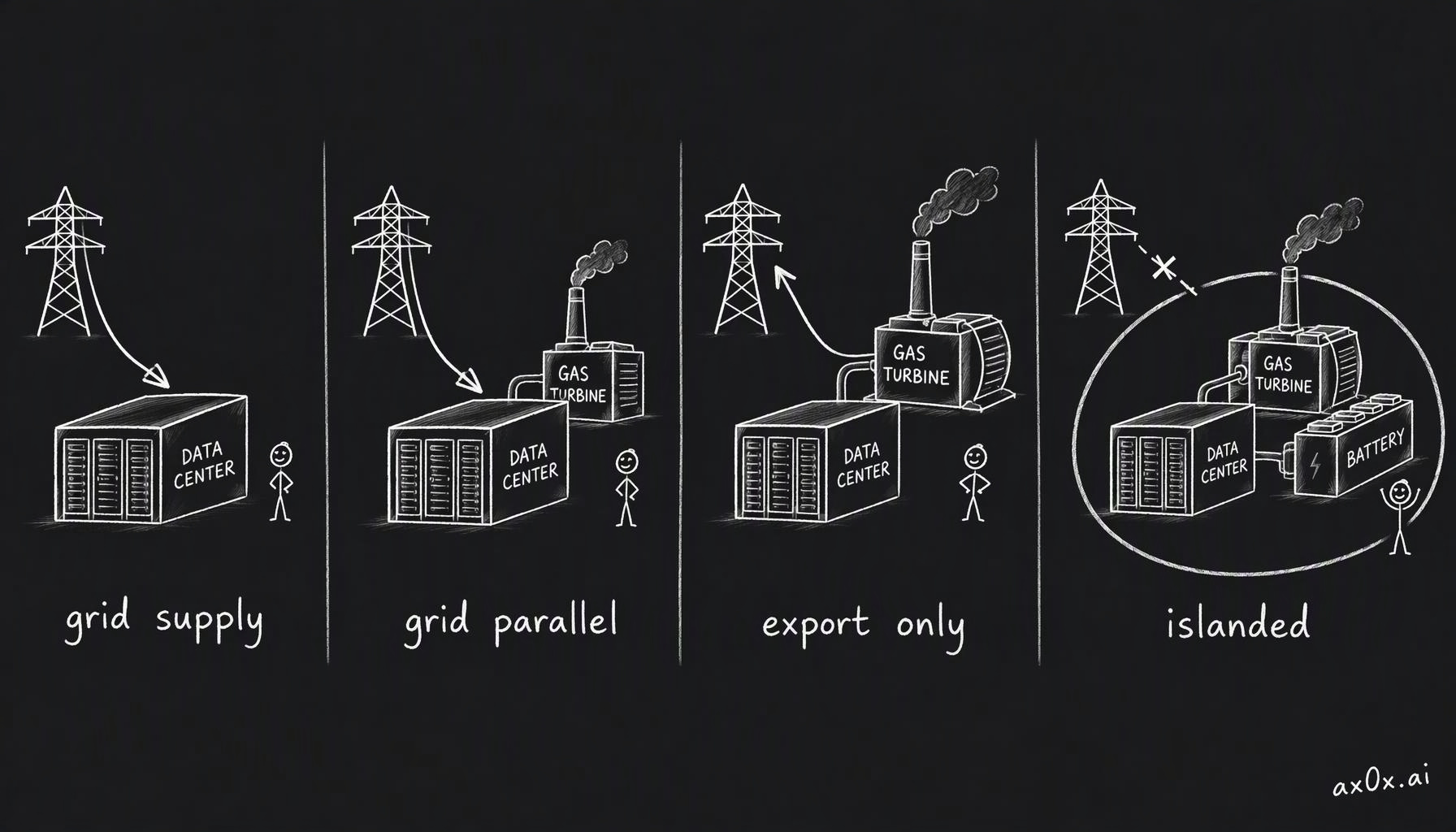 Four ways to wire a campus: grid supply, grid parallel with your own generation importing for peaks, export only where you generate everything and sell the surplus, and islanded with no grid at all
Grid supply. The utility is the normal source, and backup is designed separately. This was the default before the AI boom, because grid power is cheaper and more reliable than anything you can run yourself. Multi-year lead times on interconnection and equipment broke that default.
Grid parallel. You run your own generation alongside a grid connection that's allowed to import. Kian's example: a 1 GW campus with a guaranteed base load of at least 500 MW runs a 500 MW turbine for the base and imports from the grid for peaks, like a midday surge. How much you're allowed to import is negotiated with the utility.
Export only (Kian's label, not a standard term). You generate everything yourself, never import, and sell surplus back to the grid. Because the grid will never bail you out, you have to oversize, say 1.5 GW of generation for about 1 GW of load, and build redundancy into your own plant.
Islanded, or fully behind the meter. No grid at all. This one needs batteries or other fast balancing, because there's nothing to absorb the swings. On the ERCOT grid, if one power plant trips, more than 1,460 other units share the job of covering it. An islanded data center has only what it built. Kian calls islanded usually the fastest way online and probably the most expensive. The first half needs a caveat: turbines have multi-year waits too, so it's fastest only if you already hold the equipment. On cost, a16z's analysis agrees that on-site power almost always costs more, and that sites switch to the grid once it's available.
That last pattern has a name: bridge power. Run on-site gas while you wait in the queue, then, once the grid connection lands, make the grid primary and keep the turbines as backup. You start producing tokens, and revenue, before the utility shows up, and the turbines stay useful afterward. Abilene is the example. About 360 MW of simple-cycle gas turbines were permitted on site in January 2025: ten units, five GE LM2500XPRESS and five Solar Titan 350. Gas arrives through dedicated laterals, spur pipelines off a main transmission line, built by the pipeline company Energy Transfer. Crusoe, which built the campus, says it connects directly to ERCOT and draws primarily from the grid, with the gas plant ultimately serving as backup for the data halls instead of diesel generators. So Abilene was never islanded. It's a grid campus that used turbines to buy time.
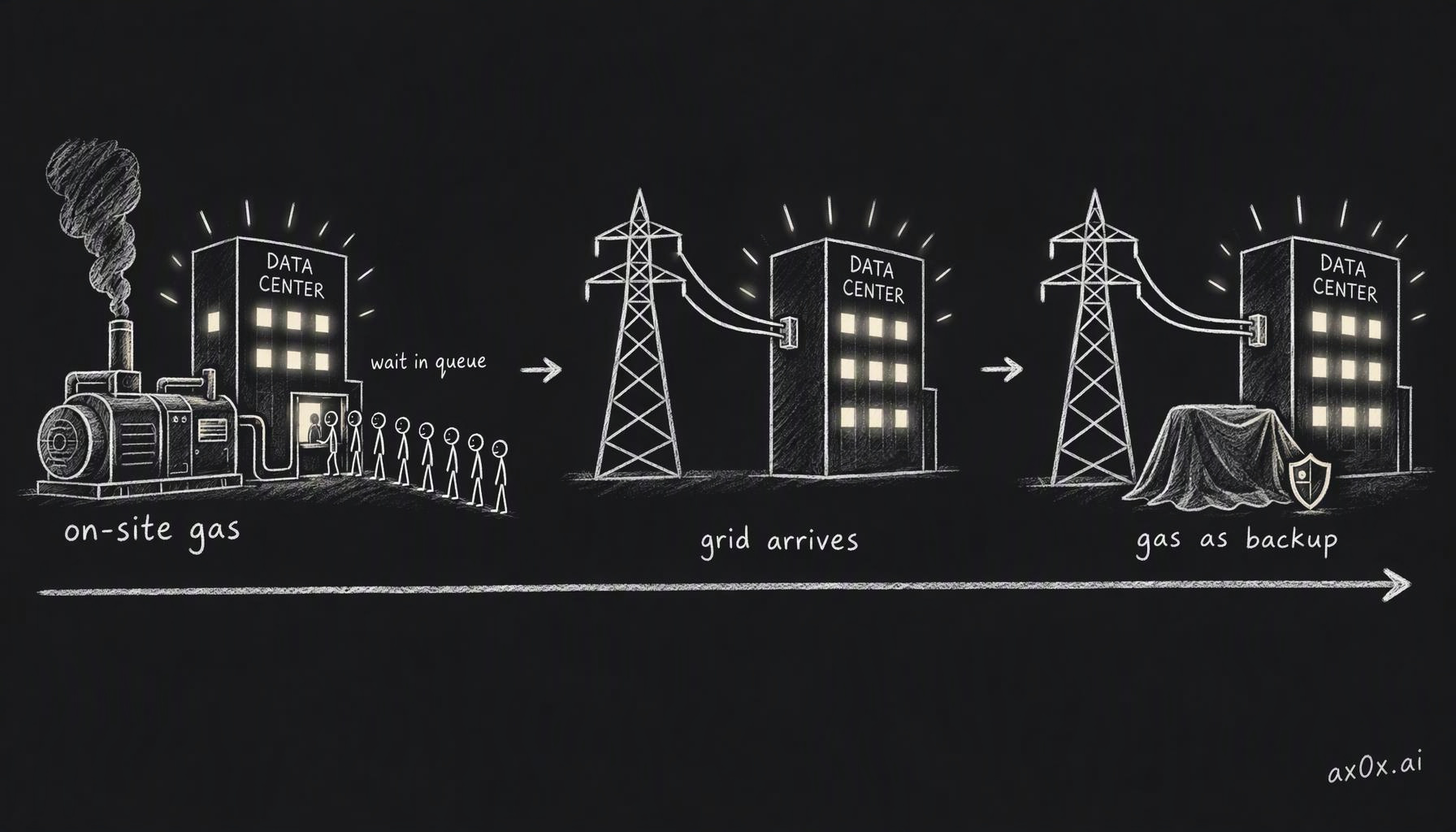 Bridge power: run on-site gas while the grid connection waits in the queue, then make the grid primary once it lands and keep the turbines as backup
Kian's generalization: a site with 100 MW of grid import can only run 100 MW of compute, but add two 500 MW units of your own and the campus can grow to gigawatt scale while the grid becomes the backup. SemiAnalysis expects 40+ GW of behind-the-meter data-center power in the US by 2028, with on-site generation powering more than half of new data centers each year by then. As of September 2026 it was tracking about 75 GW of firm, binding orders for on-site generation for AI compute, roughly 20 GW of it placed in the second quarter of 2026 alone.
Two kinds of turbine, and three kinds of fast
Almost all of that on-site power is gas, so it's worth knowing what's being bought.
A simple-cycle gas turbine, or SCGT, is essentially a jet engine bolted to the ground. A compressor squeezes air, fuel burns in it, the hot high-pressure exhaust spins a turbine, and the turbine shaft spins a generator. The units data centers buy run about 35 to 40% efficient, meaning that share of the gas's energy comes out as electricity and the rest leaves as hot exhaust. The largest frame turbines reach about 43% in simple cycle.
A combined-cycle plant, or CCGT, keeps the same gas turbine at the front and stops wasting the exhaust. That heat goes through a boiler to make steam, and the steam drives a second turbine and generator, the way a nuclear plant makes power, as Kian puts it. One fuel input, two generators. GE rates its biggest model, the 7HA.03, at over 64% efficient in combined cycle; the best measured plant record is about 63%. The first 7HA.03s to enter commercial service are at FPL's Dania Beach plant in Florida: one combined-cycle block where two of those gas turbines, about 430 MW each on their own, feed one steam turbine, for roughly 1,260 MW total.
So why not build combined cycle everywhere? Kian gives three reasons. It costs more and is more complex, with two major subsystems to maintain. It takes longer to build. And it plays a different role. A combined-cycle plant should run all the time to pay back its capital; a simple-cycle unit has fewer parts, starts and ramps faster, and costs less up front. His example: a data center that needs a steady 500 MW and peaks at 800 MW in the daytime would buy a 500 MW combined-cycle plant for the base and 300 MW of simple cycle for the peak, which might sit idle half the time.
The break-even works like two cost lines. Each machine's yearly cost is a fixed cost plus fuel cost times hours run. Combined cycle starts higher (more fixed cost) but climbs more slowly (less fuel per megawatt-hour). Below some number of hours a year, simple cycle is cheaper; above it, combined cycle wins. Kian's example lands at about 4,800 of the 8,760 hours in a year. (His stated fixed costs don't produce that; with the fuel gap in the next section, it takes a fixed-cost gap of about $8 million a year, say $8 million against $16 million.) The rule of thumb survives: run more than about half the year, and the efficient plant pays.
Kian then splits "fast" into three meanings, and they come back throughout the series. Delivery: how quickly engineering, procurement and construction can get equipment on site and energized. Startup: how quickly generation goes from stopped to producing after an outage. Ramp: once on, how quickly the site reaches its peak output. For the argument in this part, delivery is the one that matters, and here turbines have become their own queue. GE Vernova, one of the big three makers alongside Siemens Energy and Mitsubishi Power, reported a gas-turbine backlog plus slot reservations of 116 GW in the second quarter of 2026. Its heavy-duty deliveries are sold out through 2028, lead times are "directionally about three years," and it is taking reservations for 2031. Slot-reservation agreements with non-refundable deposits are real, and resale of slots on a secondary market has been reported; Kian goes further and says speculators reserved slots with no intent to use them and flipped them at a profit, though I found no documented case of it.
The fast path is therefore smaller machines: aeroderivative turbines (jet-engine-derived units) and other compact turbines like Abilene's LM2500XPRESS and Titan 350 units, plus reciprocating engines. This is also why, as Kian puts it, odd suppliers are flooding in. Cummins, long a major maker of data-center generators, is in the mix, and Boom Supersonic, the supersonic-jet startup, announced "Superpower" turbines for data centers in December 2025 with Crusoe as launch customer. Gas-rich states are the natural homes for all this: Texas first, and Pennsylvania, the second-largest gas producer in the US.
One month early beats a year of fuel
Now the calculation that, to me, is the cleanest thing in these chapters.
Take a 100 MW plant running around the clock, with fuel at $20 per megawatt-hour of fuel heat (about $5.90 per million BTU). A 40% efficient simple-cycle unit has to burn 250 MWh of gas every hour to deliver 100 MWh of electricity. A 60% combined-cycle plant burns about 166.7 MWh. That's $5,000 an hour against $3,333, a gap of about $1,667 an hour. Over 8,760 hours, the inefficient plant burns about $14.6 million more fuel per year.
Now the other side. A 100 MW facility with a PUE of about 1.2 (PUE being total facility power divided by IT power, from part one) leaves about 80 MW for racks. That's roughly 550 GB300 NVL72 racks, or about 40,000 GPUs. Rent them at an illustrative $2.50 per GPU-hour for a 730-hour month and that's on the order of $70 million of revenue per month. These are worked-example assumptions, so treat them as rough. But the comparison isn't close: one month of earlier service is worth several times a whole year of extra fuel. Kian's summary is that right now you can make a lot of money by being inefficient, as long as you're early.
The same numbers carry a caveat, and Kian stresses it repeatedly: this only holds while compute sells at a premium. The unusual build choices in this industry make sense only because an extra month of compute is worth so much right now. If GPU-hour prices fell far enough, the fuel bill would start to matter again.
Colossus 2 traded efficiency for time
The course's showcase for this logic is xAI's Colossus 2. xAI has since become part of SpaceX, after a merger announced in February 2026. The compute sits in Memphis, Tennessee. Its gas plant sits about six miles south, across the state line in Southaven, Mississippi, at a former Duke Energy plant xAI bought in mid-2025. Kian reads the location as a deliberate choice: on-site gas emits millions of tonnes of CO₂ a year at this scale and needs an air permit, and if one state got difficult, the other was right there.
The permitting history, corrected from the course: the regulator is Mississippi's Department of Environmental Quality (MDEQ), not the EPA. MDEQ treated the early turbines as "temporary-mobile" units that could run for up to 12 months without an air permit, a position critics dispute. On March 10, 2026, MDEQ's permit board approved a permanent plant of 41 turbines totaling about 1.2 GW, an average of roughly 29 MW each across a mix of models. The NAACP and the Southern Environmental Law Center have appealed. Dozens of temporary turbines ran while the permanent plant was being built.
A site this far off-grid needs something to do the grid's job of absorbing swings, and SemiAnalysis's September 2025 analysis showed Tesla Megapack batteries near Colossus 2 alongside new medium-voltage lines linking the two sites.
Those lines are the part Kian calls "impressive and creative." The normal chain runs: generate, step up to high voltage for transmission, step down to medium voltage, step down again on campus. High-voltage transformers are slow to get. Wood Mackenzie put average lead times for large power transformers at about 128 weeks in 2025, so two to three years, sometimes more. According to SemiAnalysis, xAI skipped high voltage entirely and ran the plant-to-campus link at medium voltage, with the medium-voltage gear bought from China. I couldn't see the report itself, but customs records showing an xAI affiliate importing more than 2,000 tonnes of Chinese-made transformers for the Tennessee site partly back it up.
The price of skipping high voltage is resistive loss, and here the I²R rule from part one comes back. Kian's illustrative pairing: move 200 MW of three-phase power at unity power factor. At 161 kV that takes about 717 amps per line; at 34.5 kV it takes about 3,347 amps, 4.67 times the current. Heat loss in a conductor scales with the square of current, so on the same conductors that's about 22 times the loss. Run four parallel sets of conductors and you cut the resistance four times, which brings the penalty down to about 5.4 times. These voltages are a teaching example, not xAI's disclosed design. The trade itself is the point: more copper and more wasted heat, in exchange for not waiting years for transformers.
The contracts on xAI's compute show why buying time could make sense. According to SpaceX's IPO filings, Anthropic pays $1.25 billion a month for capacity at Colossus 1 (at least 300 MW, later expanded to Colossus 2), through May 2029, with a 90-day termination clause. Google pays $920 million a month from October 2026 to June 2029 for about 110,000 NVIDIA GPUs. That's $2.17 billion a month combined. Kian cites SemiAnalysis as saying those contracts pay back the entire data-center build in under a year. I couldn't check that estimate, and the argument doesn't need it. Next to monthly fees in the billions, $14.6 million a year of extra fuel per 100 MW barely registers.
So when you read that some AI company is burning gas in small, inefficient turbines next to a gigawatt campus, the likely explanation is arithmetic, and that arithmetic holds only while compute is this scarce. The same caution goes for headlines built on queue totals. If SemiAnalysis's tracking is right, only about one requested gigawatt in eight in Texas has a real site behind it, so hundreds of gigawatts "requested" probably says more about how cheap it was to file than about what will get built.
Next, part four follows that power from the campus fence down to the one volt a GPU actually runs on.
This series is compiled from Kian's (@neuralkian) freeCodeCamp course "Inside an AI Factory – Power, Cooling, and GPUs Explained" (originally titled From Watts to Tokens; course notes at kiankyars.github.io/gigawatt). The framework and most examples are Kian's; I reorganized it by theme and re-checked the numbers, so any errors are mine. Companies are named only as examples, and nothing here is investment advice.