
The GPU-Hour Ledger
Run one GPU for an hour and the electricity costs somewhere between a dime and about forty cents. Rent that same hour from a GPU cloud and you pay a few dollars. That gap is the subject of this last part. The power bill, which every earlier part treated as the scarce thing, turns out to be a small line on the ledger. The big line is the chip. So the questions that decide who makes or loses money in compute are about contracts: who locks in a price and for how long, who pays when a GPU sits idle, and who is left holding capacity if the world ends up with more compute than it can use.
That might sound like it contradicts part three, where power was the bottleneck. Both hold at once: power is hard to get quickly, and once it flows it is cheap next to what it feeds. The second half of this part puts every earlier part in one place, the Stargate campus in Abilene, Texas, which Kian's course uses as its closing case.
The last part followed the heat out of the building. This one follows the money.
Electricity is cents per GPU-hour
Kian starts with a toy model. Take one GPU over 100 hours, rented 80% of the time, drawing 1 kW while it works. The 80 busy hours use 80 kWh and the 20 idle hours add roughly 4 kWh, so 84 kWh buys 80 billed hours, or 1.05 kWh per billed GPU-hour. At $80 per megawatt-hour that is about 8.4 cents. Double the power price to $160/MWh and it is about 17 cents.
That model flatters the GPU a little. A GPU never runs alone: the same server holds CPUs, network cards, fans and power conversion, and the cooling plant sits on top of all of it (that overhead is the PUE from part one). NVIDIA's DGX H100 server is rated at 10.2 kW maximum for eight GPUs, about 1.3 kW per GPU. A GB300 NVL72 rack is around 135 kW for 72 GPUs, about 1.9 kW each. Add a PUE of roughly 1.25 to 1.3 and you get about 1.2 to 1.7 kWh per GPU-hour at the meter for H100-class machines and about 2.3 kWh for GB300. At $80 to $160 per MWh, that works out to roughly 10 to 37 cents per GPU-hour.
Now the other column. In April 2026 an H100 on a one-year contract rented for $2.10 to $2.70 per GPU-hour, according to SemiAnalysis's price index. SemiAnalysis puts current five-year GB300 contracts at about $4.50 to $4.60. Put the realistic electricity band against those rents and power comes to roughly 4% to 13% of the price. Kian's conclusion survives the correction: electricity is cents, the GPU is dollars.
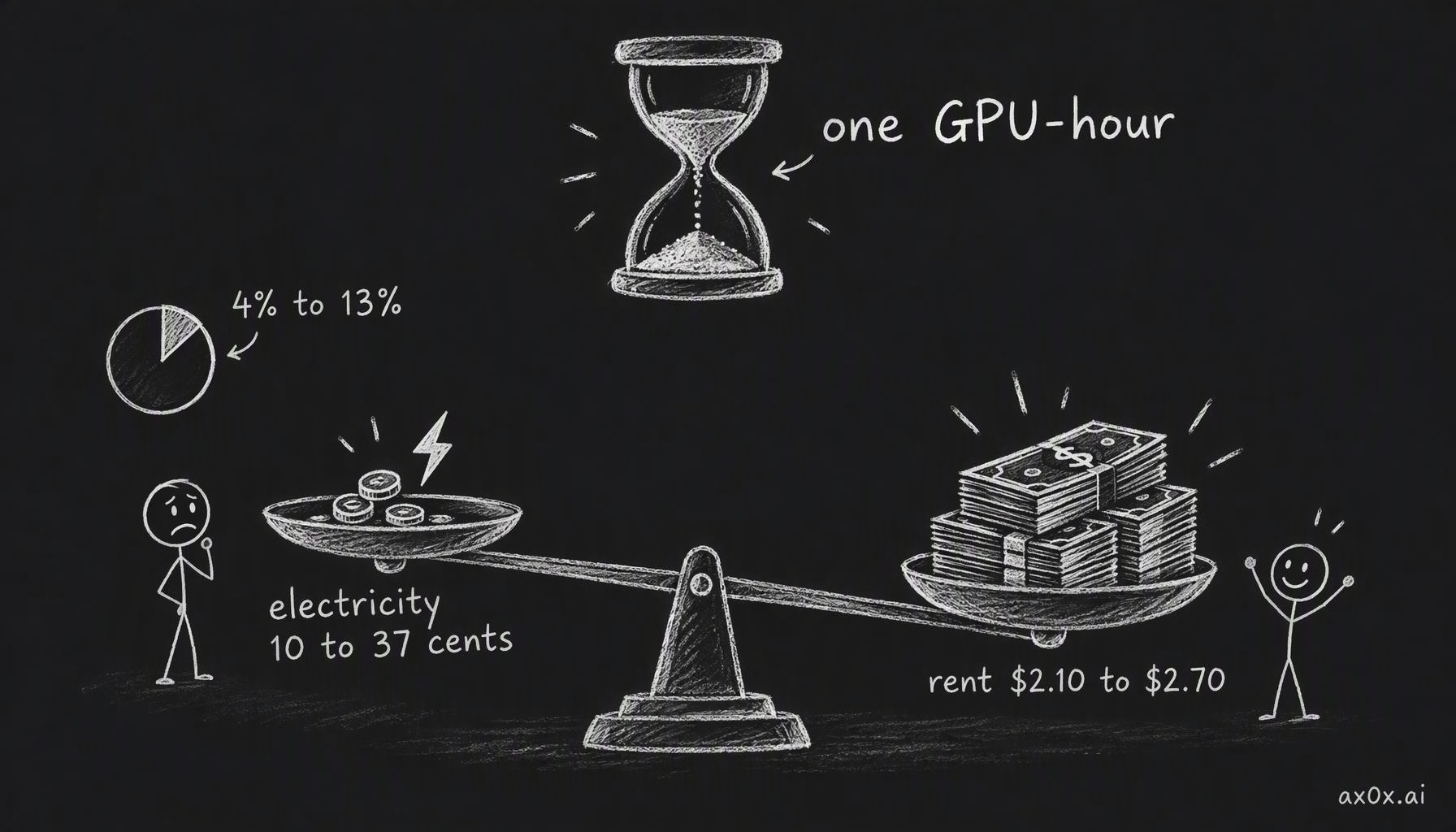 One GPU-hour: the electricity costs roughly 10 to 37 cents, while an H100 rents for $2.10 to $2.70, so power is only about 4% to 13% of the price
Where do the dollars go? Kian's answer is the hardware, and he points at NVIDIA's margins. The precise figure is a 75.0% gross margin in NVIDIA's second quarter of fiscal 2027, gross meaning what's left after the cost of making the product, before research and everything else the company spends on. A cloud that buys GPUs pays that markup up front and earns it back an hour at a time over years. That is why idle hours hurt so much more than expensive kilowatt-hours.
Power prices still move, and contracts decide who feels it. There are two basic structures. With a fixed all-in price, the provider absorbs changes in both directions: a GPU cloud that finds cheaper power keeps the difference, and one hit by a price spike eats it. With a pass-through, the customer pays increases, or an agreed index scales the billed rate with power prices.
For now the GPU clouds make money at the operating level: CoreWeave reported a 16% adjusted operating margin in the third quarter of 2025, alongside an adjusted net loss. Kian's view is that the electricity line barely matters while compute is scarce, and that in an oversupplied market, with rents falling toward cost, those cents would start to decide who stays profitable.
What gets sold, and for how long
A GPU cloud sells one of two things. The first is GPU-hours, or a commitment to a whole cluster: the customer runs its own training or inference and often resells the output to its users through its own API. The second is tokens through a model API, where the provider runs the model and the end user just buys output.
Even the first product splits in two on the same hardware. Bare metal, or self-managed, means the customer handles serving, scaling and updates. Managed inference means it is still the customer's model, but the cloud runs the serving. Anthropic signed a multi-year agreement with CoreWeave, a specialist GPU cloud, in April 2026, with the value and hardware undisclosed; Kian's understanding is that Anthropic runs that capacity self-managed, which isn't public. On the managed side, Cursor's "fast apply" model, a fine-tuned 70B model, runs on Fireworks with speculative decoding at around 1,000 tokens per second. Managed inference hands traffic spikes to the provider; self-managed keeps flexibility and keeps the provider away from your weights.
Then there is how the hours are rented. On-demand has no term and you leave when you like. Spot is spare capacity at a moving market price that the provider can take back at short notice. AWS, for example, gives a two-minute warning, so anything running on spot should checkpoint regularly and restart from the last save. Committed capacity is a contract for a fixed rate per GPU-hour over a fixed term, and it is an obligation. On-demand costs more than committed because nobody promised anything, and more than spot because nobody can take it away from you.
CoreWeave, which calls itself "the AI Hyperscaler" but is usually classed as a neocloud, gets almost all its money the third way. Over 98% of its 2025 revenue came from committed contracts, up from 96% in 2024 and 88% in 2023.
Contract length is a bet on where prices go
From the seller's side, a long contract trades repricing chances for certainty. Sign a customer for five years and the revenue is locked in. Sign for one year and you can reprice at renewal. Kian compares it to choosing between a fixed and a variable mortgage. If compute gets scarcer, the short contract wins for the seller. If compute gets cheaper, the long contract protects it.
So far, scarcity has been winning. SemiAnalysis tracks H100 one-year contract prices as a band from the 25th to the 75th percentile, with terms of three months and longer typically assuming about 25% prepayment. The band was $1.45 to $1.95 per GPU-hour in October 2025, $1.50 to $2.05 in January 2026, $1.80 to $2.35 in February, $2.00 to $2.70 in March and $2.10 to $2.70 in April. The midpoint went from $1.70 to $2.40, up roughly 40% in six months. A GPU is supposed to lose value every month after it ships. This one repriced upward.
Kian reads this as meaning that five-year deals signed a year ago are bargains for the buyers, locked well below market, and that those buyers will pay a premium when they renew. That is his reading, and it assumes compute stays tight for the rest of those terms.
His worked example shows the trade in numbers. A cloud has 1,024 GPUs for a year. Option A commits the whole fleet at $2.50 per GPU-hour, every hour paid: 1,024 × 8,760 hours × $2.50 comes to $22.43 million. Option B keeps the fleet uncommitted at $4.00 but only rents half of it on average, for $17.94 million. The breakeven is the ratio of the prices: $2.50 / $4.00 = 62.5%. At 62.5% utilization the uncommitted pool earns the same as full commitment while leaving 37.5% of the fleet free. At 80% utilization it earns about $6.3 million more. The catch is that $4.00 has to hold as the average price for the whole year, and utilization has to hold with it.
On those numbers the uncommitted pool looks attractive, so why does CoreWeave commit almost everything? Because of how the GPUs get paid for.
The signed contract is what gets financed
A GPU cloud buys its hardware mostly with borrowed money, and lenders much prefer lending against a signed customer contract, because the contract's cash flow is what pays the debt. The chain runs from a signed contract to predictable cash, then to debt, then to more GPUs. The GPUs are the collateral; the contract is what convinces the bank.
The pricing of that debt shows how much the contract matters. CoreWeave's DDTL 2.0 loan charged SOFR (a benchmark interest rate) plus 6.00% on money backed by specified investment-grade customer contracts, and SOFR plus 13.00% on money backed by non-investment-grade ones. The hardware was the same in both cases. The interest spread more than doubled depending on who had signed.
That leaves the uncomfortable case: capacity nobody has signed for. Here Kian brings in NVIDIA. In an order form signed on September 9, 2025 and disclosed on September 15, NVIDIA agreed to buy whatever capacity CoreWeave can't sell, with an initial value of $6.3 billion, through April 13, 2032, about six and a half years from signing. It is a capacity purchase order, neither a loan nor an investment. The rate NVIDIA pays isn't public. Kian illustrates with a hypothetical $2 per hour, set below market so CoreWeave still has every reason to find real customers. For NVIDIA's 2026 AI Cloud Partner backstops in general, SemiAnalysis estimates an average of about $2.35 per GPU-hour for GB300, against the $4.50 to $4.60 of five-year market contracts.
A floor like that changes the cloud's options. It can take the floor to its lenders. And, in Kian's reasoning, which SemiAnalysis also describes for the AI Cloud Partner program, it can sign shorter customer deals (three two-year contracts instead of one five-year lock-in) and rent to NVIDIA in the gaps between customers. NVIDIA's newer backstop deals also include a revenue share, so it takes some of the upside along with the downside.
How big is that downside? NVIDIA's 10-Q for the quarter ended July 26, 2026 shows $36 billion of "AI cloud agreements," spread over roughly six years. That is one line of its exposure. SemiAnalysis counts about $530 billion of gross off-balance-sheet guarantees across six lines that quarter. Kian considers NVIDIA's backstops conservative relative to its balance sheet, compared with Oracle's commitments, and he thinks oversupply is a real possibility rather than a fringe one, which is what makes the backstop a genuine risk for NVIDIA. There are signs the arrangement is under some strain: the Wall Street Journal reported on August 27, 2026, via Reuters, that NVIDIA had paused some revenue-sharing deals less than two months after launching the program, and NVIDIA denied pausing it and said the program was evolving.
Building it without switching off what already earns
The physical build runs on the same ledger. Most choices here trade money for time, and Kian stresses that they make sense only while an extra month of compute sells at a premium.
The first choice is the ground. Greenfield means building on empty land, as at Abilene. Brownfield means reusing an existing shell and utilities, which is often faster but fits less well. xAI's Colossus 1 went into a former Electrolux appliance factory in South Memphis. The substation there had about 8 MW and the site needed about 150 MW. The local utility upgraded it to 50 MW, TVA approved the full 150 MW in late 2024, and on-site turbines covered the gap. The site did get to reuse an existing 20-inch water main and an existing 16-inch gas main.
Meta put GPU clusters in weatherproof tents at its Prometheus site in New Albany, Ohio, to get compute running before the permanent halls were done; Kian estimates tents go up in weeks to months. Meta also went the other way in Temple, Texas, where it halted a half-built hall in December 2022 and rebuilt it to an AI-ready design. Per SemiAnalysis, Meta's older designs ran tens of kilowatts per rack, the lowest density among the hyperscalers.
The land itself can carry surprises. Texas has split estates, where a mineral owner or lessee can use the surface to drill even on land you own, with protection for existing uses only in limited cases. New Era Energy & Digital's planned campus near Odessa, 493 acres phased toward about 1.4 GW, was still waiting on a final surface waiver from one leasehold operator as of its latest 2026 update. Neighbors matter too: Rogers built a sound-barrier enclosure around the chillers at its data center in Owen Sound, Ontario, which sits close to homes and a church. Fiber should arrive by diverse routes, as at QTS's Suwanee campus. And when a second hall goes up next to a live one, you build and test the new access road and fiber first, cut over, and only then dig. Kian's hypothetical price for cutting the live fiber is about $1 million a day.
Then the engineering, procurement and construction, or EPC. Engineering sizes the switchgear, transformers and connections. Procurement orders the package and reserves factory slots for long-lead gear. Construction pours foundations, sets equipment skids and connects them. Kian's worked case shows why this can't be frozen early. A 20 MW IT site is laid out as ten 2 MW zones. Midway through, the rack design doubles from 100 kW to 200 kW, so each zone goes from twenty racks to ten. Current per branch roughly doubles at the same voltage, past a 160 A branch rating. Coolant flow per rack goes from about 2.4 kg/s to 4.8 kg/s for a 10 °C rise, past a 3 kg/s branch. Pressure drop scales with the square of flow, so 20 kPa becomes 80 kPa against a 60 kPa limit. Floor load per rack position roughly doubles too, with a GB300 NVL72 at around 1.5 tonnes. The example is invented, but the drift is real: an AFCOM survey put average rack density at 16 kW in 2025 and 27 kW in 2026.
The industry's answer is to move work into factories. AWS's Project Houdini with Cupertino Electric, reported in April 2026, builds data-hall modules about 45 feet long off-site, cutting server installation to two or three weeks from about fifteen. Siemens and Compass Datacenters combined medium-voltage switchgear and a transformer on one factory-tested skid. Prefab from many suppliers only works if the pieces fit, which is what the Open Compute Project's interface specs are for. Its UQD (Universal Quick Disconnect) connectors let one supplier's plug fit another's socket, though a standard plug doesn't fix capacity, and in the 200 kW case the branch still needs redesign. The 800 V DC push from part four is being standardized through OCP as well. Acceptance testing moves into the factory too (wiring, leak tests, controller logic on simulated signals), leaving the site to check field joints, real flow and real sensors.
Last, energize by zone. A zone runs only when its power, cooling and network are all finished. In Kian's example, 60 of the 100 racks reach that point first, 12 MW live, while the rest are still waiting on cooling or electrical work. Those 12 MW start earning while the other 8 MW are still under construction.
Abilene, end to end
Abilene touches every earlier part, so it makes a good recap. Start with who does what. The land is the Lancium Clean Campus. Crusoe designs, builds and operates the facility. Oracle leases it, deploys its own cloud there (OCI), and, per Epoch AI, owns the chips. OpenAI runs the workloads. Crusoe didn't carry the capital alone: Blue Owl Capital and Primary Digital Infrastructure formed a $3.4 billion joint venture with it in October 2024 for phase 1 (about 206 MW), expanded in May 2025 into a $15 billion joint venture for the six phase-2 buildings. Kian finds the three-layer arrangement odd, since Crusoe could in principle sell to OpenAI directly, and reads it as Oracle's strategy of taking on a huge obligation to OpenAI. Each layer is a contract resting on the one below it, and Kian's caution is that the stack works as long as OpenAI keeps paying and might not hold in a compute surplus.
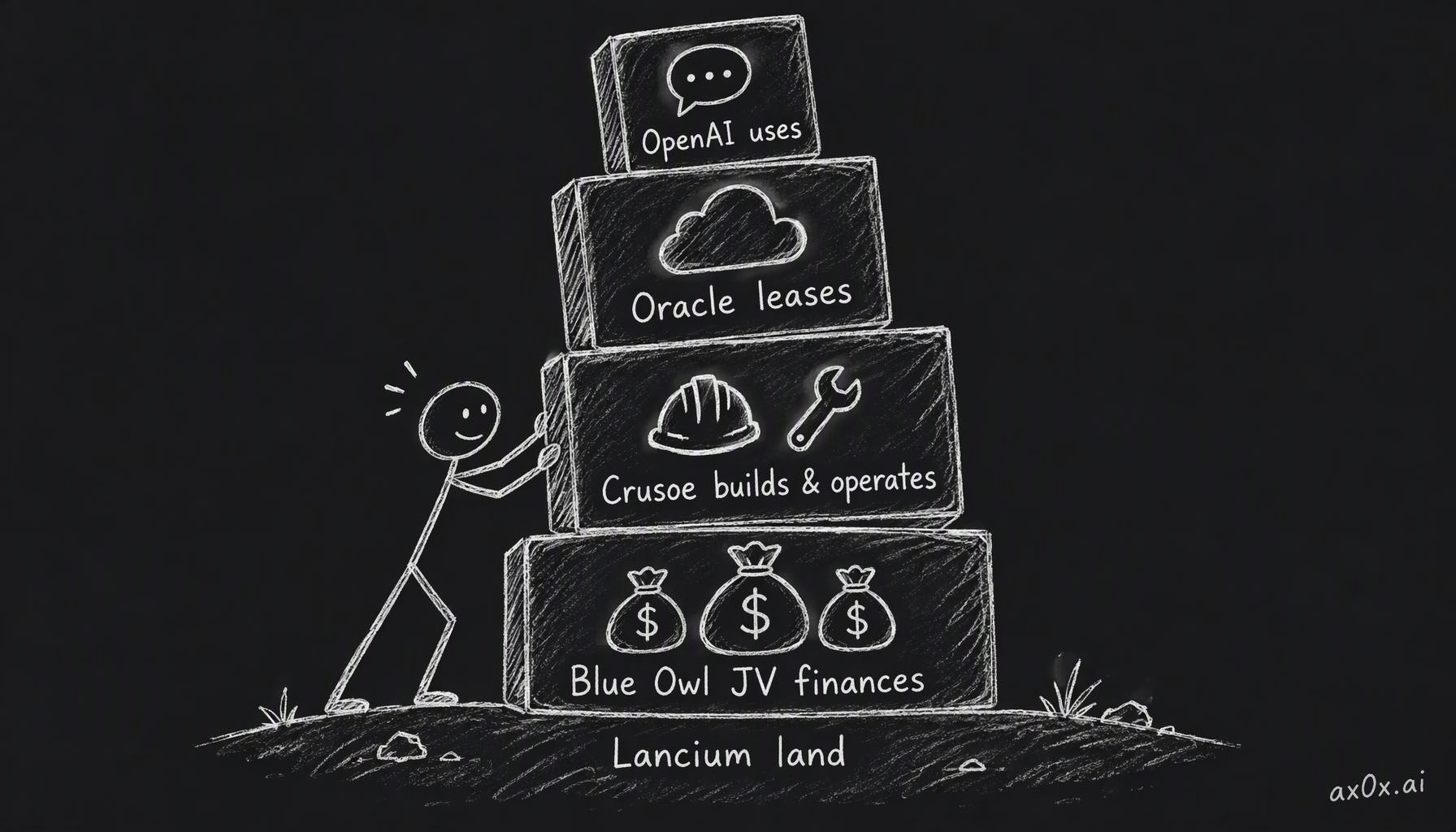 The Abilene stack: Crusoe builds and operates the campus on Lancium land, Oracle leases it and runs its cloud there, OpenAI uses the compute, and a Blue Owl joint venture supplies the capital
The full campus is eight buildings, about 4 million square feet and 1.2 GW. In the terms of part one, that gigawatt is the size of the power pipe, the ceiling. How much compute comes out depends on everything downstream of it.
The workload sets the network. Inference often fits inside one scale-up domain such as an NVL72 rack, while pre-training needs a fabric across racks and eventually across buildings (part two and part six). Kian notes OpenAI will want the halls interconnected for large training runs, which means wiring live buildings to new ones without disturbing either.
Power came the way part three described. Crusoe says the site connects directly to ERCOT, the Electric Reliability Council of Texas, while about 360 MW of on-site simple-cycle gas turbines bridge the wait and will ultimately serve as backup for the data halls in place of diesel generators. That turns the turbines into one more runner in part five's relay. The reason to bridge is the queue: ERCOT's large-load interconnection requests went from 63 GW at the end of 2024 to about 226 GW in November 2025 and about 410 GW in March 2026.
From the fence inward, it's part four's staircase, starting from a 345 kV import for phase 2. Crusoe also verticalized the slow part of that staircase. It builds its own medium-voltage switchgear, low-voltage switchboards, enclosures, controls and copper busbar in Tulsa, Oklahoma. A second Tulsa plant opened on September 14, 2026, adding 400,000 square feet and bringing its manufacturing footprint to about a million, and the Tulsa operation has supplied Abilene with thousands of switchboards. Kian's point is that developers that used to orchestrate vendors like Siemens, ABB and Schneider Electric now build gear themselves to control lead times.
Heat leaves the way part seven described: closed-loop facility water, rejected through air-cooled chillers, with no evaporation. By Crusoe's figures, each building needs about a million gallons to fill once, then around 50,000 gallons a year for maintenance. Crusoe says it chose this system, rarely used at this scale because it costs more over its life, for responsible water management in dry, water-stressed West Texas. Kian calls that a half-truth. His reading is that water cooling would have drawn a backlash, and that depending only on electricity may simply be the better long-run bet. The counterpoint is that air-cooled chillers use more electricity than evaporative cooling, worst on exactly the hot Texas afternoons when power is tightest.
Then the timeline, planned against delivered. Construction began in June 2024. Phase 1, two buildings of about 980,000 square feet and 200+ MW, was targeted for energization in the first half of 2025. Crusoe says both buildings were energized within a year of the start, Oracle began delivering GB200 racks in June 2025, and Crusoe declared phase 1 live, running OpenAI work, on September 30, 2025. Phase 2, six buildings, began in March 2025 with a mid-2026 target; the final building topped out in November 2025. In September 2026 Oracle said 75% of total capacity had been delivered, with the rest in later quarters. Epoch AI's satellite-based tracking, updated October 2, 2026, sees about 421 MW of IT power operating and projects about 843 MW by the fourth quarter, numbers that sit below Oracle's, though they may count different things (IT power against total power). Phase 1 arrived roughly on time. Phase 2 is late. And through all of it, the first halls ran OpenAI's work while the rest of the campus was still being built around them, which is the zone-by-zone energization from the last section at gigawatt scale.
Kian closes his course on this line, and I'll paraphrase it. At the rack, the workload decides what power, cooling and network you need. Across a hall, those needs become distribution and cooling systems serving rows. Across a campus, they become substations, outdoor cooling, generation, land and financing. A hardware choice becomes a facility design. What this last part adds is that the facility design ends up as a stack of contracts.
So if you're wondering why the price you pay per token doesn't seem to follow electricity prices, this is probably most of the answer. Power is roughly a dime to forty cents of a GPU-hour that rents for dollars. When token prices move, I'd look first at how scarce GPUs are and what the contracts underneath say, and only then at the power bill.
That's the end of the series. If you came in here, part one draws the map from the start.
This series is compiled from Kian's (@neuralkian) freeCodeCamp course "Inside an AI Factory – Power, Cooling, and GPUs Explained" (originally titled From Watts to Tokens; course notes at kiankyars.github.io/gigawatt). The framework and most examples are Kian's; I reorganized it by theme and re-checked the numbers, so any errors are mine. Companies are named only as examples, and nothing here is investment advice.