
The Horus Heresy: How a Father's Greatest Son Broke the Galaxy
There is a corpse on a golden throne at the heart of the human galaxy, and it has been dying for ten thousand years.
It cannot speak. Its body was broken beyond healing in a single afternoon of violence, and the only thing keeping its mind tethered to the world is a machine that devours roughly a thousand human souls a day. A trillion-strong empire kneels before it and wages eternal war in its name, convinced it is a god.
It would have hated all of this. In life, the being on that throne was a militant atheist who outlawed religion and tried to drag a superstitious species into an age of reason. The empire it built is now the most fanatically religious civilization in history. That irony — the founder's dream becoming its precise opposite — is the engine of the entire setting. To understand it, you have to understand the war that broke everything.
If you've followed this series, you've met the grimdark galaxy and its squabbling factions, and walked the 60-million-year timeline. The Horus Heresy is the moment on that timeline where the music stops. Everything bleak about the 41st millennium — the god-worship, the paranoia, the endless war — is downstream of one civil war that lasted less than a decade. This is the story of how the galaxy broke, told from the inside.
Companion slide deck → The Horus Heresy: a visual retelling — an 18-slide web deck for talks and demos. Use ← / → (or swipe) to move through it; press Esc for the index.
The man who wanted to be his species' first rational ruler
To feel the tragedy, you have to start with the dream, and the dream belonged to one man. The Emperor of Mankind is the oldest human in existence — a being who, in the lore, has lived since the dawn of civilization, accumulating immense psychic power across the millennia. (His kind are called Perpetuals — humans who simply do not die.) For most of history he stayed hidden, waiting. Then, in the late M30 — the 30th millennium, roughly the year 29,000 — he stepped onto the stage of an Earth shattered into warring techno-barbarian fiefdoms and conquered the whole planet, then the Moon, then turned his eyes outward.
His plan was specific and, by the standards of this universe, almost heartbreakingly hopeful. Humanity's scattered colony worlds were dying in isolation, cut off by warp storms during a 5,000-year dark age. He would reunite them under one banner — not a religious banner, a rational one. He founded the Imperial Truth: a creed of science, secularism, and human self-determination. No gods. No worship. Especially not of him — for he had spent his long life fighting the things that lurk in the warp and feed on human belief, and understood better than anyone alive exactly how dangerous gods are.
To wage this reconquest — the Great Crusade — he needed generals. So he built them.
Twenty sons, scattered to the void
Beneath the Himalayas, in gene-laboratories no Imperial scientist has ever been able to reverse-engineer, the Emperor created twenty superhuman beings from his own genetic code. These were the Primarchs — demigods in human shape, each a transhuman general engineered to lead an army and embody a facet of war. Towering, brilliant, all but immortal. Think of them as the Emperor's sons, because that is exactly how he and they came to see it.
He never got to raise them. The four Chaos Gods — the malevolent entities of the warp — tore open a rift in the gene-vaults and scattered all twenty gestating infants across the galaxy. They landed on lost human worlds and grew up alone: as gladiators, as tyrants, as monks, as orphan-kings. Chaos had played the first move in a game that would take centuries to mature.
From each Primarch's genetic material the Emperor also grew a Legion of Space Marines — thousands of genetically enhanced warriors, twenty Legions numbered I through XX. As the Great Crusade swept outward from Terra around 798.M30, he found his lost sons one by one on their adopted homeworlds and reunited each with the Legion grown in his image.
Here is one of the eeriest things about the lore: there were twenty Legions, but the official records only ever discuss eighteen. The IInd and the XIth — two whole Primarchs, two whole Legions, hundreds of thousands of warriors — were deliberately and totally erased. Names, homeworlds, fates: blank, expunged from every Imperial archive before the Heresy even began. This is not an author's oversight; Games Workshop has kept it intentionally empty for decades. Anyone who tells you the "real" names of the lost Legions is selling you fan-fiction. The silence is the point.
The eighteen who remained would, in time, tear themselves in two. And the favorite would lead the fall.
The Warmaster
Among all the recovered sons, one stood above the rest: Horus Lupercal, Primarch of the XVI Legion, the Luna Wolves. He was the first Primarch the Emperor found, and the closest. Where other Primarchs were aloof, or brutal, or strange, Horus was magnetic — a natural leader, a brilliant warrior, a diplomat who could win a planet with a handshake as easily as with a gun. His brothers loved him; his father trusted him above all others. If the Crusade had a beating heart, it was him.
So when the Great Crusade reached its high-water mark at the Triumph of Ullanor — a colossal victory over the largest Ork empire humanity had yet faced — the Emperor named Horus Warmaster: supreme commander of the entire Crusade, the first and only Primarch to hold the title. And then he did the unnatural thing. He went home.
The Emperor withdrew to Terra and locked himself away on a secret project he refused to explain to anyone — not even to Horus — leaving the galaxy's reconquest entirely in his favorite son's hands.
You can feel the trap closing already. His project, concealed even from the Primarchs, was the construction of a human Webway gate: a doorway into the alien dimension that would have freed humanity from ever traveling through the soul-eating warp again. But to Horus, who knew none of that, it looked like abandonment — promoted, then ignored, carrying the whole galaxy on his back while his father did something in secret and sent no word. The resentment had a foothold now. Chaos only needed to widen the crack.
The wound that would not heal
It widened on a moon called Davin.
There was a man in Horus's circle who was not what he seemed: Erebus, First Chaplain of the Word Bearers Legion. That Legion and its Primarch Lorgar had a particular grievance — Lorgar had led his sons in worshipping the Emperor as a god, and the Emperor, who hated nothing more than worship, had publicly humiliated him for it. Lorgar had since found four real gods to serve, in the warp. He and Erebus had been secretly serving Chaos for years, waiting for their chance at the Warmaster.
On Davin, a Chaos-tainted world, Horus was struck down by an anathame — a xenos blade with daemonic, soul-poisoning properties. The wound festered; it would not heal. As Horus lay dying, his desperate advisors were steered by Erebus toward a local cult who promised to save him through ritual. The ritual cast his spirit into the warp — and there, Chaos showed him a vision.
It was a careful, devastating piece of theater. Erebus disguised himself as Hastur Sejanus — Horus's beloved friend, dead years before — and walked the Warmaster through a future. In it, mankind had crowned the Emperor a god and built a vast, cruel, superstitious religion in his name. The Primarchs were forgotten; Horus's own contributions, everything he'd bled for, erased from history. The secular dream was dead, replaced by exactly the kind of god-cult the Emperor had sworn to destroy.
Here is the cruelest part, the irony the entire setting turns on: the vision was true. That is the future — it is the 41st millennium, and Horus's rebellion is precisely what causes it. Chaos showed him a real future and let him believe he could prevent it by betraying his father. He turned not out of lust for power, but out of grief and a manipulated love, convinced he was saving humanity from his father's failure.
So forget the idea that Horus was simply an evil, power-hungry villain. He wasn't, and that's what makes it a tragedy rather than a melodrama. He was the most loved, the most capable, the most loyal — and Chaos found the one true grievance in his heart and turned it into a blade aimed at his father's throne.
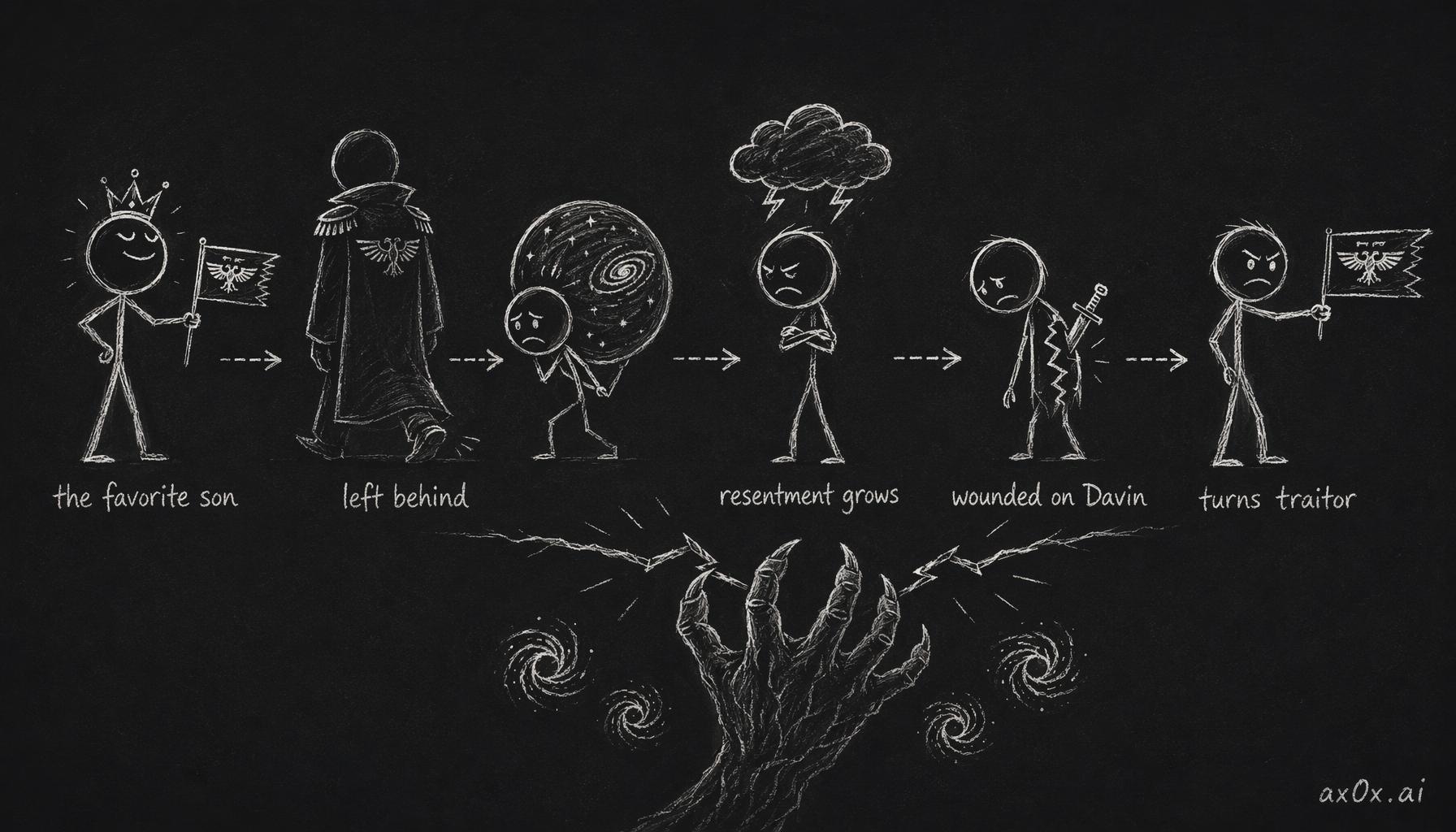 The causal chain of Horus's fall: promoted to Warmaster then abandoned, resentment takes root, wounded on Davin, and Chaos widens that real grievance with a false vision until he turns his weapon on his father.
Eight billion dead to hide a secret
Horus came back from Davin healed and damned. Before he could march on Terra, he had to purge the loyalists hiding inside his own Legions — quietly, before word reached his father.
He did it with the Isstvan III Atrocity of 005.M31 — the year 30,005, the first overt act of the Heresy. Horus ordered the elements he distrusted — drawn from his four committed Legions, the Sons of Horus, Emperor's Children, World Eaters, and Death Guard — down onto the surface of Isstvan III, then virus-bombed the planet with his own loyal troops on it. Roughly eight billion died in the opening minutes — a massacre designed to look like a tragic accident of war and to scrub the rot of loyalty from his Legions in one stroke.
It didn't fully work. A few hundred loyalist Space Marines survived in sealed bunkers, dragging out a months-long ground war against their own former brothers. And one ship escaped: the frigate Eisenstein, carrying the Death Guard captain Nathaniel Garro and a handful of loyalists who broke through the blockade and ran for Terra to scream the truth. The Warmaster is a traitor. It was the first time anyone on Terra would hear those impossible words.
The Drop Site Massacre: the trap fully sprung
When word of Horus's treachery reached Terra, Rogal Dorn of the Imperial Fists dispatched seven Legions to Isstvan to crush the traitor before he could gather strength. The first wave — the Iron Hands, Salamanders, and Raven Guard, led by the Primarch Ferrus Manus — made planetfall on Isstvan V and slammed into Horus's forces.
What they didn't know was that the second wave coming to reinforce them — the Iron Warriors, Night Lords, Alpha Legion, and Word Bearers — were already traitors. Four more Legions, secretly turned, landing behind the loyalists as friends. The loyalists fought their way forward, the traitors holding the line ahead of them, reinforcements at their backs. And then the reinforcements opened fire.
The Drop Site Massacre is the moment the true scale of the betrayal became visible: not one rogue Warmaster, but nine Legions in revolt. The eighteen known Legions had split almost perfectly in half — nine loyal, and nine turned: the Sons of Horus, Emperor's Children, World Eaters, Death Guard, Thousand Sons, Word Bearers, Iron Warriors, Night Lords, and the Alpha Legion, whose loyalties the lore keeps maddeningly ambiguous to this day. Caught between two enemies, the three loyalist Legions on the ground were annihilated. Ferrus Manus, charging in fury, was beheaded by his own former best friend, the traitor Primarch Fulgrim — the first Primarch to die in the war, killed by a brother. The Iron Hands, Salamanders, and Raven Guard were shattered to scattered survivors, remembered ever after as the Shattered Legions. In a single afternoon, the Imperium lost half the strength it had thrown at the rebellion.
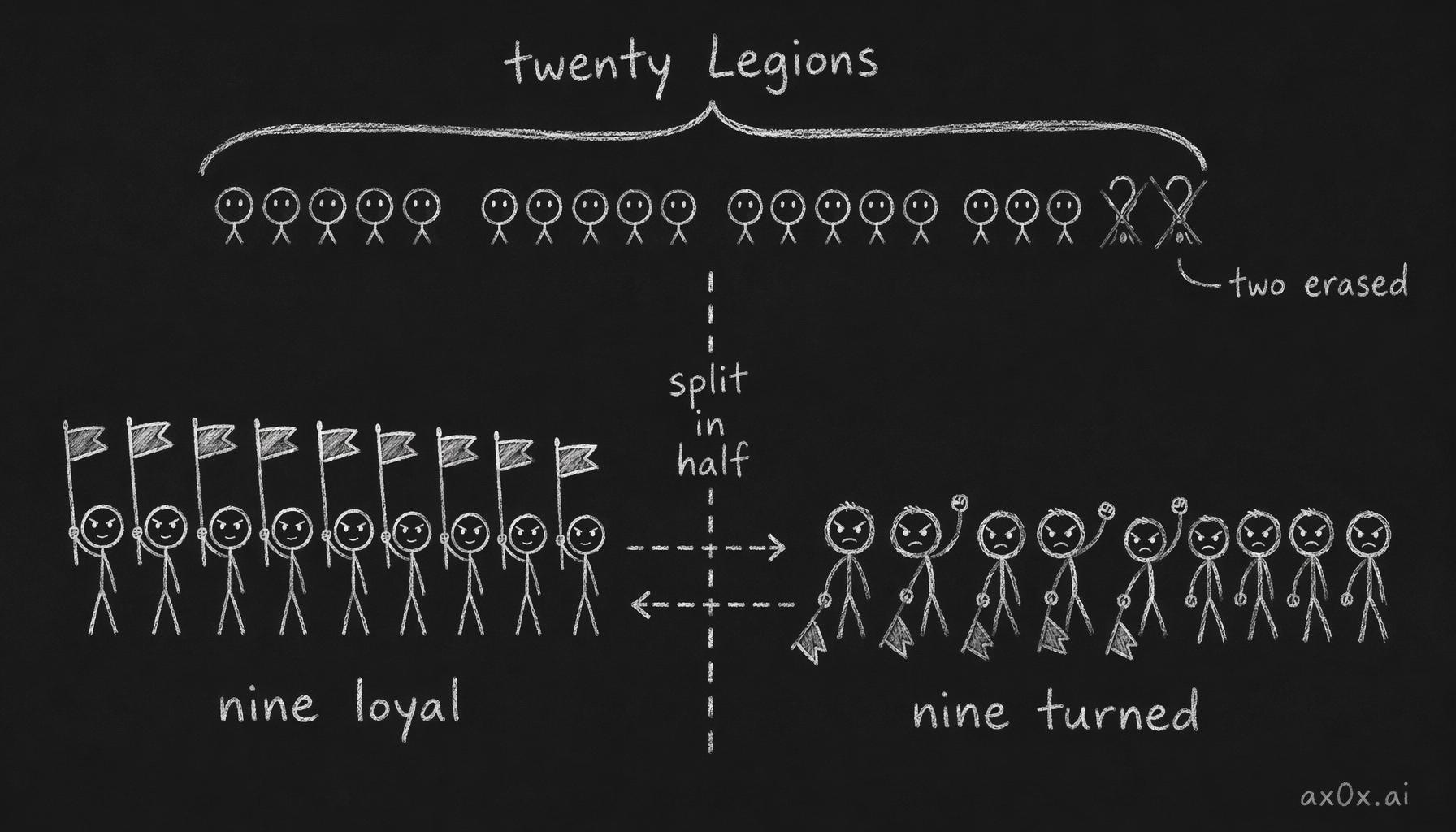 The structure and splitting of the twenty Legions: two are erased into blanks, and the remaining eighteen split almost perfectly in half — nine loyal, nine turned.
The tragedy within the tragedy: the burning of Prospero
Not every Legion that fell did so out of malice. The saddest case is Magnus the Red and his Thousand Sons — a story about how good intentions get punished in a universe rigged against them. Magnus was the greatest sorcerer among the Primarchs, and his psychic dabbling had already put him on trial: at the Council of Nikaea, the Emperor had personally banned sorcery across all Legions. Magnus chafed but obeyed, mostly.
Then he learned, through that same sorcery, that Horus had turned traitor. Frantic to warn his father, he did the one forbidden thing — he sent a psychic message screaming across the galaxy to Terra. The warning arrived, and tore straight through the wards of the Emperor's secret Webway project, cracking open the very defenses meant to keep the warp out of the Palace. Magnus had tried to save the Imperium and instead detonated its most important secret weapon.
The Emperor, enraged, sent Leman Russ and the Space Wolves to bring Magnus to Terra to answer for it. But Horus got to Russ first and twisted the order from arrest into destroy. The Space Wolves, Custodes, and Sisters of Silence fell on the Thousand Sons' homeworld of Prospero and burned it to ash. Magnus, his sons slaughtered around him for the crime of loyalty, finally broke and accepted a bargain from the Chaos God Tzeentch to save what remained. A loyal Primarch, driven into the arms of Chaos by the very father he was trying to protect. That is the kind of story this setting tells.
The long march and the last wall
Horus did not race to Terra. He couldn't — loyalist Primarchs fought a delaying war across the galaxy, buying time in blood, and the rebellion's advance ground on for some seven years. But the tide came on, and eventually the traitor fleet arrived in the skies above humanity's birthworld.
The Siege of Terra, around 014.M31 — the year 30,014 — is the climax of the saga and one of the largest battles ever depicted in fiction. Traitor Legions, war-Titans the size of buildings, and daemons pouring out of the warp threw themselves at the Imperial Palace, a fortress-continent designed and held by Rogal Dorn, the "Praetorian of Terra." Behind its walls stood the Imperial Fists, Blood Angels, White Scars, the elite Custodian Guard, and the Emperor himself. The siege ground on for weeks of carnage, walls breached and rebuilt, billions dead.
And then Horus made his final, fatal gambit. He lowered the void shields of his flagship, the Vengeful Spirit, leaving it open and vulnerable in orbit — bait, daring his father to come and end it personally. The Emperor took it, teleporting aboard with a small honor guard. So did his sons.
The duel that ended an age
Sanguinius reached Horus first.
The winged Primarch of the Blood Angels was, by most accounts, the most beloved of all the brothers — noble, beautiful, kind in a way few Primarchs managed to be. He found Horus on the bridge of the Vengeful Spirit, bloated with the power of all four Chaos Gods at once. Sanguinius knew he could not win. He fought anyway. Horus strangled the Great Angel to death — but legend holds that in his last moments, Sanguinius cracked a single chink in Horus's defenses, a flaw that would matter very soon. His death rippled backward through his Legion as a psychic shockwave, branding the Blood Angels with the Black Rage — a curse that makes their warriors relive their Primarch's final, doomed battle in berserk fury, ten thousand years later still.
Then the Emperor arrived, and father faced son for the last time. It was a duel fought on two planes at once — bodies and souls, blades and psychic fire. And the Emperor held back. Even now, even here, he could not bring himself to destroy his favorite son. He pleaded; he fought defensively; and Horus, empowered by gods, took him apart, shattering his spine, gouging out an eye, cracking open his armor. The most powerful human who ever lived was being beaten to death by his own child because he loved him too much to strike back.
What finally turned it was an atrocity. Horus, gloating, annihilated one of the Emperor's faithful warriors utterly — body and soul, erased from existence — purely to prove that nothing of the old loyalty would survive. In that instant the Emperor understood the son he loved was truly gone, and that this thing wearing Horus's face would do it forever, to everyone. He stopped holding back. He unleashed the full force of his power and annihilated Horus's soul, burning it out of the warp so completely that not even Chaos could ever resurrect him.
When Rogal Dorn fought his way to the bridge, he found the tableau that would define a religion: Sanguinius dead, Horus reduced to nothing, the Emperor broken beyond saving. They carried him back to Terra.
The golden cage
There was a machine waiting beneath the Imperial Palace — the Golden Throne, built as the control mechanism for the Emperor's Webway project, the very secret work that had started this whole spiral of resentment. Now it was repurposed into a life-support sarcophagus, the only thing capable of keeping his shattered body and mind from dissolving entirely.
They sat the broken god-king upon it, and there he has remained ever since — neither alive nor dead, unable to move or speak, his vast psyche kept burning by the daily sacrifice of (in the lore's grim flavor) roughly a thousand psykers. From that prison, his mind projects the Astronomican, the psychic lighthouse that lets ships navigate the warp. He is the Imperium's foundation and its prisoner at once.
The Great Scouring followed — a seven-year counter-offensive that drove the surviving traitor Legions into the Eye of Terror, the vast warp rift where time runs strange and Chaos festers. There they endure, unaging, to menace the galaxy ten thousand years later. One of Horus's lieutenants, Ezekyle Abaddon, escaped with them and grew into the great villain of the "present," launching Black Crusade after Black Crusade to finish the work his Warmaster began.
The survivors rebuilt — but they rebuilt in fear. Roboute Guilliman wrote the Codex Astartes and broke the enormous Legions apart into small Chapters of around a thousand warriors each, so that never again could a single charismatic commander point the unstoppable might of a Legion at Terra. The thing that made Horus possible — concentrated military power in one beloved man's hands — was deliberately dismantled.
Why the wound still bleeds
Here is the part that turns a war story into the spine of an entire universe. The Emperor's secular dream is dead. In its place rose the Adeptus Ministorum — a galaxy-spanning church that worships the Emperor as a literal god, burns heretics, fears knowledge, and has turned humanity into the most superstitious, xenophobic, technologically frozen civilization imaginable. The Imperial Truth he founded to drag mankind toward reason produced, within a single lifetime, its exact opposite.
Which is to say: Horus got the future he was shown. He betrayed his father to prevent a god-cult from rising, and in doing so he wounded the Emperor so badly that the Emperor became a literal god on a literal throne — the object of exactly that cult. Chaos didn't need to lie. It just needed to show a proud, grieving son a real future and let his love do the rest.
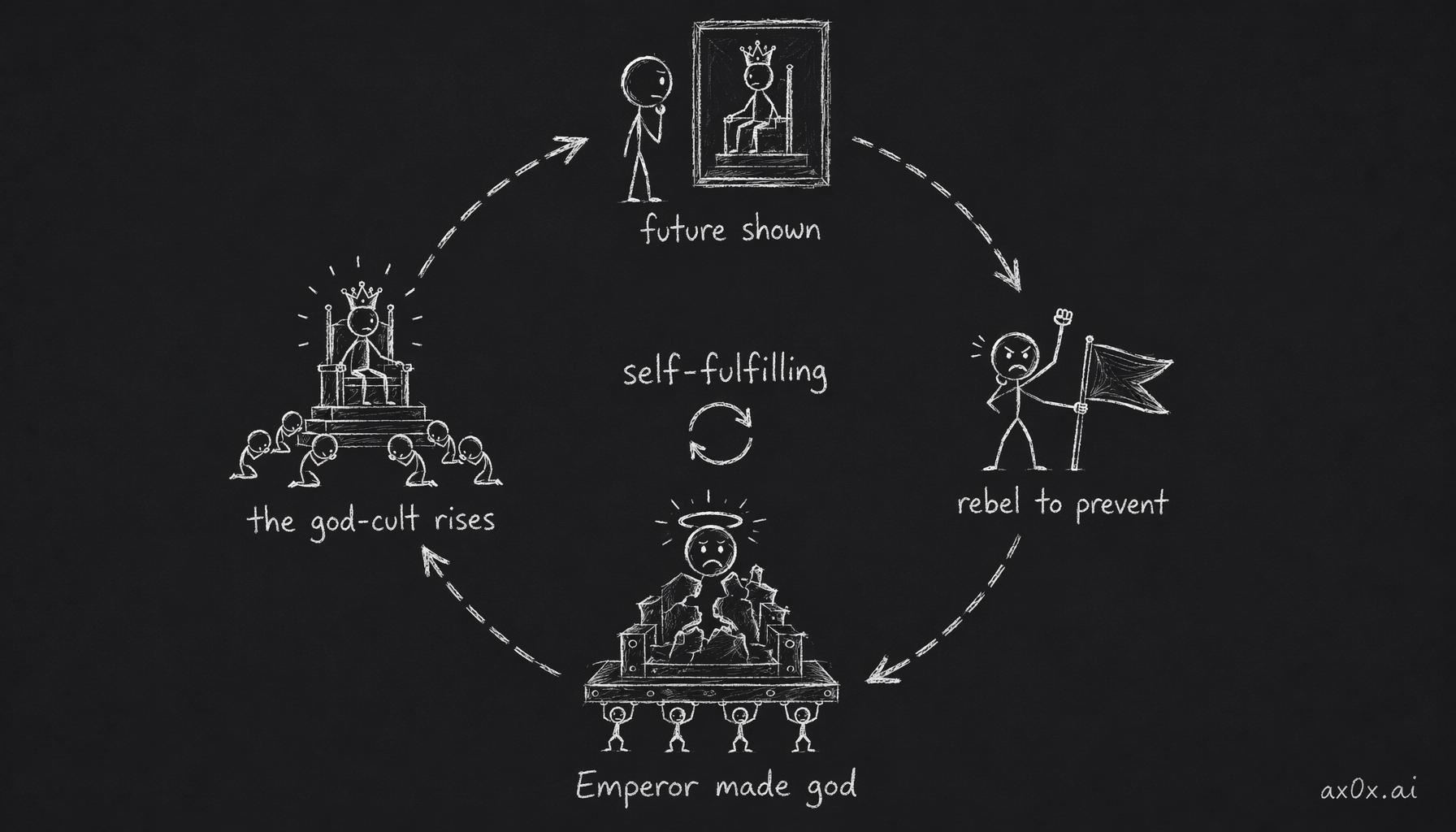 The self-fulfilling prophecy loop: the future Chaos showed Horus is the very future his rebellion to prevent it ends up creating — the loop closes on itself.
That is the genius of the Horus Heresy as worldbuilding: it is not merely backstory, it is the reason the 41st millennium is the way it is. The eternal war the Imperium fights, the dead-god it kneels to, the paranoia and the rot — all of it is scar tissue around a single betrayal. Forty thousand years from now, soldiers will die in the dark, never knowing why their galaxy is so cruel. The answer is a dying father and the son he loved too much to kill in time.
Black Library has spent the better part of two decades chronicling it — over sixty books, from Dan Abnett's Horus Rising in 2006 to the Siege of Terra finale that concluded only in January 2024. Eighteen years to tell the story of a war that lasted nine. If you want a doorway in, the opening trilogy — Horus Rising, False Gods, and Galaxy in Flames — is the best entry point into all of Warhammer 40,000. It is the one place where the grimdark hadn't fully set in yet, and you can still see, just for a moment, the future that might have been.
Then Horus fell, and the galaxy broke, and it has been bleeding ever since.
Warhammer, Warhammer 40,000, and all associated names are © Games Workshop. This is a fan-written lore explainer for educational and commentary purposes.