
Why the War Never Ends: The Core Conflicts of Warhammer 40,000
There is a sentence stamped onto the spine of every rulebook, every codex, every loading screen in the universe of Warhammer 40,000: "In the grim darkness of the far future, there is only war."
Most science fiction treats war as a problem to be solved. A villain to defeat, a planet to save, a treaty to sign in the final chapter. Warhammer 40,000 does something stranger and far more honest. It builds a galaxy where war is not the problem. War is the physics. It is baked into the metaphysics, the religion, the biology, the economics, and the literal structure of space itself. You cannot fix it any more than you can fix gravity.
If you are coming in cold — maybe from the introduction to the grimdark galaxy, or after meeting the factions of the 41st millennium — the natural question is the one every newcomer asks: who's supposed to win? The answer, and the thing that makes the setting tick, is that nobody is. Nobody can. And the people who designed it that way did so on purpose, as a joke at the expense of anyone who'd want to live there.
There are no heroes. The author said so out loud.
Let's get the most important misconception out of the way first, because almost everyone arrives believing the opposite.
The Imperium of Man — the sprawling human empire of a million worlds, the one with the heroic golden-armored super-soldiers on all the box art — is not the good guy. It is a fascist, theocratic, genocidal dystopia, and it was designed that way from the beginning as a piece of satire.
This isn't a fan reading. In November 2021, Games Workshop, the company that owns the whole thing, published a statement so blunt it made gaming headlines: "There are no goodies in the Warhammer 40,000 universe. Especially not the Imperium of Man." They went on to call it "a monstrous civilisation" and "a tyrannical, genocidal regime, turned up to 11," and used the occasion to ban real-world hate-group symbols from their events.
To understand why, you have to go back to the source. The setting was born in 1987 — its first edition was titled Rogue Trader — and largely written by a designer named Rick Priestley. The cultural water he was swimming in was Thatcher-era Britain and its loudly anti-authoritarian comics: 2000AD, with its dystopian lawman Judge Dredd and its anti-fascist saga Nemesis the Warlock. Mix in Frank Herbert's Dune and Michael Moorcock's eternal-champion gloom, and you get the recipe. The Imperium is militarism, religious nationalism, and unchecked state power cranked to absurdity. The grim darkness is the punchline, not the aspiration.
So when you look at the Imperium's central image — a god-emperor worshipped by trillions — and find it grotesque, you are reading it correctly. That grotesqueness is the design.
The wound the whole empire is built on
Here is the literal core of the Imperium, and it tells you everything.
Roughly ten thousand years before the "present day" of the setting, the Emperor of Mankind — an immortal, immensely powerful psychic who had set out to reconquer the galaxy for humanity — was mortally wounded. He has spent every day since sitting on the Golden Throne, a life-support machine that is also a psychic amplifier, in a state somewhere between life and death. To keep him there, the Imperium sacrifices thousands of psykers — humans with psychic potential — to the Throne every single day, burning them up as fuel.
Now the irony that makes the satire land: in life, the Emperor outlawed organized religion. He promoted a doctrine called the Imperial Truth — secular, rationalist, atheist — which denied the existence of gods entirely. The galaxy-spanning religion that now worships him as a literal deity is a direct betrayal of everything he stood for. The Imperium didn't just become a theocracy. It became the exact theocracy its founder explicitly forbade.
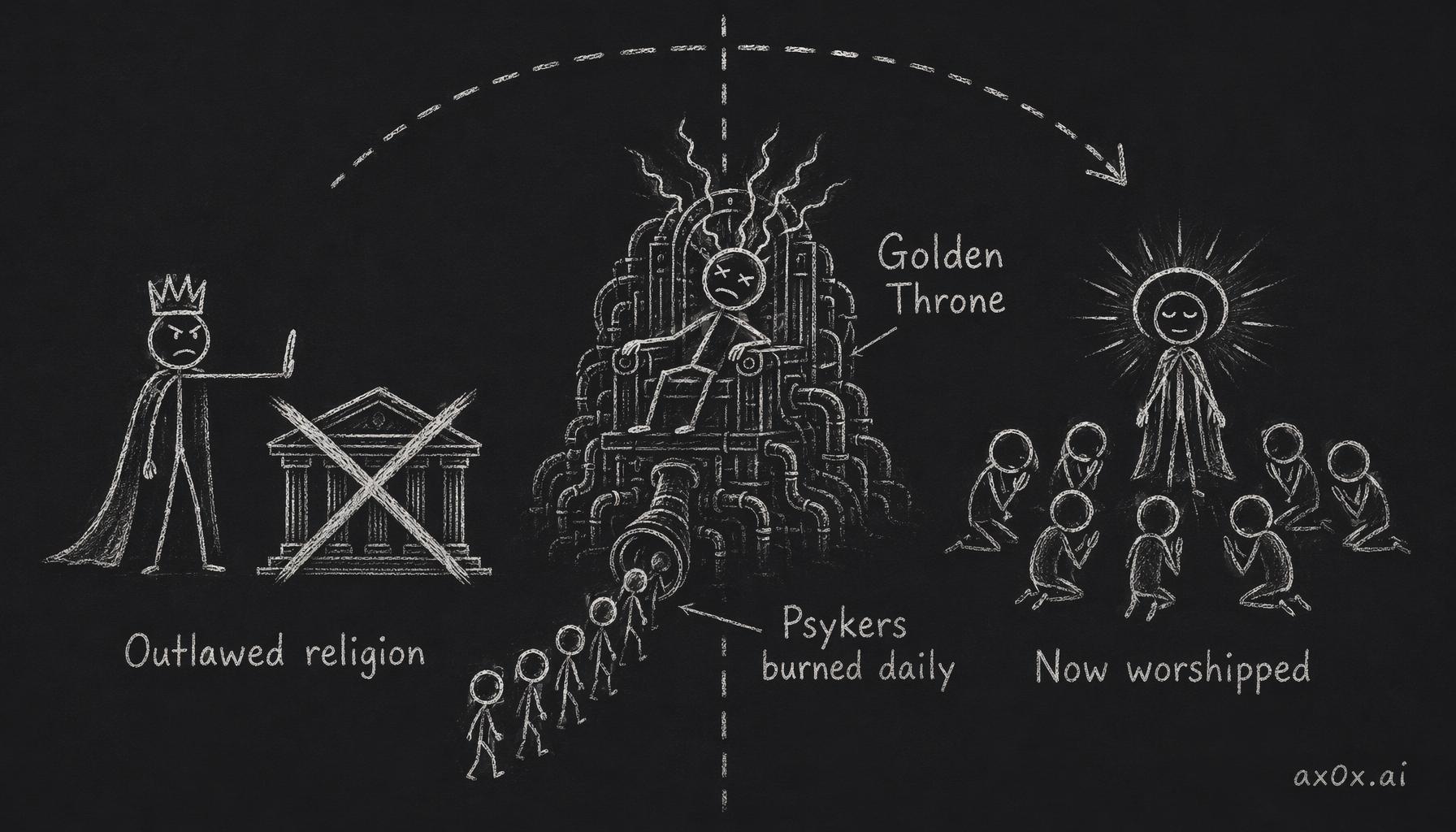 In life the Emperor outlawed religion and preached atheism; now worshipped as a god, the Imperium became the exact theocracy its founder forbade.
How did the wound happen? That's the Horus Heresy, the civil war that broke the galaxy, and it deserves its own telling. The short version: the Emperor's favored son, the Warmaster Horus, was corrupted by Chaos and turned half the Space Marine Legions against their father. The war climaxed at the Siege of Terra, where Horus killed the angelic primarch Sanguinius, and the Emperor in turn killed Horus — and was maimed beyond recovery in the doing. Everything that came after, the rot and the fanaticism and the ten-thousand-year siege mentality, grows out of that single afternoon.
The four engines of slaughter
So why can't anyone just win? Because the conflicts aren't strategic. They're structural. There are four big ones, and each is a perpetual-motion machine.
Order versus Chaos: an enemy that cannot die
Faster-than-light travel in 40K runs through the Warp (also called the Immaterium or Empyrean), a parallel dimension of raw psychic energy. The catch — and it is a catastrophic catch — is that the Warp is shaped by the emotions of every living thing in the galaxy. Over millions of years those emotions have congealed into four malign gods.
They are the Chaos Gods, the Ruinous Powers, and each one is an emotion turned predatory:
- Khorne, the Blood God — rage, war, murder. "Blood for the Blood God, skulls for the Skull Throne."
- Nurgle, the Plague Father — disease, decay, despair, and paradoxically a kind of grandfatherly love and acceptance.
- Tzeentch, the Changer of Ways — ambition, scheming, sorcery, endless change.
- Slaanesh, the Dark Prince — excess, pleasure, perfection, and pain. The youngest of the four, born from the decadence of an entire alien civilization (more on that horror below).
The gods' foot soldiers are daemons — fragments of a god's power given form — and here is the structural trap: a daemon cannot permanently die. Slay one and its essence simply seeps back into the Warp and reforms over time. You can win every battle against Chaos and still never reduce its supply by one. Every Warp jump and every human psyker is a potential doorway for them. The war against Chaos is a war against the weather.
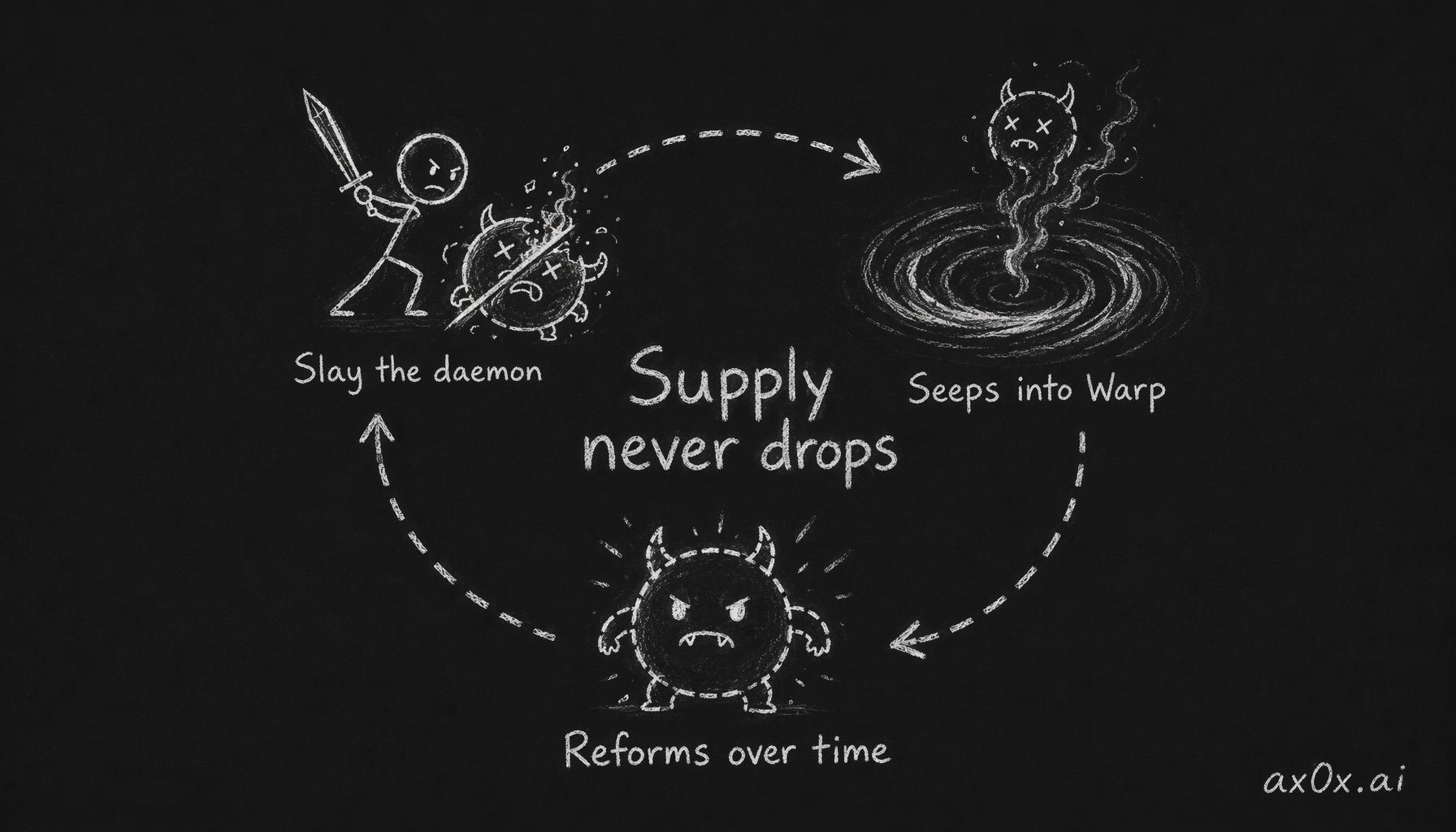 Slaying a daemon only lets its essence seep back into the Warp and reform, so its supply never drops — the war against Chaos is a war against the weather.
The Great Game: even Chaos can't win
But Chaos can't win either, and for a beautiful reason. The four gods hate each other. They are locked in something called the Great Game — a never-ending struggle for supremacy inside the Warp with no permanent victor. Khorne (war) opposes Slaanesh (pleasure); Tzeentch (change) opposes Nurgle (stagnation). The moment one god grows too strong, the other three temporarily ally to drag it back down.
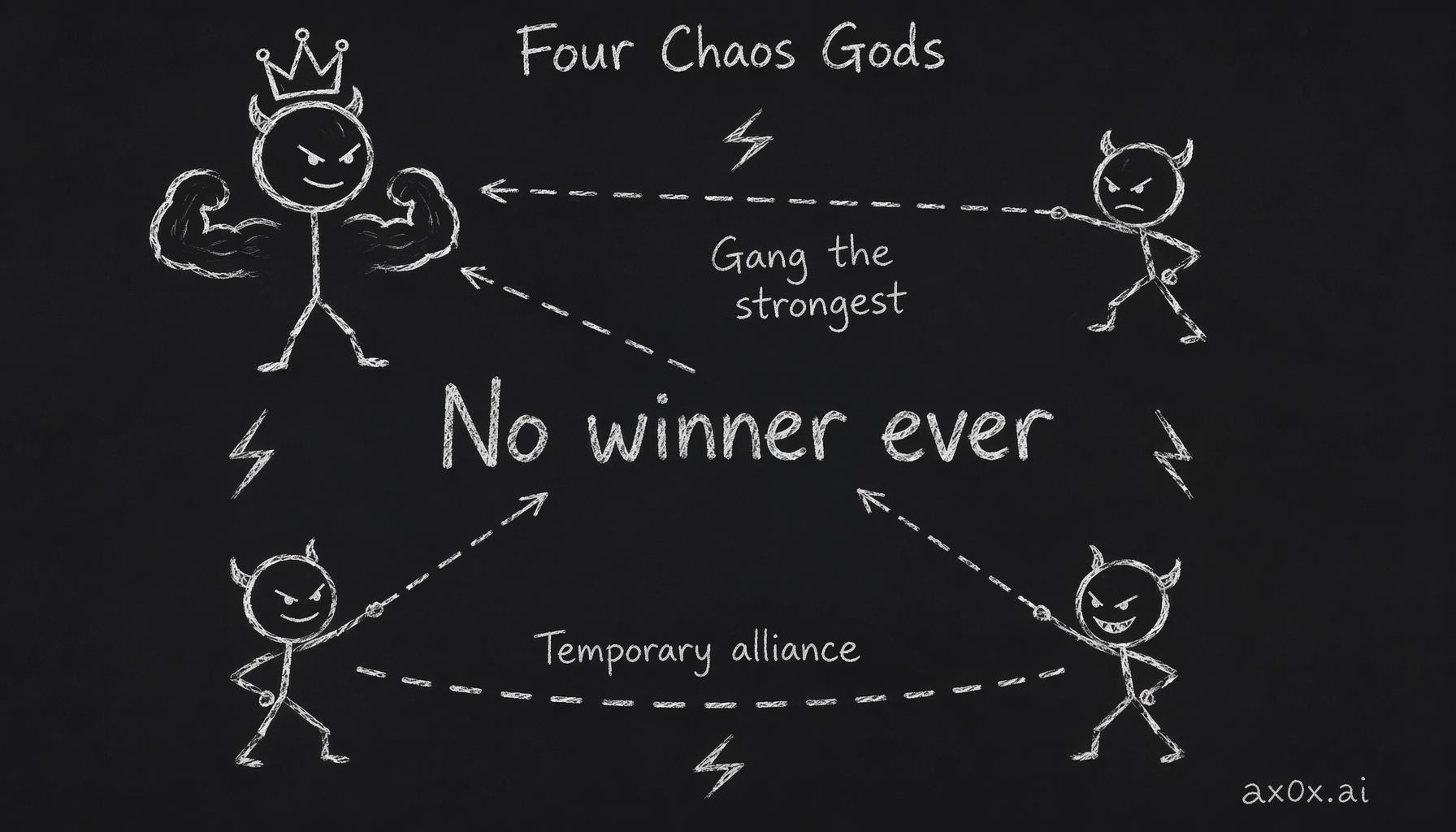 The four Chaos Gods hate each other; whenever one grows too strong the other three temporarily ally to drag it back down, locking them in a game with no winner.
This is the masterstroke of the setting's design. Chaos is the single most powerful force in the galaxy and it is fundamentally incapable of coordinated victory, because its own nature is division. The thing that makes it terrifying — that it is made of raw, uncontrolled emotion — is the same thing that guarantees it will sabotage itself forever.
Mankind versus Xenos: genocide as state religion
The second great axis is the Imperium against everyone non-human. The Imperial Creed, enforced by the state church (the Adeptus Ministorum, or Ecclesiarchy), is built on three commandments: purge the heretic, beware the mutant and psyker, and abhor the alien. The phrase the Imperium lives by is "suffer not the alien to live." Xenophobia isn't a prejudice here. It's codified law, divine commandment, and military doctrine all at once.
The cruelest example is the T'au Empire — a young, idealistic alien civilization that expands through technology and diplomacy under a philosophy called the Greater Good (the Tau'va). They are, arguably, the closest thing the setting has to a hopeful society. (The lore keeps it ambiguous — there are uncomfortable rumors about forced relocation and a rigid caste system — but compared to everyone else, they're practically utopians.) And precisely because they offer a coherent alternative, the Imperium treats them as an existential heresy to be exterminated on sight. In 40K, hope itself is a threat to be purged.
The Imperium versus itself
The third axis barely needs an external enemy. The Imperium is so vast, so paranoid, and so internally fractured that it spends enormous energy fighting itself. The Inquisition purges entire human worlds on suspicion of corruption. Planetary governors rebel. The tech-priests of the Adeptus Mechanicus, who worship a Machine God and guard technology as religious lore, pursue their own agenda. The Astra Militarum (the Imperial Guard, humanity's trillions-strong conventional army) and the Space Marines are routinely turned against human worlds deemed heretical. A civilization this size, run on fear and religion, generates its own civil wars as a byproduct.
Here is how those four engines feed one another:
The scar across the sky
For decades the setting's clock was frozen just shy of the year 1000 in the 41st millennium (written 999.M41 — the 999th year of the 41st thousand-year span). Then Games Workshop did something rare: it moved the story forward, and it did so by tearing the galaxy in half.
The agent of that catastrophe is Abaddon the Despoiler, Horus's successor as Warmaster of Chaos. For ten thousand years Abaddon launched assault after assault out of the Eye of Terror — thirteen of them, the Black Crusades. The thirteenth, around 999.M41, finally landed the killing blow. He destroyed Cadia, the fortress world that had guarded the gateway between realspace and the Eye of Terror for the entire history of the Imperium. For ten millennia the Imperial battle-cry had been "Cadia stands." Now Cadia fell.
Its fall ripped open the Cicatrix Maledictum — High Gothic for "Accursed Scar," better known as the Great Rift. This is not a doorway or a portal. It's a galaxy-spanning chain of Warp storms, a wound in reality itself, and it physically and psychically split the Imperium roughly down the middle.
The consequences were apocalyptic. The Rift's opening triggered the Noctis Aeterna, the "Blackout," during which the Astronomican — the psychic lighthouse projected by the dying Emperor that guides all Warp travel — was dimmed or snuffed out across enormous regions. Fleets were stranded. Whole sectors went dark.
When the dust settled, there were two Imperiums:
- The Imperium Sanctus — Terra's side, still bathed in the Astronomican's light, still functioning as an empire.
- The Imperium Nihilus — the "Dark Imperium," the half cut off on the far side of the Rift. No guiding light, Warp travel nearly impossible, worlds isolated and besieged by Chaos. Its inhabitants call it the gates of Hell.
The one ray of light is also the proof there's no escape
If you want the closest thing 40K has to a hero arriving in the nick of time, it's this: in that same dark hour, a primarch came back.
Roboute Guilliman, primarch of the Ultramarines and one of the Emperor's loyal sons, had lain in stasis for ten thousand years, frozen at the edge of death from a Heresy-era wound. He was resurrected through an unlikely collaboration: the technology of the brilliant, heresy-adjacent tech-priest Belisarius Cawl, and the power of the nascent Aeldari death-god Ynnead, channeled by an alien priestess. A human saint raised by alien gods and forbidden science — even the rescue is a compromise with everything the Imperium claims to hate.
Guilliman declared himself Lord Commander and Regent of the Imperium and launched the Indomitus Crusade to stabilize the shattered empire. He fielded a new, physically superior generation of Space Marines, the Primaris, which Cawl had been secretly perfecting for ten thousand years. (Out of universe, this is also how Games Workshop refreshed its miniature line in 2017.) The current narrative epoch — the Era Indomitus, the Age of the Dark Imperium — begins here, and with it the clock finally ticked past 999.M41 into early M42.
But notice what Guilliman's return actually is. It is not victory. It is a man waking up after ten thousand years, looking at the corpse-god his father has become and the superstitious horror his rationalist empire turned into, and being privately, quietly appalled — while having no choice but to keep the whole rotten machine running, because the alternative is extinction. The brightest moment in modern 40K is a competent administrator realizing he cannot fix anything, only delay the end.
The closed loop
This is the thesis, and once you see it the whole galaxy snaps into focus: nobody wins, because every victory just feeds the war.
Walk the math. The Imperium cannot win — it is rotting from the inside and besieged on every front. Chaos cannot win — the Great Game guarantees the gods knife each other before any of them takes the board. And the xenos races each pursue ends that are not just incompatible but mutually annihilating:
- The Tyranids, the Great Devourer, are an extragalactic hive-mind swarm that eats all biomass, world by world, and cannot be reasoned with or bought off.
- The Necrons, soulless android god-killers, slumbered sixty million years and are now waking to reclaim an empire that no longer exists.
- The Orks are a fungal war-species engineered for one purpose, who literally grow stronger the more they fight and whose collective belief warps reality. You cannot defeat them; fighting them is food.
- The Aeldari (the dying elder race once called the Eldar) are just trying to survive the consequences of their own ancestors' decadence — which birthed Slaanesh in the first place.
Every one of these is a total, exclusive end-state. There is no configuration of the galaxy that satisfies more than one of them. So the galaxy settles into permanent stalemate — not peace, but mutual, grinding, eternal annihilation.
That's why the war never ends. Not because the writers are lazy, but because the setting is a precisely engineered trap. Order can't beat Chaos because Chaos doesn't die. Chaos can't unite because Chaos is division. Humanity can't make peace because peace is heresy. And no faction can be reasoned with, because their goals don't overlap on a single point.
The grimdark isn't pessimism for its own sake. It's a satire that took its own logic seriously — about what happens to a civilization that responds to an unwinnable war by worshipping the war itself, and calling its corpse-god a savior. If you want to see where the conflict came from in the first place, the 60-million-year timeline traces every fracture back to its source.
In the grim darkness of the far future, there is only war. The horror, and the genius, is that the sentence is not a warning. It's a description.
Warhammer, Warhammer 40,000, and all associated names are © Games Workshop. This is a fan-written lore explainer for educational and commentary purposes.