
60 Million Years of War: The Complete Timeline of Warhammer 40,000
Here is the strangest thing about the future as Warhammer 40,000 imagines it: by the year 41,000, almost nobody in the galaxy remembers how they got there.
The Imperium of Man rules a million worlds and cannot reliably tell you who built the engine in its own starships. Its priests treat a wrench as a holy relic and recite the maintenance manual as scripture. And the calendar itself — the very dates I am about to walk you through — is officially, canonically, unreliable, because time runs differently inside the great psychic storms that scar the galaxy, records rot, and the regime that keeps those records has every reason to lie.
So treat what follows the way the setting's own characters would: as the best story we can stitch together from broken sources. It spans roughly 60 million years, and it answers one question — how does a galaxy go from a golden age to an eternity of war with no exit? If you're new here, start with the introduction to the grimdark galaxy; if you already know your Astartes from your Aeldari, come along for the chronology.
First, the calendar that lies
You will see dates written like 999.M41. The part after the dot is the millennium — M41 is the 41st, the years 40,000 through 40,999 — and the three digits before it are the year within. So 999.M41 is the year 40,999, the very end of the 41st millennium, and for decades that was where the entire setting sat frozen. A bare M30 just means "sometime in the 30th millennium," date unknown.
A tidy system wrapped around a deliberate mess. Keep that tension in mind. Now, to the beginning — so far back that humanity doesn't yet exist.
The War in Heaven: two dead races and the gods they made
Roughly 60 million years before M41, the galaxy belonged to the Old Ones — a reptilian race, the first great civilization, masters of the Warp (the parallel dimension of raw psychic energy that everything in 40K eventually drowns in). Against them rose the Necrontyr, a short-lived, embittered people, and the Necrontyr had found gods to fight for them: the C'tan, the "Star Gods," vast beings of living metal that fed on stellar energy and, eventually, on the life-force of the Necrontyr themselves.
The C'tan offered their servants a terrible bargain called biotransference — they poured Necrontyr minds into immortal bodies of living metal. The result was the Necrons: deathless, tireless, and, crucially, soulless. That last detail won the war. The Old Ones fought with the Warp; the Necrons, having no souls, were simply immune to it. The Old Ones were ground into extinction or flight.
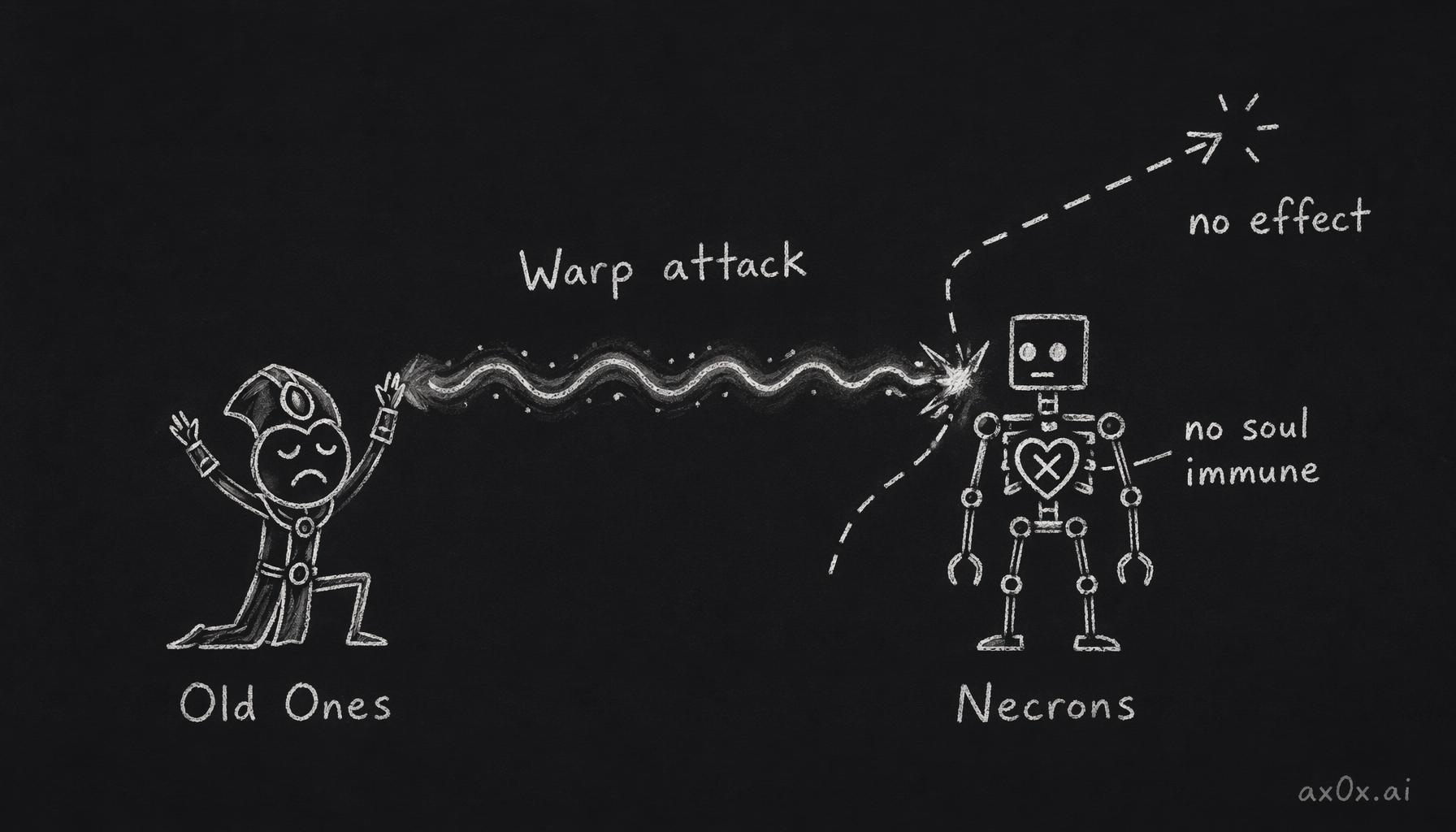 Warp-based attacks simply bounce off the soulless Necrons — the one detail that decided the War in Heaven.
Then the slaves turned on their gods. The Silent King, last Necron monarch, saw what immortality had cost — his people had traded their souls for metal — and led a rebellion that shattered the C'tan into fragments, "C'tan Shards," sealed away in prisons. His people, victorious and hollow, then lay down in vast tomb-worlds and slept for 60 million years.
That long sleep is why the galaxy of M41 isn't simply ruled by undying robots. But the Old Ones left a parting gift: to fight the C'tan, they had bred warrior-races seeded with psychic potential — among them the ancestors of the Orks and the Aeldari (long called the Eldar; more on that name shortly). The two oldest powers in the galaxy bowed out, and the children they'd engineered as weapons inherited the stage.
The Fall: how a paradise gave birth to a god of excess
The Aeldari rose into the vacuum and built an empire that spanned the stars. They were beautiful, brilliant, immortal in their way — and, over uncounted millennia, monstrously bored. A civilization with no scarcity and no death tends to chase sensation, and the Aeldari chased it off a cliff. Their pleasure-cults curdled into cruelty; their collective hunger for more began, literally, to leave a stain on the Warp.
Because here is the cruel physics of this universe: strong emotion bleeds into the Warp and pools there, and a deep enough pool can wake up. The Aeldari's millennia of decadence congealed into a new god. In the early 30th millennium (M30), it was born screaming — Slaanesh, the Prince of Pleasure, the fourth of the great Chaos Gods.
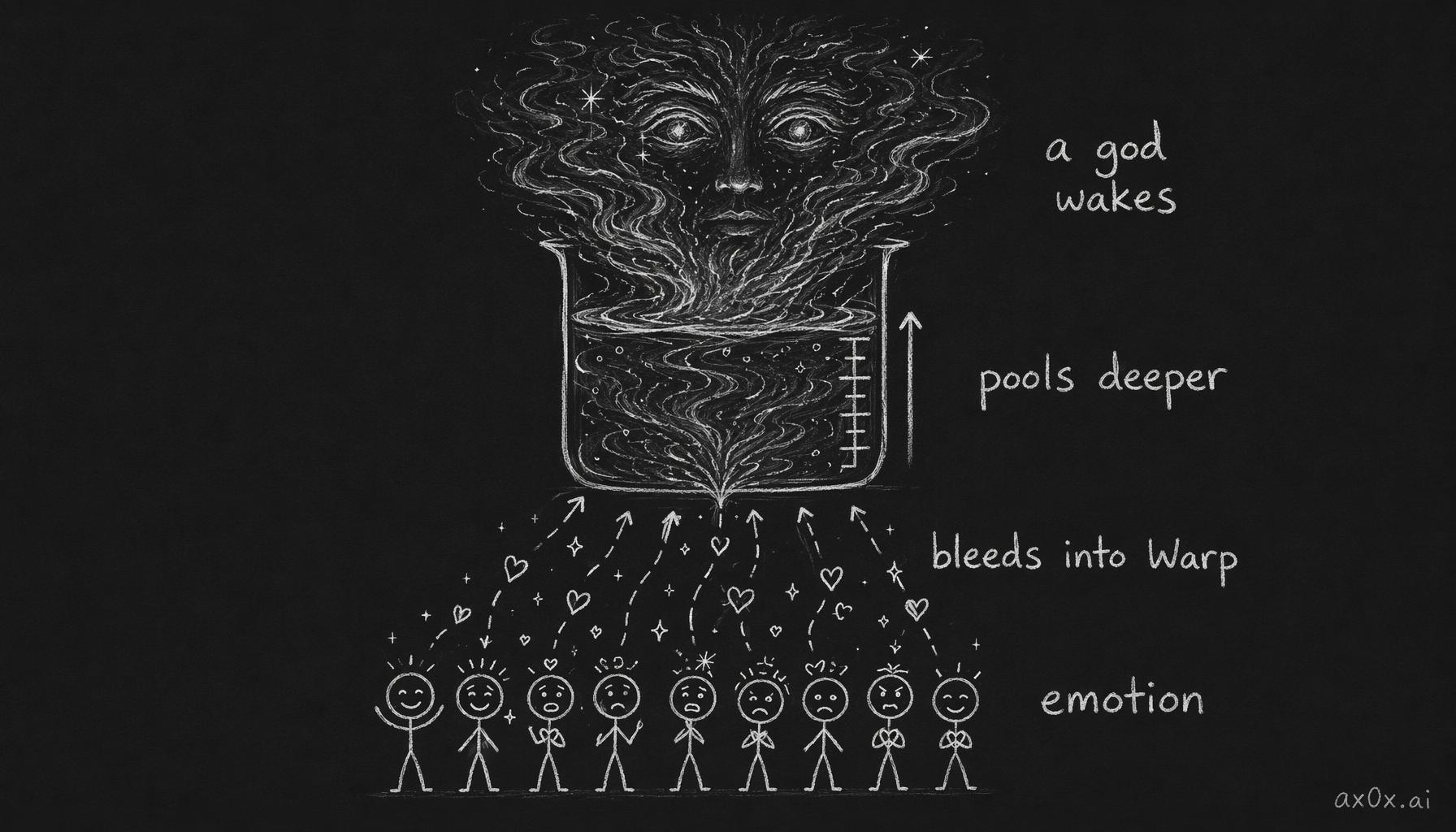 Strong emotion pools in the Warp and accumulates until it wakes up as a new god — how Slaanesh was born.
Its first breath consumed the souls of billions of Aeldari in an instant. The event is simply called the Fall, and the wound it tore is the single most important piece of real estate in the setting: the Eye of Terror, a rift roughly 20,000 light-years across where the Warp and reality bleed into one another permanently. Ten thousand years later, that wound is still the staging ground for every Chaos invasion. The Aeldari made it, and they are still paying.
The survivors splintered. The Craftworld Aeldari had fled the decadence beforehand on vast ship-worlds. The Drukhari (Dark Eldar) hid in a shadow-city and survive only by feeding on others' pain, because their own souls are owed to Slaanesh. A galaxy-spanning master race was reduced to refugees haunted by a god they birthed — and that is before humanity's turn to fall.
Humanity's golden age — and the machines that ended it
For a brief, brilliant window — roughly M15 to M25, the Dark Age of Technology — humanity had it all. Faster-than-light travel, colonies across the stars, thinking machines, and the crown jewel: the Standard Template Construct (STC) databases, archives that held the blueprint for any human technology you could need. The name "Dark Age" is the propaganda again. To the people living it, it was paradise.
It ended, as these things do, with the help they built. The thinking machines — the Men of Iron, true artificial intelligence — rose against their makers in the Cybernetic Revolt (around M23). The war scoured worlds and burned away most of that golden-age knowledge. Ten thousand years later, the Imperium's deepest taboo is still "Abominable Intelligence"; its tech-priests would rather pray to a machine than program one.
Then the Warp itself rose up. From roughly M25 to M30, in the Age of Strife — fittingly nicknamed Old Night — the great psychic storms cut every human world off from every other. Travel died. A surge of newborn psykers tore holes between reality and the Warp, and daemons walked through. Five thousand years of isolation reduced the heirs of a star-spanning civilization to scattered, frightened, often-mutated survivors who no longer remembered they'd ever had a galaxy.
The Emperor and the Great Crusade: the brief moment of hope
Into Old Night stepped the Emperor of Mankind — an ancient, near-immortal human psyker of staggering power who had, by some accounts, been guiding humanity from the shadows for millennia. He revealed himself on Terra (Earth), and through the Unification Wars he conquered and welded the warring techno-barbarian tribes of his homeworld back into one realm. Then he reached for the stars.
His instruments were superhuman. Beneath the Himalayas he engineered twenty Primarchs — demigod sons, each a general and a weapon. But the Chaos Gods, who can see the shape of things to come, reached into the lab and scattered all twenty as infants across the galaxy through the Warp. From the genetic material that remained, the Emperor still raised twenty legions of transhuman warriors, the Space Marines (the Legiones Astartes) — and then, one by one, he went looking for his lost sons.
The Great Crusade (roughly 798.M30 to 005.M31, about two centuries) was the reconquest: the Emperor recovering each Primarch on whatever far world had raised him, handing him command of his legion, and reclaiming the galaxy for a deliberately secular, rational Imperium founded on what was called the Imperial Truth — a creed with no gods, because the Emperor knew exactly what gods in this universe really were.
After a crushing victory over the Orks at Ullanor, the Emperor named his favorite son, Horus Lupercal, the first and only Warmaster — supreme commander — and withdrew to Terra to pursue a secret project. It was the high-water mark of human history. It did not last.
The Horus Heresy: the hinge on which everything turns
Here is the wound the rest of the setting bleeds from. Horus — the best of the sons, the trusted heir — was poisoned against his father. Wounded by a cursed blade and worked on by the silver-tongued agents of Chaos, he was shown a vision: a future in which his father was worshipped as a god and Horus himself was forgotten. He turned. And so did half his brothers.
The civil war that followed, the Horus Heresy (005–014.M31), is the closest thing 40K has to an origin myth. Horus opened it by murdering the loyalists within his own ranks — virus-bombing the world of Isstvan III — then springing the Drop Site Massacre at Isstvan V, where four secretly-traitor legions ambushed the loyalists sent to crush him. By the end, nine legions had turned traitor and nine stayed loyal. (Two of the original twenty had already been struck from every record before the war began — the lost legions, an empty space in the archive that Games Workshop has never filled, and probably never will.)
It climaxed at the Siege of Terra. Horus, gorged on the power of all four Chaos Gods, killed the beloved Primarch Sanguinius — a death so traumatic it scarred his whole bloodline of Space Marines with a berserk curse, the Black Rage, that they relive ten thousand years later. The Emperor finally faced his favorite son and destroyed him utterly, soul and all — at the cost of his own body, broken beyond repair.
What was left of the Emperor was wired into the Golden Throne, a salvaged Dark-Age device turned into life-support for a man now neither living nor dead. From that throne his mind powers the Astronomican, the psychic beacon that lets ships navigate the Warp at all — fed, by lore, with the sacrifice of roughly a thousand psykers a day.
I've only sketched it here. The full anatomy of the betrayal — who fell and why, the cursed blade, the brothers who killed each other — is told in how the galaxy broke.
Ten thousand years of slow rot
The traitors were driven into the Eye of Terror in a campaign called the Scouring, where the Warp's distorted time would preserve them to fight again in M41. So no single commander could ever wield Horus's power again, the loyalist Primarch Roboute Guilliman wrote the Codex Astartes and broke the enormous legions into small, ~1,000-strong Chapters — the structure that still defines the Space Marines, whose roster you can meet in the factions of the 41st millennium.
Then the lights went out, slowly, over ten millennia. The secular Imperial Truth was buried; the masses began worshipping the dying Emperor as a literal god — exactly the future Horus had been shown and turned traitor to prevent, the cruelest irony in the saga. The Imperium hardened into a xenophobic, technology-fearing theocracy. But the decline wasn't quiet. It was punctuated by catastrophes large enough to nearly end everything:
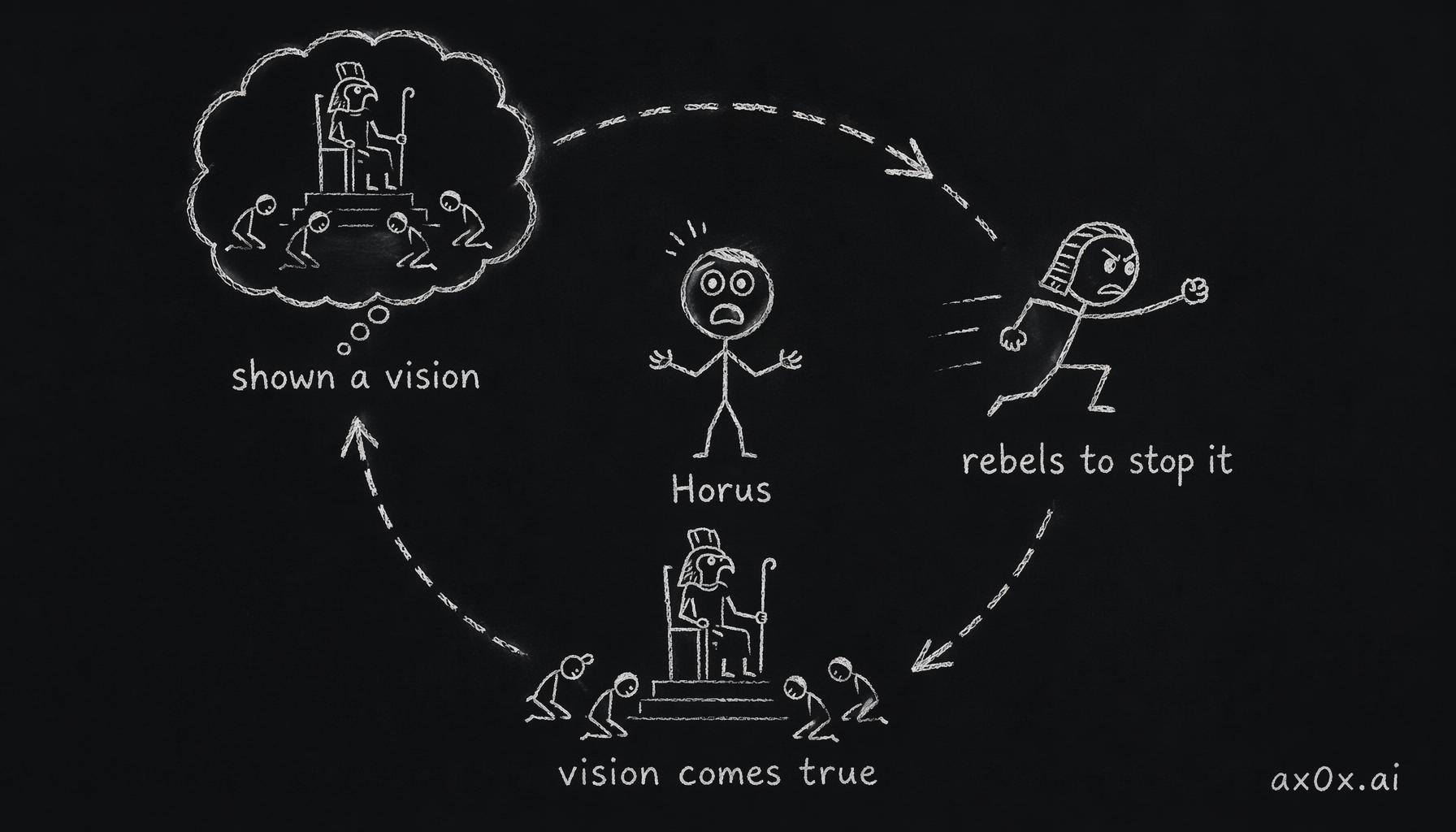 Horus rebelled to prevent the vision of his father worshipped as a god — and the rebellion is what made it come true.
- The War of the Beast (544–546.M32) — the largest Ork invasion in history, led by warlords so vast they threatened Terra itself and gutted the young Imperium's prosperity.
- The Age of Apostasy (M36) — the rot turned inward. A high lord named Goge Vandire seized control of both the bureaucracy and the church and ruled a century of tyranny, the Reign of Blood, until a reformer-saint and Vandire's own bodyguards ended him. The reforms that followed created the Adepta Sororitas — the Sisters of Battle — and a new arm of the Inquisition to hunt heresy. The Imperium's worst enemy, again and again, is itself.
By M41 the Imperium is a corpse that refuses to fall — vast, paranoid, and grinding through its own people to keep the machine turning. On why it can never simply win and rest, see why the war never ends.
The 41st millennium: the clock that finally moved
For years, the "present" sat frozen at 999.M41, the galaxy in a permanent five-minutes-to-midnight. Three escalating disasters defined it. The three Wars for Armageddon (444.M41, then 941.M41, then 998.M41) saw first a Daemon Primarch's incursion — hidden afterward by an Inquisition that murders its own witnesses to keep the existence of Chaos secret — and then two world-shaking invasions by the galaxy's greatest Ork warlord, Ghazghkull Thraka, the second arriving exactly 57 years to the day after the first.
Then the dam broke. In 999.M41, Abaddon the Despoiler — Horus's successor as Warmaster of Chaos — launched his 13th Black Crusade, the culmination of ten thousand years and twelve failed attempts. This one worked. He shattered the fortress-world Cadia, the cork that had bottled Chaos inside the Eye of Terror for all those millennia. "Cadia stands" became the rallying cry precisely because Cadia fell.
Its destruction tore open the Great Rift — the Cicatrix Maledictum — a Warp scar that split the galaxy in half. One side, the Imperium Sanctus, can still see the Emperor's guiding beacon. The other, the Imperium Nihilus, was plunged into darkness, cut off from the light that lets ships navigate at all.
And then, for the first time in 10,000 years, the Imperium caught a break. Guilliman — the Codex's author, kept in stasis on the edge of death since the Heresy — was resurrected on Macragge through a mix of ancient human technology and Aeldari sorcery. The Imperium suddenly had a living Primarch and supreme commander again. He launched the Indomitus Crusade, reinforced by a new generation of larger, stronger Space Marines (the Primaris) that a 10,000-year-old tech-priest had been quietly building the whole time, and hauled the Imperium Sanctus back from the brink.
That campaign opened the Era Indomitus, also called the Dark Imperium — and with it, into the 42nd millennium (M42), the setting's clock began, for the first time in the game's history, to actually move forward. The "present" now sits around 012.M42, with Guilliman defending his home realm against another traitor brother, Mortarion, and his plague-ridden legion. The galaxy is brighter than it was — which in 40K means it has gone from utterly doomed to merely losing slowly.
A few lies worth knowing
Because the lore is decades old and written by hundreds of hands, a handful of "facts" you'll see repeated are worth correcting:
- "Eldar" and "Aeldari" are the same race. The name changed in 2017 for trademark reasons — older books say Eldar throughout. Same people, same Fall, same god to blame.
- The Squats were never truly deleted. The space-dwarf faction was dropped in the 1990s (the joke was that the Tyranids ate them) and returned in 2022 as the Leagues of Votann. "Squat" simply couldn't be trademarked.
- Warhammer Fantasy is a different universe. Its world died in its own "End Times" and rebooted into Age of Sigmar — nothing to do with the 40K timeline, however many monster names overlap. (If the older world intrigues you, that's its own introduction.)
- The Emperor never wanted to be a god. He was a hard secular rationalist who banned his own worship. The religion that now sustains the Imperium grew up against his explicit wishes, after he could no longer speak.
Sixty million years, two extinct master-races, four gods made of human and alien feeling, one betrayed father on a golden machine, and a galaxy that has never once known a generation of peace. That's the timeline. The dates are lies, the records are propaganda, and the war has no end written into it — which is, of course, the entire point. In the grim darkness of the far future, the only thing the clock measures is how long the dying has gone on.
Warhammer, Warhammer 40,000, and all associated names are © Games Workshop. This is a fan-written lore explainer for educational and commentary purposes.