
The World That Was: An Introduction to Warhammer Fantasy
In 2015, Games Workshop did something almost no one in the business of imaginary worlds ever dares to do. They took a setting they had spent thirty-two years and a fortune building — a place beloved by millions, sold in dozens of languages, the subject of hundreds of novels — and they killed it. Not retired it. Not "rebooted it" in the gentle Hollywood sense where the old films still exist on a shelf. They wrote an ending in which the world physically tore itself apart, almost everyone died, and the broken remnant of the planet went tumbling through the void. Then they stopped making the game.
This is the story of that world while it still existed. Fans now call it, with a kind of mournful precision, the World-That-Was. In its own time it had a humbler name: the Old World.
To understand why anyone would mourn a fictional planet, you have to understand what made it different. Most fantasy worlds are wish-fulfillment. The Old World was the opposite. It was a place designed, from its foundation, to be losing.
A mirror of Europe, tilted toward despair
Start with the map, because the map is the joke that makes everything else land.
The Old World is Europe. Not "Europe-inspired" in the vague way of most fantasy — it is Europe with the serial numbers barely filed off, rendered in the early sixteenth century, all gunpowder and plague and squabbling principalities. The central nation, the Empire (a sprawling patchwork of feuding provinces ruled by an elected Emperor), is the Holy Roman Empire wearing a fake moustache. To its west sits Bretonnia, a land of armoured knights, peasant serfs, and grail quests — Arthurian France. To the north and east lies Kislev, a frozen realm of horse archers and onion-domed cities: Russia. There is Tilea, a coast of merchant city-states and mercenary companies (Italy); Estalia, all proud duels and reconquest (Spain); Norsca, the fjord-cut home of raiders (Scandinavia); and far to the east, Cathay (China) and Nippon (Japan).
The trick is that this familiarity is bait. You arrive thinking you understand the place — oh, this is just medieval Europe with wizards — and then the setting closes the trap. Because in the Old World, all the dark fears that real medieval Europeans only imagined are literally, physically true. The witch your ancestors burned really was channeling something monstrous. The plague really is sent by a god who loves you for rotting. The forest at the edge of the village really is full of things that want to wear your skin. The Old World takes the medieval worldview — superstitious, paranoid, certain that damnation is one bad harvest away — and says: you were right to be afraid. You just didn't know the half of it.
The setting's creators, lead designer Rick Priestley and his collaborators at Games Workshop, nailed this tone from the start. The wargame, Warhammer Fantasy Battle, first hit shelves in July 1983. But the tone crystallized three years later in the companion roleplaying game, Warhammer Fantasy Roleplay (1986) — widely credited with inventing what we now call grimdark. In most fantasy roleplaying, you play a hero. In Warhammer Fantasy Roleplay you might play a ratcatcher. A gravedigger. A roadwarden patrolling a stretch of mud where bandits outnumber travellers. Survival was the win condition. Glory was for people who hadn't been paying attention.
The hole in the sky
To understand why the Old World is so relentlessly besieged, you have to go up — to the top of the world, where reality has a wound.
Long before there were men or elves, the world (its true name, per the lore, is Mallus) was the workshop of the Old Ones — godlike beings who arrived from elsewhere, reshaped the planet, even nudged it closer to its sun, and engineered the first thinking races as servants and caretakers. They travelled between stars through Warp Gates at the north and south poles: doorways stitched into the fabric of the universe.
Then the gates broke.
What poured through was not an army. It was Chaos — raw, unfiltered magic and malevolence from a parallel dimension, the same stuff that dreams and nightmares are made of, but with a will behind it. The collapse, remembered in the lore as the Great Catastrophe (roughly fifty-six centuries before the setting's "present day"), flooded the world with this energy. The Old Ones vanished. And where the gates had been, at both poles, the land curdled into the Chaos Wastes — endless, shifting, hallucinatory badlands where the laws of physics are merely a suggestion and the corruption never stops bleeding southward into the warm and living world.
The cataclysm left other scars. It flung warpstone — solidified Chaos, a substance that mutates anything it touches — across the whole planet. (Touch enough of it and you stop being human; the Beastmen, goat-headed horrors haunting every forest, are what humans become when Chaos has its way.) And it hung a second moon in the sky: Morrslieb, the green moon, which is not a moon at all but a colossal chunk of warpstone. It waxes and wanes on no fixed schedule, and when it swells fat and green, bad things stir. The honest white moon, Mannslieb, keeps a sane and steady cycle. Its sickly twin keeps Chaos's calendar.
This is the structural genius of the Old World: the threat is not a villain you can defeat. It is a permanent feature of the cosmos, leaking in through a hole that can never be closed. The best anyone can do is hold the line — and the line is always, slowly, losing ground.
Eight invisible winds
Here is the most elegant idea the setting ever produced, and one worth lingering on: in the Old World, magic is weather.
The Chaos energy bleeding from the northern rift doesn't arrive as one undifferentiated force. As it drifts south across the world, it separates — the way white light splits through a prism — into eight distinct currents called the Winds of Magic. Each has a colour, a temperament, and a name. Aqshy, the red wind of fire and passion. Azyr, the blue wind of the heavens. Chamon, the yellow wind of metal and alchemy. Ghur, the brown wind of beasts and the hunt. Ghyran, the green wind of life. Hysh, the white wind of light and reason. Shyish, the purple wind of death. And Ulgu, the grey wind of shadows and deception.
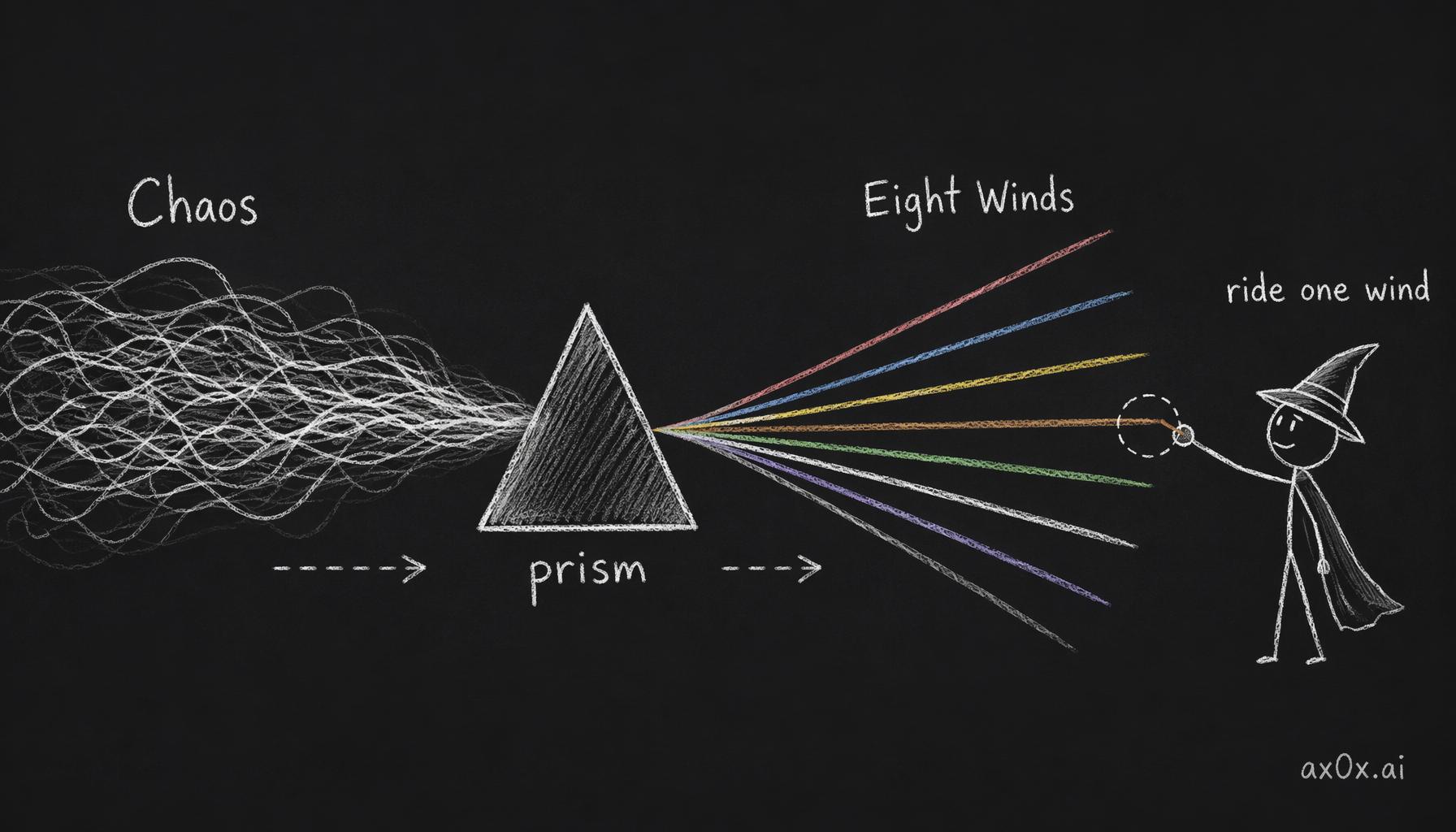 As Chaos energy drifts south it splits through a prism into eight Winds of Magic, and a wizard can only ride one
A human wizard cannot wield raw Chaos — it would burn out their mind in seconds. What they can do is learn to ride a single wind. So the Empire's wizards are organized into eight Colleges of Magic, each mastering one: a Bright Wizard channels fire, an Amethyst Wizard death. Magic here isn't a generic mana bar — it's a set of distinct, dangerous, weather-like forces, and every spell is, quite literally, a calculated breath drawn from the breath of Chaos itself.
The world doesn't simply drown in this energy only because two ancient races bail water against the tide. On the island-continent of Ulthuan, the High Elves maintain the Great Vortex, a vast magical whirlpool that sucks excess Chaos out of the world to keep a second catastrophe at bay. And in the steaming jungles of the south, the Lizardmen — descendants of the Old Ones' servants — still labour, with cold reptilian patience, to complete a Great Plan whose authors departed five thousand years ago. The world is held together by housekeeping. Stop sweeping, and Chaos fills the room.
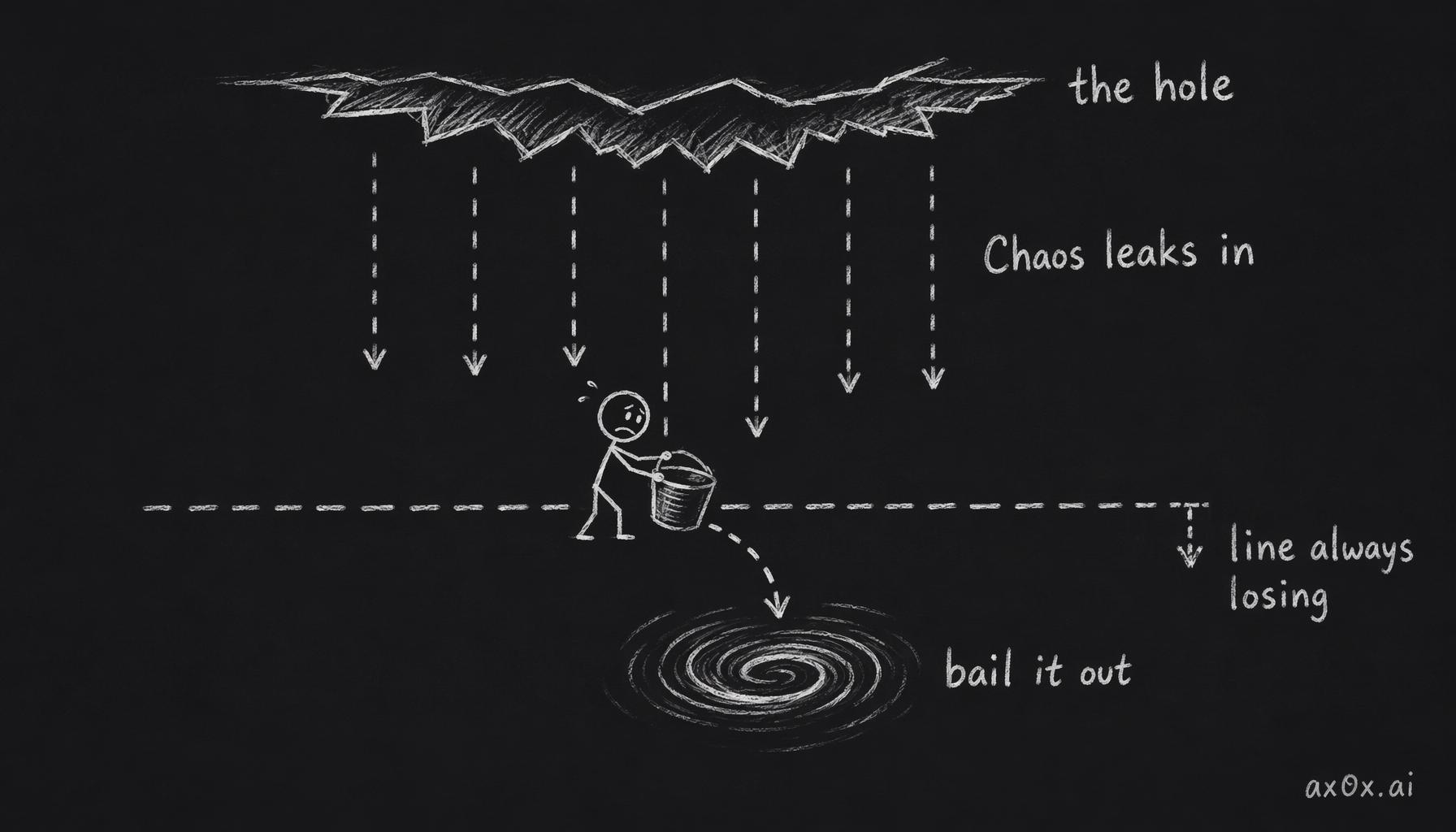 The hole in the sky never closes and Chaos keeps leaking in, so the Elves must forever bail it out just to hold a line that is always slowly losing ground
The man who became a god
Against all of this — Chaos in the north, ratmen below, the dead refusing to stay buried, greenskins boiling out of the mountains — stands one fragile light: the Empire of Man. And the Empire exists because of one person.
Around three thousand years before the setting's present, a chieftain's son named Sigmar was born to the Unberogen, one of a dozen scattered, warring human tribes. A twin-tailed comet streaked the sky the night of his birth — an image that would become his emblem forever. As a young warrior, Sigmar rescued a Dwarf High King from an orc ambush, and in gratitude the Dwarfs (a proud, grudge-keeping mountain people, the Old World's master smiths) gave him Ghal Maraz, "Skull-Splitter" — a runic warhammer that named both his weapon and, eventually, the entire franchise.
Sigmar did two things no one before him had managed. He forged a lasting alliance between men and Dwarfs, and he united the twelve quarrelling tribes into a single people. The seal on it came at the First Battle of Black Fire Pass, where his combined force crushed a massive greenskin invasion pouring out of the mountains — the founding military miracle of human civilization in the Old World. Crowned the first Emperor, Sigmar set the clock running: year zero of the Imperial Calendar, the date everything else is measured from.
Then, the legends say, he laid down his crown and walked east into the mountains, never to be seen again. Centuries later his people began to worship him — not as a saint, but as a god. The Empire's religion is a crowded polytheistic one: alongside Sigmar stand Ulric, the grim old god of war, winter, and wolves (whose cult is older than the Empire itself, and whose high priest crowned Sigmar in the first place), and Taal, lord of wild places and beasts. But Sigmar is the heart of it — a human being deified, the patron saint of the idea that order is worth dying for even when you're losing.
The Dark Gods and their endless game
If Sigmar is the Old World's promise, the Chaos Gods are its sentence. There are four of them, and they are not metaphors. They are real powers in the Warp, and each is sustained by a specific emotion that mortals can't help but feel.
Khorne is rage and bloodshed — every murder, every battlefield, every fit of fury feeds him; his throne sits atop a mountain of skulls. Nurgle is decay, plague, and despair, and he loves his children with a horrible tenderness, gifting them diseases the way a doting grandfather hands out sweets. Tzeentch is change, ambition, scheming, and sorcery — the patron of everyone who has ever wanted more and plotted to get it. And Slaanesh, the youngest, is excess: pleasure and pain pursued past every limit, the god of those who never learned the word "enough."
The dreadful elegance is that you cannot starve these gods, because their food is the human condition. As long as people feel anger, hope, fear, and desire, the Chaos Gods grow fat. The only mercy is that they hate each other almost as much as they hate the world — locked in an eternal squabble the lore calls the Great Game, Khorne forever at odds with Slaanesh, Tzeentch scheming against Nurgle. If the four ever truly cooperated, the world would have ended on day one.
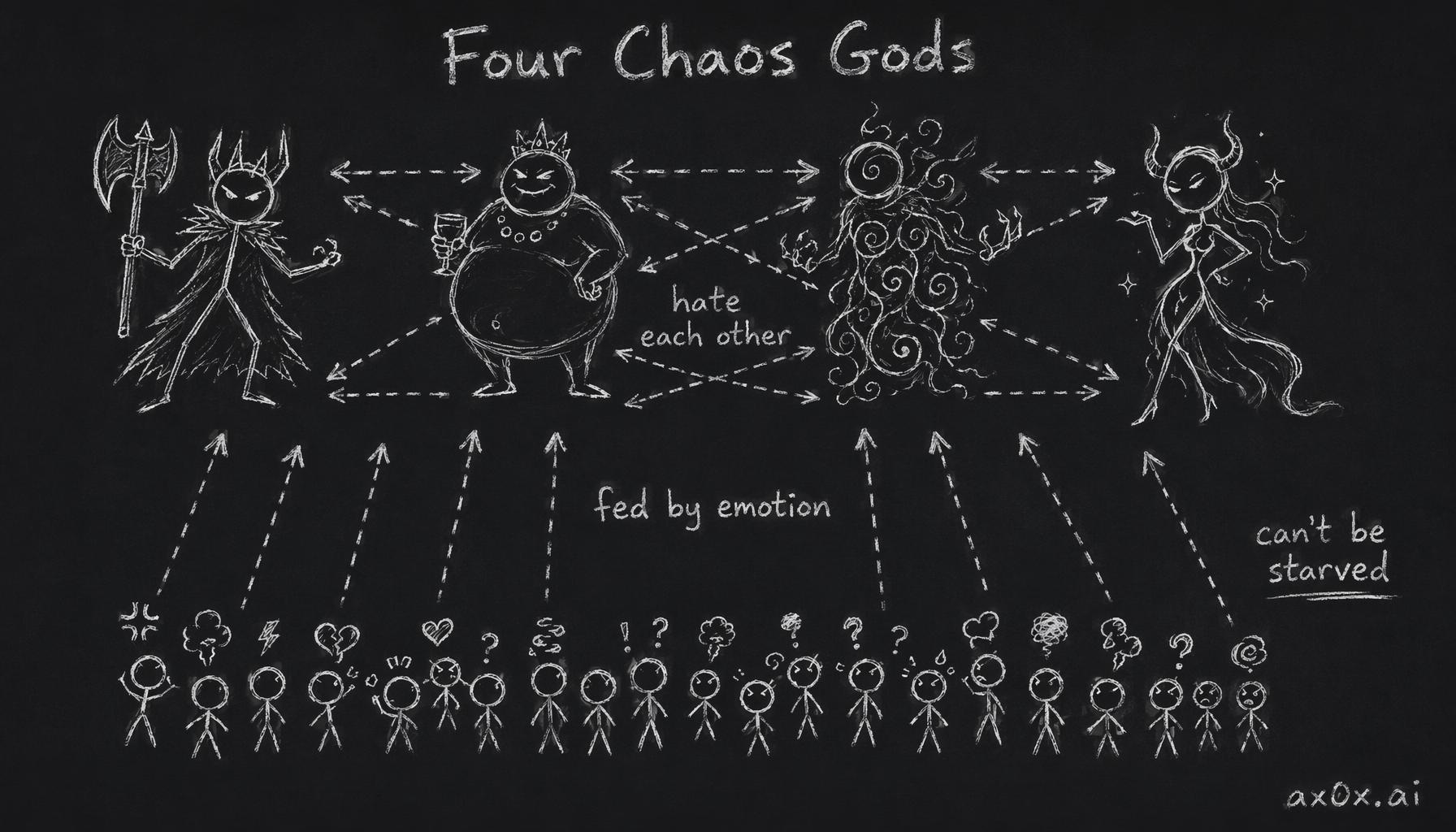 The four Chaos Gods feed on human emotion so they can never be starved, and the only mercy is that they hate each other and stay locked in mutual strife
And Chaos is only the headline threat. Beneath the cities of men scurries a civilization of millions of Skaven — scheming, treacherous ratmen who worship a Horned Rat and weaponize warpstone, and whose existence most of the Old World refuses to even believe in. The deserts to the south hold the Tomb Kings, the reanimated god-kings of a dead Egyptian-analogue empire. The forests breed Beastmen. The mountains spill endless Orcs and Goblins. The aristocracy of one whole region are literal vampires. For a fuller tour of who's shaking a fist at whom, see the factions of the Warhammer world; for why none of them can ever actually win, see the endless war of Order and Chaos.
A familiar shape
If any of this is ringing a distant bell, that's not an accident. The Old World was Games Workshop's first great setting, and three years later, in 1987, the company aimed the same lens at the far future and produced Warhammer 40,000 — a science-fiction universe that took the Old World's core ideas (a holy human empire, a hole in reality, four gods of Chaos feeding on emotion) and scaled them up to a galaxy and forty thousand years. The two worlds were never officially the same place, but the family resemblance is unmistakable. If you'd like to see what the same designers did with spaceships and a million worlds, start with the grimdark galaxy of Warhammer 40,000. Many of the Old World's deepest ideas — the four Dark Gods chief among them — were first whispered here.
How to kill a world on purpose
For three decades, the Old World stood in this exquisite, doomed balance. The line held. Barely.
In 2014, Games Workshop announced it would stop holding. The five-book campaign called The End Times did what the setting had always promised but never delivered: it let Chaos win. The resurrected arch-necromancer Nagash rose; the greatest champion Chaos had ever raised, Archaon the Everchosen, led the largest army in the world's history. Province by province, faction by faction, the Old World was overrun and then, finally, physically destroyed — the planet torn apart, the population annihilated, Sigmar himself left clinging to the shattered core as it fell through the dark.
Why would a company torch its own beloved property? The honest answer is commercial, and fans still argue about it. Warhammer Fantasy Battle, by its final 8th edition (2010), rewarded vast ranked blocks of identical infantry — beautiful on a tournament table, ruinous for the wallet and patience of a hobbyist who has to buy, build, and paint a hundred near-identical models. Sales lagged; the rules had bloated. So Games Workshop wrote the world a Viking funeral and replaced it with something built to sell: Warhammer Age of Sigmar, set not on a single medieval planet but across eight infinite, magic-shaped Mortal Realms — a clean slate, a new cosmology, and (crucially) miniatures sold as small, characterful heroes rather than ranked hordes.
It is important to be precise here, because it's the single most-misunderstood point in all of Warhammer. Age of Sigmar is not "the Old World after the apocalypse." The Mortal Realms are entirely new places. Only fragments crossed over — Sigmar himself, ascended now to a cosmic god-king, and the broken core of old Mallus, which he rebuilt. Everything else is gone. The continuity was severed on purpose. The full story of that ending, and what rose from the ashes, is its own tale — see the End Times and the birth of the Mortal Realms.
But the Old World refused to stay dead.
The fan grief over the World-That-Was never faded, and in January 2024 Games Workshop did something rare: it brought the setting back — not as a continuation, but as a kind of historical reenactment. Warhammer: The Old World is a separate game set roughly three centuries before the old default era, in a fractured period the lore calls the Anarchy, deliberately positioned before the apocalypse ever happens. It's a place to visit the world while it still lives. A snow globe of a civilization we already know is doomed — which, when you think about it, is the most Warhammer thing imaginable.
That is the Old World: a mirror of our own history with the lights turned down, a planet with a hole in its sky, held together by housekeeping and the memory of a man who became a god. It was always losing. That was the point. And for thirty-two years, watching it lose — slowly, beautifully, defiantly — was one of the great pleasures of the hobby.
Warhammer, Warhammer 40,000, and all associated names are © Games Workshop. This is a fan-written lore explainer for educational and commentary purposes.