
Order and Destruction: A Field Guide to the Factions of the Old World
There is a book, kept in a mountain hall called Karaz-a-Karak, that the Dwarfs have been writing for over four thousand years. It is called the Dammaz Kron — the Great Book of Grudges — and it records every slight, theft, betrayal, and broken promise ever committed against the Dwarf race, each one inked in blood and waiting to be settled. No entry is ever forgotten. No grudge is ever fully closed until the wronged party or their heirs have taken proportionate vengeance, which, given the scale of some entries, may take centuries.
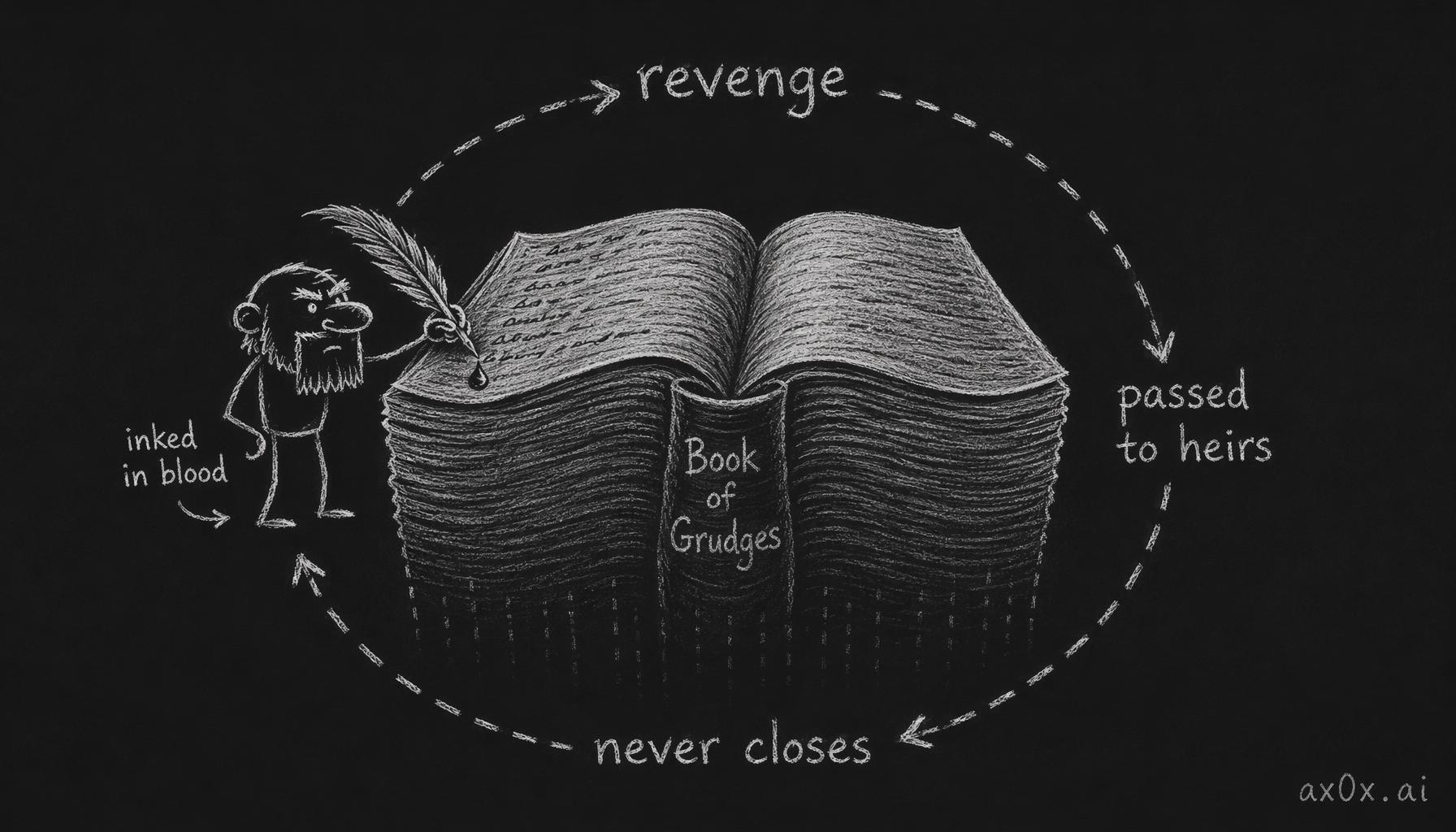 How the Dwarfs' Book of Grudges becomes a loop that never empties — inked in blood, awaiting revenge, passed to heirs, never closed.
You could not design a better symbol for the entire setting. The world of Warhammer Fantasy — introduced in the first part of this series, the world that was — is not dying because its enemies are too strong. It is dying because the people who should be standing shoulder to shoulder against the dark are instead nursing thousand-year grudges, denying threats out of pride, and occasionally going to war over a shaved beard. This is the great tragedy hiding inside the dice and miniatures: civilization has all the pieces it needs to survive. It will simply never put them on the same side of the board.
To understand why, you have to meet the players. They sort, loosely, into two camps — the Forces of Order, who want to keep their corner of a hostile world, and the Forces of Destruction, who want to drag everything back into ruin. But the most interesting fault lines run inside the camp of Order, between people who should be friends.
The races that build, and the reasons they can't get along
Start with the humans, because there are two human kingdoms and they could not be more different.
The Empire of Man is the setting's beating heart and its most relatable faction — a sprawling, quarrelsome confederation of provinces that reads like Renaissance Germany handed a few cannons and a great deal of religious anxiety. It was forged by one man, Sigmar Heldenhammer, a tribal chieftain who united twelve squabbling human tribes, allied with the Dwarfs, and broke a massive greenskin invasion at the First Battle of Black Fire Pass. The Dwarf High King Kurgan Ironbeard, whom Sigmar had once rescued, gave him a warhammer named Ghal Maraz ("Skull-Splitter") and pledged a master runesmith to forge the Twelve Runefangs — ancestral swords still carried by the Empire's rulers today. Sigmar was crowned the first Emperor, then walked east into the mountains and never returned, becoming the state god. His Empire is run by Elector Counts who bicker constantly and vote on who wears the crown; in the "present day," it sits on Karl Franz, who rides a griffon and wields Sigmar's own hammer. The Empire is brave, ingenious, and forever one bad winter from falling apart — which is precisely why people love it.
West of the Empire lies Bretonnia, and if the Empire is gunpowder and pragmatism, Bretonnia is the chivalric fairy tale taken at face value. Its knights are among the deadliest cavalry in the world, sworn to a Code of Chivalry and to quest for the Grail, believing themselves blessed by a mysterious goddess, the Lady of the Lake, who once appeared to the kingdom's founder Gilles le Breton and turned his ragged dukes into the first Grail Knights. It is a beautiful story. It is also, from the dirt's-eye view, a brutal feudal hierarchy where a tiny aristocracy lives in storybook glory atop a vast population of downtrodden serfs who do the dying and none of the questing. Warhammer rarely lets you admire something without showing you its cost.
Then there are the Dwarfs (the Dawi) — and here the tragedy sharpens. They are an ancient, master-crafting, mountain-dwelling people whose civilization peaked long ago and has been shrinking ever since, their underground holds — the karaks — lost one by one to earthquakes, goblins, and ratmen in a slow catastrophe their own histories call the Time of Woes. The Dwarfs respond to decline with grim stubbornness: they keep their grudge-book, revere their ancestor-gods, and produce Slayers — warriors so shamed by failure that they dye their hair into great orange crests, renounce all possessions, and go looking for a monster large enough to kill them honorably. No faction in fiction is quite so committed to dying well.
The Elves are split three ways, and the splits are the whole story.
The High Elves (the Asur) live on Ulthuan, a ring-shaped island continent that is, quietly, the single most important place in the world. At its center spins the Great Vortex, a magical maelstrom maintained by Elven mages that continuously siphons raw Chaos energy out of reality. Without it, the world would have drowned in Chaos millennia ago. The High Elves are beautiful, arrogant, and exhausted from holding a line nobody thanks them for.
Their dark mirror, the Dark Elves (the Druchii), live on the freezing northern continent of Naggaroth and run an economy on slavery, murder, and the worship of Khaine, the god of murder. They raid the coasts of the world for captives, sacrifice constantly, and dream of conquering the homeland that exiled them. We'll get to why they're exiled — it's the best soap opera in the setting.
The third branch, the Wood Elves (the Asrai), withdrew from all of it into Athel Loren, a sentient forest that will simply kill you for walking under the wrong tree. They are ruled jointly by Orion, the King in the Woods — who burns to death on a pyre every midwinter and is reborn every spring — and his queen Ariel. Their armies include the trees themselves: animate Dryads, Tree Kin, and ancient Treemen like Durthu. The Wood Elves don't want to save the world. They want everyone to leave their forest alone, and they will commit startling violence to enforce it.
Finally, two of Order's strangest members. The Lizardmen of the steaming jungles of Lustria are the oldest living faction — cold-blooded servants of the long-vanished Old Ones, those near-divine alien architects who terraformed the world and seeded its younger races. The Lizardmen are commanded by the Slann, immense psychic toad-priests who spend most of their time in meditative trances, reading the cosmic blueprint they call the Great Plan and nudging history back toward it. Their society is rigidly biological: Slann at the top, then the warrior-bred Saurus, the clever little Skinks, and the hulking Kroxigor. They are not defending civilization out of kindness — they are correcting the world toward a design older than every other race combined.
And on the northern frontier sits Kislev, a cold Russia-flavored kingdom of Winged Lancers and Ice Witches, ruled by a Tzar or Tzarina. Kislev matters out of all proportion to its size for one brutal reason of geography: it is the first thing in the way when Chaos marches south. It bleeds so the Empire has time to muster.
The grudges that doomed them
Here is where the Great Book of Grudges stops being a quirk and becomes the explanation for everything.
Long before Sigmar, the High Elves and the Dwarfs were allies and trading partners — the two great civilizations of the early world. Then it fell apart in a war so foundational the Dwarfs simply call it the War of Vengeance, and everyone else calls the War of the Beard (roughly the centuries around -2000 to -1600 in the Imperial Calendar, the dating system that counts from the founding of the Empire as year zero). The spark, in the oldest telling, was an Elven insult to a Dwarf trade delegation, capped when a Dwarf ambassador's beard was shaved — an unforgivable mutilation by Dwarf reckoning. In later, more tragic versions of the lore, the original raids that provoked the Dwarfs weren't High Elves at all, but Dark Elf raiders in disguise, deliberately poisoning the alliance. The war happened anyway. It ran for centuries, shattered the friendship permanently, and ended with the Dwarf High King Gotrek Starbreaker killing the High Elf Phoenix King Caledor II in single combat and seizing his crown — but only after Caledor had killed Gotrek's own son. Two of the most advanced races in the world crippled each other over a misunderstanding, and never trusted one another again. That single grudge is, in many ways, why nobody can hold the line today.
The Elven split is even more operatic. The first High Elf king, Aenarion, drew a cursed weapon — the Sword of Khaine, the Widowmaker — to throw back the world's first Chaos invasion, and in doing so doomed his bloodline. His son by the sorceress Morathi was Malekith, who grew into the greatest Elf of his age and fully expected to inherit the throne. The ruling Council passed him over. When Malekith tried to prove his right by walking through the sacred Flame of Asuryan — which legitimate kings pass unharmed — the flame burned him, nearly to death. Humiliated and scarred, he turned on his own people. His war, the Sundering (around -2750 IC), climaxed in an attempt to break the Great Vortex that backfired so catastrophically it sank much of Ulthuan beneath the sea. Defeated, Malekith and his followers fled north to Naggaroth, where he became the Witch King, ruling with his mother Morathi scheming behind the throne. Every Dark Elf raid for the next two and a half thousand years is, fundamentally, one rejected heir's tantrum metastasized into a civilization.
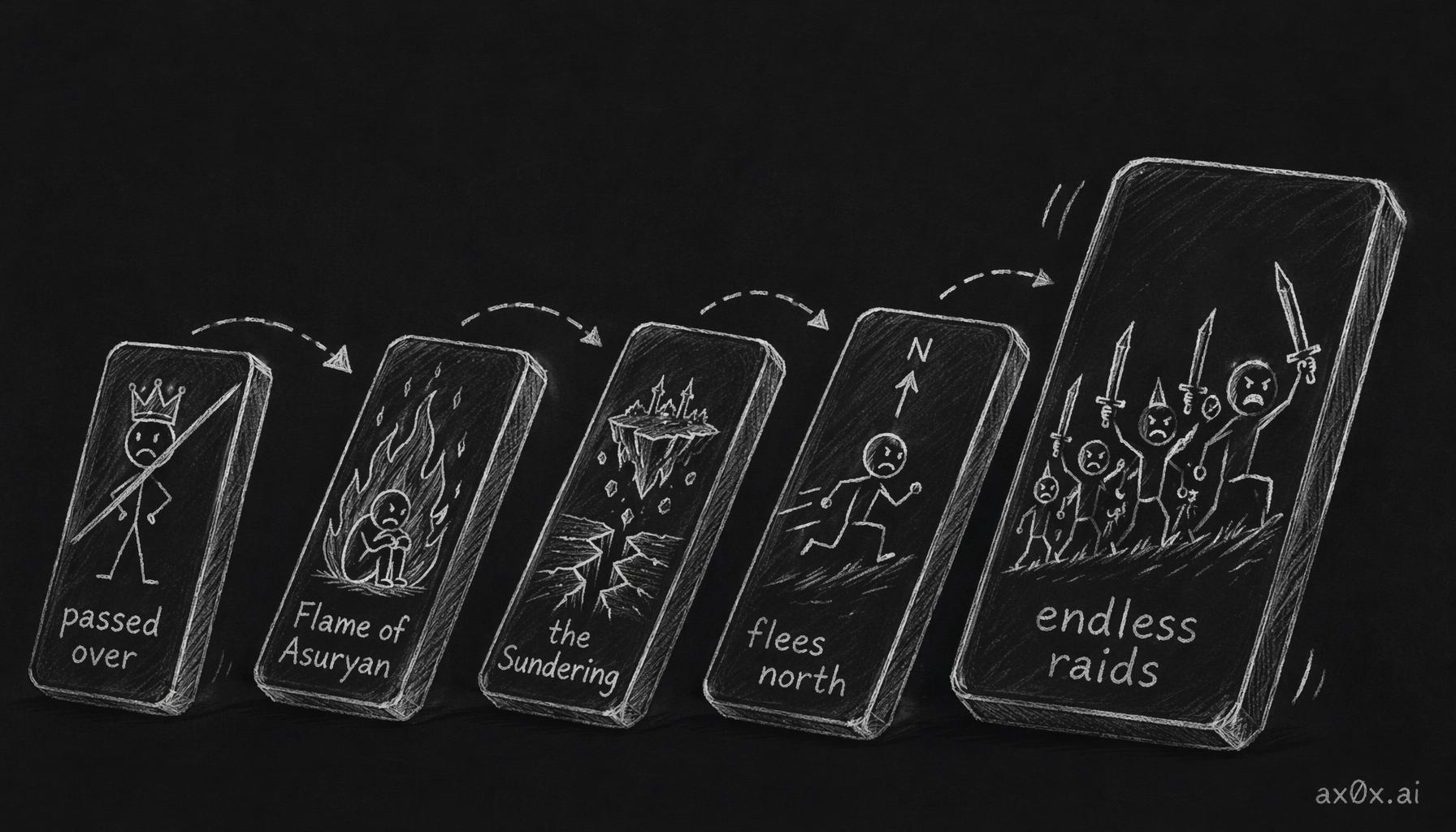 How Malekith's single denied throne topples like dominoes into 2,500 years of Dark Elf war.
Hold onto Malekith's name. His story has the single best twist in the whole saga, and it pays off in the End Times, the apocalypse that closes this series.
The forces that want it all to end
If Order is a family that can't stop fighting at dinner, Destruction is the long list of things waiting outside the door.
Looming over all of it is Chaos — the metaphysics of the setting made into an enemy. Chaos pours into the world through collapsed gateways at the poles, and it answers to four gods locked in an eternal contest called the Great Game: Khorne, lord of blood and rage; Nurgle, the paradoxical god of disease who loves his followers even as he rots them; Tzeentch, the schemer of change and sorcery; and Slaanesh, the youngest, born from Elven excess and forever hungry for Elven souls — which is why High Elves wear protective talismans and Dark Elves sacrifice to feed something else first. Chaos fields daemons spilled straight out of the magic-realm, the Beastmen who are born corrupted in the deep forests, and the human Warriors of Chaos — the Norse-coded tribes of the frozen north who periodically unite under a champion and march south to burn everything.
But the threat I'd put real money on isn't Chaos. It's the Skaven.
The Skaven are ratmen, and they are everywhere — a teeming, scheming civilization burrowed into the Under-Empire, a network of tunnels running beneath every other realm on the map. They number in the untold millions, they wield insane technology powered by warpstone (solidified Chaos), and they have, on paper, the strength to overrun the entire surface world. Two things stop them. First, they betray each other so relentlessly that their ruling Council of Thirteen can barely coordinate a meeting, let alone a conquest. Their four Great Clans — the mad warlock-engineers of Skryre, the monster-breeders of Moulder, the plague-monks of Pestilens, and the assassins of Eshin — spend as much energy knifing one another as fighting the surface. Second, and this is my favorite detail in all of Warhammer: the Empire's authorities officially deny the Skaven exist. Sightings are dismissed as peasant superstition. There is a worldwide rat-civilization actively undermining human cities, and the official position of human government is that it's a fairy tale. The cover-up is its own running plotline.
The rest of the roster is a parade of nightmares. The Greenskins — Orcs and Goblins — are a fungal species that reproduces by spores, which is why you can never quite exterminate them: kill an Orc and you've just fertilized the next batch. They live only to fight, worship the brother-gods Gork and Mork (one "brutally cunning," the other "cunningly brutal"), and when enough of them gather, their collective bloodlust generates a literal psychic phenomenon called a Waaagh! that empowers their shamans and swells into an unstoppable migration of violence.
Then there is everything death has to offer, all of it tracing back to one man: Nagash, a priest-king of the desert civilization of Nehekhara who invented necromancy and created the first vampires by refining an Elixir of Life from warpstone. He is the source code for every undead thing in the setting. His attempt to raise his entire dead civilization as slaves was foiled when a freed king ran him through with a Skaven-forged blade — but the botched ritual woke something else: the Tomb Kings, the mummified rulers of Nehekhara, who rose with their minds and personalities intact (not shambling zombies — furious dynasts) under Settra the Imperishable, who rejects even Nagash's mastery with the setting's best one-liner: "Settra does not serve. Settra rules." From Nagash's first vampires descend five bloodlines, including the ambitious von Carstein counts, whose Vlad nearly conquered the Empire from the dark province of Sylvania.
And rounding out the field: the Ogres, mercenary giants who worship a meteor that ate their homeland and now hire their appetites out to anyone with food; and the Chaos Dwarfs, Dwarfs cut off in the east and corrupted into a bull-god-worshipping industrial slave-empire, the dark inversion of everything their northern cousins stand for.
Why none of it will save them
Lay the board out and the arithmetic looks survivable. Order has the Great Vortex draining Chaos, the Slann steering history, the Empire's guns, Bretonnia's cavalry, Dwarf craft, and Elven magic. If those powers ever genuinely combined, Chaos might actually lose.
They never will. The Dwarfs won't forgive the Elves. The High Elves and Dark Elves will fight until one is extinct. The Empire and Bretonnia squabble; the Wood Elves won't leave their trees; the Lizardmen serve a plan no human will ever read. Every faction has a grudge-book of its own, written or remembered, and every grudge is one more reason the door stays unguarded while the things outside it grow stronger.
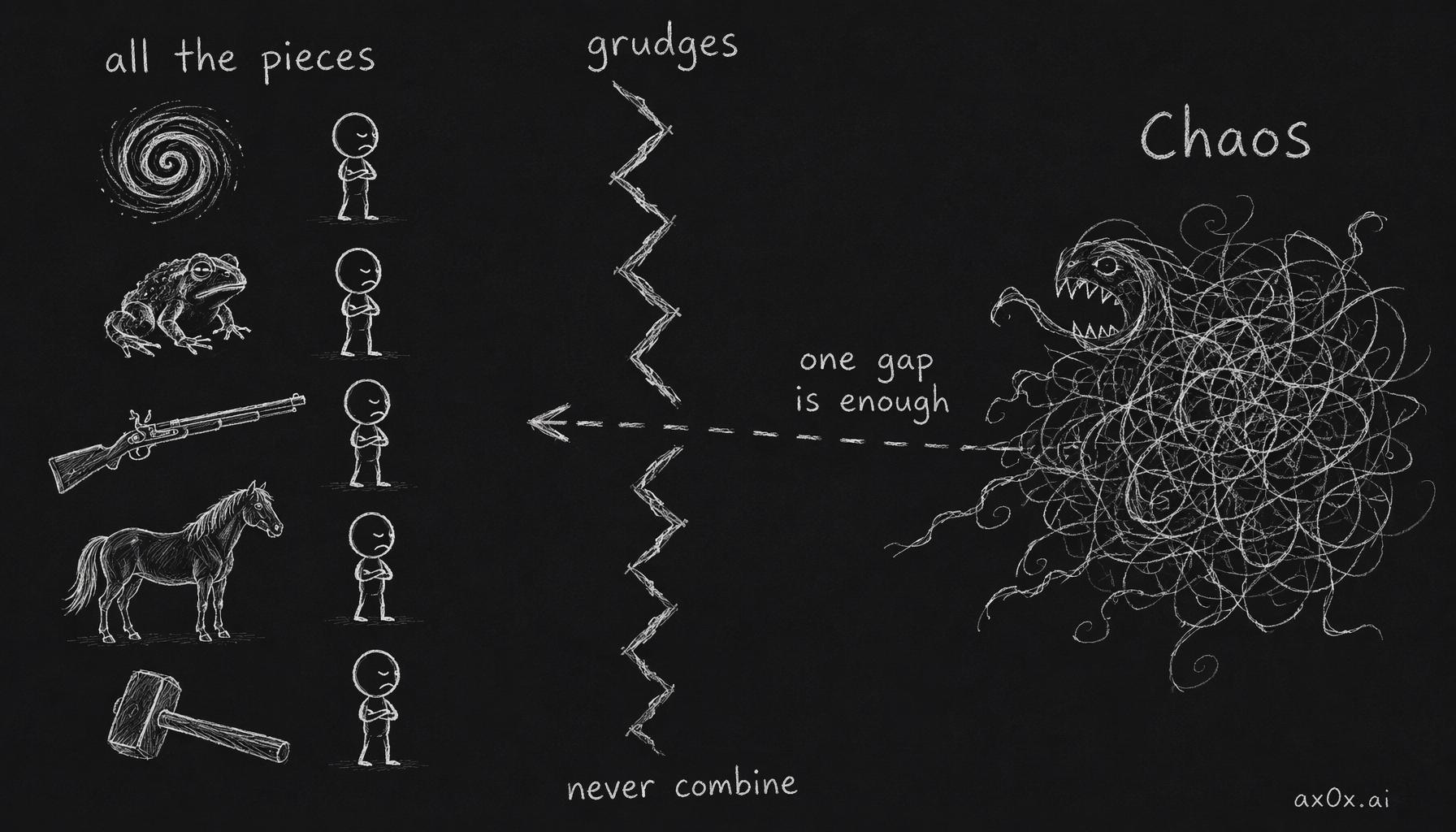 Order holds all the pieces but grudges keep them from combining, while Chaos needs only one gap.
That is the engine of the whole setting — not good versus evil, but a civilization too proud and too wounded to unite, fighting an enemy that needs only one moment of disunity to win. In the next part, we'll watch that engine run: the endless war of Order and Chaos, the incursions and sieges and last stands that fill the centuries between Sigmar and the apocalypse. If you've come from the science-fiction half of Games Workshop's universe, you'll recognize the shape of it — the same machinery of pride and ruin drives the factions of the 41st millennium, just with more lasers and fewer beards.
The grudges, though — the grudges are pure Warhammer Fantasy. And the book is never, ever finished.
Warhammer, Warhammer 40,000, and all associated names are © Games Workshop. This is a fan-written lore explainer for educational and commentary purposes.