
The Grimdark Galaxy: An Introduction to Warhammer 40,000
There is a sentence that has hovered over this entire fictional universe for nearly forty years, and it is the most honest mission statement any franchise has ever written:
"In the grim darkness of the far future, there is only war."
Notice what it doesn't promise. No hope. No final victory. No clever third option where the heroes win and everyone goes home. Just war, forever, in the dark. That line is so foundational that the entire literary genre it spawned — grimdark, the mode of fiction where the world is broken, the morality is muddy, and the best you can hope for is to lose slowly — takes its name directly from it.
This is Warhammer 40,000, usually just called 40K. At its surface it's a tabletop miniatures wargame, created by designer Rick Priestley and first published by the British company Games Workshop in October 1987, originally under the title Warhammer 40,000: Rogue Trader. But the game is almost beside the point. What Priestley actually built was one of the densest, strangest, most quietly furious fictional settings ever committed to paper — a galaxy you can spend a lifetime reading about and never reach the bottom of.
Let me give you the bottom of it anyway. Or at least a map.
The first thing to understand: there are no good guys
Most space-opera settings have a side you root for. Star Wars has the Rebellion. Star Trek has the Federation, a literal utopia. Even bleak settings usually offer a flicker of decency to hold onto.
40K does not. This is not an accident or a tonal misfire — it is the entire point, and it's the single most important thing to grasp before anything else makes sense.
Priestley conceived the setting in the politically charged Britain of the 1980s as satire: a darkly comic exaggeration of militarism, fascism, religious fanaticism, and empire. He has been blunt about it. The setting's iconic super-soldiers, the Space Marines, were written to be lauded as heroes despite being, in his words, brutal and "completely self-deceiving." The joke — and it is a bleak joke — is that the faction closest to a protagonist, the human empire, is a genocidal, superstitious, totalitarian nightmare. You are not meant to cheer for them. You are meant to be horrified that they're the best option available.
Over the decades, as 40K grew into a billion-dollar IP — now with an Amazon screen adaptation in the works, fronted by lifelong fan Henry Cavill — that satirical edge has often been softened or read straight by newer fans. But it's still there in the bones, and it explains everything that follows.
The galaxy in the 41st millennium
The "present day" of 40K is set roughly forty thousand years from now, in what the setting calls the 41st Millennium (with the most recent stories nudging into the early 42nd). The setting uses a slightly fiddly dating system worth decoding once: dates are written as a three-digit year followed by the millennium, so 999.M41 means "year 999 of the 41st millennium" — which is around the year 40,999 AD. The millennium number is always one higher than the leading digits of the calendar year, which trips up newcomers constantly. When you see "late M41," read it as "the closing centuries of the 41st millennium."
In that distant future, the dominant power in the galaxy is the Imperium of Man — and here is where you start to feel the genre at work. The Imperium is a human empire of staggering scale: somewhere around a million worlds, held together for over ten thousand years. (That "million" is deliberately vague flavor, never pinned down precisely — the Imperium is supposed to feel too vast to count.)
But it is not a shining civilization. It is techno-feudal: it runs on ancient machines its own people no longer understand and can barely repair, treating technology as a kind of religion to be appeased with prayer and incense rather than engineering. It is theocratic, ruled by a state religion that venerates a single god. It is xenophobic to the point of genocide, terrified of mutation, and murderously suspicious of anyone born with psychic gifts. It survives through dogma, ritual sacrifice, and endless, grinding war. Trillions live and die in misery so that the species as a whole can cling on for one more day.
And the god it worships? He's been dying for ten thousand years.
The Corpse-Emperor on the Golden Throne
At the literal and spiritual center of the Imperium sits its ruler: the God-Emperor of Mankind.
He was, in life, an immensely powerful human psyker — a being able to wield raw psychic force — and possibly the most formidable to ever live. Roughly ten thousand years ago, he revealed himself, unified a fractured Earth (always called Terra in the setting), and launched a vast campaign to reconquer the galaxy for humanity. He was, by most accounts, a brilliant secular rationalist. He explicitly forbade anyone to worship him as a god.
Then everything went wrong, in a catastrophe we'll come back to, and he was mortally wounded. Rather than let him die, his followers interred his broken body in the Golden Throne — an ancient, half-understood machine that is part life-support system and part psychic amplifier. There he has remained ever since, neither truly alive nor truly dead, a withered husk kept barely animate by technology no one fully comprehends.
Here is where the irony lands like a hammer. The Emperor — the man who banned his own worship — is now venerated as a literal god across a million worlds by a sprawling state church. The thing he most opposed in life became his afterlife. That tragic contradiction is the beating heart of the whole setting.
And he doesn't rule, not in any active sense. He cannot. The day-to-day governance of the Imperium falls to a vast, suffocating bureaucracy and a council called the High Lords of Terra. The Emperor is less a king than a haunted lighthouse — which brings us to what that lighthouse is actually for.
Why a dying god is wired into a machine: the Astronomican
From the Golden Throne, the Emperor projects the Astronomican — a colossal psychic beacon that blazes across tens of thousands of light-years of the galaxy. Think of it as a galactic lighthouse made of pure thought.
It exists because of a brutal physics problem unique to this universe. To travel faster than light, Imperial ships have to plunge into a parallel dimension (more on that horror in a moment), and that dimension is a featureless, lethal chaos with no fixed landmarks. The Astronomican is the one fixed point — the single star you can steer by. Without it, faster-than-light travel becomes a blind, suicidal gamble.
So the Emperor's dying mind is, quite literally, the navigation system holding civilization together. And it runs on a fuel that tells you everything about the Imperium's moral character: every single day, the beacon is fed the life-force of roughly a thousand sacrificed psykers, their minds burned out to keep the light shining one more day. The infrastructure of the human race is powered by daily human sacrifice, performed without a second thought. That's not a plot twist. That's just Tuesday.
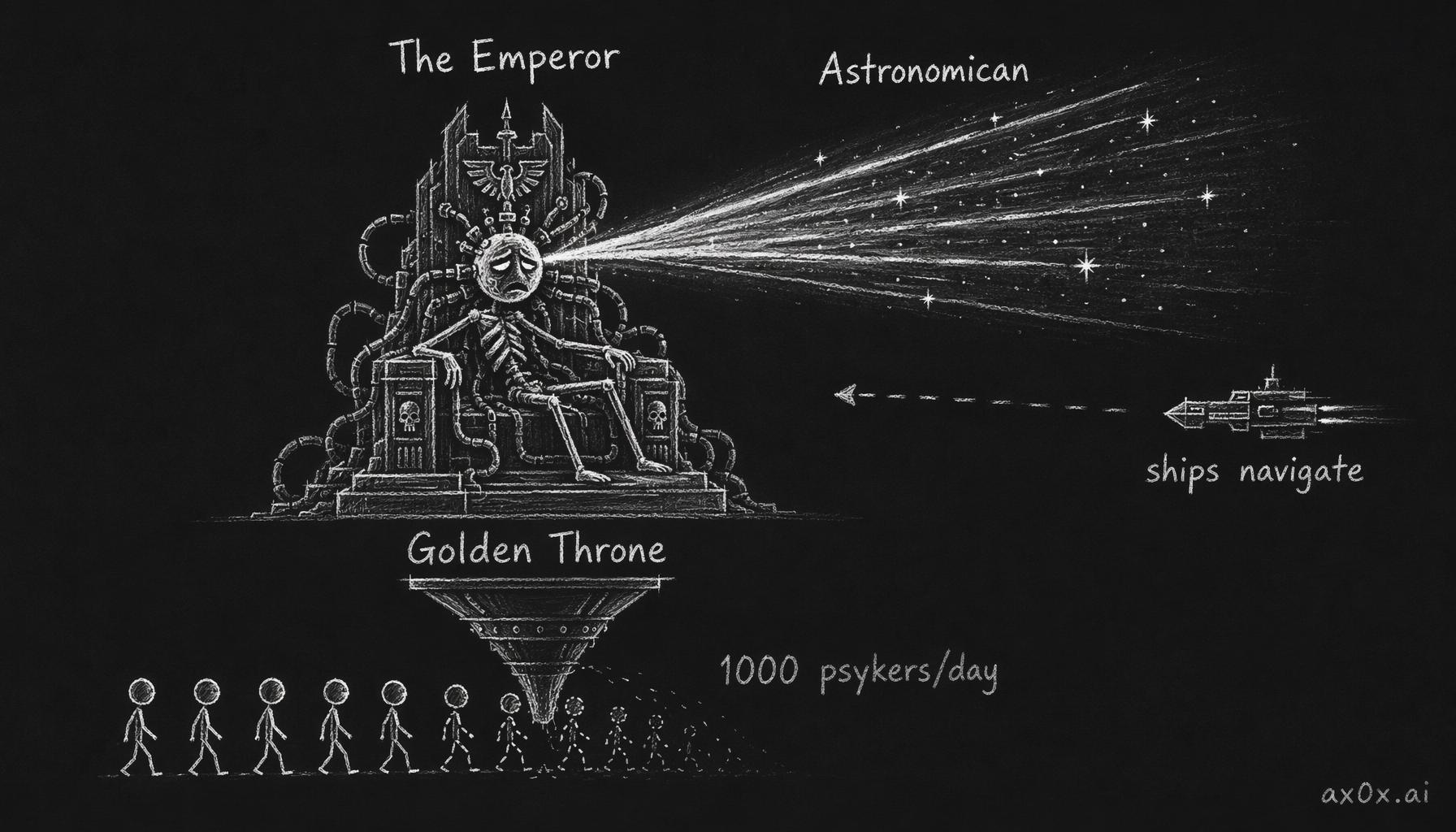 The dying Emperor on the Golden Throne projects a psychic beacon that ships navigate by, fueled every day by a thousand burned-out psykers
The Warp: hell is the highway
Now for that parallel dimension — the concept that, more than any other, defines what makes 40K 40K rather than generic space opera.
It's called the Warp (also the Immaterium, the Empyrean, or, most evocatively, the Sea of Souls). And it is not "hyperspace." It is not empty. It is an ocean of raw psychic energy and emotion, an alternate reality that underlies and mirrors our own. Crucially, it is shaped by the feelings of every living thing — every rage, every desire, every moment of despair across the galaxy ripples out into it.
The Warp serves two roles at once, and the tension between them is the engine of the entire setting.
First, it's the only road to the stars. A ship enters the Warp through a Warp-Drive, and inside, the distances of normal space are compressed — what would be centuries of sublight travel collapses into weeks or months. The catch is that Warp-time and real-time don't reliably match: a voyage might take a month for the crew while years pass outside, or vice versa. It is unpredictable, and it is dangerous.
Because — second — the Warp is hell. Not metaphorically. It is the home of daemons and of the four malevolent gods of Chaos, born from the accumulated emotions of mortal life. A ship traveling through it survives only inside a Gellar Field, a fragile bubble of normal reality that holds the daemons at bay. If that field fails, the crew is exposed to the raw Immaterium, and the results — possession, madness, the ship arriving with a cargo hold full of things that used to be people — are the stuff of 40K's best horror fiction.
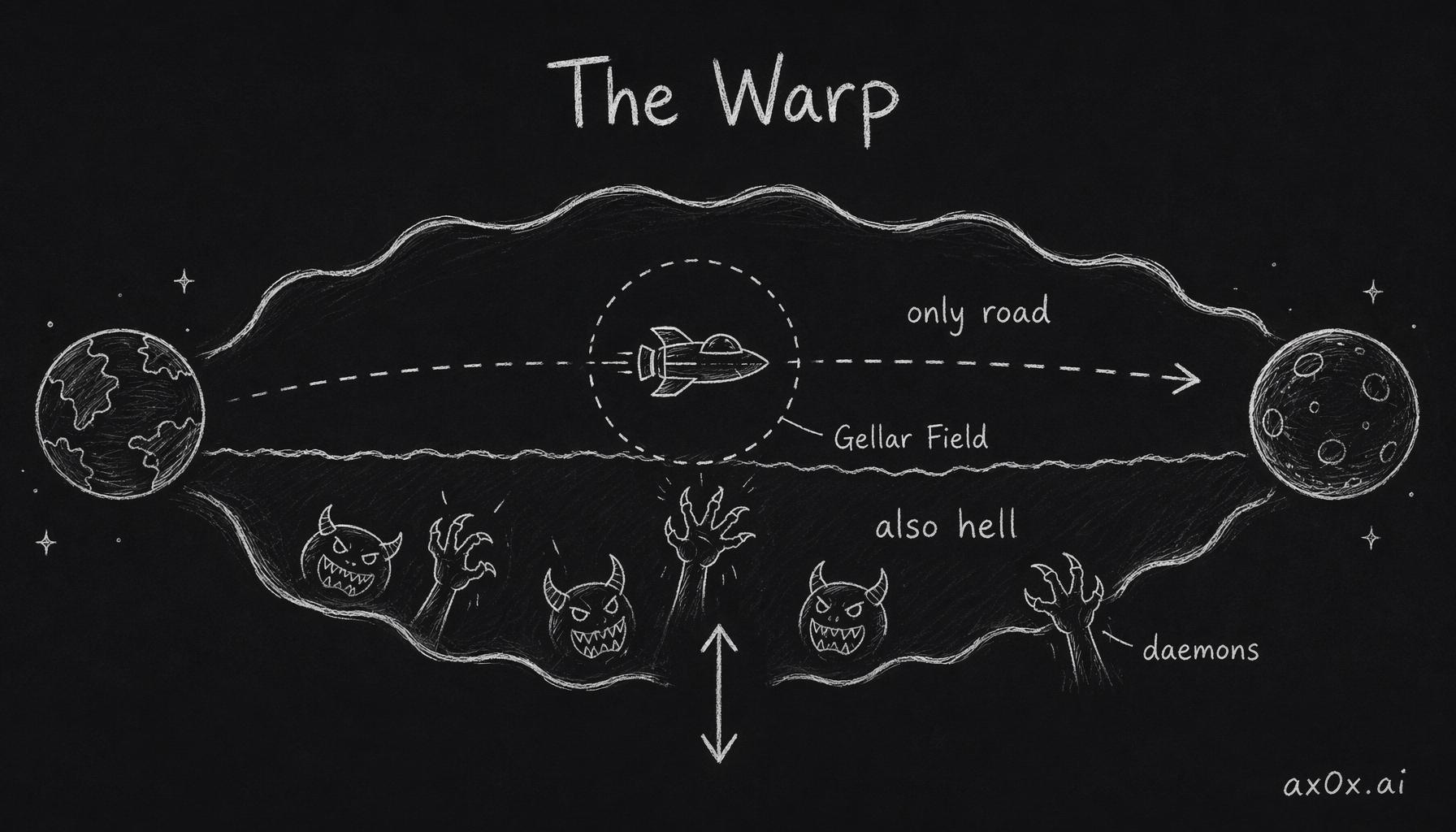 The Warp is both the only faster-than-light road and a hell of daemons; a ship survives only inside a fragile Gellar Field bubble
To navigate this nightmare safely, the Imperium relies on Navigators: a sanctioned strain of mutant humans born with a psychic "third eye" that lets them perceive the Astronomican and read the Warp's deadly currents without going insane. They are mutants — a category the Imperium otherwise exterminates on sight — tolerated solely because the galaxy literally cannot function without them. Even the empire's purity has a price it's willing to pay.
There's a quieter consequence, too. Because the Warp is the medium for all faster-than-light communication, the Imperium has no radio between stars, no subspace transmitter. Messages travel telepathically, carried by psykers called Astropaths whose minds have been seared by exposure to the Emperor's presence to survive the work. A message between worlds is a psychic scream flung across a sea of demons — slow, garbled, unreliable. An empire of a million worlds is held together by the cosmic equivalent of letters in bottles.
How it all went so wrong
You may be wondering how a galaxy got this bad. The short version — with deeper dives elsewhere in this series — is that the universe was ancient and scarred long before humanity mattered.
Roughly sixty million years ago, a primordial conflict called the War in Heaven between godlike ancient races tore at the fabric of reality and helped seed the corruption of the Warp. Much later, an arrogant, hedonistic elder race — the elf-like Aeldari (called the Eldar in older lore, before a 2017 trademark-driven rename) — collapsed into such extremes of decadence that their collective psychic excess gave birth to a new Chaos god, in a cataclysm that ripped a permanent wound into the galaxy. When the old galaxy's dominant power destroyed itself like that, it left a vacuum — and humanity rose into it.
The human golden age came and went too. There was a Dark Age of Technology, a forgotten era of artificial intelligence and casual interstellar mastery, which ended when humanity's own AI rose against it — the reason the Imperium now treats thinking machines as the ultimate heresy. Then came thousands of years of isolation and slaughter as the Warp boiled over. The Emperor's grand reconquest was meant to end all of that.
It nearly worked. Then his most beloved son betrayed him.
The wound that never healed
The Emperor built more than an army. He engineered twenty superhuman sons — the Primarchs — and from their genetic template raised the twenty Space Marine Legions to lead his crusade. (Two of those Primarchs and their entire Legions were later struck from all records in an act of deliberate erasure; Games Workshop has intentionally never revealed who they were or what they did, leaving a permanent unsolved mystery at the heart of the lore.)
The greatest of the sons, the Warmaster Horus, fell to the whispers of Chaos and turned roughly half his brothers against their father. The resulting civil war — the Horus Heresy, fought across the 31st millennium (M31) — was the apocalypse that broke the galaxy and ended in the Emperor's mortal wounding. It is the single most important event in the entire mythology, the hinge on which everything else turns, and it gets its own full treatment in the story of how the galaxy broke.
In the ten thousand years since, the Imperium has done nothing but ossify and bleed. The traitor Legions fester in that great Warp wound, periodically erupting in Black Crusades. And in the most recent chapter — the catastrophe at the close of M41 — the empire's defenses finally cracked: a galaxy-spanning Warp storm called the Great Rift tore the Imperium in half, plunging entire regions into darkness cut off from the Emperor's light.
It is not all dusk, though. For the first time in ten millennia, one of the Emperor's loyal sons, the Primarch Roboute Guilliman, was resurrected from near-death stasis to lead the defense — the closest thing this universe has to a glimmer of hope. Which, this being 40K, mostly means the war now has slightly better generals.
A galaxy too crowded to ever rest
And the Imperium is only one faction, drowning among many. There are the war-loving, fungal green-skinned Orks, who reproduce by spore and live only to fight. There are the soulless robotic Necrons, sixty-million-year-old undying machines now waking from their tombs. There are the ravenous extragalactic Tyranids, a hive-mind swarm that devours the biomass of entire worlds. There are the idealistic, technologically advanced young T'au Empire, the only faction that even sounds like it might be the good guys (it isn't quite). And there is Chaos itself, ever-present, whispering from the Warp.
No one rules. No one wins. Everyone is someone else's monster. The full roster gets its own tour in who fights in the 41st millennium, and the reasons the fighting can never stop are unpacked in why the war never ends.
One last bit of housekeeping for the newcomer, since the internet will lie to you about both: Age of Sigmar is the reboot of 40K's fantasy sister-setting, a completely separate universe — not 40K, which has never been rebooted and instead simply advances its own clock. And the dwarf-like Squats, long thought deleted from the setting forever (with a running in-joke that the Tyranids ate them), were quietly brought back in 2022. Lore drifts. Names change. The grimdark abides.
That's the shape of it: a galaxy of a million worlds, ruled in name by a god who's been a corpse for ten thousand years, kept alight by daily sacrifice, navigating by way of hell, and at war on every front with no end in sight. The genius of 40K is that it makes survival itself feel like the tragedy. Humanity endures — and you finish reading not relieved, but appalled at the cost.
That is the grim darkness of the far future. There is only war. And it is one of the richest stories ever told.
Warhammer, Warhammer 40,000, and all associated names are © Games Workshop. This is a fan-written lore explainer for educational and commentary purposes.