
Who Fights in the 41st Millennium? A Field Guide to the Factions of Warhammer 40,000
There is a line that fans of this setting repeat like a prayer, half-joking and entirely serious: in the grim darkness of the far future, there is only war. It is not hyperbole. It is the load-bearing fact of the entire universe. Every faction in Warhammer 40,000 has, at some point, decided that the correct response to existence is to point a very large gun at it.
But a war is only as interesting as the people fighting it — and the genius of 40K, the thing that has kept it alive since its 1987 debut, is that it gives you no one to root for. There are no good guys. There is a fanatical, rotting human empire that burns its own children for thinking the wrong thoughts. There are gods made of pure emotion who want to wear your soul as a hat. There are aliens ranging from "merely genocidal" to "literally a planet-eating swarm with no off switch." You don't pick a side in 40K. You pick which flavor of doom you find most aesthetically pleasing.
Let's meet the combatants. Three great blocs divide the galaxy — the Imperium of Man, Chaos, and the Xenos (aliens) — and within each there are factions who hate each other almost as much as they hate everyone else.
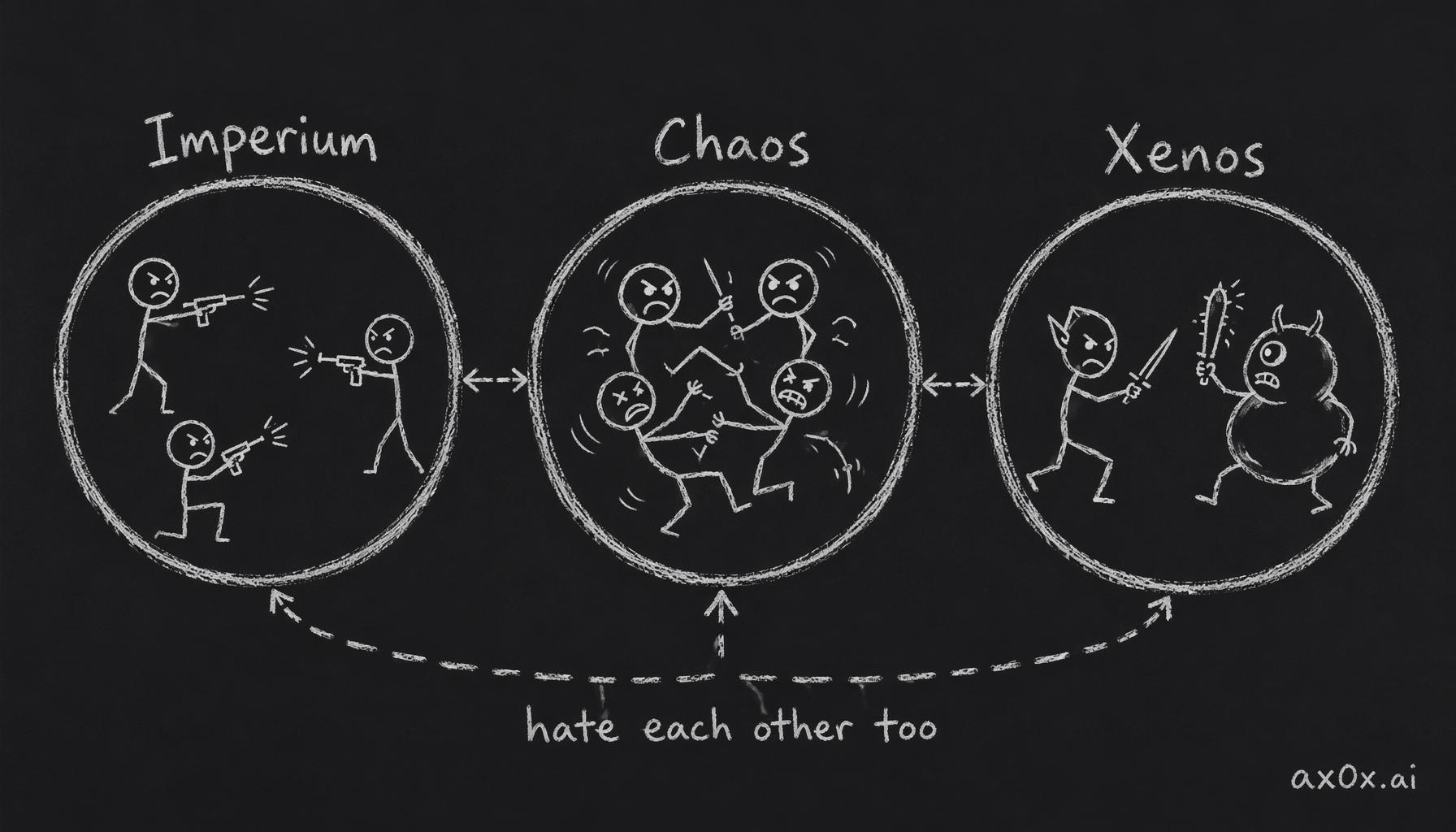 The galaxy splits into three great blocs — Imperium, Chaos, Xenos — and each bloc's members fight one another almost as much as they fight outsiders
The Imperium of Man: a corpse on a throne, worshipped by a trillion souls
Start with the home team, because it is the largest and the most tragic. The Imperium of Man is a galaxy-spanning human empire of roughly a million worlds, and it is dying on its feet. It is a theocracy — a state religion fused with the government — and the god at its center is a literal corpse that won't finish dying.
That god is the Emperor of Mankind. Ten thousand years ago he was a living super-being who tried to drag humanity into a golden age of reason. Then his own favorite son betrayed him (we'll get there) and mortally wounded him. Since then he has sat on the Golden Throne on Terra — old Earth — neither alive nor dead, a failing life-support machine keeping the most powerful psychic mind in human history barely flickering. His will projects a psychic lighthouse, the Astronomican, that lets ships navigate the warp, and his half-corpse is worshipped by a trillion citizens. The cruel irony — and 40K runs on cruel irony — is that the Emperor spent his life trying to stamp out religion, and is now the most worshipped figure in galactic history.
The Imperium doesn't have one army. It has dozens of competing bureaucracies — the Adepta — deliberately kept separate so that no single person can ever again seize total power. The big ones:
Space Marines: the poster boys, and not the main army
The Adeptus Astartes — the Space Marines — are the seven-foot, gene-engineered warrior-monks on the cover of every box. Surgically rebuilt from human teenagers using genetic templates called gene-seed, given extra organs, and sealed into power armor, they are the Imperium's elite shock troops and very, very good at killing.
Here's the misconception worth killing immediately: Space Marines are not the Imperium's main army. They are a tiny elite — roughly a thousand warriors per Chapter, and around a thousand Chapters across the whole galaxy. Iconic ones include the noble blue Ultramarines, the vampiric red Blood Angels, the Viking-flavored Space Wolves, and the secretive Dark Angels. They are the scalpel, not the hammer.
A recent twist: the Primaris Space Marines, a bigger, tougher upgrade that one obsessive tech-priest secretly spent ten thousand years developing in the shadows, then unleashed en masse to reinforce a galaxy on the brink.
The Astra Militarum: the actual hammer
The Astra Militarum — for decades known as the Imperial Guard, before Games Workshop renamed it in 2014 to something it could trademark — is the real army. The "Hammer of the Emperor": untold trillions of ordinary human soldiers backed by tanks, artillery, and the cold willingness to spend a million lives to take a single hill. No genetic enhancement. No power armor. Just a lasgun, a flak vest, a commissar behind you ready to shoot anyone who runs, and the grim mathematics of overwhelming numbers. When 40K's wars are won, it is mostly these people — frightened, ordinary, expendable — who win them.
The rest of the Imperial machine
- The Adeptus Mechanicus — the red-robed Tech-Priests of Mars, who worship technology as a literal religion. They build the Imperium's guns, ships, and city-sized walking war-machines (Titans), but no longer understand most of it; they recite prayers and beg machine-spirits for cooperation. They hoard knowledge like dragons and are about as friendly.
- The Adeptus Custodes — the Emperor's personal bodyguard, the "Ten Thousand," each forged by the Emperor's own hand and superior to any Space Marine. Clad in golden armor, they spent millennia cloistered on Terra guarding their dying master.
- The Inquisition — secret police and witch-hunters answerable to almost no one, who burn worlds rather than let a single heresy spread. Their three branches hunt heretics (Ordo Hereticus), demons (Ordo Malleus), and aliens (Ordo Xenos).
- The Adepta Sororitas — the Sisters of Battle, the all-female warriors of the state church, so fervent that their faith manifests as literal battlefield miracles. Flamethrowers and zealotry, in roughly equal measure.
The throughline: the Imperium is humanity at its most powerful and its most monstrous, surviving through faith, fear, and sacrifice on an incomprehensible scale. It is the protagonist faction the way a sinking battleship is the protagonist of a drowning.
Chaos: the gods you make by feeling things
Now for the enemy that can never be defeated, because you create it just by being alive.
Faster-than-light travel in 40K runs through the Warp (also called the Immaterium), a parallel dimension of raw psychic energy that sits beneath reality like an ocean under thin ice. The catch: the Warp is shaped by the emotions of every living thing in the galaxy. Pour enough rage, enough hope, enough lust into that ocean over millions of years and it congeals into something that thinks. Something hungry. These are the Chaos Gods — the Ruinous Powers — and there are four of them.
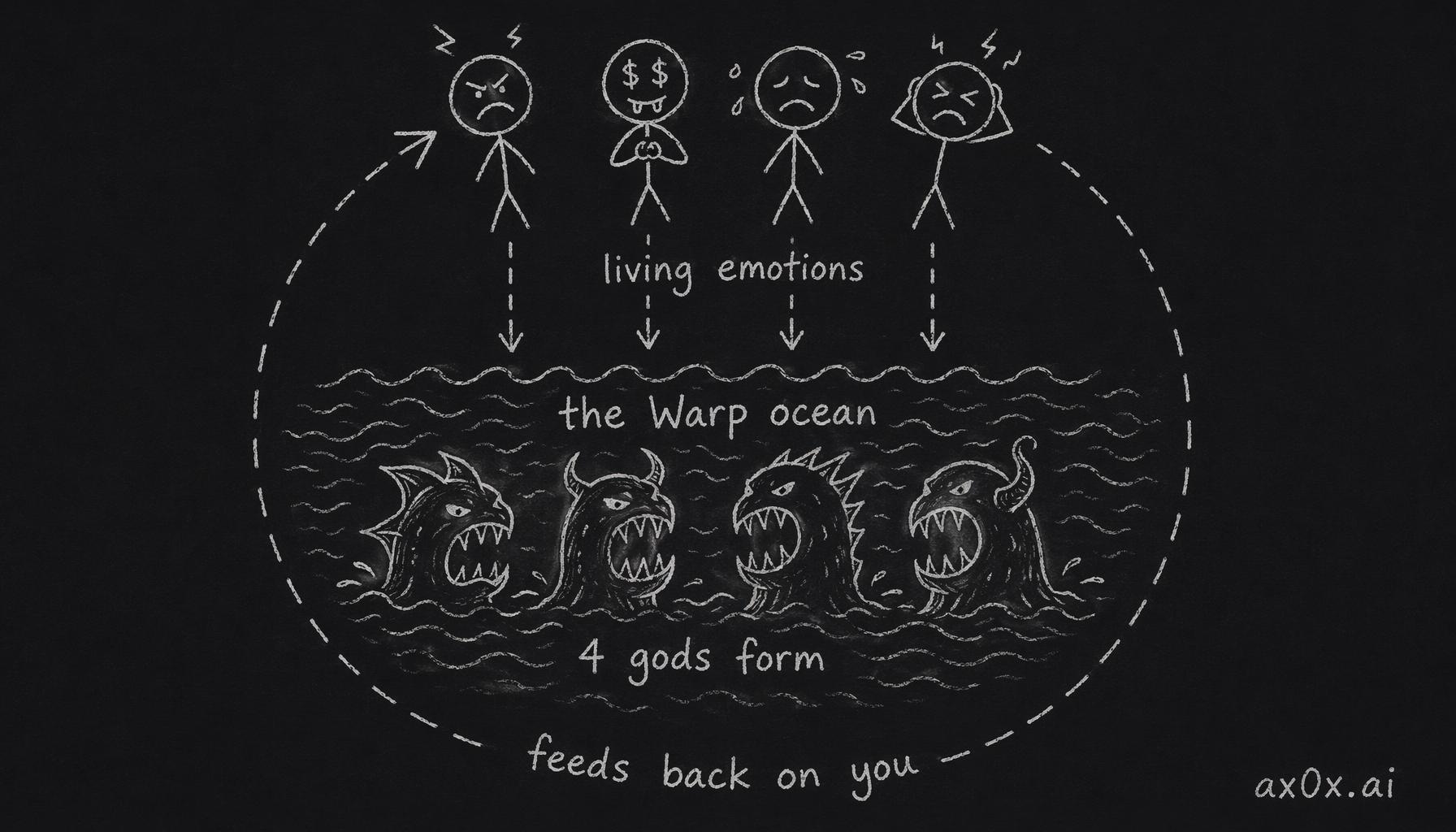 Living beings' emotions pour into the ocean of the Warp, congeal over millions of years into four Chaos Gods, and the gods feed back on you — a loop with no off switch
- Khorne, the Blood God: rage, war, murder, and a savage code of martial honor. He wants skulls. He does not especially care whose. "Blood for the Blood God" is the whole pitch.
- Nurgle, the Plague Father: disease, decay, and despair — but also a strange, smothering love. Nurgle is the cheerful grandfather of rot, who gives you a horrific plague and is genuinely delighted you get to share it. His other domain is endurance: the stubborn will to survive the unsurvivable.
- Tzeentch, the Changer of Ways: change, ambition, sorcery, and scheming. Tzeentch is plans inside plans inside plans, the patron of every manipulator who has ever thought what if I were in charge instead. His plots are so convoluted that he sometimes works against himself on purpose.
- Slaanesh, the Dark Prince: pleasure, excess, perfection, obsession. The youngest god, and the most dangerous to the soul, because Slaanesh starts as wanting nicer things and ends as a need that consumes everything. (Slaanesh's birth, as we'll see, broke an entire civilization.)
Crucial point most newcomers get wrong: the four gods are not a team. They spend most of eternity at war with each other — Khorne despises the subtlety of Slaanesh; Tzeentch's endless scheming is anathema to Nurgle's contentment. They call it the Great Game. Only rarely do they unite, under the banner of Chaos Undivided, and when they do, the galaxy should be afraid.
Chaos fields armies of daemons — fragments of the gods given form — and, more chillingly, Chaos Space Marines: the corrupted Astartes who turned traitor ten thousand years ago, sustained by the Warp ever since, waging what they call the Long War to tear down the Emperor who they feel betrayed them. Their warlord is Abaddon the Despoiler, heir to the original traitor, who has launched thirteen great invasions out of the Warp.
The original sin: the Horus Heresy
You cannot understand Chaos Space Marines without understanding the wound at the heart of the setting — and it's worth a paragraph here even though it earns its own deep dive and sits at the center of the galaxy's long timeline.
Before the Imperium decayed, the Emperor had twenty superhuman sons called Primarchs, each given command of a Space Marine Legion. (Trivia that drives lore-hounds mad: there were twenty, but two — the IInd and XIth — were deliberately erased from all records, their names and fates left forever blank. Games Workshop has never explained it, and never will.) His chosen warlord was the Primarch Horus — and in the 31st millennium (M31, the 31st thousand-year mark on the in-universe calendar), Chaos seduced Horus into rebellion. Nine Legions turned traitor. The resulting civil war, the Horus Heresy, ended with Horus dead, the Emperor mortally wounded onto his Throne, and the surviving traitors fleeing into a warp-rift called the Eye of Terror, where they have festered and plotted for ten thousand years. The traitors of today are the survivors of that betrayal. The Long War never ended. It just paused.
The Xenos: everyone else thinks they're the main character
Beyond humanity and the gods sprawl the aliens — the Xenos — and the Imperium's official position on all of them is extermination. Here is who's out there.
The Aeldari: the elves who already lost
The Aeldari (renamed from Eldar in 2017, when GW discovered Tolkien had a prior claim on the word) are an ancient, hyper-advanced, psychic elder race — and they are a cautionary tale. At their height they ruled the galaxy. Then they grew decadent, drowning in pleasure and excess, and their collective sin gave birth to a Chaos God: Slaanesh, who erupted into being in M30 and devoured nearly the entire Aeldari race's souls in an instant. This catastrophe, the Fall, also tore open the Eye of Terror. The Aeldari are the people who broke the galaxy by partying too hard, and they have been paying for it ever since.
The survivors splintered:
- The Asuryani (Craftworld Aeldari) flee aboard continent-sized ships called craftworlds, living in rigid emotional discipline so they don't feed Slaanesh, and storing their souls in gemstones at death.
- The Drukhari (formerly Dark Eldar) hide in the dark city of Commorragh and stave off Slaanesh's hunger by torturing other beings and drinking the agony — space-elf vampires of pain.
- The Harlequins are masked dancer-warriors serving Cegorach, the trickster Laughing God — the only Aeldari deity to survive the Fall.
- The Ynnari worship Ynnead, a god of the dead they believe they can awaken to finally kill Slaanesh and free their species.
Orks: war is the point
The Orks are 40K's gleeful agents of chaos (small-c). A fungus-based species engineered eons ago for one purpose — fighting — they are big, green, indestructible, and delighted to be at war. Their society organizes around the WAAAGH!: both their tidal-wave war-migrations and a genuine collective psychic field every Ork generates. That field is why their cobbled-together junk weaponry works — Orks collectively believe their guns will fire, so reality obliges. A red vehicle goes faster because Orks know red ones go faster. It's played for comedy, but it's real lore, and it makes them terrifying: an enemy whose delusions become physics.
Necrons: the robots who killed their own gods
The Necrons are the oldest threat to wake back up. Sixty million years ago they were the Necrontyr, a mortal race cursed with short, sickly lives. Desperate for immortality, they made a pact with the C'tan — godlike beings of living energy — and underwent biotransference, pouring their minds into undying metal bodies. They got immortality. They lost their souls, their bodies, and most of their capacity to feel. Then their leader, the Silent King, realizing what he'd done, betrayed and shattered the C'tan into enslaved fragments and put his entire race to sleep. Now they are waking, dynasty by dynasty — a galaxy-spanning empire of soulless android pharaohs who want their domain back.
Tyranids: the swarm with no soul to bargain with
The Tyranids are the purest horror in the setting because there's nothing to negotiate with. They are an extragalactic swarm — not a culture, a force of nature — directed by a single gestalt consciousness, the Hive Mind. Their hive fleets descend on worlds, consume all biomass down to the bacteria, and convert it into more Tyranids, drawn across the void by the psychic noise of life itself. They don't hate you. A wildfire doesn't hate the forest.
Their advance scouts are the Genestealer Cults — and here's the trap: a Genestealer infects a human population, breeds hybrid generations that look human-ish, and builds a secret cult that worships the coming swarm as saviors. The cult subverts a world from within, then beacons the hive fleet — which promptly eats the cultists along with everyone else. Faith rewarded with digestion.
The T'au and the Leagues of Votann: the newcomers
Two factions buck the grimdark mood:
- The T'au Empire is young, optimistic, and technologically slick, united under an ideology called the Greater Good that prizes cooperation over conquest. They are the closest thing 40K has to idealists — they'd rather recruit you than kill you. The catch lurks in their rigid caste system, run by a leader-caste called the Ethereals whose near-total control raises a question the lore loves to dangle: is the Greater Good genuine enlightenment, or extremely good propaganda?
- The Leagues of Votann are 40K's space dwarves — the Kin, stocky human-descended folk who fled to the galactic core, each clan guided by an ancient ancestor-AI. They have a fun history: originally called the Squats, they were quietly axed in the 1990s (fans joked the Tyranids ate them), then revived in 2022 — first teased as an April Fool's gag, then confirmed real the next day.
So who do you root for?
Nobody. That's the point, and it's why 40K endures. The Imperium would burn you for heresy. Chaos would unmake your soul. The Aeldari would let your whole species die to save a handful of their own. The Orks would shoot you for fun, the Necrons would file you under "biological contaminant," and the Tyranids would simply process you.
What you get instead is a galaxy where every faction is the hero of its own bleak epic, all of them convinced they're the last hope against the dark — and all of them, in their way, the dark itself. With the players introduced, the obvious next question is why none of them can ever win — why the war, structurally, can never end. Pull up a chair. Everyone's losing, and it's glorious.
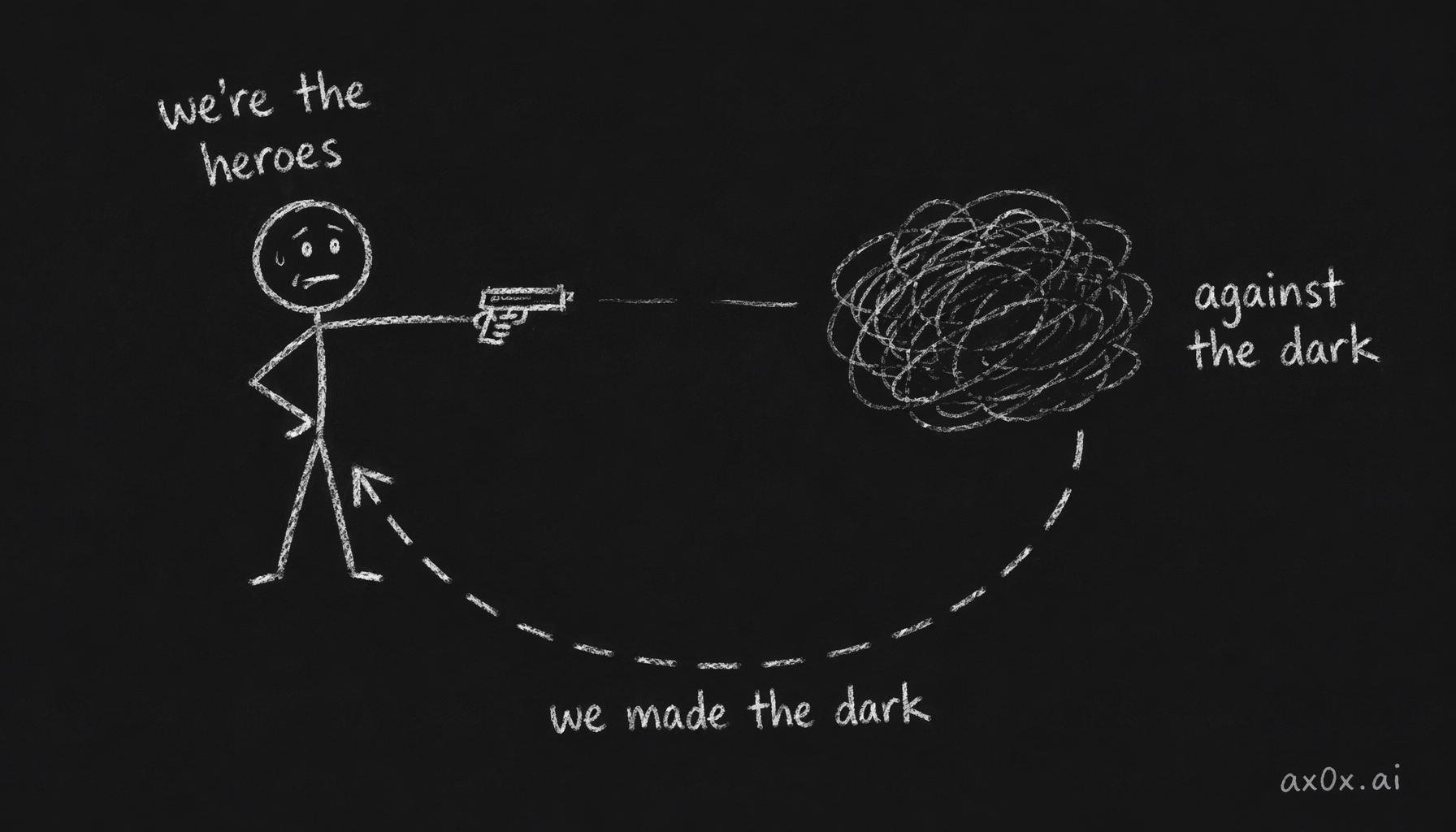 Every faction thinks it's the last hope against the dark — but trace it back and the dark is usually something they made themselves, cause looping into a circle
Warhammer, Warhammer 40,000, and all associated names are © Games Workshop. This is a fan-written lore explainer for educational and commentary purposes.