
The Day a Company Murdered Its Own World: Warhammer's End Times
Most fictional apocalypses are bluffs. The hero teeters on the brink, the comet veers off at the last second, and the status quo reasserts itself by the next installment. Comic books have a word for it — the reset button — and almost every long-running franchise leans on it, because killing your own setting means killing the thing fans paid to live in.
In 2015, Games Workshop pressed the opposite of the reset button. It took Warhammer Fantasy — a beloved world it had cultivated for three decades — and, with full deliberation, destroyed it. Not "the heroes nearly lost." The planet was physically torn apart. The continents sank. The gods died or fled. And when the dust settled, the old world was gone, replaced by something entirely new.
This is the story of how that happened in the fiction — and, just as interestingly, why it happened in the boardroom.
The world had a clock, and it was always running down
If you read the introduction to this series, you already know the shape of the place. The World-That-Was (a name applied only in retrospect, once it no longer existed) was a single dark-fantasy planet menaced from its northern pole by Chaos — the raw, malevolent magic that leaks into reality through a wound the world's godlike creators, the Old Ones, accidentally tore open at the dawn of time.
The crucial thing to understand about this setting, the thing that separates it from most fantasy, is that the good guys were always losing. Slowly, but always. The endless war between Order and Chaos was never a war anyone could win — only postpone. The Empire of man held the line not because it was destined to, but because, every few centuries, a hero showed up to plug the dam for one more lifetime.
That gives the timeline a particular rhythm: a recurring nightmare with recurring saviors. To understand why the End Times landed so hard, you have to see the pattern it broke.
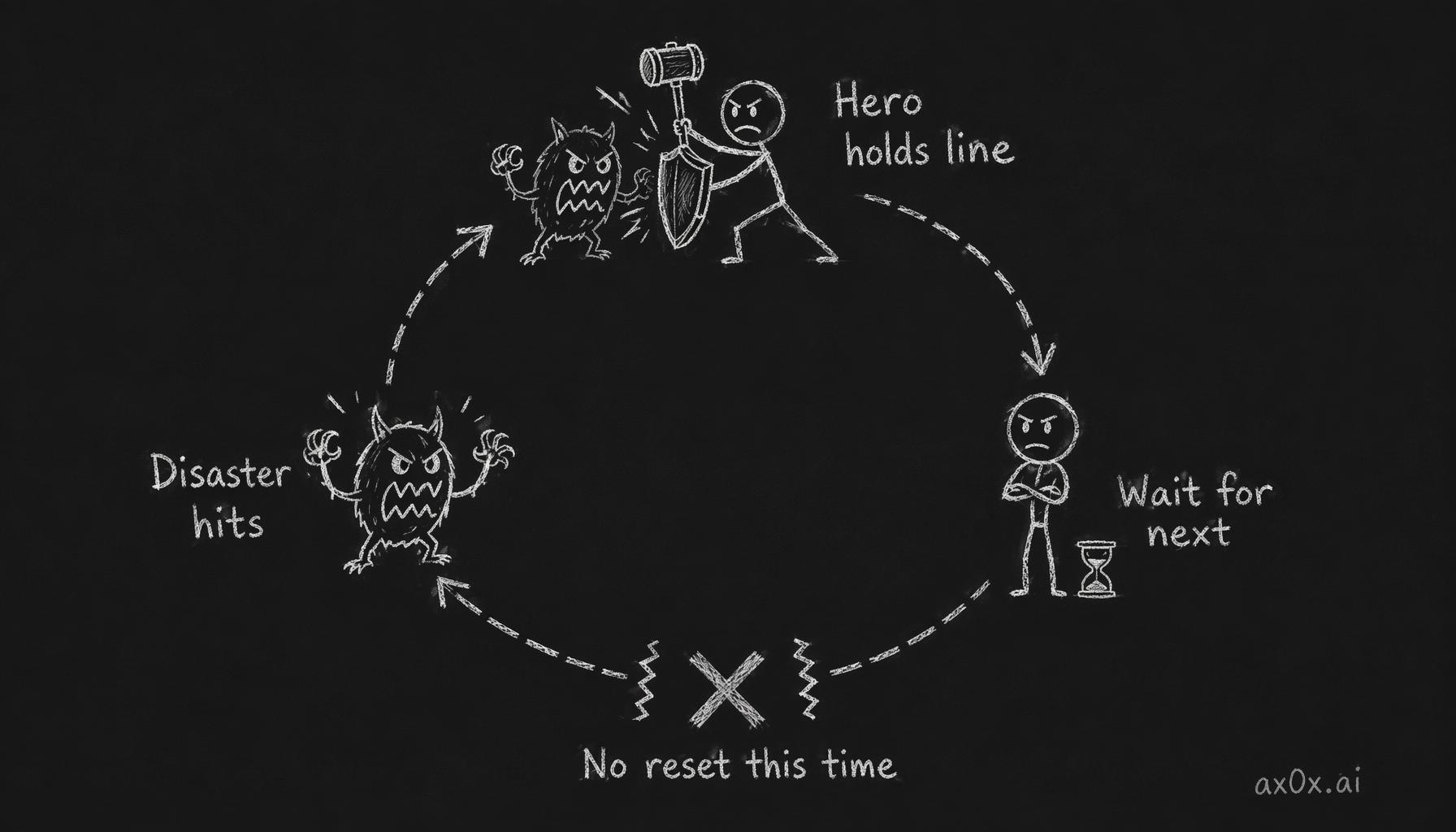 The old world's fixed disaster-savior-repeat loop, broken for the first time by the End Times with no reset pressed
Twice before, Chaos came south in full force and was beaten back.
The first was the Great War Against Chaos (2302–2304 in the Imperial Calendar, the in-world dating system that counts from the founding of the human Empire). A warlord called Asavar Kul was crowned Everchosen — the single champion the four Chaos Gods anoint to lead their united armies — and poured a horde down out of the wastes. The city of Praag in icy Kislev fell so completely that, in one of the setting's signature images of horror, its surviving inhabitants were warped and fused alive into the very walls. The Empire was saved by Magnus the Pious, a charismatic leader who reunited a fracturing nation through sheer faith and force of will, and broke the invasion at the Gates of Kislev.
The second was the Storm of Chaos (2521–2522 IC), a campaign in which a new Everchosen named Archaon marched on the city of Middenheim to snuff out a sacred flame. A messianic young warrior called Valten, rumored to be the founding hero Sigmar reborn, rose to oppose him. The setting's clock ticked toward midnight — and then stopped. Players fought a global tabletop campaign to decide the outcome, the invasion was repelled, and the world went on.
Here is the first thing that makes Warhammer unusual as a piece of fiction: the Storm of Chaos no longer happened. Games Workshop later wiped it from the official record — a retcon, short for "retroactive continuity," the writer's eraser that declares past events were never canon. Archaon's defeat at Middenheim was un-written. He would get to march on that city again. And this time, no one would stop him.
Five books, one funeral
Between 2014 and 2015, Games Workshop published The End Times — five thick, expensive narrative volumes, each titled after the force tearing the world apart: Nagash, Glottkin, Khaine, Thanquol, and Archaon. Read them in order and you are not reading a story with a climax. You are reading a controlled demolition, floor by floor.
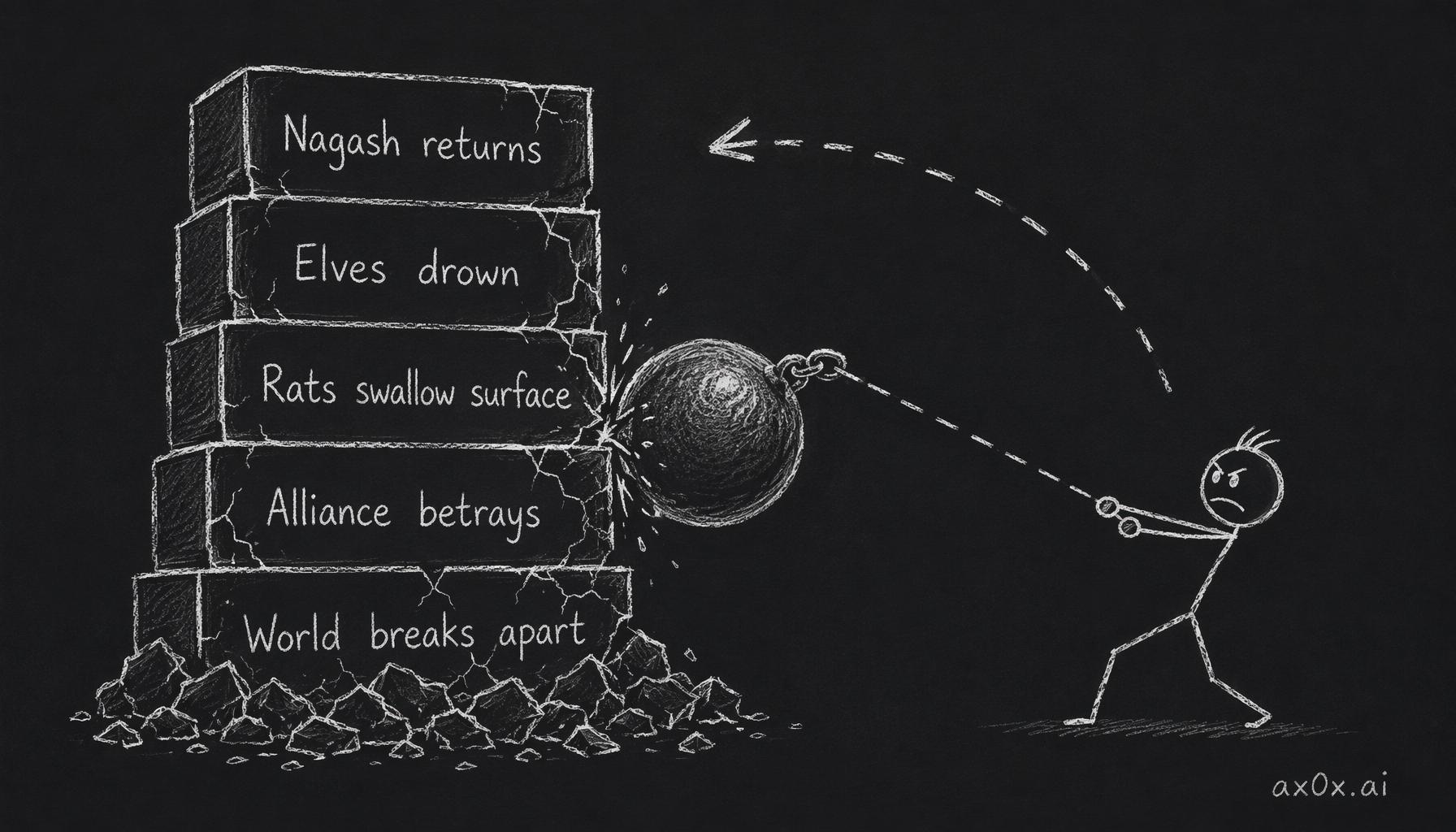 The five End Times novels as a planned demolition, one floor knocked out per book from Nagash's return to the planet breaking apart
It opens, fittingly, with the dead.
Nagash is the setting's first necromancer — a prince of the ancient desert kingdom of Nehekhara who, thousands of years before the Empire existed, invented the magic of undeath, drank an elixir of immortality, and made himself the supreme lord of all things that refuse to stay buried. (Every vampire in the world traces back to a stolen, corrupted sip of that same elixir.) For most of history he was a defeated, scattered thing. In the End Times, two of his servants — the loyal liche Arkhan the Black and the treacherous vampire Mannfred von Carstein — gather the lost Nine Books of Nagash and perform the ritual to bring him back. The price is the sacrifice of an innocent: Aliathra, an elf princess of pure soul. With her death, Nagash returns not as a monster but as a living god of death, a new power in a world already coming apart.
Then it accelerates. The plague-god's champions, the Glottkin, lead a tide of rot into the Empire's heartland. The Emperor, Karl Franz, is seemingly killed in battle — and then reborn, struck by a bolt from the heavens, as Sigmar Incarnate: a mortal man become the avatar of his own patron god, wielding the legendary warhammer Ghal Maraz. The fiction is, by now, abandoning all pretense of restraint. Old characters are dying and being remade into demigods at a furious pace.
The cruelest blow lands in Khaine. The elves — High and Dark, sundered from each other for millennia in a civil war as old as the Empire itself — are the world's most ancient civilized race, and the End Times kills nearly all of them. The island-continent of Ulthuan, the High Elf homeland, sinks beneath the sea. The elven pantheon perishes. The greatest of the elf heroes, the warrior Tyrion, is corrupted and dies impaled on the bloody-handed war god's own sword. And in a twist 7,000 years in the making, the great villain Malekith — the burned, hateful Witch King who founded the Dark Elves out of spite for being denied a throne — is finally, grudgingly proven the rightful heir all along, becoming the Eternity King of the few elves left alive.
By Thanquol, the rats arrive. The Skaven — a teeming subterranean civilization of scheming, plague-ridden ratmen, the setting's most darkly comic faction — boil up out of the earth in numbers no one had ever believed real. They overrun the dwarf holds. They drown the lizardmen. The greatest mountain-fortress in the world, Karaz-a-Karak, falls. The undercity that was always there, beneath everyone's feet, finally swallows the surface.
And in Archaon, the survivors make their last stand.
How you actually break a world
The final act gathers the few remaining heroes into a single desperate alliance, organized around an elegant idea: the Incarnates. There are eight Winds of Magic in this world — eight colored streams of raw sorcerous power, each bound to a concept like Fire or Death or Light. In the world's final hours, eight champions each become the living vessel of one Wind. Karl Franz holds the Heavens. Nagash holds Death. Malekith holds Fire. The mage Teclis holds Light. Together, in theory, they are strong enough to face what is coming.
What is coming is Archaon the Everchosen — born a man named Diederick Kastner, once a sworn knight of the god Sigmar, now the thirteenth and final champion of Chaos, the Three-Eyed King, crowned "Lord of the End Times" by the oldest daemon in creation. He marches on Middenheim a second time, to finish what the retconned Storm of Chaos was never allowed to.
The Incarnates meet him there. And then the alliance does the most human thing imaginable: it betrays itself. Mannfred and Nagash — the dead never were team players — turn on the living at the decisive moment. The defense collapses. The Skaven, in their lunatic genius, detonate the world's own underworld. And the planet, never named while it lived and called Mallus only in obituary, simply comes apart.
That is the End. No comet veers off. No reset.
Why a company kills its own world
Now the boardroom, because the fiction was downstream of a business decision, and pretending otherwise does the story a disservice.
By the early 2010s, Warhammer Fantasy Battle — the tabletop game the lore existed to sell — was in trouble. Three problems, all real:
First, the models weren't selling. Fantasy was a rank-and-file game: you fielded big regimented blocks of infantry, dozens of identical figures shoulder to shoulder. The trouble with that is you only buy a regiment once. Players had their armies. They reused them edition after edition, and Games Workshop — a company that lives or dies by selling new plastic — watched the core ranges stagnate.
Second, the rules had grown into a thicket. Three decades of expansions had left a ruleset that was dense, intimidating, and actively hostile to newcomers — the worst possible quality for a hobby that needs a constant intake of new players to survive.
Third, and most quietly decisive: the names were legally worthless. You cannot trademark "The Empire." You cannot trademark "High Elves," or "Dwarfs," or "Bretonnia." These are generic English words, free for any rival to use. For a company whose entire value is its intellectual property, that is an open wound — and it is the same logic that, in the sister setting of Warhammer 40,000, would later rename the "Eldar" into the ownable, trademark-able "Aeldari."
So Games Workshop made a cold, radical call. Don't patch the old game. End the world — give the thirty-year story a real, mythic, unforgettable finale — and build a new one on ground you fully own. The End Times was, in the most literal sense, a product launch wearing the costume of an apocalypse.
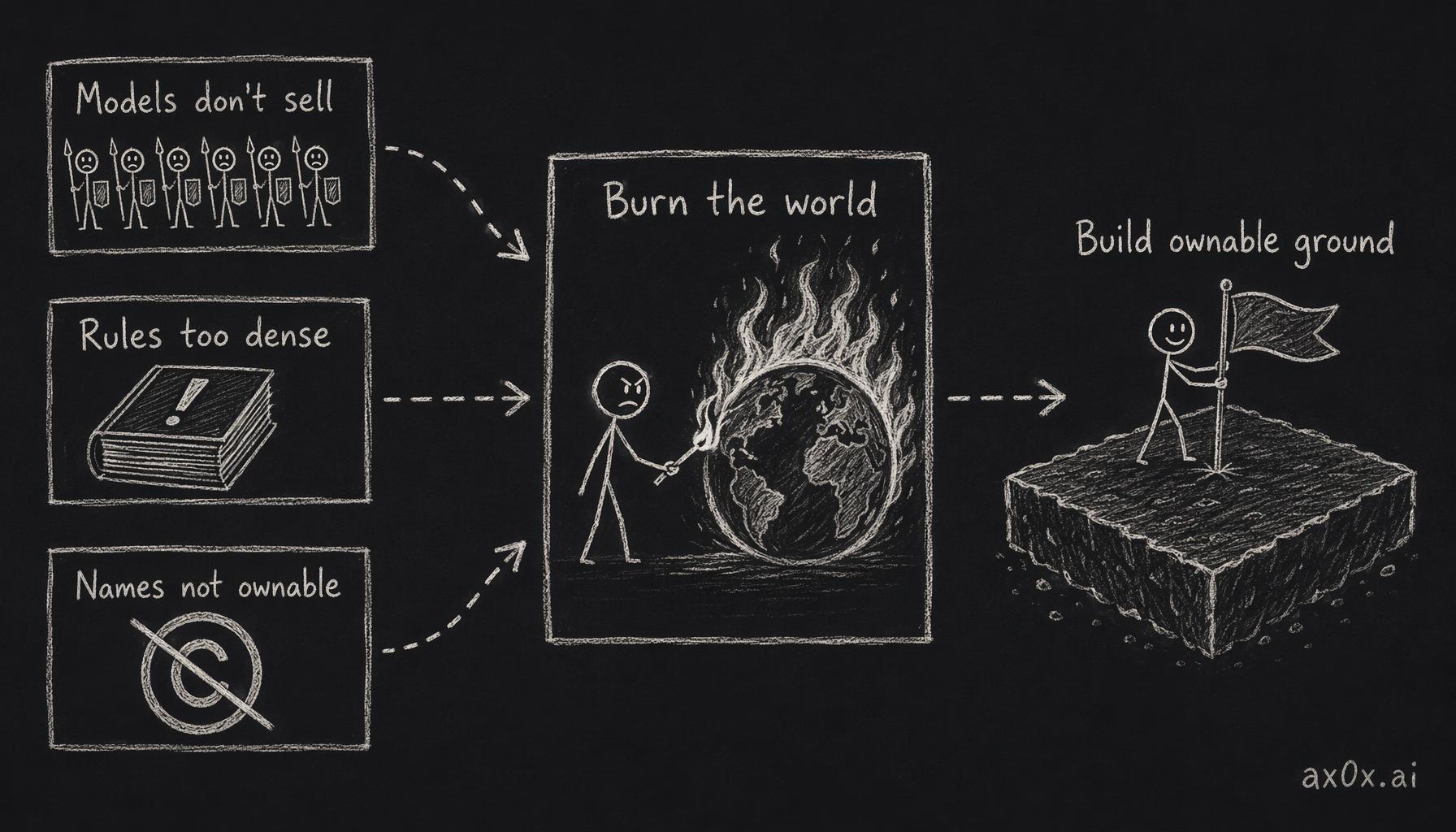 Three business pains funnel into one radical call — burn the old world and rebuild on fully owned, trademark-able ground
What rose from the ashes
Here is where it could have been merely cynical, and instead became genuinely strange and beautiful.
Sigmar — the mortal hero who founded the Empire and was deified after death — does not die with his world. His spirit clings to the shattered, glowing core of the dead planet as it streaks across the void like a twin-tailed comet (his own ancient holy symbol, now made literal). Adrift for an age, the comet is finally found by Dracothion, a vast star-dragon, a living constellation, who recognizes a kindred fire and carries the god-spirit to a new cosmos.
That cosmos is the Mortal Realms: eight enormous worlds of pure magic, each one made from a single Wind that bled out of the dying world. Azyr, the Heavens, becomes Sigmar's domain. Shyish, the realm of Death, falls to the resurrected Nagash. There are realms of Fire, Life, Metal, Beasts, Light, and Shadow, all arranged around the seething Realm of Chaos and stitched together by Realmgates — magical doorways between worlds. This is Warhammer Age of Sigmar, launched in July 2015, and it is not a sequel. The old planet is genuinely dead. These are new worlds entirely.
The new setting has its own creation myth, and it rhymes with the old one's tragedy. First came the Age of Myth, a golden age in which Sigmar gathered the surviving gods — Nagash among them — into a Pantheon of Order and built shining civilizations across the realms. Then came the Age of Chaos, when Archaon's hordes returned (he survived the world's end too; villains so good get to keep their jobs) and, exploiting a secret betrayal by the soul-hoarding Nagash, overran every realm but the Heavens. Sigmar, in despair, sealed the gates of Azyr and vanished from the realms for centuries.
When he finally struck back, he had built an army worthy of the new world's grandeur. During his long exile, Sigmar had been collecting the souls of the mightiest mortal heroes and reforging them with celestial lightning into immortal warriors of living storm: the Stormcast Eternals. They are the new face of the franchise, and — crucially — a name no competitor can ever touch. The current era, the Age of Sigmar proper, opens with these golden thunder-knights storming back through the Realmgates to take the worlds back.
There is even a tragic catch baked in, the kind of detail that tells you the writers cared. Each time a Stormcast falls in battle, his soul is recalled to the Heavens and reforged into a new body — but every reforging scrapes away a little more of his memory, his warmth, his humanity. Immortality, in this world, has a running price. It is the old Warhammer pessimism, smuggled intact into the shiny new setting.
The lesson of the End Times
What makes the End Times worth a reader's attention — even one who will never touch a miniature — is that it is one of the cleanest case studies you will find of a deliberate creative-destruction, executed at full commitment.
Games Workshop had every incentive to bluff. To stage another near-apocalypse, let a hero plug the dam one more time, and keep selling the same armies. Instead it chose to give thirty years of story a genuine ending, accept that some fans would never forgive the loss of their world, and bet the entire franchise on building something new it could actually own.
The bet, by the way, worked. Age of Sigmar struggled at launch and then grew into a pillar of the company. The old world wasn't even gone for good — in 2024 Games Workshop revived it as The Old World, a separate game set safely before the End Times, so the apocalypse and the world it destroyed can now both be sold at once. Even death, in Warhammer, turns out to be a product line.
But the death was real when it counted. For one strange year, a company looked at the most valuable thing it owned and, with open eyes, set it on fire — and trusted that something better would rise from the ash. Most worlds end with a whimper, or a bluff. This one ended on purpose.
Warhammer, Warhammer 40,000, and all associated names are © Games Workshop. This is a fan-written lore explainer for educational and commentary purposes.