
A World Under Siege: How the Old World Lost Its War
There is a moment, common to every Warhammer Fantasy story, where you realize the good guys are not going to win the war. Not this battle, maybe — a heroic stand can buy a province a few more decades. But the war, the long one against the dark, was lost before any of these characters were born. The Old World is a candle, and it has been guttering since before humans learned to write.
This is the third stop in our tour of the world that was, and the one where the setting's central mood finally makes sense. We have met the factions who hold the line and the factions who want to erase it. Now we ask the harder question: why does the line keep failing? Why is a world this full of heroes, wizards, dragons, and dwarf-forged artillery losing — slowly, grindingly, century by century — to its enemies?
The short answer: the Old World is fighting on too many fronts, against enemies that don't tire, can't be reasoned with, and in some cases live in the literal foundations of every city. The long answer is one of the best tragedies in fantasy, so let's take it properly.
The leak that never stops
To understand the war, start with the wound. At the north and south poles of the world sit the ruins of two Warp Gates — colossal portals built by the godlike Old Ones, the alien architects who terraformed the planet and seeded its younger races. When those gates collapsed during the Great Catastrophe (roughly -4500 IC, deep in the world's prehistory, dated against the Imperial Calendar that counts from the founding of the human Empire), they did not simply break. They turned the poles into open arteries between reality and the Realm of Chaos — a parallel dimension of raw, living magic.
That magic, the Winds of Magic, bleeds south from both poles in a constant gale. Where it pools thickest, near the poles, reality goes soft: the land mutates, the dead walk, and daemons coalesce out of pure emotion. These are the Chaos Wastes, and they are not a region you conquer. They are weather.
This is the structural fact that dooms everyone. The four Chaos Gods — Khorne (rage and bloodshed), Nurgle (decay and disease, who loves his victims even as he rots them), Tzeentch (change, scheming, and sorcery), and Slaanesh (excess in every form) — are not invaders who can be repelled. They are fed by mortal feeling. Every battle feeds Khorne. Every plague feeds Nurgle. Every ambitious schemer feeds Tzeentch. The Old World cannot stop generating the emotions that empower its own destroyers, because to stop feeling would be to stop being alive.
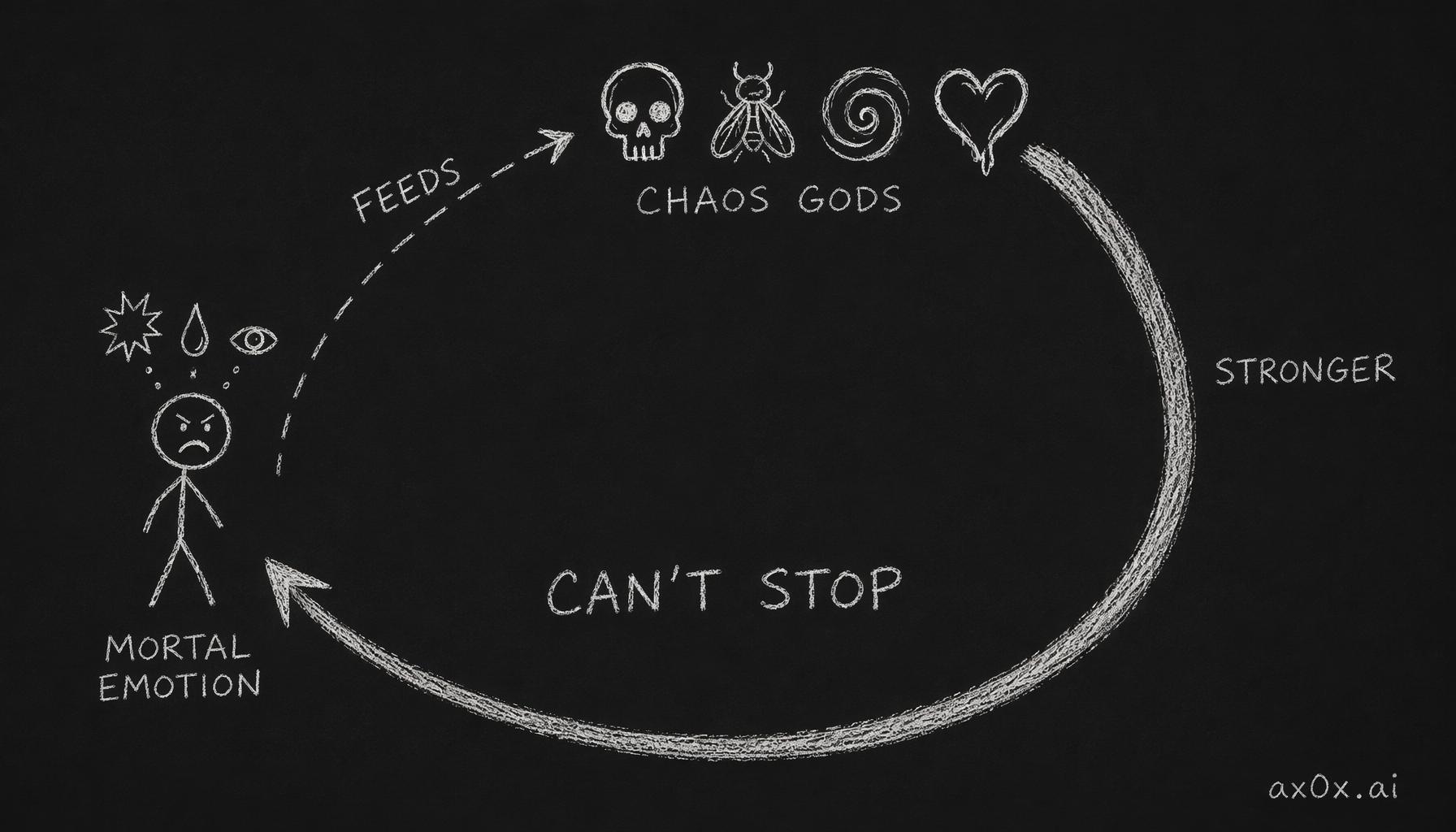 Mortal emotion feeds the Chaos Gods and makes them stronger, and the living can never stop feeling — so the war can never be won.
So the line does not hold because the enemy can be defeated. The line holds because two things hold it up — and both are running down.
The two dams: Ulthuan and the Slann
The first dam is the Great Vortex of Ulthuan, the ring-shaped island home of the High Elves (the Asur, in their own tongue). At the heart of their continent spins a magical maelstrom, maintained for thousands of years by exhausted Elven mages, that does one job: it sucks the excess Chaos energy out of the world and dumps it back where it came from. Without the Vortex, the Winds of Magic would saturate everything and Chaos would simply walk in. The High Elves are, in a real sense, the planet's dialysis machine — and they have been bleeding to death for millennia to keep running it.
The second dam is older and stranger. In the steaming jungles of Lustria live the Lizardmen, and behind them the Slann — vast, psychic mage-priests created by the Old Ones to enact a cosmic blueprint called the Great Plan. When the Polar Gates first collapsed and daemon legions poured into the world, it was the Slann who sealed the worst of the breach, at the cost of half their number. They have been quietly steering the world's magical defenses ever since, reading plaques older than human language.
Hold this image: the entire setting rests on a leaking dam, plugged by a dying race of elves and a dwindling order of psychic frog-priests, both of them inheritors of a job assigned by gods who left and never came back. That is the baseline. Everything else is happening on top of it.
Civilizations that should be allies, at each other's throats
Here is the cruelest part. The forces of Order — the ones who should be united against the leak — spent their strongest centuries destroying each other.
It started with the Elves. The first Phoenix King, Aenarion, drew a cursed weapon called the Sword of Khaine to throw back the first Chaos incursion, and in doing so doomed his bloodline to violence. His son Malekith — ambitious, brilliant, certain the throne was his by right — was passed over for the crown. When Malekith tried to claim it anyway by walking through the sacred Flame of Asuryan, the flame burned him nearly to death, marking him as unworthy. He did not take the hint. Backed by his mother, the sorceress Morathi, and a hidden cult of Slaanesh-worshippers, he tore the Elven race in half.
This civil war, the Sundering (around -2750 IC), ended in catastrophe. Malekith's sorcerers tried to break the Great Vortex itself — to drown Ulthuan in raw Chaos rather than let his rivals keep it. The counter-spell sank a third of the continent. The defeated Malekith fled across the ocean to the freezing land of Naggaroth, became the Witch King, and founded the Dark Elves (the Druchii): a slave-raiding, blood-sacrificing mirror of everything his cousins stood for. The Elves never recovered their numbers. The dam-keepers had cut their own workforce in half.
Then the Elves dragged the Dwarfs down with them. For an age, Dwarfs (the Dawi) and High Elves had been the great alliance of the ancient world — Elven magic and Dwarf craft. But Dark Elf raiders, disguised as High Elves, began provoking the Dwarfs; insults were exchanged; a Dwarf ambassador's beard was shaved, which to a Dwarf is roughly the worst thing that can happen to a person. The result was the War of Vengeance (also called the War of the Beard, roughly -2000 to -1600 IC), centuries of slaughter that ended only when the Dwarf High King Gotrek Starbreaker killed the Phoenix King in single combat. By the time it was over, both elder races were spent. Their golden ages were behind them, permanently.
Worth pausing on what this means. The two civilizations best equipped to fight Chaos — the elves with their magic, the dwarfs with their armies — exhausted themselves on a war that began with a misunderstanding engineered by Dark Elves. The Old World's decline is not just external pressure. It is a self-inflicted wound that never healed.
The enemy in the floor
While the surface races bled each other white, something was breeding underneath them. Beneath every kingdom, every farm, every cathedral, runs the Under-Empire — a worldwide warren of tunnels belonging to the Skaven, a teeming civilization of ratmen who worship the Horned Rat and run on Warpstone, the solidified form of Chaos itself.
The Skaven are the setting's great dark joke. They outnumber every other race combined. Their mad warlock-engineers of Clan Skryre build weapons that should not work; their beastmasters of Clan Moulder flesh-craft monsters; their plague monks of Clan Pestilens weaponize disease; their Clan Eshin assassins kill from the shadows. By any rational accounting they should have conquered the world a dozen times over.
They haven't, for one reason: they cannot stop betraying each other. Their ruling Council of Thirteen is a nest of mutual assassination. Every Skaven warlord's first instinct, on the cusp of victory, is to knife the rival standing next to him. Their own treachery is the only thing holding the surface world up — which is a thin thread to hang a civilization on.
And the cover-up makes it worse. For most of its history, the Empire of Man — the great human nation founded by Sigmar — officially denies that the Skaven exist. Sightings are dismissed as peasant superstition. There is a worldwide rat-army eating the foundations of the world, and the people most threatened by it have decided, as a matter of policy, that it is a fairy tale. You can practically hear Tzeentch laughing.
The dead who won't stay down
If Chaos is the leak and the Skaven are the rot in the foundations, the Undead are the past refusing to die — and they exist because of one man's ambition.
Nagash was a priest-king of Nehekhara, the Old World's analog of ancient Egypt. Obsessed with conquering death, he invented necromancy, recorded it in nine black books, and in the process created the first vampires by handing a corrupted elixir of immortality to Queen Neferata of Lahmia. Every walking corpse, every vampire count, every death-mage in the entire setting traces back to him. He was eventually slain — by a king armed, in a typically grim irony, with a blade forged by the Skaven — but his death-curse misfired and instead woke the Tomb Kings: the mummified rulers of Nehekhara, risen with their minds and memories intact, led by Settra the Imperishable, who serves no one and rules a desert empire of the dead. (Settra's defining line — "Settra does not serve. Settra rules." — tells you everything about a king too proud to even accept undeath as a master.)
Nagash's children kept the wound open. Centuries later, the vampire Vlad von Carstein seized the gloomy province of Sylvania and nearly conquered the entire Empire in the von Carstein Wars, wielding a ring that simply refused to let him die. His heirs — the mad butcher Konrad, the cunning necromancer Mannfred — kept the war going for generations. The Empire that should have been facing north toward Chaos was forced, again and again, to fight its own buried dead instead.
Death by a thousand fronts
Step back and look at the map of the Empire of Man — the human heartland, a fractious confederation of provinces founded by Sigmar after he united the human tribes and won the Battle of Black Fire Pass alongside his Dwarf allies. Now count its enemies.
To the north: Chaos, in periodic invasions led by champions called the Everchosen, plus the Beastmen infesting every forest and the marauding Warriors of Chaos of the frozen wastes. The cold kingdom of Kislev stands as the first shield against this — a Russia-flavored bulwark that takes the initial blow of every Chaos tide so the Empire has time to muster.
To the east and below: the Greenskins — Orcs and Goblins, a fungal race that literally grows from spores and so can never be exterminated, only beaten back. When enough of them gather, their collective belligerence builds into a Waaagh!, a psychic war-frenzy that powers their shamans and rolls forward like an avalanche.
Below that: the Skaven, always.
In the graves: the Undead.
And underneath all of it: the leak that powers the lot.
The Empire is not fighting a war. It is fighting six wars at once, on every compass point and one straight down, with provinces that don't always trust their own Emperor and a state religion that bickers over whether to pray to Sigmar or the war-god Ulric. The miracle is not that the Old World is losing. The miracle is that it lasted as long as it did — and that miracle has a name and a price, which we'll come to.
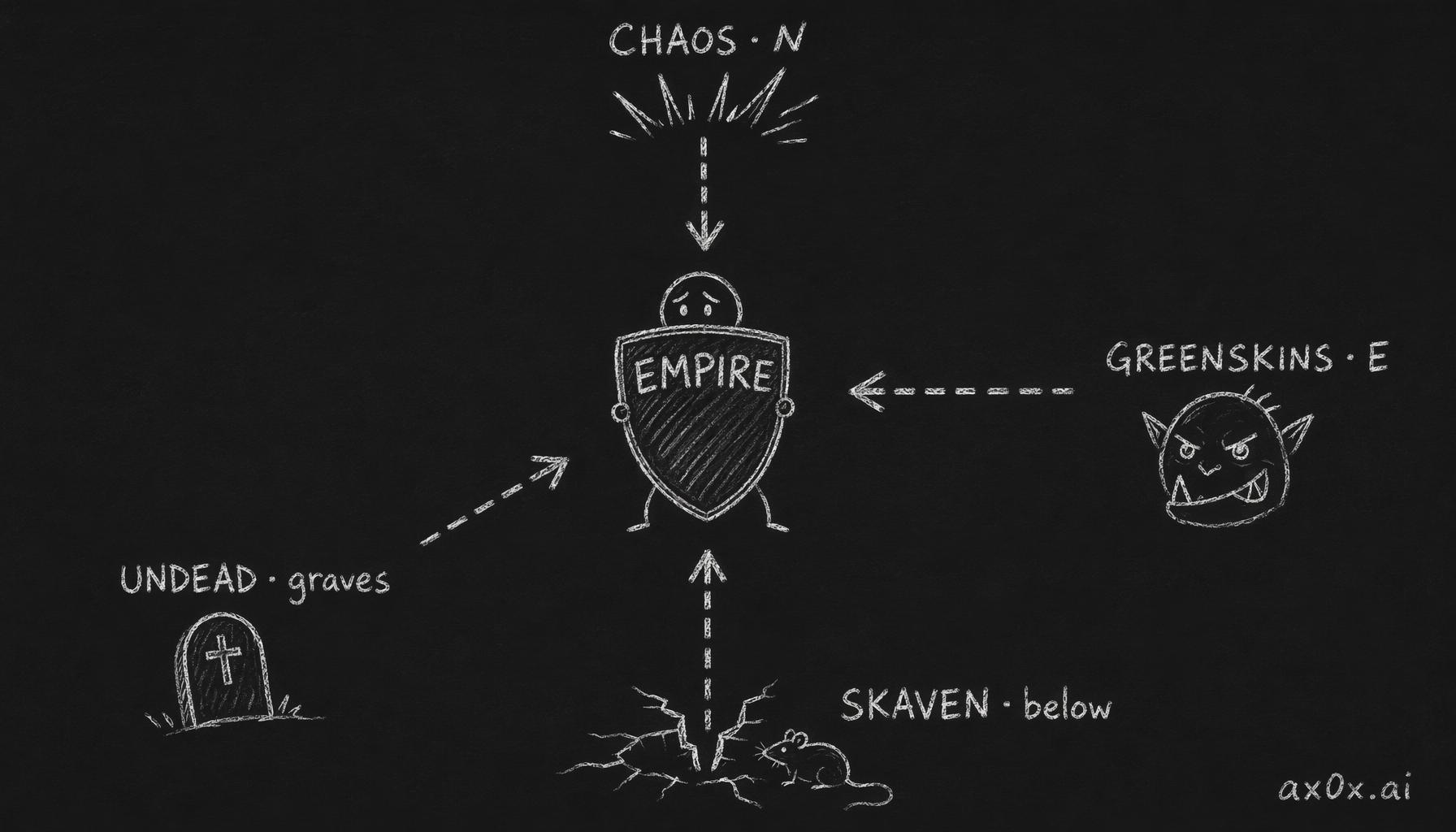 The Empire is pinned in the center, besieged from six directions at once — which is why the line can never hold.
Why this war is the whole point
It would be easy to read all this as bleak for its own sake. It isn't. The endless siege is the engine of every story Warhammer Fantasy tells, and it produces something rarer than a happy ending: meaning under pressure.
A Bretonnian knight quests for a Grail he will probably never find. A Dwarf Slayer dyes his hair orange and walks into a doomed battle seeking an honorable death to atone for a shame he can never undo. An Empire general holds a bridge for one more night knowing reinforcements aren't coming. None of them believe they will win the war. They fight anyway, because the alternative — letting the dark in without a fight — is the one thing worse than losing.
That is the difference between Warhammer Fantasy and a fairy tale. The defenders are not promised victory. They are offered only the choice of how to lose, and they keep choosing to lose on their feet, with a hammer in hand. The rivalries we walked through — Dwarf against Elf, Elf against Elf, the living against the dead — are tragic precisely because every soldier wasted on an old grudge is a soldier not standing at the wall when the real night comes.
And it does come. The siege we've described is the stable version of the Old World — the centuries-long status quo of slow bleeding. But a setting built on a leaking dam has only one possible ending, and the dams cannot hold forever. The Vortex weakens. The Skaven multiply. Nagash stirs in his tomb. Somewhere in the north, a fallen templar named Diederick Kastner is gathering the relics that will crown him the final champion of Chaos.
What happens when all six wars arrive at once — when the dams finally break and the Old World pays the bill it has been deferring for five thousand years — is the subject of the End Times, where this world ends and a stranger one is born.
For now, hold the image that defines the whole setting: a candle, guttering, with the dark pressing in on every side — and a hand cupped around the flame, refusing to let it go out one moment sooner than it must.
Warhammer, Warhammer 40,000, and all associated names are © Games Workshop. This is a fan-written lore explainer for educational and commentary purposes.