Serenity's Alpha Died the Day It Went Public
A friend messaged me at midnight: should we go distill an account called Serenity? He'd gone viral on X, the names he dug into were obscure small-caps buried deep in the AI supply chain, and his return claims were turning into legend. His pitch: build a bot that buys and sells whatever he does — wouldn't that be great?
My first reaction was cold. Pointless.
The reasoning is simple. If a strategy genuinely compounds and has the capacity to absorb capital, the rational move is to quietly add to the position, lever up, and pile in more — not to broadcast it. The content business monetizes attention; finance doesn't have to. So the moment an investing account turns into a traffic magnet, the first instinct I reach for is: is he sharing research, or distributing into the position he built before posting?
But we argued it all night, and by morning I'd walked half of it back. This isn't a choice between genius and pump operator. The more accurate read: his research ability may be genuine, and the trade itself changed character once it went viral. Both can be true at once.
Finance doesn't need an audience
Most things that get broadcast monetize through the broadcast itself — write articles to grow a following and sell ads, post videos to grow views and sell courses. But a trading strategy that's replicable, leverageable, and high-Sharpe? Publishing it just dilutes your own return. No rational operator does that.
So once an account starts needing reach, needing reposts, needing its track record seen, its return structure has almost certainly absorbed the reach itself as an input. By the time you act, you're not buying his thesis — you're buying the price his thesis already moved.
That isn't an accusation that he's dumping. It's something subtler: in micro-cap, low-coverage, thinly traded names, the line between publishing a thesis and distributing into demand you created barely exists.
He starts from the system, not the stock
Set the copy-trading worry aside. His research method has real substance.
The impressive part isn't that he called a few tickers — it's where he starts thinking. He never begins from a ticker. The starting point is always a large structural shift in an industry, and then he traces it up the chain. AI infrastructure is scaling out this fast — where does the system architecture buckle first? As compute climbs, which link jams first: interconnect, optics, substrate materials, external light sources, packaging, test, capacity, the customer qualification cycle? If the demand is locked in, is the market only watching the few obvious mega-caps and missing some small but indispensable supplier?
That's a different game from "AI is hot, so buy AI stocks." It asks a harder question: when a demand wave lands, which layer — materials, capacity, qualification, physical process — becomes the constraint nobody can route around?
When I mapped the whole AI picture last year, the core call was that compute is the new oil and the opportunities hide in the depth of the supply chain. His bottoms-up, find-the-bottleneck method is basically that essay turned into live trades.
But the public market isn't a thesis defense. A research call, once published, changes the market it describes. Especially when the name is a thinly traded small-cap, publishing stops being "expressing a view" — it can become the catalyst for the price itself.
Once alpha goes public, it turns into something else
This was the sharpest disagreement that night: if you publish alpha, is it still alpha?
My answer: the original one is probably gone, but it mutates into something else.
Early on, what he likely held was research-driven edge — understanding certain supply-chain bottlenecks earlier than the market, surfacing a few companies that were undervalued, misread, uncovered.
But once he became a traffic center, new variables got mixed into the price. He names a direction, retail starts researching, more people repost, the already-thin small-cap float gets absorbed in a day, the price climbs, the climb in turn "proves" he was right, and more money pours in. By that point the fundamentals might still be real, but the price is no longer just a function of fundamentals — it's also narrative diffusion, liquidity shock, and chase-the-rally emotion.
This is Soros's reflexivity: the rise becomes the reason for the rise.
The same thesis is a research opportunity when no one's watching, price discovery when a few start to get it, and a crowded trade once everyone is reposting and distilling it. Many people think they're replicating his edge, when what they're actually replicating is his tail liquidity risk. The early movers got paid for seeing what others didn't. The latecomers are betting they aren't the last one holding the bag.
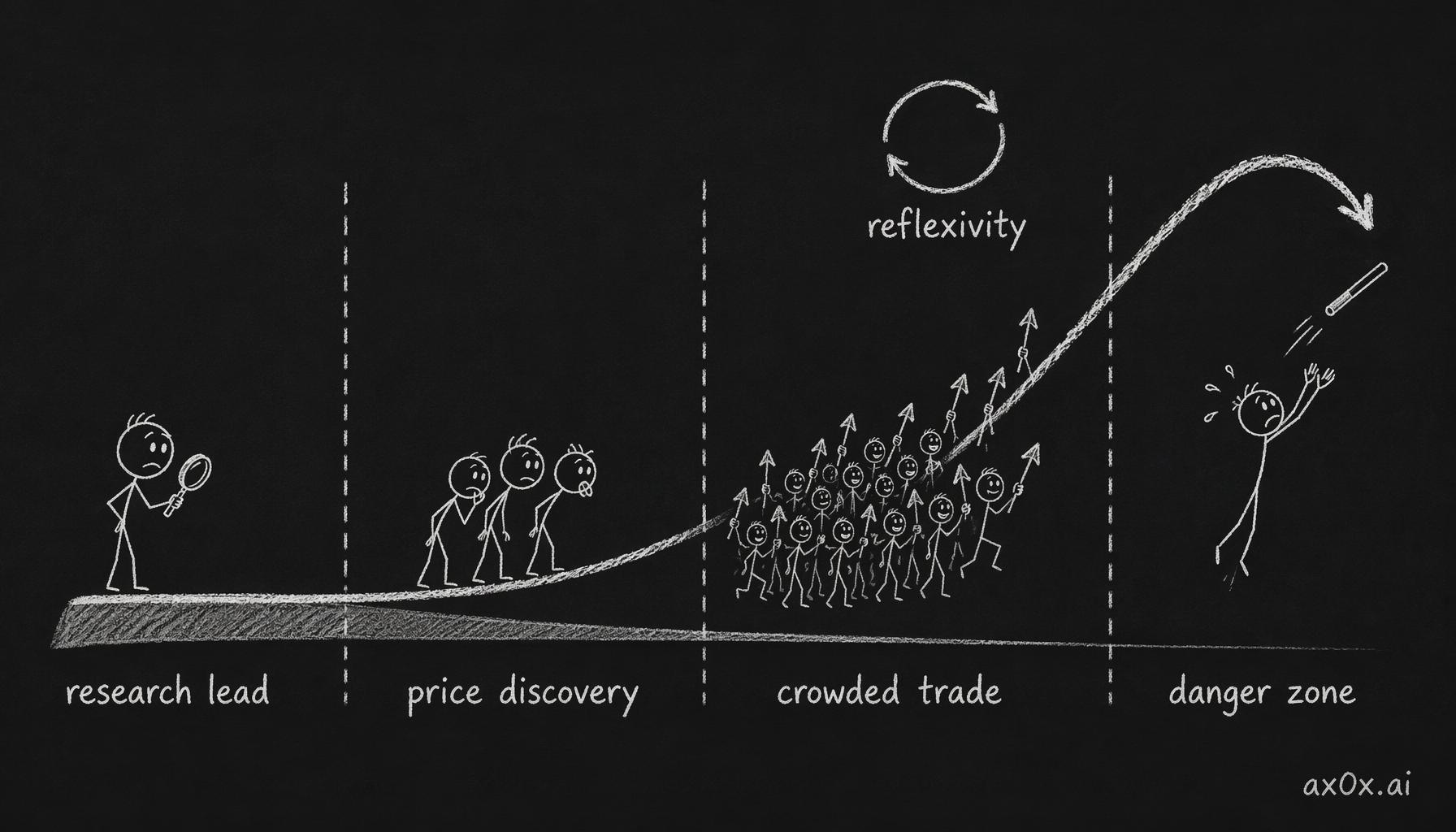 The same thesis passes through four stages as it spreads, decaying from unwatched alpha into a crowded trade — reflexivity turns the rise itself into the reason to buy.
Earlier this year, during the "lobster fever" episode, an ordinary open-source project got amplified into a nationwide craze in China by acquaintance networks, short-video algorithms, and the retail investor base. The logic is identical: late in the cycle, what moves the price is no longer the thing itself — it's the amplifier.
Why we built the skill anyway
At this point my friend pushed back: then why bother building anything?
Because the part of him worth distilling is the way he thinks, which has very little to do with his specific holdings. Those two things are far apart.
The low-grade distillation fixates on positions: which ticker did he name, when did he post, can I auto-follow. That path is a trap. By the time you can see that information, it's usually post-diffusion: the information has spread, the price has moved, the liquidity structure has shifted. You think you're following an expert; you're really buying a signal the market has already absorbed.
What's actually worth taking from him is different: how he traces a macro trend down to a specific bottleneck, how he tells a genuine chokepoint from a free-riding beneficiary, how he verifies a company can actually capture the economics, how he judges that the market hasn't priced it, and how he notices a thesis has already curdled into a crowded trade.
So the skill we built does the job of a bottleneck-research debugger. It doesn't tell you what to buy. It forces you to break a market narrative down until it's concrete enough — and falsifiable enough — to test.
Start from the system, not the stock: what demand wave is happening, where does the old architecture fail, what new material, process, capacity, or qualification does the new one need, which link becomes the constraint.
Then sort candidate companies into three buckets. A beneficiary rides the theme, but the system can route around it. A bottleneck constrains capacity, yield, or deployment speed. A chokepoint is one the architecture genuinely can't avoid within the relevant time window. A huge share of investing losses come from mistaking a beneficiary for a chokepoint.
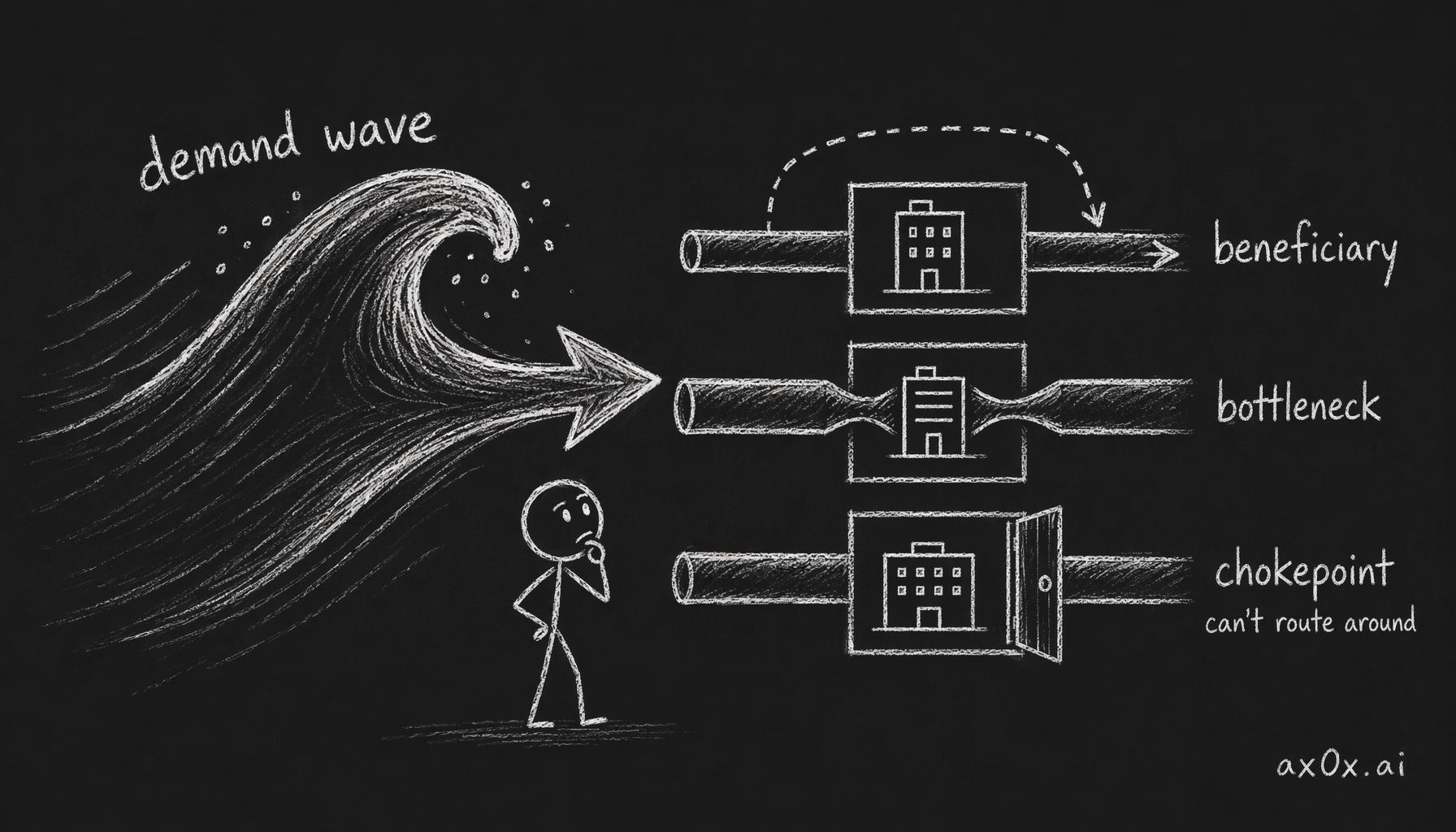 A demand wave hits the supply chain and sorts candidate companies into beneficiary, bottleneck, and chokepoint — the ones the system can route around are just free-riders; the unavoidable link is the real opportunity.
Then grade the evidence. A social post is only a lead. A company's own marketing copy is a weak signal. Customer and supplier mentions, industry roadmaps, patents and technical papers are medium signals. Filings, named contracts, capacity disclosures, and margin and cash-flow conversion are the strong ones. A thesis has to keep climbing to higher evidence tiers — it can't stop at "sounds plausible."
Then verify whether the company can actually capture the value. Does it truly control the scarce asset, or is it merely adjacent to it? Can customers dual-source, can competitors expand fast, does pricing power show up in gross margin, will it need dilutive financing to get there?
The last step — the one this whole episode makes most necessary — is a reflexivity filter. Every thesis first has to answer which stage it's in: a pre-diffusion research lead, a diffusion-stage thesis the market is just starting to understand, a crowded attention trade that's been reposted to death, or a post-squeeze danger zone. The same company carries completely different risk/reward at different points in its diffusion. What copy-trading ignores most easily is exactly that: distribution already moved the price.
I built one rule into the skill: its output can only be hypotheses to verify, never buy/sell advice. The way it's meant to be used is "map the CPO supply chain for me — which links are real bottlenecks and which are just beneficiaries," not "which tickers did he name, follow them for me."
What's scarce in the AI era is the order of the questions
The most interesting thing about this episode isn't whether one person is a market wizard.
It's that it drags a very real problem into the open. AI now summarizes, copies, and diffuses information an order of magnitude faster than before. Any public edge gets absorbed by the market faster, so the value of merely copying an outcome only keeps falling. What becomes scarce isn't a ready-made answer — it's a better system of questions: pulling real constraints out of a grand narrative, separating story from evidence, writing down your kill criteria before the excitement, and holding that a thesis might be right while the current price makes it a bad bet.
This is the same thing I kept circling when I wrote the zero-code investing-research course last year: the tools keep getting stronger, but the order of judgment has to be yours. We didn't build this to replicate anyone — we built it to avoid getting pulled along by the hype. Distill the holdings and you get a late copy-trading bot. Distill the research process and you might get a thinking framework that ports to other domains entirely.
He may well be the real thing, and the research logic may genuinely have substance. But once the trade goes public and viral, it's no longer the alpha it started as: research edge early, price discovery in the middle, a liquidity game at the end. The thing worth a normal person's effort isn't what he bought — it's how he saw that bottleneck before everyone else. Which tickers he held is the least important fact in the whole story.
I've open-sourced the process. It won't hand you a ticker. It'll just keep interrogating you: what system did this demand wave actually change, which link is genuinely jammed, what evidence tier are you on, and has this call already been seen by too many people? Anyone who can answer those cleanly didn't need to follow anyone's trades in the first place.
The skill is called
serenity-bottleneck-research, in AX-skills — with a slide deck walking through the whole framework. It produces hypotheses to verify, not buy/sell signals — and neither does this essay. Nothing here is investment advice.