
Too Fast to Promote
I came across a workplace discussion recently that stung a little:
Someone uses AI to crank their efficiency through the roof — code ships faster, demos ship faster, and the spur-of-the-moment ideas from their boss and the C-suite all get built quickly.
By rights, that person should be the easy promote, right?
The reality is the opposite.
They become more and more "useful," more and more like a high-throughput execution node. Anyone with an idea can toss it to them to try; anyone with an ad-hoc need can get it built fast; if the project works, they're efficient; if it flops, well, it was cheap anyway.
In the end, they did do a lot, and a lot of people appreciate them. But come promotion time, the problem surfaces:
The work is scattered. There's no clear through-line. It never adds up to a strong promotion story. And more importantly, the org sees their hands, not their head.
It made me reconsider: what is a promotion, really?
The default model most people carry is:
I do good work → my boss notices → I get promoted.
But that model is too student-brained.
In school, get the answer right and you get the points; score high and you rank higher. The rules are clear, feedback is direct, the reward system is relatively transparent.
Companies don't run that way. Inside a company, a promotion is more like:
Under limited resources, limited headcount, real politics, and uncertain timing, the org decides whom to place into a higher-responsibility seat.
So the model I now prefer for thinking about promotion:
Promotion = capability × narrative × sponsor motive × org slot × politics/timing
Note: this is multiplication, not addition. Any factor approaching zero drags the whole thing down.
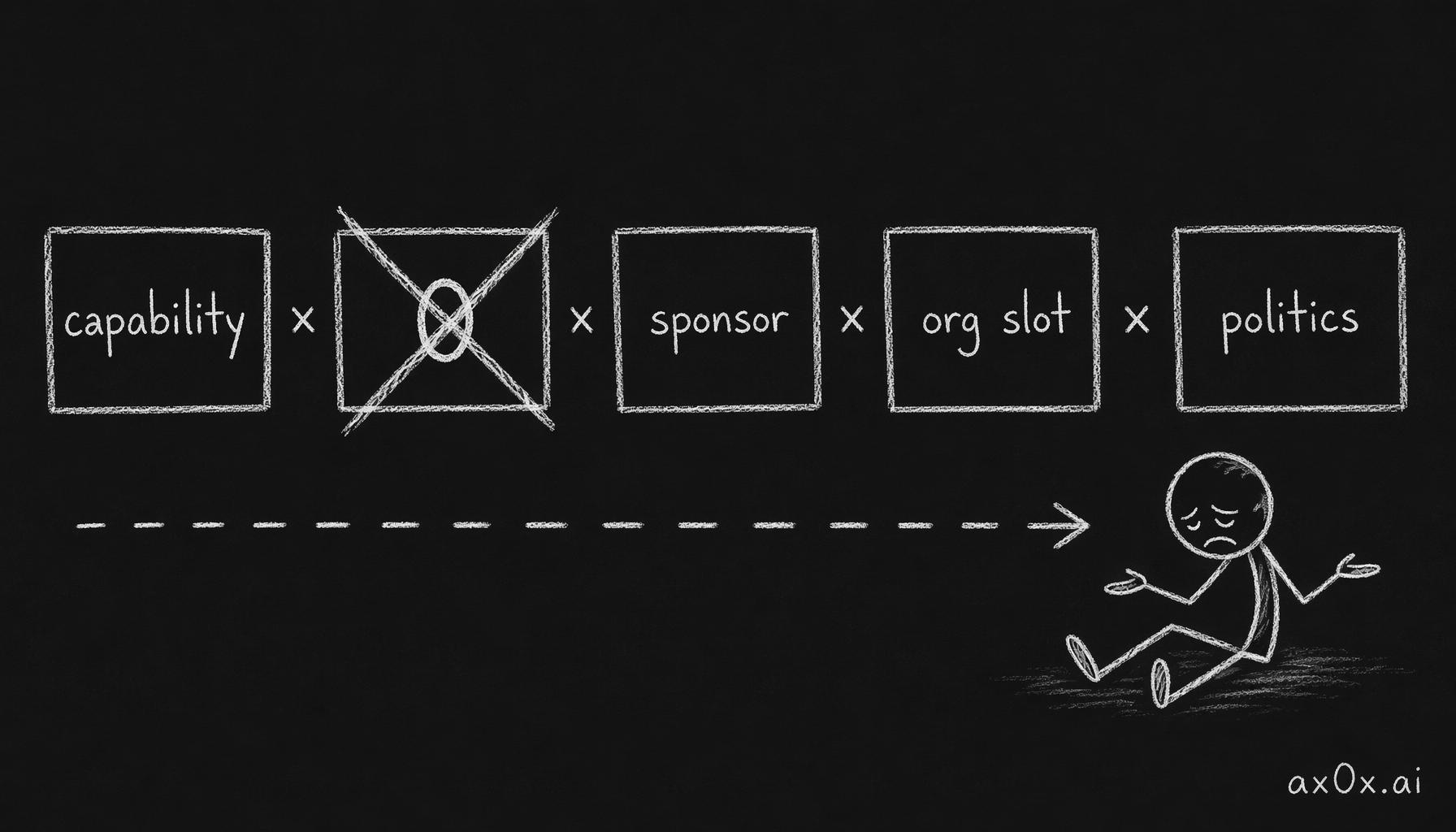 Promotion is a product of five factors: any one near zero zeroes out the whole case, and effort can't backfill it
Your capability is high, but no one fights for you — no. Your sponsor is strong, but there's no org slot — no. You did a lot, but it doesn't tell a "next-level capability" story — no. Your boss supports you, but someone with veto power doesn't buy it — no. You did great, but you hit a freeze, a reorg, or a quota crunch — also possibly no.
This isn't to say effort is useless. It's to say: effort is the entry ticket, not the master key.
1. Capability: not "I'm capable," but "I'm already working at the next level"
People argue they deserve a promotion because: I do a lot, my output is high, my quality is good, I respond fast, my boss can't do without me.
Those are all capability. But what they mostly prove is:
You're a strong performer at your current level.
They don't necessarily prove you're already working at the next level. And there's a crucial difference here.
A strong executor is good at: you give me a problem, I solve it; you give me a requirement, I deliver; you give me a direction, I push it forward; you give me a fire, I put it out.
But for someone at a higher level, the org expects: you can define the problem, judge what shouldn't be done, converge a direction out of ambiguity, make others stronger, change a system rather than just complete a pile of tasks, turn one success into a repeatable mechanism.
So "capability" in a promotion isn't simply being strong. It's:
Have you already, stably, repeatably, and at low risk, taken on the responsibilities of the next level?
AI massively amplifies the first kind of capability: execution. You write code faster, analyze faster, write docs faster, produce plans faster, build demos faster.
But if you're not careful, it can obscure the second kind: judgment.
Because people get more and more used to deploying you this way: "This one's fast, toss it to them to try." "This one's useful, have them build a first version." "Not sure this'll work, but they can build it in a day." "Just let them run it."
Over time, your label isn't "this person has judgment." It's "this person can really grind."
That's the new trap of the AI era. It's not that you aren't strong. It's that you're strong in a way that looks too much like a tool.
2. Narrative: doing a lot of work doesn't mean people see your value
There's a counterintuitive fact about work:
Impact, on its own, doesn't automatically form a promotion case.
You did A, B, C, D, E, F — six things, each one decent. But to a committee, it may just sound like: "This person is busy." "This person is reliable." "This person has strong execution."
That's not enough.
A strong promotion narrative usually isn't "I did a lot of projects." It's:
The org faced an important problem; I identified the key bottleneck; I drove several interlocking projects; and together they built a durable system capability — which proves I'm already working at next-level scope.
That's a promotion thesis. In plain terms:
All your effort has to compress into one sentence other people are willing to repeat.
For example:
"They didn't just build a few AI demos — they turned our team's AI product exploration from gut-feel trial-and-error into an evaluable, reusable, scalable discovery engine."
"She didn't just fix a pile of bugs — she rebuilt the entire stability-governance mechanism, drove incident rates steadily down, and got multiple teams to reuse the approach."
That's a completely different tier from "I worked hard."
Narrative isn't spin. Narrative is translating your work into value-language the org can understand.
Especially in the AI era: if you work too fast, take on too much, and let projects scatter, you're more likely to lose your narrative through-line.
Today you build a demo. Tomorrow you fight a fire. The day after you test an idea for a VP. Next week you patch some ad-hoc gap. Each thing has value, but stacked together they don't look like a path — they look like a random walk.
That's why some genuinely strong people get this feedback at promotion time: scope isn't clear enough, impact isn't concentrated enough, no demonstrated next-level leadership, needs more evidence.
Translated: I know you're capable. I just don't know what to promote you into.
3. Sponsor motive: someone liking you isn't someone betting on you
People say: "My boss is pretty supportive." "My boss thinks I should get promoted too." "My boss gives me great reviews."
But you have to distinguish three kinds of people:
A mentor is willing to give you advice. A supporter is willing to say nice things about you. A sponsor is willing to spend political capital on you.
A promotion needs a sponsor. And a sponsor comes down to three questions.
One: do they have power? Your boss supports you — but does their boss listen to them? Does anyone on the committee defer to them? Can they block the objections?
Two: do they have motive? This is the most pragmatic part. What problem of the sponsor's does your promotion solve? Why do they need you promoted? Once you go up, which bigger charter can you own for them? Which strategy can you push for them? Which org risk can you lower for them? Which key capability can you protect for them?
If the answer is just "because I deserve it," the sponsor's motive is weak.
A company isn't a moral reward system. The higher you go, the less a promotion is "a reward for past effort" and the more it's "a justification for future authority." The org has to believe: not "you did a lot before, so here's a title," but "there's a bigger responsibility seat ahead, and you need to formally sit in it."
Three: are they willing to spend political capital on you? A real sponsor isn't the person who tells you "you're great" to your face. It's the person who, when you're not in the room and someone questions you, stands up and says: "This person is worth it." "I'll carry that risk." "This person is already at the next level." "We need them to take on more."
A lot of failed promotions aren't a case of nobody liking you. It's a case of nobody willing to fight for you all the way.
4. Org slot: being qualified isn't the same as the org needing this level of you
A promotion isn't a certification exam. It's not that you cross a capability line and a title gets issued automatically. The org also asks:
Is there a problem big enough right now that needs a higher-level you to own it?
That's the slot.
A slot isn't only headcount, and it isn't only budget. It includes: the company's current strategic priorities, whether your direction is a core direction, whether there's enough scope, whether there's promo quota, whether your level pyramid allows it, whether the org genuinely needs one more senior IC or manager, and what new responsibility you formally own once you go up.
A lot of people get stuck not because they aren't strong, but because their position can't carry a higher-level case.
Say you're on a maintenance team: lots of work, but mostly short-term support, local optimization, reactive response. You're slammed every day, but it's hard to prove: I changed a system, I defined a direction, I influenced multiple teams, I owned an org-level problem.
At that point, grinding harder has low marginal return. What you need isn't more effort — it's a different battlefield, a different problem, a different scope.
A blunt judgment:
If the org has no slot big enough, then no matter how strong you are, you'll only be used as a more senior tool.
This is why some people get promoted fast right after switching companies. They didn't get stronger overnight. The new environment finally has a slot that can explain their value.
5. Politics/timing: promotion isn't single-threaded approval, it's distributed consensus
A lot of people hate the word "politics" — they think it means flattery, working connections, picking sides.
But when it comes to promotion, politics more precisely means:
Multiple power nodes making a risk judgment on whether this person deserves to be granted more authority.
The higher you go, the less a single boss decides. There may be a skip, a VP, a calibration, a committee, another C-level's veto, other candidates, a shift in org direction, a reorg, a budget contraction, a project falling out of favor, or a historical impression you have no idea about.
So you can't only ask "does my boss support me." You also have to ask: Who will evaluate me? Who might oppose me? Who has veto power? Who has heard my case? Who only knows me as a useful person? Who thinks I'm not strategic enough? Who loses resources, credit, or a sense of control if I get promoted?
This isn't teaching paranoia. It's real-world stakeholder management.
A lot of senior promotions fail not because the packet was written badly, but because the packet showed up too late. By the time of the formal review, if the key people are hearing your case for the first time, it's already too late.
The effective approach is to pre-wire six to twelve months ahead: let the key people know what problem you're solving, understand your reasoning, see your influence, take part in your wins, digest their doubts about you early — and make sure the sponsor is holding material they can repeat, defend, and align around.
It sounds like a hassle. But the higher you go, the more the job stops being "doing the work" and becomes "getting the org to believe the work is worth doing, and that you're the right person to do it."
6. Why it's a multiplicative model
Because being especially strong on one factor can't automatically backfill another to zero.
High capability × low narrative = senior workhorse. You did a lot, but people only remember that you're "capable and useful."
High capability × weak sponsor = admired but not bet on. Everyone thinks you're good, but nobody will spend political capital on you.
Strong sponsor × low slot = someone wants to push you, but there's no seat. Your boss likes you, but the org has no scope big enough for you to prove the next level.
High capability × bad politics = you're strong, but the key people don't buy in. You think it's a performance problem; really, consensus never formed.
High AI output × low narrative = the new trap of the AI era. The faster you are, the more you get called on at random; the more you get called on at random, the harder it is to form a through-line; the less through-line you have, the harder it is to get promoted.
That's the dangerous part. AI makes you stronger, but it can also turn you into the org's "human agent runner." You're no longer a decision-maker — you become an interface: input requirement, output result; input idea, output demo; input chaos, output stopgap.
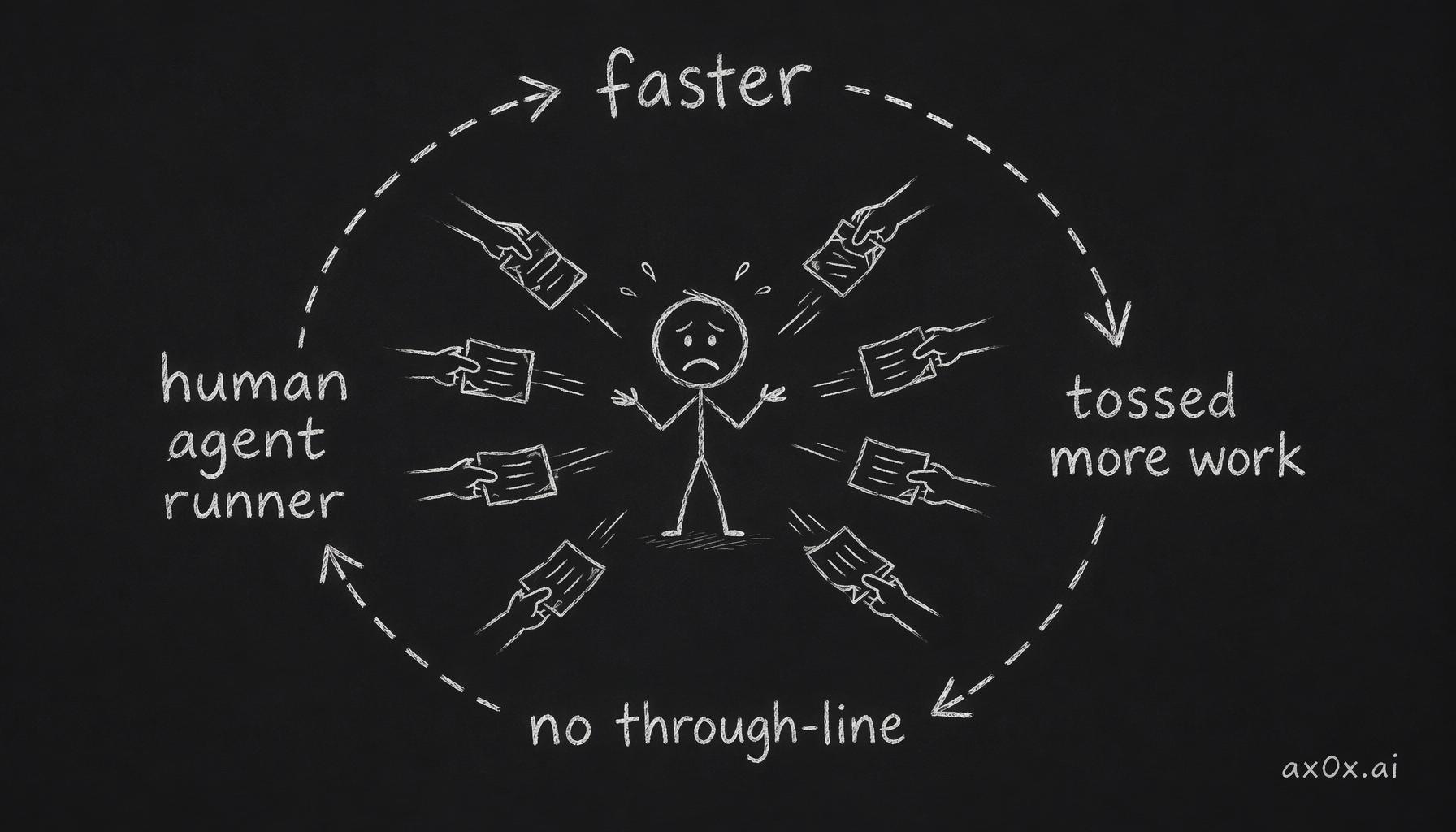 The AI-era trap loop: the faster you are, the more work gets tossed at you, the more scattered your narrative, until you're positioned as a human tool
Valuable in the short run. Mispositioned in the long run.
7. What you really need to upgrade isn't efficiency — it's other people's mental model of you
In the AI era, everyone's discussing efficiency: how to write code 10x, auto-generate slides, auto-organize docs, auto-run research, run workflows with agents.
All important. But for a career, efficiency alone isn't enough. What you actually need to manage is:
How other people understand your value.
Do they see you as the hand or the head? As an executor or a decision-maker? As someone who'll take on anything, or someone who defines direction? As high-throughput capacity, or a low-risk recipient of authority?
That decides your career path.
If you take on everything unconditionally, you're training the org: "Go to them to get something built fast."
If you first help clarify the problem, judge ROI, design the experiment, cut the low-value directions — and then deliver at high quality — you're training the org: "Go to them to improve the quality of a decision."
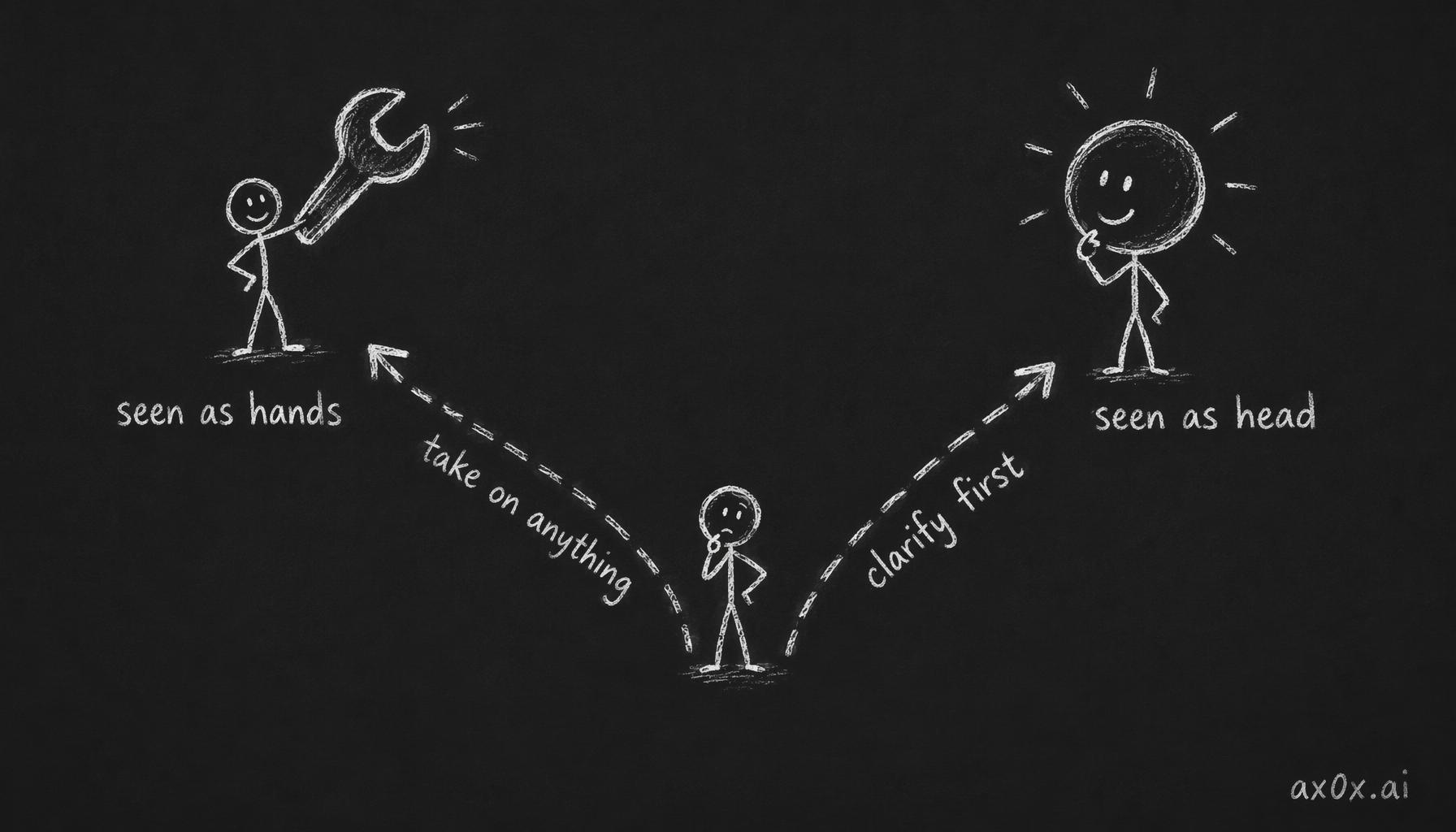 Same person, two paths: taking on anything trains the org to see your hands; clarifying and judging first trains it to see your head
The former is the workhorse path. The latter is the upgrade path. This is the same move I described in from rower to navigator: AI lets you do more of the rowing, but the leverage is in steering — and whether you get to steer depends on whether you've deliberately managed how people position you, instead of waiting for the org to notice on its own.
8. So what do you actually do?
A few things matter a lot.
First, write the promotion thesis before you take on projects. Don't wait until you've done a pile of things and then ask "how do I package this into promotion material" — too late. Ask it the other way around: What level am I trying to prove this year? What's the core evidence for that level? What's the most important problem in my org? Which problem is big enough to carry my case? Which projects can jointly prove the same thesis?
Don't say "I did a lot of AI projects this year." Say "this year I'll prove I can turn the team's AI exploration from scattered demos into an evaluable, reusable, scalable discovery engine." That way every project you take on connects into a line.
Second, don't unconditionally reward people for tossing requests at you. Many people are scared of pushback — afraid the boss thinks they're uncooperative, afraid others think they're not eager, afraid to miss a chance to shine. But high-grade pushback isn't refusing work — it's elevating the problem.
Not "I don't want to do this," but: "What decision is this demo meant to answer?" "What's the success criterion?" "Who adopts it once it's done?" "How does it relate to our most important current goal?" "Is there a cheaper way to test the same hypothesis?"
You're not slowing down. You're upgrading yourself from executor to thought partner.
Third, turn every delivery into judgment evidence. Don't just report "it's done." Report: "Why I did it this way." "Which directions I ruled out." "What risks I found." "What judgment this result changed." "How resources should be allocated next."
The same demo, if you only show the result, is execution evidence; if you show the reasoning, it's next-level evidence.
Fourth, actively manage your sponsor's motive. Don't just ask your boss "when can I get promoted." A better framing: "If I'm going to the next level, what scope do you think I need to formally own?" "What problems on the team would you like someone to solve systematically?" "Which part of my current work best supports your upcoming priorities?" "If you were making my promotion case in six months, what evidence would you want to see?"
You want to help the sponsor form this sentence:
"I need this person promoted not because they worked hard in the past, but because we have a key responsibility seat ahead that they need to formally take on."
That sentence is far more useful than "they're strong."
Fifth, periodically check whether you're on the workhorse path. A few questions to ask yourself each month: Does my recent work share a through-line? Am I defining problems, or just taking them? Am I building system capability, or just doing more work? Do people come to me for my judgment, or for my speed? Could what I'm doing become a promotion story in six months? Have I made the team stronger, or just made myself busier? Do I have a sponsor — and why do they need me promoted? Do the key people already know my value? If I were gone tomorrow, would the company lose a person, or lose a capability?
These questions are brutal. But they beat burning yourself out while waiting for the org to notice you on its own.
9. One last thing
Promotions aren't unimportant. Money, title, scope, platform, resources, voice — all very real. But don't read a promotion as a medal for effort. It's more of an org signal:
This person is considered worthy of more responsibility.
So the real question isn't "did I work hard." It's: "Does the org need a higher-level person to take on some key responsibility?" "Am I considered the most suitable, lowest-risk, most bet-worthy person right now?" "Has my work been told as a clear, credible, repeatable story?" "Is there someone with enough power willing to bet on that story?"
In the AI era, this matters more, because execution keeps getting cheaper. When execution gets cheap, simply "being fast" stops being scarce. Once the output itself is cheap, what's valuable is the layer of judgment behind the output.
What's scarce is judging what's worth doing, defining the real problem, organizing resources, building systems, influencing others, taking on responsibility, converging complex things, and turning random effort into strategic outcomes.
So don't just use AI to make yourself a faster workhorse. Use AI to upgrade yourself into a stronger decision-maker.
The danger isn't that you're too slow. The danger is that you're so fast nobody bothers to understand your head.
So which factor do you think matters most for a promotion — capability, narrative, sponsor, slot, or politics and timing? I increasingly think a lot of people get stuck not because they lack capability, but because they've gone too long without actively managing their own positioning at work.
This started from a friend's essay, Yage's "Boost productivity 10x with AI, become the model workhorse — does that get you the raise and promotion?", and the group discussion that followed. The model here is my own synthesis; names from the chat have been left out.