Productivity Will Be Liberated. People Won't.
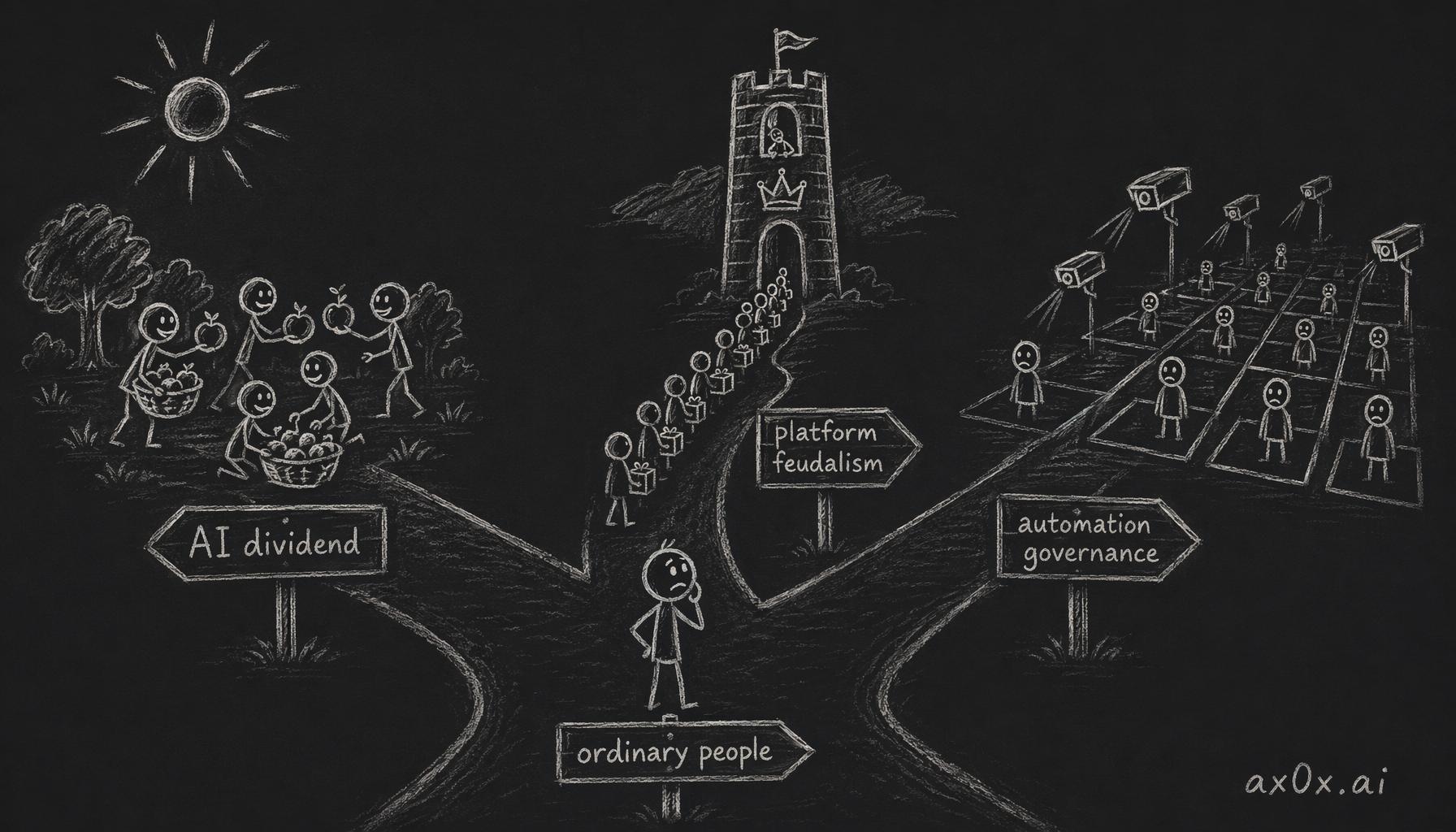 Three paths: AI dividend society / platform feudalism / high-automation governance
A group chat I'm in landed on a question that's both interesting and a little bleak:
If AI plus embodied intelligence keeps advancing, productivity rises sharply, and most jobs can be done by AI and robots — do ordinary people end up living freer lives?
The optimistic version: everyone has a basic income, and the cost of healthcare, education, law, and starting a company drops through the floor.
Or does productivity rise while the gains go mostly to big companies, big capital, and big platforms — and the average person just moves from "employee" to "managed case"?
The more I think about it, the less I believe the future bends toward utopia on its own.
The likelier future is three paths braided together:
Path one: AI dividend society. The productivity of AI and robots is partly socialized; everyone gets baseline compute, public AI services, and a share of the automation dividend.
Path two: platform feudalism. A handful of platforms own the models, compute, robots, and distribution. People look free but grow more and more dependent on the platform.
Path three: high-automation governance. States and large companies use AI to classify, score, predict, allocate, risk-manage, and govern people. You aren't necessarily poor — but you're managed in fine detail.
Which of these dominates decides whether the AI era frees people, or just frees productivity while people stay stuck.
1. The underlying shift: labor is turning into capital
The scariest thing about AI plus embodied intelligence isn't "will robots get as smart as humans."
The thing that actually matters is this:
Labor is shifting from an employment relationship into a capital expenditure.
A company used to need people to get things done. Support needs people. Code needs people. Warehousing, delivery, QA, care work, security — all people.
But if AI gets strong enough and robots get cheap enough, the company no longer has to employ that many people.
It can buy models, rent compute, deploy a robot fleet, and wire up automated workflows.
In other words, the part that used to be "human labor" gets compressed, more and more, into a capital stack:
chips → compute → power → models → agents → robots → a real-world deployment network.
Whoever owns that chain owns the machine labor of the new era. This is why I keep coming back to the idea that compute is the root of all of it — it's turning from a commodity into the layer that decides who gets to produce and who only gets to consume.
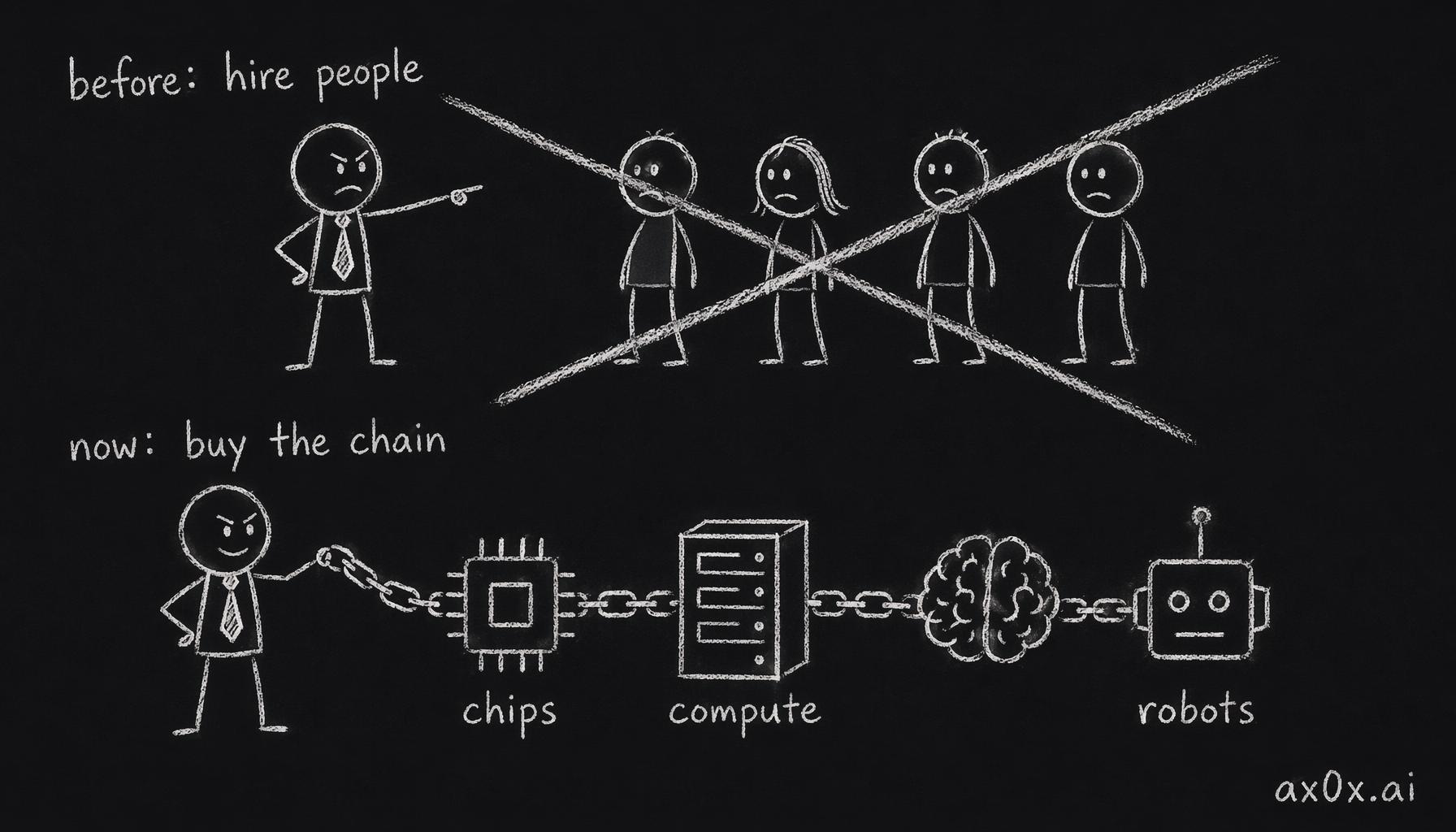 Labor is turning from employment into capex: before you hired people, now you buy the chain
It's also why I don't buy the easy story: "AI raises productivity, so everyone's life gets easier."
Rising productivity doesn't automatically make ordinary lives easier. What matters is who owns the new productivity.
If the ownership of machine labor sits with a few platforms, what ordinary people get may just be cheaper services, richer entertainment — and less bargaining power.
2. Path one: the AI dividend society
This is the better road. I'd call it the citizen-shareholder model.
Its core isn't simply handing out cash. It's giving every person, as a citizen, a minimum right to enter the AI production system.
A more idealized version of the future might include things like:
Everyone gets a basic compute account. Students learn with a public AI tutor. Ordinary people understand their rights through a public legal AI. Patients get first-pass triage, record-keeping, and visit prep from a public medical AI. Researchers and small founders can apply for public compute credits. Small companies don't get a chokehold put on them by a few cloud and model providers on day one.
In other words, AI isn't only a private company's product — it's also public infrastructure. Like roads, the power grid, libraries, public education, and the healthcare system before it.
The point of this path isn't "how much cash do we mail each person every month." It's:
The means of production in the AI era can't be entirely monopolized by a few companies.
What actually needs distributing isn't money — it's four rights
First, the right to compute. A new class divide is coming: some people can train, deploy, and orchestrate AI; others can only consume it. If ordinary people, small companies, schools, hospitals, and research institutions can't get compute that's cheap and stable enough, they're left as tenants of the big platforms.
Second, the right to models. Not every frontier model has to be public — but for education, healthcare, law, government, and research, society should at least have public models that are good enough. Otherwise the future is: the rich use the strongest private AI, the poor use a public chatbot that's two generations behind.
Third, the right to data. If our behavior, health, spending, work, and learning data all get vacuumed up by platforms, who then train models on it and sell the capability back to us, that's absurd — you contribute the data and still pay rent to use it. The future needs personal data vaults, data trusts, data portability, licensing, and audit mechanisms.
Fourth, the right to automation gains. If machines do the work and corporate profits jump, society needs some way to capture a slice of the automation dividend — a robot tax, an excess-profit tax on AI, a data-center resource tax, sovereign funds, public robot fleets, or some form of AI dividend. Otherwise the higher the productivity, the more concentrated the capital returns.
This path can also rot
But don't romanticize it. The bad version of the AI dividend society is bureaucratic AI.
It's called public AI, but it's slow, dumb, and miserable to use. The rich use top-tier commercial models; everyone else uses the low-spec public one. Public compute is nominally for small companies and researchers, but the quota gets eaten by big institutions and the well-connected. AI in government nominally raises efficiency, but really becomes finer-grained data collection and behavior management.
There's another failure mode: you get a cash subsidy, but rent, healthcare, education, and energy prices all rise together — and the subsidy flows right back to asset owners.
So whether the AI dividend society works doesn't hinge on a slogan like "we want UBI." It hinges on a whole institutional stack: Is public compute strong enough? Are public models usable enough? Are data rights enforceable? Can automation gains actually be captured? Can ordinary people appeal an AI decision? Can they migrate from one platform to another?
Without those, the "AI dividend" is just a placebo.
3. Path two: platform feudalism
This is the default road, the one I think is most likely.
It needs no conspiracy and no villain. It just needs today's business logic to keep running.
Whoever has the money builds the data centers. Whoever has distribution gets the users. Whoever has the model becomes the API. Whoever has the robot fleet replaces human labor. Whoever owns identity, payments, credit, insurance, and compliance controls the entry points to society.
In the end, the average person is nominally a free user but increasingly resembles a tenant on digital land. I call this platform feudalism.
Why "feudalism," not just "monopoly"?
Monopoly is about market concentration. Feudalism is about dependence.
Today, switching a shopping app is still pretty easy. But switching off an AI platform, in the future, may be very hard.
Because your AI assistant remembers your preferences. Your workflows live inside it. Your customer relationships live inside it. Your files, knowledge base, calendar, health data, and financial data all live inside it. Your credit history, transaction record, and professional reputation may live inside it too.
You can leave, in theory. But after you leave, your life and work efficiency fall off a cliff.
That's the most dangerous part of platform feudalism: the platform doesn't force you to stay — you just can't function without it.
The early years even feel great
Platform feudalism doesn't start out miserable. The opposite: early on it can be wonderful.
Goods are cheaper. Delivery is faster. Support is on 24/7. An AI doctor is always available. An AI tutor is endlessly patient. An AI companion really gets you. Games, short video, virtual worlds, and personalized content are abundant. Robot services keep getting cheaper.
Lots of things that used to be expensive, scarce, and annoying become cheap, instant, and personalized.
But the price is this: your income opportunities, credit rating, work allocation, social visibility, and transaction chances increasingly depend on the platform.
You don't necessarily lose your job. But you may become a human node inside an AI workflow.
The AI takes the order, sets the price, splits the task, allocates it, does QA, and rates it. You handle exceptions, the last mile, the liability signature, and the emotional labor.
You're still working — but your bargaining power drops. Because the platform can slice the work fine enough that countless people compete for the same tiny task.
The most expensive thing in the future isn't goods — it's freedom
The most cyberpunk part of this road:
Material things get more abundant, but assets get harder to own. Entertainment gets cheaper, but attention gets harder to reclaim. Services get more convenient, but the cost of exit keeps rising. AI capability spreads everywhere, but ownership of AI concentrates.
The future may not be "too poor to eat." It may be a stranger state: you don't feel poor, but structurally you are.
You use very advanced AI every day. You eat well. You have endless entertainment. You can chat, learn, make images, see a doctor, invest, and find companionship with AI.
But you can't afford the core assets. You have no genuinely stable career path. You can't leave the platform. You can't accumulate means of production. You can only keep subscribing.
The AI assistant is a subscription. The office agent is a subscription. The education agent, the healthcare gateway, the mental-health companion, the home robot, your kid's tutoring, elder care, even privacy protection — all subscriptions.
In the end, a person becomes a bundle of subscriptions. That isn't poverty in the traditional sense. It's cheap pleasure plus expensive freedom.
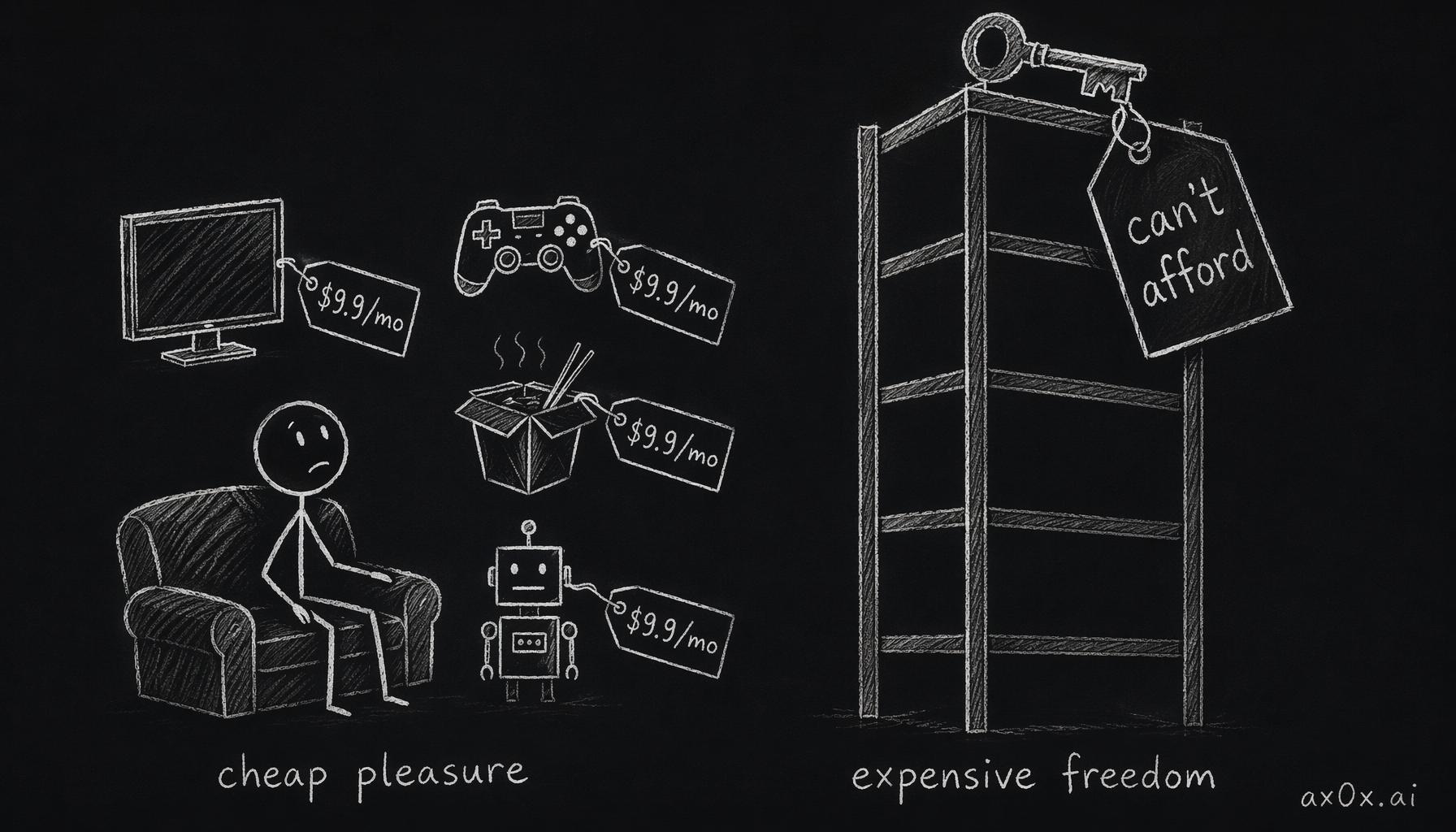 Cheap pleasure, expensive freedom
UBI can show up here too — but it curdles
Platform feudalism doesn't necessarily oppose UBI. It might even welcome a certain kind of UBI.
Because if you give ordinary people cash, they spend it on platform subscriptions, entertainment, delivery, AI companions, online education, and healthcare gateways — and the money flows right back to the platform. It's like handing serfs food stamps that can only be spent at the lord's store.
So the thing to watch isn't "is there UBI." It's: Did you get cash, or a voucher? A survival subsidy, or an asset share? A platform discount, or a means of production? The right to merely stay alive, or the right to participate in the distribution?
Those are very different things.
4. Path three: high-automation governance
The third road is darker. I'd call it algorithmic bureaucracy.
It doesn't have to look like classic dictatorship, and it doesn't start with robot dogs patrolling the streets. The more realistic form:
States, local governments, financial institutions, insurers, schools, hospitals, employers, and platforms use AI to classify, predict, score, risk-manage, allocate, and govern people.
The keyword isn't "make money" — it's "governable." Make society more legible, more computable, more sortable, more interveneable.
How is it different from platform feudalism?
Under platform feudalism, you're mainly a user, consumer, worker. The platform cares: Will you retain? Will you pay? Will you produce? Can you be orchestrated more efficiently?
Under algorithmic bureaucracy, you're mainly a managed subject. The system cares: Are you compliant? Are you high-risk? Do you deserve a subsidy? Might you be committing fraud? Do you need intervention? Should you be restricted?
One is a commercial system, the other a governance system. But the likeliest future is the two merging — the platform supplies the tech and data, the state supplies legitimacy and coercion, and the average person is both orchestrated by the platform and managed by the system.
What does daily life feel like?
Not someone arresting you every day. More like being pre-classified by a system every day.
You apply for benefits; the system says you're medium-high risk and need more documents. You apply for a loan; the system says your income stability is insufficient. You look for a job; the system says you're a low match for the role. You go through customs; the system flags you for secondary screening. You buy insurance; the system says your health behavior is poor. Your kid applies to a school; the system says the family risk profile is mediocre. You post content; the system says it triggered a safety policy. You complain; support says, "that's how the system judged it."
The scariest part isn't any single rejection. It's that you don't know why you were rejected, don't know which data point counted against you, don't know how to fix it, and can't find anyone actually accountable.
Over time, people start adjusting their own behavior to avoid tripping the system. That's the deepest psychological consequence of algorithmic governance: people begin to internalize the model.
You don't refrain because you believe in something. You refrain because you're afraid the system will misjudge you.
What does a subsidy look like on this road?
In a high-automation governance society, truly unconditional UBI is actually unnatural. Bureaucratic systems instinctively love conditions, eligibility, review, classification, and risk control.
So what's more likely: conditional basic income, use-restricted subsidies, dynamic benefit quotas, digital rationing, AI learning credits, health-behavior points, training-linked stipends, credit status that affects benefits.
You'll have food, basic healthcare, entertainment, AI companionship. You probably won't be entirely abandoned. But everything comes with conditions.
You aren't left alone. You're managed in exquisite detail.
That's the part I think of as "darker cyberpunk." It isn't necessarily squalid — it can be clean, convenient, safe. But you don't have much real freedom of movement.
5. The likeliest future: all three braided together
I don't think the future runs cleanly down a single road. The likeliest version is a blend:
Platforms handle production and consumption. The state handles identity, subsidies, and order. Public AI infrastructure provides a little cushion.
That is: the platform gives you pleasure, the state gives you order, capital takes the asset returns, and the public system gives you a baseline.
It doesn't sound like a classic apocalypse. It's more like a comfortable cyberpunk:
Cheap goods, powerful AI, robot services, AI companions, immersive entertainment, a basic subsidy, omnipresent risk control, deeply bound platform identity, and a near-impassable gap between asset classes.
The poor don't necessarily starve, but they can't climb. Ordinary people aren't necessarily jobless, but their bargaining power keeps falling. Society isn't necessarily chaotic, but choices keep shrinking.
This may be harder to resist than a classic dystopia, because it isn't pure oppression. It gives you convenience, entertainment, safety, a baseline life — and then slowly takes away your right to exit.
6. So what should ordinary people actually care about?
Don't just ask, "Will AI replace me?" That question is too narrow.
The better question: am I selling time, or orchestrating a system?
The most dangerous position in the future is selling only your time. Because AI will keep slicing human work into smaller, more standardized, more replaceable tasks.
The people with real bargaining power will own or control some kind of system: assets, compute, data, distribution, brand, customer relationships, an industry license, a robot fleet, a real-world deployment network, compliance liability, organizational capability.
"People who can use AI" aren't automatically safe, because using AI quickly becomes a basic skill. This is the flip side of the point I made writing about the super-individual: AI amplifies what one person can do — but after the amplification, what actually separates people is whether you stand on the "owns the system" side or the "orchestrated by the system" side.
The safer position: Can you use AI to amplify your assets? Can you own a data loop in some vertical? Can you hold the customer relationship? Can you orchestrate a stack of automated workflows? Can you move from executor to system owner?
7. The real fight isn't how strong AI gets — it's who owns it
AI will keep getting stronger, robots will keep getting cheaper, productivity will most likely rise. But that doesn't automatically mean ordinary people get freer.
History is full of technical advances that raised total productivity. Whether ordinary people then got a share of the gains was never decided automatically by the technology.
It depends on property rights, institutions, taxation, antitrust, data rights, whether people have a right to appeal, whether they can migrate off a platform, and whether automation gains become a public dividend or a few companies' valuation.
Writing about the intelligence curse, I raised a similar worry: when human labor stops being the scarce resource, what decides a person's fate is no longer "what can you do" but "what do you own." The AI era pushes that logic to its extreme.
So I increasingly believe the most important question of the AI era isn't "will AI become conscious," "will robots be like humans," or "when does AGI arrive." It's:
Once machines do the work — who owns the machines? Who owns the models? Who owns the compute? Who owns the data? Who owns distribution? Who owns the final say?
Those questions decide the shape of the future society. My own overall thesis on AI starts from exactly this question of ownership.
8. My conclusion
After AI plus embodied intelligence, roughly three forces pull on the future.
The first wants to make AI public infrastructure, so everyone shares the automation dividend. The second wants to make AI a platform rent, so ordinary people keep paying for cheaper, more convenient services. The third wants to make AI a governance tool, so society becomes more stable, controllable, and predictable.
The best future is one where the first force is strong enough. The likeliest future is the second and third merging.
That is: platforms own the production system, the state plugs into the governance system, and ordinary people get cheap services, a basic subsidy, and infinite entertainment — but rarely own real means of production.
That's why I call it "a darker cyberpunk." Not because the future is necessarily poor, but because it could become:
More material abundance, more concentrated power. Cheaper entertainment, more expensive freedom. Smarter services, deeper dependence on the system. Productivity gets liberated — people don't.
That last line, I think, is the most important reminder of the AI era:
Don't just celebrate that productivity went up. Ask who the productivity belongs to.
References: IFR World Robotics 2025 (industrial robots in factories doubled over a decade); IEA, Energy and AI (AI's energy demand); Stanford HAI 2026 AI Index (frontier models and investment concentration); the Alaska Permanent Fund Dividend labor study and OpenResearch unconditional cash study (cash transfers and employment); Amnesty International on Denmark's AI welfare system (discrimination risk in algorithmic governance).