
AI Companies Are Starting to Pay for Time
I recently listened to an episode of the Chinese podcast Shifen Xiyin about AI and electricity. Its guests, electricity-market researcher Cai Yuanji and Greenpeace's Shu Yiwen, discussed data centers, renewable energy, gas generation, and financing. One observation stayed with me: in parts of the United States, a developer cannot get a new data center connected on the schedule the business needs.
That makes the problem easier to understand. A model team works toward its next release. A chip buyer works toward the next hardware generation. A utility has to expand a substation, secure equipment, build transmission, and establish who will pay for it. Those schedules can be very far apart.
For an AI company, a compute purchase now depends on questions further upstream. When will these machines have power? How much can they reliably draw? Who carries the cost if that date slips by a year?
This extends an issue I discussed in my earlier essay on AI and wealth distribution: AI infrastructure ties up substantial capital. The podcast made me want to examine the gap between an asset being essential and its owner earning an attractive return.
Power has to arrive somewhere specific
It helps to separate capacity from consumption. GW measures power; TWh measures energy over time. A proposed 1 GW campus might refer to its eventual buildout, an available grid connection, or its IT load. Those are different claims.
A facility drawing an average of 1 GW continuously for a year consumes 8.76 TWh. If the 1 GW refers to servers alone, cooling and electrical losses add to the facility's consumption. A campus being built in phases will not necessarily use anything close to its ultimate capacity during its first year.
The podcast cites an IEA projection of 945 TWh for global data-center electricity consumption in 2030. That was the 2025 estimate. The April 2026 update projects roughly 950 TWh, up from 485 TWh in 2025, or around 3% of global electricity demand in 2030. This covers all data centers, including non-AI activity. It is also a forecast, subject to changes in demand, equipment supply, and efficiency. IEA's updated outlook
A modest global share can coexist with severe local constraints. Large loads cluster in particular places. Spare generation elsewhere does not guarantee that transmission can deliver it to the required location, especially during the hours when the system is already under stress.
I would therefore be specific about claims that America is “running out of electricity.” Some regions face difficulty supplying large new loads, reliably, by the dates developers want. Permitting is one contributor. Generation availability, transmission, equipment supply, and cost allocation also matter. PJM's explanation of a capacity-price increase, for example, cites generator retirements, higher forecast peak demand, and changes to reliability rules. PJM's account
Paying more for an earlier connection can be economically sensible. The comparison includes revenue earned sooner, less idle equipment, and the risk that hardware becomes less competitive while the company waits.
Building an onsite power plant does not automatically solve the timing problem. The IEA's 2026 analysis notes that gas turbines, permits, and the redundancy needed for reliable operation create their own constraints. Moving to a different supply chain may simply mean joining a different queue. IEA's discussion of onsite gas generation
A patient user does not make idle GPUs cheap
Another useful observation in the episode concerns where AI work can run. A real-time voice interaction needs a fast response. A batch evaluation or a report due the following morning may tolerate more delay. Workloads that require substantial computation but return relatively little data can sometimes move toward better power availability.
That is a plausible direction, with limits. Inference includes both urgent and deferrable work. Data access, service commitments, and the network inside a computing cluster still matter.
There is also a distinction between moving a task farther away and stopping the machines that perform it.
If I submit a task tonight and accept the result tomorrow morning, I have given the operator scheduling freedom. But the operator has already paid for its GPUs. Depreciation, facilities, networking, and financing costs continue while the machines are idle. Waiting for cheap electricity can save energy costs while reducing the amount of work the equipment delivers over its useful life.
At a simple level, the cost per completed task includes its share of hardware, facilities, and financing, plus electricity and other variable costs. Reducing one component does not guarantee a lower total. If utilization falls far enough, each task has to carry more fixed cost.
This is why I would qualify the podcast's repeated claim that electricity represents 60–80% of operating costs. Operating costs of what? A facility operator's day-to-day expenses? A GPU service including hardware depreciation? Is electricity passed through to the tenant? Without a clear denominator, that percentage cannot establish how much cheaper the final AI service becomes when electricity prices fall.
Short periods of flexibility are a different proposition. In a 2025 field demonstration, a 256-GPU cluster in a commercial data center reduced cluster power by 25% for three hours while meeting the experiment's AI service-quality commitments. That is practical evidence that scheduling can help. It remains a bounded demonstration with a particular workload mix, scale, and event duration, rather than proof that large campuses can economically follow the weather all year. Field demonstration paper
Google also disclosed demand-response agreements targeting machine-learning workloads in 2025, while emphasizing that these arrangements remained early and available only in certain locations. That extends the evidence beyond a single experiment without establishing universal availability. Google’s implementation
The more plausible near-term bargain is limited flexibility: delay some jobs, reduce power for some workloads, or curtail demand during a few difficult hours in exchange for compensation or an earlier connection. The economics depend on deadlines, recovery overhead, and the value received by the operator.
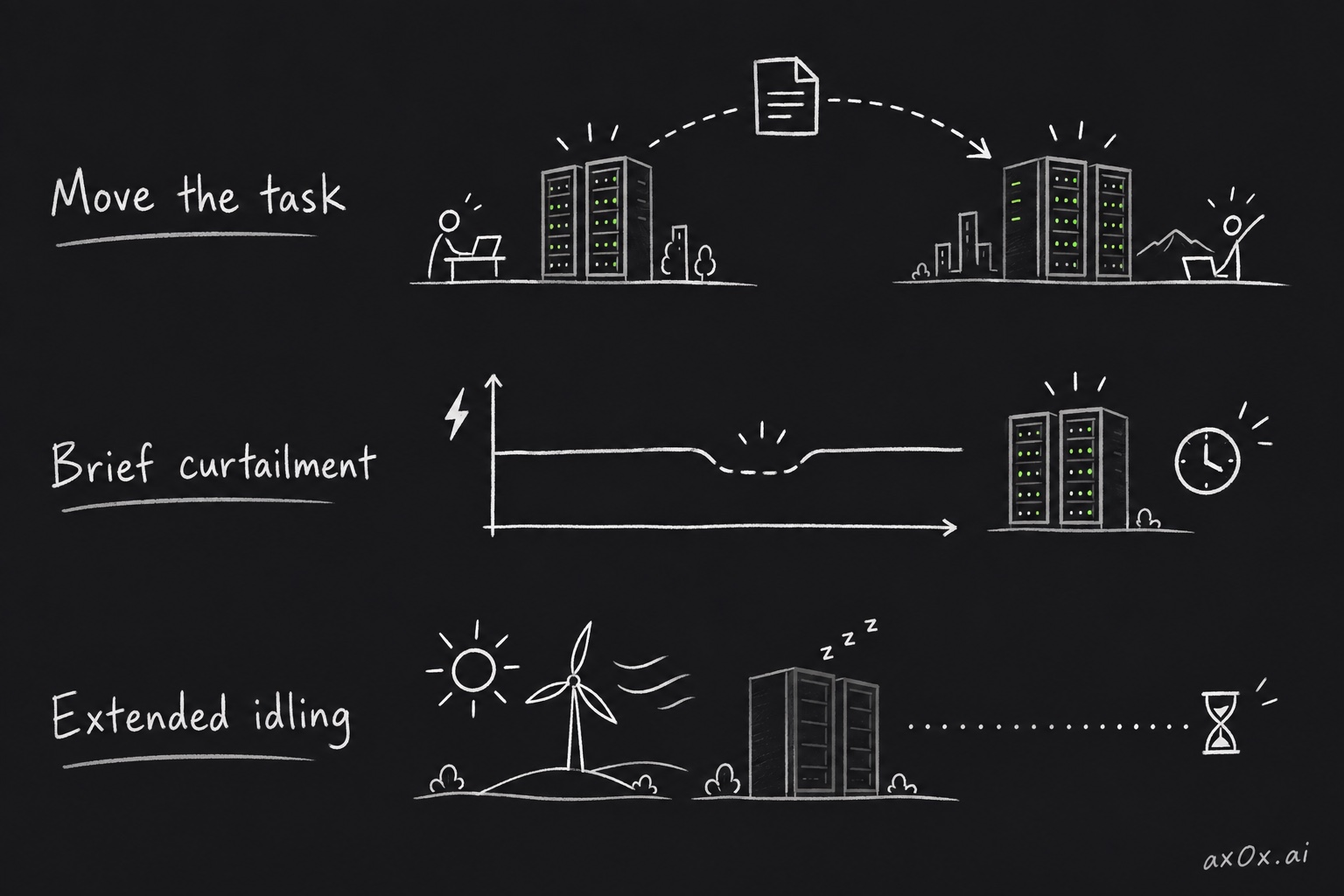 Moving tasks, briefly curtailing power, and extended idling create different flexibility and utilization tradeoffs
There is a useful counterexample. Older hardware bought cheaply, or a cluster that already lacks enough work, may face a much lower opportunity cost of curtailment. Such equipment could be better suited to following inexpensive power. We should distinguish idle capacity caused by weak demand from capacity deliberately left idle despite having valuable work available.
| Operational choice | Potential benefit | Cost or constraint to check |
|---|---|---|
| Run an entire job in another region | Use power available there | Data movement, jurisdiction, local capacity, latency |
| Curtail at peak hours and catch up later | Relieve temporary grid stress | Delays, recovery overhead, spare capacity for catch-up |
| Remain idle for long periods awaiting cheap power | Closely follow generation availability | Lost output and higher fixed cost per completed task |
There is a product-design implication here. An agent service that distinguishes “respond now” from “deliver by morning,” and supports reliable checkpoints and recovery, gives its infrastructure operator more options. Calling a product asynchronous does not by itself create those capabilities.
China's incentives need to meet at the project level
Cai divides the Chinese side into three sets of interests. Local governments want investment and economic development. Computing companies want inexpensive, reliable electricity. Energy developers want customers for renewable output and, ideally, customers willing to adjust their demand.
These interests overlap, but they are not identical.
A continuously operating data center can be an attractive electricity customer. It still wants power when renewable output is low. Cheap land and abundant wind resources do not automatically produce inexpensive round-the-clock reliability. Someone has to provide storage, grid balancing, other generation, or a reduction in demand. Someone also has to pay for those services.
Local development needs similar distinctions. Construction investment, permanent employment, local tax receipts, and the arrival of companies that actually use the computing capacity are separate outcomes. A location can obtain the first without obtaining much of the last.
Direct renewable connections offer another way to organize supply, but they do not eliminate balancing costs. China's 2025 national rules explicitly distinguish grid-connected and off-grid projects, a distinction retained in the 2026 rules for multi-user direct connections. Grid-connected projects still declare connection capacity, define supply responsibilities, and bear applicable charges. A dedicated line does not provide free reliability. NDRC and NEA rules
China's power construction and manufacturing capabilities can support computing growth. Turning that advantage into a competitive AI service still requires chips, cluster networking, software, utilization, and paying customers. Electricity improves part of the cost structure; the other parts remain necessary.
Annual renewable matching leaves a timing question
Shu's distinction between annual and hourly clean-energy matching is particularly useful.
A company may procure renewable electricity or qualifying environmental attributes equal to its annual electricity use. Depending on the applicable accounting standard, that can satisfy an annual matching goal. It does not establish that sufficient clean generation was available in the relevant grid during every hour the company operated.
Google made this distinction explicit when it announced its next climate goals in 2020: annual renewable matching had already been achieved, while carbon-free energy in every location, every hour, remained a separate ambition. Adding time and location makes the engineering substantially harder. Google's explanation
Both types of commitment deserve to be evaluated on their actual terms. Annual procurement can support renewable generation. Covering the difficult hours in a particular grid requires additional work. Renewable energy, carbon-free electricity, and the policy category called “green electricity” also have different boundaries, especially concerning nuclear generation.
A low-cost annual certificate therefore tells us little about the cost of reliable hourly clean supply. Generation is one part of the bill. Delivering it at the required time and place is another.
Who carries the years without enough customers?
The episode's discussion of REITs, power-purchase agreements, and private credit brings the analysis back to time.
Power plants, transmission lines, and data-center buildings can operate for many years. The economic competitiveness of a GPU can change much faster. Customer contracts have their own terms. Model efficiency and the prices customers will pay may move on yet another schedule.
Putting those obligations into one project does not align them automatically.
Suppose the power is ready and the hardware installed, but demand falls short. A long-term power commitment or loan does not disappear because the job queue is empty. Or suppose models become more efficient and customers can accomplish the same work at lower prices. That benefits users, while a project financed against a different revenue forecast may need to revise its economics.
A power-purchase agreement can reduce particular price risks, depending on its terms. It may also create fixed-price, volume, or duration commitments. Different asset lives do not automatically mean a project loses money: a power plant can serve successive GPU generations and, where feasible, other customers. The question is whether contracts cover the investment and replacement demand is available. Securitization changes who holds rights to cash flow and who bears losses. It does not make renewal risk, equipment suitability, or electricity-price exposure vanish.
We also need to distinguish an asset that owns the building and electrical infrastructure from a business that buys GPUs and sells computation. Their revenue and risk differ. Some facility contracts pass electricity costs to customers, so a price increase does not necessarily hit the owner's margin directly.
One detail in the podcast's PJM discussion deserves correction. Capacity auctions procure availability for a specified delivery period, with prices often quoted in dollars per MW-day. An advance auction does not mean the full construction cost of a future power plant immediately appears in household bills during the auction year. Delivery periods and retail billing arrangements matter; a capacity price is not a per-kWh energy price. PJM's auction explanation
For investment analysis, I would start with fairly ordinary questions. Whose project is this asset holding up? How much will that customer pay to receive it earlier? How long is the revenue contractually supported? Who takes the loss if expected demand fails to arrive?
An industry needing an asset does not establish its owner's return. Regulation, competition, contracts, and the purchase price all intervene. Scarcity can produce higher revenue. It can also produce expensive construction obligations whose returns are constrained.
For someone building AI products, the immediate question is closer to the service itself. Which work truly needs an instant response? Which jobs can queue or resume after interruption? Can we reach the same result with fewer repeated calls and retries? Those choices can affect where the service runs and how productively its equipment is used.
After this episode, I am more interested in following individual projects through their next stages: when promised power arrives, when computing capacity earns revenue, and how long customers keep paying. Those dates will tell us more about the business than an announced capacity figure alone.
An independent analysis based on Shifen Xiyin, EP.03, “The Electricity War in the AI Era,” and the episode transcript. Interpretations are the author's; guest views are attributed in the text. Sources checked on September 21, 2026. Unverified financing, project, and conference anecdotes from the episode are not used as evidence.