
Railroads, Electricity, the Internet Each Built a Middle Class. AI Might Not.
The episode of 十分吸引 (Extremely Attractive) crossed with 听懂涨声 opened with a number. The day after they recorded, SpaceX closed the largest IPO in history at $1.75 trillion; the hosts also quoted a line attributed to Jensen Huang — over the next five years, AI will mint more millionaires than the internet did in twenty. Hard to verify, but the old rule behind it is solid: over the past 150 years, every infrastructure revolution has been a wealth reshuffle, the old winners falling behind, the early movers on the new rules taking the excess returns.
The best part wasn't predicting who gets rich. It was the three of them — Shi Lei, Min, Yang Tiannan — spending an hour pulling apart the mechanism of three reshuffles: railroads, electricity, the internet. I dug a layer under their account, and made it harder: the reshuffle is never random; it runs the same logic every time. Understand the logic and you can tell which parts of the AI round will rerun, and which will break.
First: not every technology reshuffles wealth
Not every advance redistributes wealth. Shi Lei laid out the test on the show: technology matters because it recomposes the mode of production — it changes the relationships between inputs and redefines what counts as a valuable resource. What used to matter may stop mattering.
A technology that can actually flip the table has to meet two conditions. One: a positive-feedback flywheel of increasing marginal returns — the more you pour in, the steeper the payoff curve, so it spreads like wildfire. If the returns are diminishing, it can't spread and reverts to cycles and equilibrium. Two: the institutional and cultural soil — the seed may land in one place and bear fruit in another (plenty of European inventions ended up rooting in America).
So the first driver of a reshuffle is the feedback flywheel, not how advanced the technology sounds. By one count, only about 5% of technologies even reach a growth phase. The other 95% never earn the right to change the distribution at all.
The underlying logic: technology rewires the network, the old bottleneck fails, the new one gets priced
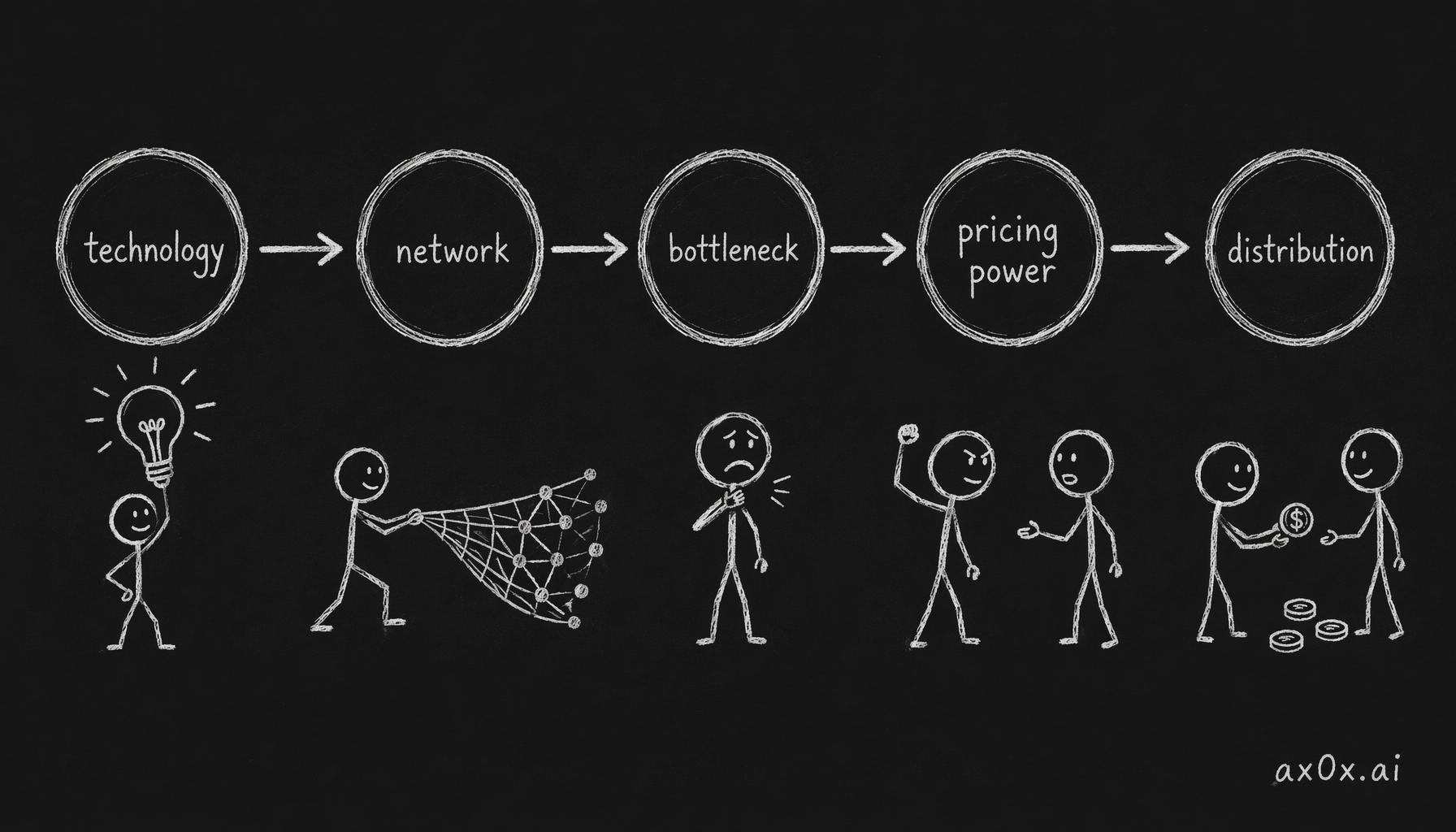 The reshuffle chain: technology → network → bottleneck → pricing power → distribution
There's a harder line to the direction of the reshuffle. Lay the three eras side by side and the mechanism is identical: what technology actually moves isn't efficiency itself, it's the wiring diagram of the economic network — who gets connected, who gets routed around, which path the traffic takes. Rewire the network and the old bottleneck stops binding; a new one surfaces; whoever is wedged at the new bottleneck gets the pricing power, and wealth follows the pricing power.
Strung together: technology changes the constraint, the constraint changes the network, the network changes the bottleneck, the bottleneck changes bargaining power, bargaining power changes the distribution.
Shi Lei offered a matching ruler: a node's value in an industrial network equals the traffic flowing through it times its retention rate. Traffic is whether you get a shot; retention is whether you can collect a toll — whether you can settle customers, data, brand, standards, a license. A Chinese barbecue town went viral for a season — people came and left, retention zero, so nothing accumulated. A place with only traffic is just busy; a place that keeps the traffic is where wealth forms.
And one counterintuitive bit: what counts as a "resource" is decided by the technology. Before refining, gasoline was a byproduct of kerosene that nobody wanted; the combustion engine arrived and gasoline became the main act. The wealth code of an era is often just seeing, one step early, what is turning from byproduct into prime asset.
Railroads: rewiring the goods network
The first round, railroads, ran roughly 1850 to 1890 — forty years.
It punched through the bottleneck of physical distribution. Before rail, goods moved by cart and canal, with a circulation radius often of tens of kilometers; every place was an isolated local market, the same good priced wildly differently across regions, hedged in by local protectionism. Railroads dropped the ton-kilometer cost, the isolated regional markets fused into a national one, and large-scale industry — heavy industry especially — rose with it.
Once physical distribution stopped being the bottleneck, the new tollbooths sat in two places. One was the junction. Traffic redistributed, and cities sprang up where the rails crossed: Zhengzhou was a mere county next to two ancient capitals, but because the Beijing–Hankou line shifted west around the Yellow River and met the Longhai line there, it grew into the logistics center of the Central Plains. Shijiazhuang was, literally, "hauled in by the train" — once a real village while the provincial seat sat in Baoding. As Shi Lei put it: a property is worth the traffic it carries — people, commerce, attention — not the dirt underneath.
This isn't city trivia. The economic historians Donaldson and Hornbeck put a hard number on it: from 1870 to 1890, a county's market access was capitalized into its farmland value at an elasticity near one-to-one — and removing every US railroad in 1890 is estimated to erase about 60% of the total value of US agricultural land. What railroads really did was reroute wealth from the old geography of rivers and ports to the new nodes the tracks defined.
The other tollbooth was the organization that could command national scale. Railroads were heavy-asset, long-cycle, capital-intensive, decades to pay back, far beyond what craft and ordinary commerce needed — which forced modern finance into being: railroad bonds, securities exchanges, investment banks, all products of that era. The cost was on the ledger too. This was Mark Twain's Gilded Age, and by its end the richest 1% held nearly half the nation's wealth.
Electricity: rewiring the energy network — and the first mass middle class
The second round, electricity and oil, ran 1870 to 1920 — fifty years.
Railroads rewired the goods network; electricity rewired the energy network. A steam-age factory had to sit next to coal and rivers, chained to its resources; electricity travels over a grid, so factories could site themselves by efficiency and market instead. Deeper still: the electric light lit the night, and the city went round-the-clock, with a night economy for the first time.
Once energy and siting freedom stopped being the bottleneck, the new tollbooth became brainpower and skill. Factories left the junctions, downtown cores freed up for commerce and offices, and white-collar work — engineers, operations, QA — appeared at scale. Mental labor's share of the economy climbed, and a skill premium emerged. Where people used to trade muscle, they began trading skill.
This round added one genuinely crucial change over railroads: a mass middle class appeared for the first time. The concentrated end was still staggering — around 1910, Rockefeller's fortune equaled 2.5% of US GDP — but by the 1920s, America had grown a thick middle layer.
This is worth getting right, because it governs how to read AI. Electricity's payoff came slowly. The economic historian Paul David documented a famous paradox: after electric motors were installed, factory productivity flatlined for years, and the real surge only came once factories agreed to re-lay the floor around "one motor per machine" and management and worker skills turned over with it — a lag of three to four decades. Electricity didn't make you rich on plug-in; it forced the entire mode of production to be redone. And redoing it took vast numbers of people: engineers, managers, clerks, technicians, QA, sales. The middle class wasn't charity handed down by a benevolent technology; it was something the new mode of production needed in order to run. "Technology connected the world" sounds nice, but what actually did the work was its big appetite — it needed people. That "does it need people" is the crux of the AI question later.
The internet: rewiring the information network — light-asset winner-take-all
The third round, the internet, 1990 to now — thirty-odd years.
It punched through the bottleneck of information. Before it, information moved by newspaper, TV, radio, telephone — one-to-many broadcast or one-to-one calls, the central node holding the power. The internet tore off the space-time constraint at once, turning it into millisecond, global, real-time exchange, and — bolted onto network effects, that engine of increasing marginal returns — grew into the platform economy: customer flow, goods flow, information flow, capital flow, four streams fusing in real time.
Once information and distribution stopped being the bottleneck, the new tollbooth was attention, and the platform that could form network effects. Whoever held the user entry point held the attention, the data, the matching — then took a cut, sold ads, ran cloud, ran finance. Platforms monopolized traffic, winner-take-all, minting a wave of fortunes. Yang Tiannan compressed the three rounds into three networks: transport, energy, information. Carnegie's steel and rail were transport; Rockefeller's oil and electricity were energy; Gates and Bezos were information. SpaceX's IPO is one person gripping all three at once — energy, transport, plus AI's information — which is why its valuation gets imagined at that scale.
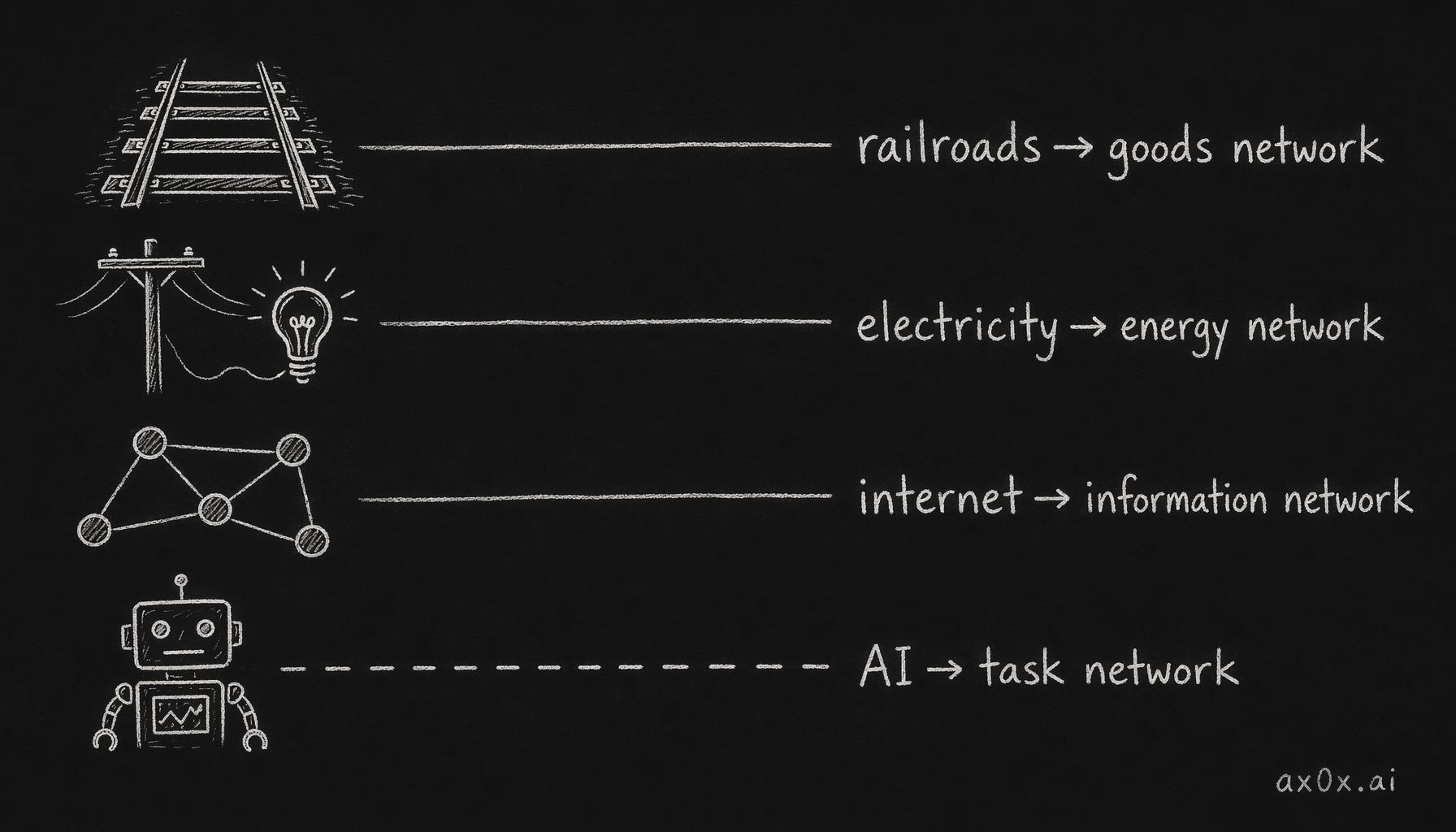 Four networks: railroads rewired goods, electricity energy, the internet information, AI tasks
But the internet's gains also spread downward, thanks to its other trait: it was light-asset winner-take-all. The marginal cost of serving one more user is near zero, so platforms expanded at enormous margins; and precisely because it was light, even as it monopolized it could hold a huge employment layer — programmers, product, operations, design, streamers, merchants, couriers. Taobao, livestreaming, creators, cross-border e-commerce: ordinary people genuinely caught this wave, and flexible employment at one point hit 40% of the workforce. Hangzhou's rise is almost a rerun of Zhengzhou's: online traffic pouring into the offline world, lifting a tourism-and-consumption city into an internet first-tier.
AI: rewiring the task network — heavy-asset winner-take-all
So what bottleneck does AI punch through?
The first three — physical distribution, energy, information — were all about moving things, people, and messages: connection and coordination. AI punches through a layer further in: cognition and execution themselves. Machines used to supply our muscle; now they start supplying our thinking, and what gets rewired is the task network — a task that used to pass through a manager, an employee, an outsourcer, a supplier may now pass straight through a model, a workflow, an agent, with a few people signing off. By the same logic, once cognition gets cheap, the new tollbooth stands somewhere else.
The hard end is compute and energy — this round's "railroad": heavy-asset, long-cycle, capital-intensive, the highest-certainty bet, so capital rushes in first. How frightening the scale of that railroad is, you can read off the power bill: the IEA estimates global data-center electricity will roughly double by 2030 to nearly 945 TWh, with demand from AI-optimized data centers more than quadrupling. The soft end is what AI can't give. Shi Lei nailed the root: an LLM goes symbol-to-symbol, with no experience of the real world; its entire "experience" is the data humans left behind by acting. So the further out you go, the more valuable a person's real-world perception and judgment become — and that "why should I trust you" sense. Same line as my piece on "Dao Rises, Skill Fades": skill depreciates, dao appreciates.
But AI differs from the internet in one fatal way: the internet was light-asset winner-take-all, AI is heavy-asset winner-take-all. Every inference burns compute, power, and depreciation. A model company is less a pure-software business than a graft of software, semiconductors, power, data centers, and financial engineering. That pushes the distribution to a crueler end: more dependent on capital markets, more dependent on debt, more prone to the mismatch where the industry is right long-term while finance pays the bill short-term.
Which leads to the sharpest cut on the show: looking at a supply chain, don't just watch who grows — watch who pays the bill. Clean energy is a great industry, but much of the time financial capital settled the tab while the chain ground itself down and kept no cash. The A-share Apple chain had the orders, but the value flowed to Apple while suppliers fronted the capex on margins thin as paper. AI's upstream looks glorious now because a few cloud giants are paying — but this year their own cash flow can no longer cover the spend, and they've started borrowing. The compute "railroad" is a trillion-dollar-scale capex, and who finally settles that bill — corporate labor savings, consumer subscriptions, or another round of the capital market holding the bag — has no answer yet. The real question in AI's distribution is who will keep paying, who can keep the money, and who's just fronting capital for someone else.
It unbundles jobs into tasks and reprices them one by one
Up to here, the logic still matches the first three rounds. The real variable is the shape of the distribution — and to see the shape you have to break "will AI replace people" into something finer.
Labor is never replaced whole; it gets unbundled into tasks and repriced one at a time. A job is a bundle of tasks: judgment, communication, execution, documentation, coordination, liability, on-site presence, creation. AI eats the symbolizable, standardizable, mass-generatable ones first. The "task framework" economists have built over the past decade made the point early: much of automation's rewrite of the wage structure is just routine tasks getting taken over by machines and pay getting re-sorted.
So what the AI era actually does to labor is this: jobs get unbundled, tasks get repriced, people get re-stratified — "white-collar disappears" is too coarse a way to say it. The same lawyer: drafting, case search, contract assembly depreciate; risk judgment, persuading the client, structuring the deal, carrying the liability appreciate. The same programmer: vanilla CRUD and test-completion depreciate; architecture judgment, abstracting the requirement, hard debugging, product feel appreciate. When everyone can generate content, code, and plans, the output stops being scarce; what's scarce is knowing what's worth doing, judging whether the result is right, and being on the hook when it isn't.
And this cut lands precisely on the people who used to be safest. The IMF estimates about 40% of jobs globally are exposed to AI, and more in advanced economies — about 60%, because cognitive work is a bigger share there. The ones getting hit are exactly the white-collar and professional-service roles long treated as "safe."
I build AI products on the front line every day, so the feel is direct: one person with AI can do what a small team used to. Shi Lei pushed that to the social level: for the individual, AI expands the circle of capability; for society, it's a dispersive force, making everyone feel "I don't really need you." Back to the crux from the electricity round — does the new mode of production need a lot of people? The first three rounds all answered yes, which is why they minted tycoons while absorbing ordinary people into a middle class. AI's answer this round may be not really. Yang Tiannan gave a cold sense of scale: a big internet company is a hundred-thousand-person org, a major brokerage tens of thousands, a fab a few thousand, a model lab a few hundred, an agent startup a few dozen. The sharper the edge, the fewer people it carries — and it was exactly the largest, most-people companies that held up the biggest middle class and the most jobs of the last era.
Stack it all up and the AI round's distribution looks like this: it will faithfully rerun the "extreme concentration" half — ownership of compute, energy, and models pulling toward a tiny few — but may never reach the "grow the middle" half. The first three went concentrate-then-broaden; AI may only concentrate, not broaden. That's the part of this reshuffle I'm least optimistic about.
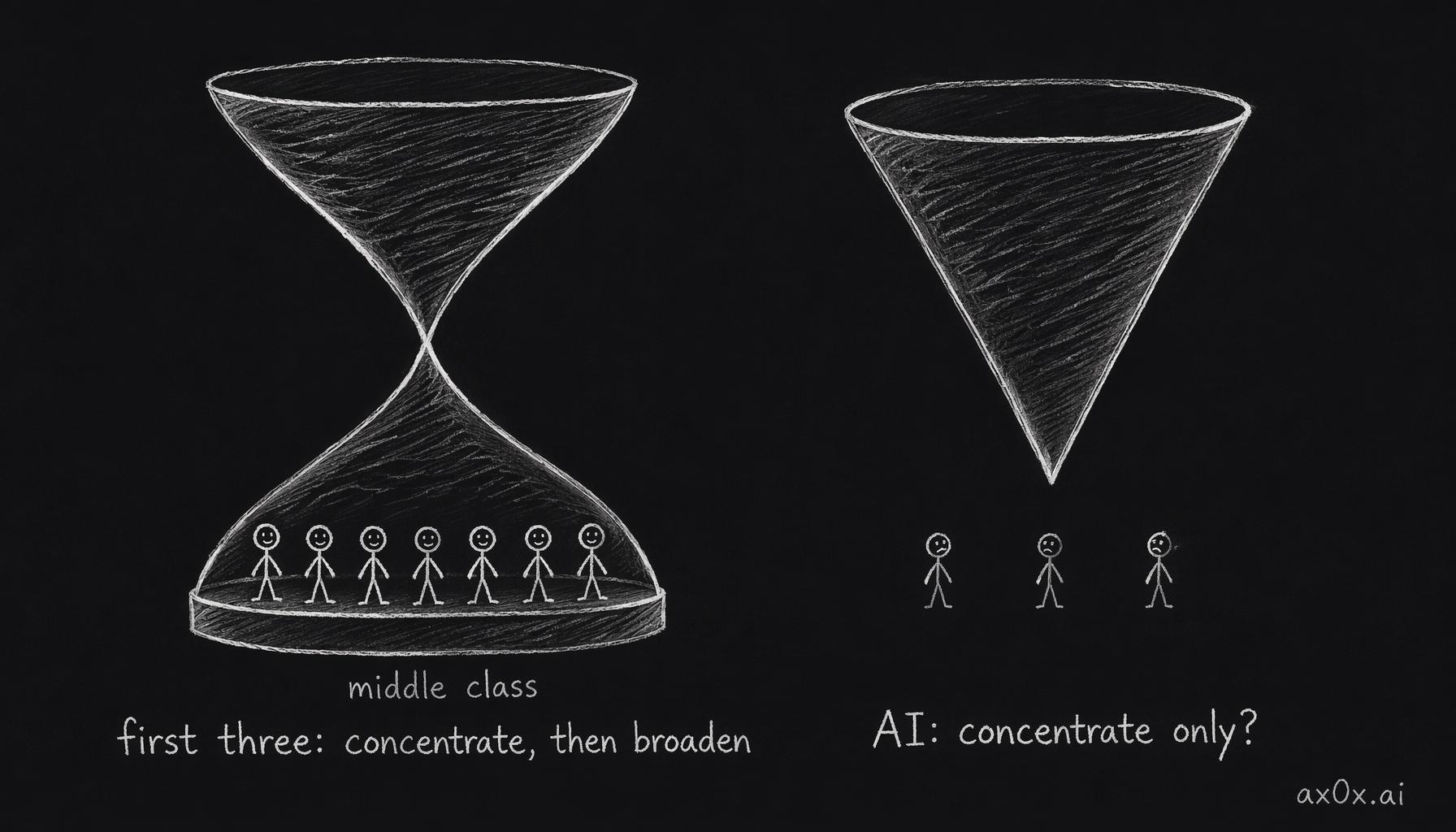 The first three rounds concentrated then broadened; AI may only concentrate
The first shock is set by technology; the correction, by institutions
There's a second half to the history worth keeping in mind, though. The first wave of distribution a technology throws off is always lopsided, because technology diffuses faster than institutions. But after each round, the institutions catch up and run a second distribution.
Railroads forced company law, bond markets, and securities regulation into being; electricity forced grid standards, utility regulation, and labor law; the internet forced platform antitrust, data rights, and payment clearing. This AI round — the matching data-property rights, model liability, copyright rework, compute and energy governance, maybe some redistribution of the automation surplus — is mostly not in place yet. The shape of the first distribution is written by technology; the shape of the correction is written by institutions — and right now we're still stuck dead in the first shock.
The distribution may already be written the moment the network sets
The underlying logic hasn't changed: technology rewires the economic network, the old bottleneck fails, the new one gets priced, and whoever sees the new bottleneck first and sits down on it wins. From railroads to AI, that holds.
What changes is whether the result spreads. The gains of the first three eventually reached ordinary people because those production modes had big appetites and could digest masses of them — electricity wanted engineers and clerks, the internet wanted programmers, operations, and merchants. AI's appetite this round may be far smaller.
We're still in the build-out: capital is grabbing the highest-certainty "railroad," compute, while the shape of the applications and who pays the bill have no answer yet. But one thing may already be set — where this round's new wealth flows is written the moment the network takes shape. The first three times, ordinary people were carried onto the train by the network itself. So the thing actually worth watching this round isn't whether new billionaires appear — they will. It's whether AI, like electricity and the internet, also grows a fresh middle class on the side; or only mints a tiny set of super-individuals, super-companies, and outsized capital returns.
The full framework — six transmission mechanisms, a nine-question research method, and a few falsifiable hypotheses — is pulled out into a research appendix for anyone who wants the harder version.
Two related threads: my overall thesis on AI starts from the question of ownership, and Who Owns the Machines picks up where the gains go once productivity rises.
References: Donaldson & Hornbeck, "Railroads and American Economic Growth" (QJE 2016) (removing 1890 railroads cuts US farmland value ~60%); Paul David, "The Dynamo and the Computer" (AER 1990) (a general-purpose technology's productivity payoff lags organizational rewiring); IMF, "Gen-AI: Artificial Intelligence and the Future of Work" (2024) (~40% of jobs globally, ~60% in advanced economies, exposed to AI); IEA, "Energy and AI" (2025) (data-center electricity roughly doubles to ~945 TWh by 2030).