The Tech–Network–Distribution Model (Appendix to The Wealth Reshuffle)
This is the framework behind Railroads, Electricity, the Internet Each Built a Middle Class. AI Might Not. The essay is for reading; getting the judgment across is enough there. This is for the framework itself — too hard, too tool-like, it would crush the essay if jammed inside, but pulled out on its own it lets you run it against the next technology yourself. Up front: this is a working framework, still changing, not settled law.
First principle: technology is the rewiring of production relations
Economics likes to split growth into capital, labor, land, energy, data, institutions. But for wealth reshuffles, technology shouldn't be treated as one more factor alongside those. It's more like an operator that rewrites the relationships among them — turning the old production function into a different one.
So what a technology revolution actually changes isn't that one variable got bigger; it's that the whole equation got swapped: which resource matters, which labor is worth paying for, which assets appreciate, which organizational form is efficient, who owns the entry point, who bears the cost, who holds the pricing power. Railroads didn't make the cart faster, they made the canal towns stop being privileged; electricity didn't make the steam engine stronger, it reorganized factories, cities, and working hours; the internet didn't make the newspaper faster, it moved information and transactions onto platforms.
Hold onto this one; every mechanism below is just its unfolding.
The wealth-capture formula
The essay used Shi Lei's ruler: node value = traffic × retention. Expand it and you get a fuller capture formula:
wealth capture = new traffic × retention × gross margin × duration × capitalization multiple − transition cost
Term by term. New traffic — which economic activity the technology routed to you: goods, energy, information, tasks, capital, attention. Retention — whether you can charge as it passes, whether you can settle data, customers, brand, standards, a license. Gross margin — whether you're a scarce bottleneck or a replaceable second-source supplier. Duration — whether your edge is backed by network effects, switching costs, scale, licenses, brand trust. Capitalization multiple — how much the capital market will pre-pay for your future; early in a revolution, what it's buying isn't profit but an option on future distribution rights. Transition cost — old-asset depreciation, skill obsolescence, reorganization, debt, friction.
In one line: wealth doesn't flow to whoever uses the technology, it flows to whoever can keep the new traffic.
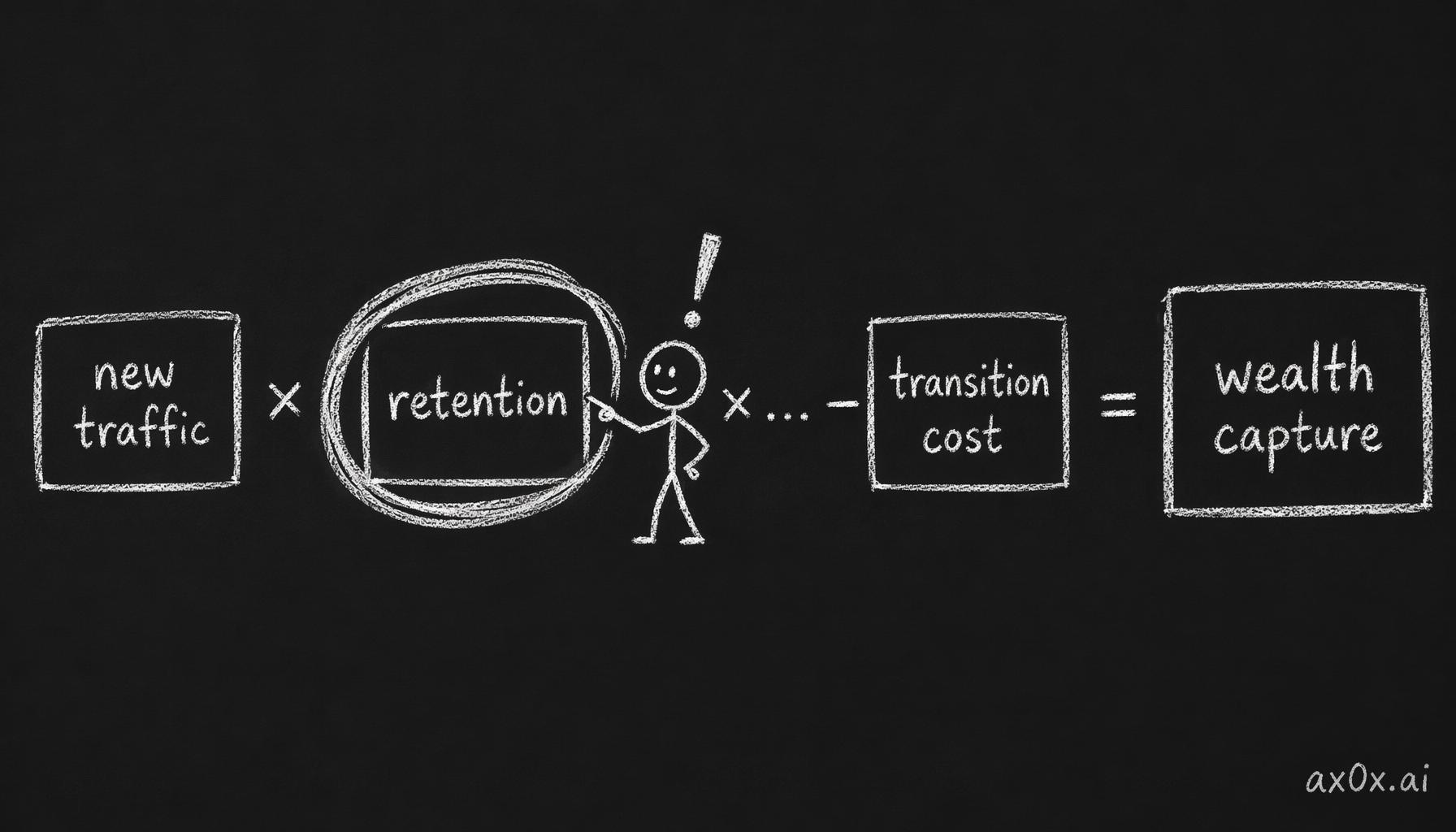 The wealth-capture formula: new traffic times retention and other coefficients minus transition cost, with retention as the term that decides who keeps the money
Six transmission mechanisms
Technology changes distribution along six lines.
Cost curve. When one cost collapses, another scarcity surfaces. Every revolution first violently kills some cost — railroads killed long-distance freight cost, electricity the cost of controllable energy, the internet the cost of copying and distributing information, AI the cost of prediction, generation, and some decisions (Agrawal, Gans, and Goldfarb abstract AI simply as "prediction getting cheap"). The pattern is symmetric: transport gets cheap, junction land gets scarce; energy gets cheap, organization and engineering get scarce; information gets cheap, attention and trust get scarce; prediction gets cheap, judgment, objectives, and responsibility get scarce.
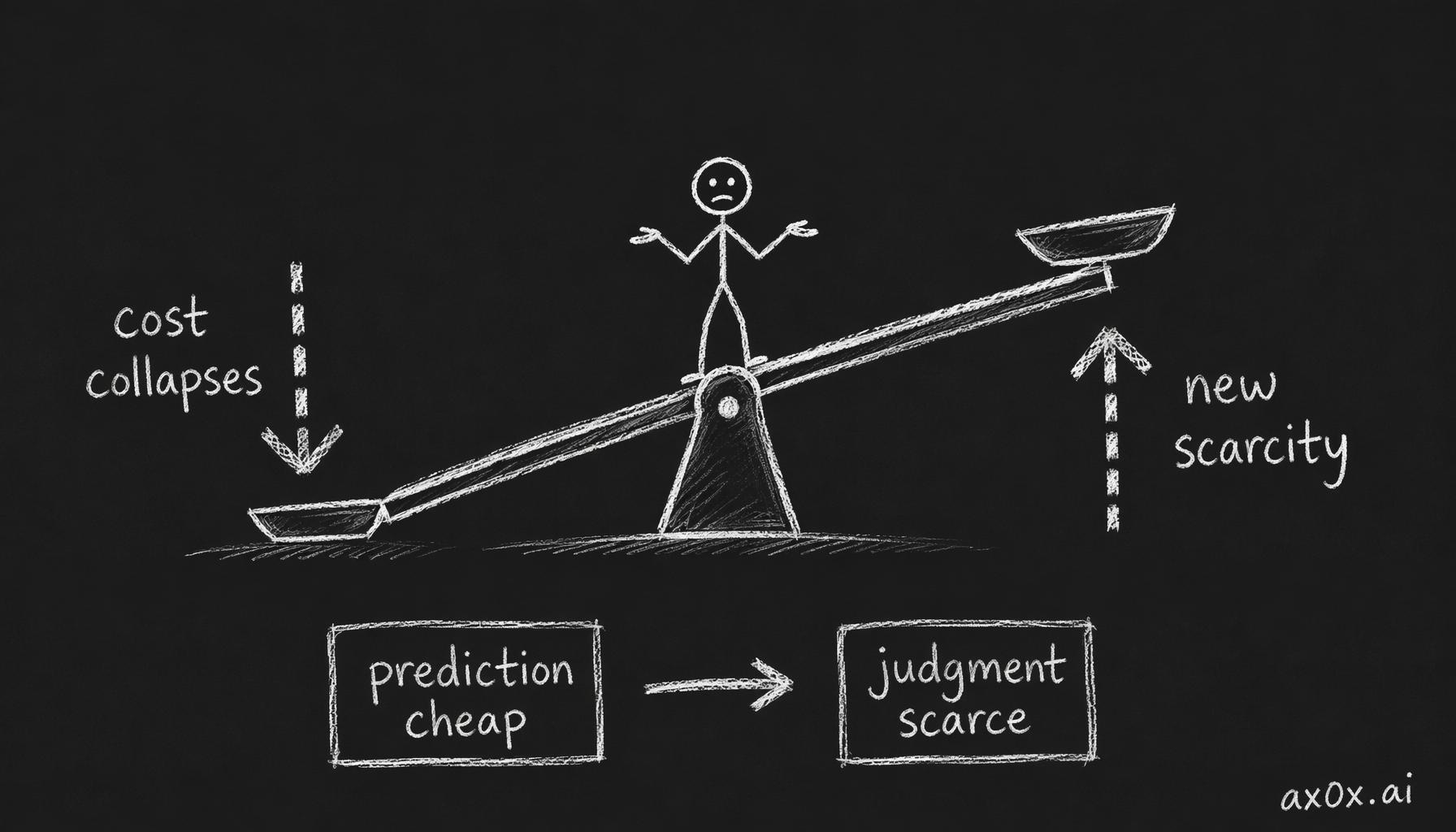 The cost-curve mechanism: when one cost is violently killed, a new scarcity surfaces beside it — prediction gets cheap, judgment gets scarce
Network topology. Technology changes who-connects-to-whom. A revolution isn't point efficiency, it's a redraw of the economic network's wiring. Railroads moved cities from along-the-river to along-the-rail; the internet moved the center from geographic hub to digital platform; AI moves the task flow from "people → organization → process" to "people → models → tools → agents." So what AI naturally weakens is the middle layer: the more a role exists to relay information, format, and execute standard steps, the more easily it gets routed around.
Bottleneck migration. Old bottleneck fails, new bottleneck gets priced. Distribution is, at root, bottleneck pricing — which explains a counterintuitive fact: inventors often don't make the most money. Teece's "Profiting from Technological Innovation" said it long ago — who captures the returns depends on appropriability and on who holds the complementary assets, and value often flows to whoever controls manufacturing, distribution, brand, standards. So with AI, don't only ask who has the best model; ask who has compute, who has power, who has the customer entry point, who has proprietary data, who can carry liability, who can keep users from switching.
Task recomposition. Labor gets unbundled into tasks and repriced. Don't ask whether labor gets replaced; break it into tasks. A job is a bundle: judgment, communication, execution, documentation, coordination, liability, on-site presence, creation. AI eats the symbolizable, standardizable ones first (the task framework from Autor and from Acemoglu & Restrepo explains the shift in the wage structure precisely as routine tasks being taken over by automation). So the formula for individual value changes: individual value = problem definition × judgment × real-world experience × trust × ability to orchestrate AI.
Who settles the bill. With no final payer, an industrial boom can still be a financial loss. Separate an industry boom from an asset boom. An industry can grow fast while the people who bought it don't make money — clean energy is the example, capacity got built with no stable payer, and financial capital ended up holding the bag. AI has five possible payers: cloud giants cross-subsidizing themselves, enterprise customers saving labor, consumers subscribing, governments and sovereign capital, and — most dangerous — the capital market. The test is hard: whether the payer can move from "capital market" to "real customer budget" decides whether a revolution survives its bubble.
Institutional feedback. Technology shocks the distribution first; institutions correct it second. Technology diffuses faster than institutions update, so the early phase is always lopsided. But a general-purpose technology only releases its productivity once complementary organization, skills, and institutions catch up — the work on AI's "productivity paradox" (Brynjolfsson, Rock, and Syverson) points to implementation lag as a big part of the gap between expectation and the data. Railroads forced company law and securities regulation, electricity forced grid standards and labor law, the internet forced platform antitrust and data rights. The shape of the first distribution is written by technology; the shape of the correction, by institutions.
AI's four layers
Drop the six mechanisms onto AI and the value sorts into four layers, each with one question. Infrastructure (chips, HBM, power, data centers, cooling): are the orders real, can the cash flow stay, will capex eat the profit? Models: does the capability gap persist, does the open-vs-closed cost gap narrow, do users have real switching cost — the model layer is strong, but the throne is slippery. Applications / workflow: can it enter the customer's budget, replace a real cost, carry a business outcome — "improves the experience" is worth little, "cuts 30% of labor, lifts conversion 20%" has a real payer. Institutions and trust: copyright, data rights, liability, certification, insurance, compliance — when answers get cheap, the signature gets expensive.
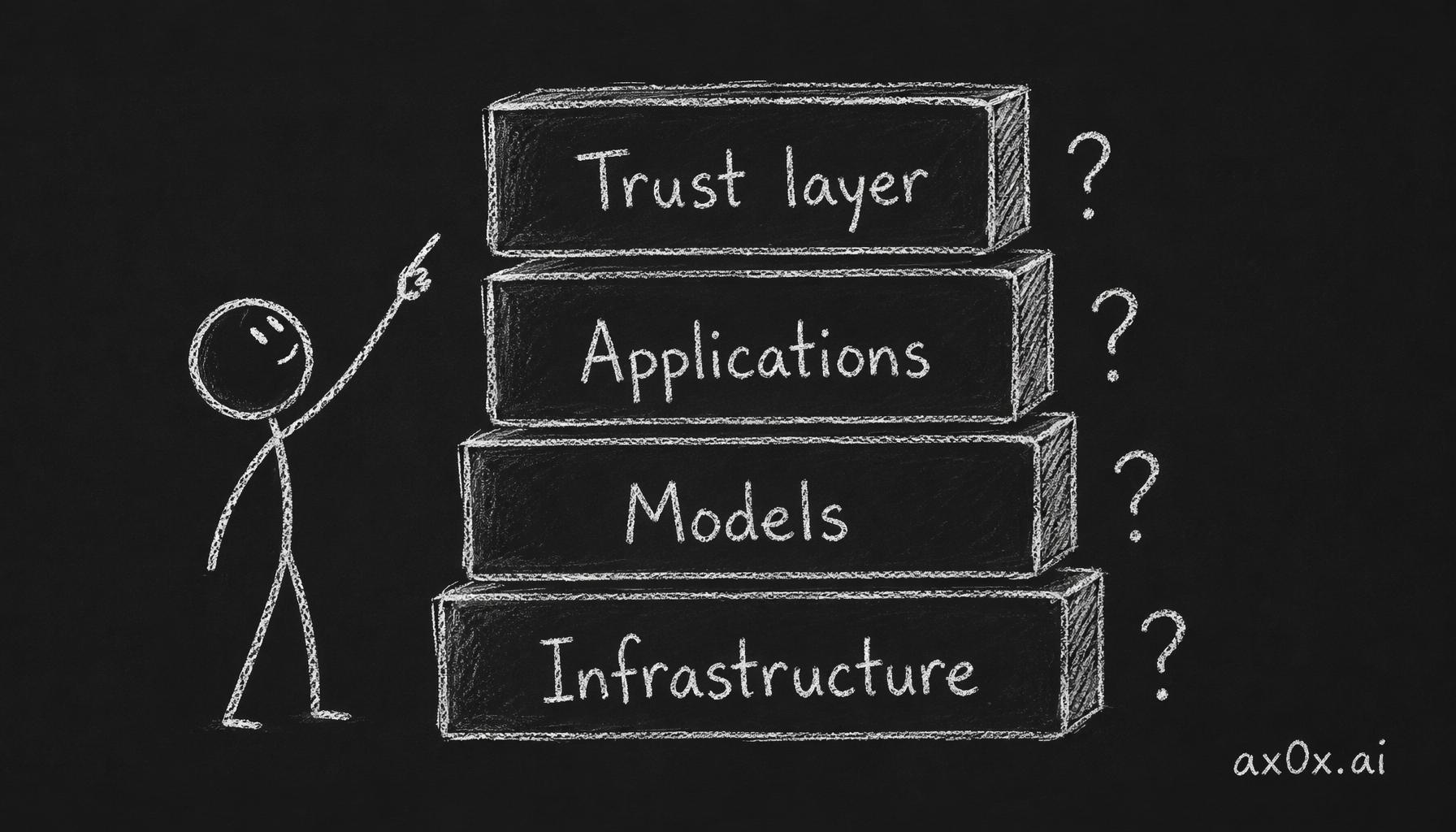 AI's four value layers stacked bottom to top — infrastructure, models, applications, trust — where value rises toward whoever signs off on the answer
The nine-question research method
Compress all of it into one checklist and run it on any technology revolution, working through nine things in order. What cost did it kill; what new traffic did it create; which nodes does the new traffic pass through; which nodes can keep the value. What's the old bottleneck and the new one; who is the final payer (no real payer means bubble). How does labor unbundle into tasks — which replaced, which augmented, which made scarcer; how does each asset class reprice — land, equities, bonds, property, human capital, data, compute, energy; and when do institutions step in to run the second distribution. Run the nine and how this revolution reshuffles wealth comes into focus.
A few falsifiable hypotheses
Finally, a few calls you can take data to and try to disprove. Technologies with high fixed cost, low marginal cost, and strong network effects naturally raise wealth concentration — railroads, the internet, AI infrastructure all qualify. If a technology lowers the tool barrier but not the distribution barrier, wealth still concentrates at the entry point: anyone can use creator tools, but the traffic sits with the platform; anyone can use AI tools, but customers, brand, distribution, and trust stay scarce. Once model capability commoditizes quickly, value migrates from the model layer to data, workflow, and distribution.
Three sharper ones. AI lowers the price of standard-answer labor and raises the price of non-standard liability labor. The later the productivity dividend shows up in the macro data, the more easily the capital market front-runs it — true in the electricity and computer eras both. And the one most worth watching: the AI era may grow a smaller new middle class than the internet did — the internet was concentrated yet still spun off vast operations, e-commerce, streaming, and ride-hail jobs, while the more frontier AI gets, the smaller the organization.
There's only one way to use this framework: don't just read it, run the nine questions on whatever technology you're staring at — where the new traffic goes, where the new bottleneck stands, who settles the bill. The judgments surface on their own.
References (theory): W. Brian Arthur (increasing returns and lock-in); David Teece, "Profiting from Technological Innovation" (complementary assets); Rochet & Tirole (two-sided markets); Autor, and Acemoglu & Restrepo (task framework and automation); Agrawal, Gans & Goldfarb, Prediction Machines (AI as cheaper prediction); Bresnahan & Trajtenberg (general-purpose technologies); Brynjolfsson, Rock & Syverson (the AI productivity paradox). Empirical data in the main essay's footnotes: Donaldson-Hornbeck, Paul David, IMF, IEA.