"She Makes Money at Everything" Is Packaging. Her Real Edge Is Bringing the Model to the Battlefield
 A lone, mud-caked general half-kneeling on a battlefield, one hand on a planted sword, the other holding open a battle manual he's still reading mid-fight — someone who fights in the mud without forgetting the model
A person who studied biology at Tsinghua, did a neuroscience PhD at Pittsburgh, and decoded brain cognition for a US military project — ended up building four companies, all profitable, in a world of "accountants driving Ferraris and influencers showing up with their gangster bosses."
This interview by Kedaibiao Lizheng has Tulong as the guest — real name Yang Ying. The title is loud: 16 years in the spotlight, makes money at everything. I came away wanting to drain half the water out of that title.
Let me get this out of the way first.
"Makes money at everything" is packaging. She says it herself in the interview: books sold like crazy, jewelry sold zero. The numbers from four companies are all self-reported on the show, with nobody auditing the books. Treat it as an inspirational story. Discount accordingly.
Strip off that layer and what's left is worth more. She doesn't have a hand that turns things to gold. She has an operating system she can carry from neuroscience into skincare, books, and courses — a machine that raises her odds noticeably in whatever industry she drops it into.
What actually stuck with me was a distinction she tossed off in passing.
There are people who only do armchair strategy, pushing pieces around a sand table. There are people who hit the battlefield and turn into bandits — they forget every principle and just start swinging. And then there's the real general: the one who, "covered in blood and mud, hacking through the chaos, still remembers what the manual taught."
That's the thesis of the whole episode. She did research for years and it left her a habit: no matter how messy the fight, she comes back — back to the model, back to what her advisor taught, back to "how do I win by being smart." Every part below is the same one thing.
She didn't predict it right — she went and got first-hand data
That 2016 US election story: the value isn't that she called Trump. It's how she got her data.
She lived in Pennsylvania, in Pittsburgh — a place so deep-blue that "the Democrats don't even need to send people to knock on doors." That year she noticed something off: the Democratic ground game had retreated back to Pittsburgh and was knocking on doors. On top of that, her lab ran a military project, so she had to drive to DC to report once a month.
On the way out she took the highway. On the way back she deliberately wound through country roads — originally just because she was after the food rural grannies and grandpas cooked — and found Trump signs planted all over the villages.
Then she did something most people wouldn't: she started recording data. She struck up conversations in small taverns, talked to roughly 50 old folks, and "only remembers one saying they'd vote Hillary." Second trip, she sampled a different village; later she drove through every village around the DC–Pittsburgh corridor, same result.
Back then everyone was waving Nate Silver's 538 model, citing Hillary's high win probability. She trusted her own first-hand data, because Pennsylvania was a light-blue state that could flip. She loves that line from Taleb's The Black Swan — History doesn't crawl, it jumps.
But don't mythologize it. Fifty grannies is a convenience sample, not a random one; jumping from "rural Pennsylvania" all the way to "the US and China are going to decouple" is a big leap with a whiff of hindsight. What it can actually teach you isn't "gut beats the model." It's something tighter:
When the world might be changing structurally, a model built on old relationships has to be recalibrated against new first-hand signal.
The data wasn't wrong. What's wrong is treating old data as eternally valid.
On whether to move home, she calculated the exit, not the upside
She wrote a sharp line about deciding to come home: in the short term I don't want to face China's problems; in the long term I don't want to face America's.
Short term — the first years home are guaranteed to be hard: housing prices, the grind, sameness, no incentive to innovate, all of it. Long term — there's a ceiling in the US. And that ceiling wasn't a guess; she actually researched it. She surveyed every Chinese professor at Pitt, Carnegie Mellon, and the surrounding schools, and found exactly three with department tenure, one dean, and zero presidents. "The ceiling for a Chinese person is full professor."
But what made the decision actually work is that it's reversible. If coming home failed, a US PhD could still get her a job and crawl back; but staying in the US would slowly close the window to ever return to China.
That's real options thinking: pick the path that keeps an exit, the one you can restart from if you lose. She wasn't sure coming home was right. She'd calculated that on this bet, the downside was survivable and the upside was bigger.
Worth noting: she left while the wind was at her back — she'd just landed a notoriously hard NIH R21 the year she left academia. Because she'd seen through a deadlock in academic evaluation: it demands both originality (no one's thought of it) and impact (immediately useful). Her analogy was brutal: it's like requiring your blind date to be a virgin and tall, rich, and handsome. Industry doesn't need every block to be original; more of the money is hidden in "re-bolting wheels that already exist."
Compete where the talent is, make money where it isn't
This is her sharpest strategy, and she says it that plainly.
When you study, go to the best school and get the principles straight. When you make money, drill into industries that are "high-margin but full of people who haven't read that many books," and do a dimensional strike. She brought data, algorithms, and biology into skincare; she says a Tsinghua junior went into luxury marketing and became the #1 jewelry-and-watch salesperson in China within two years.
In one line: your relative advantage equals your ability minus the industry's average ability. You don't need to be the strongest in society — just scarce in your target industry. She even pushes it down to the org level: "Competition is largely a contest of team talent density. You don't need to swim the fastest, just a notch faster than the field."
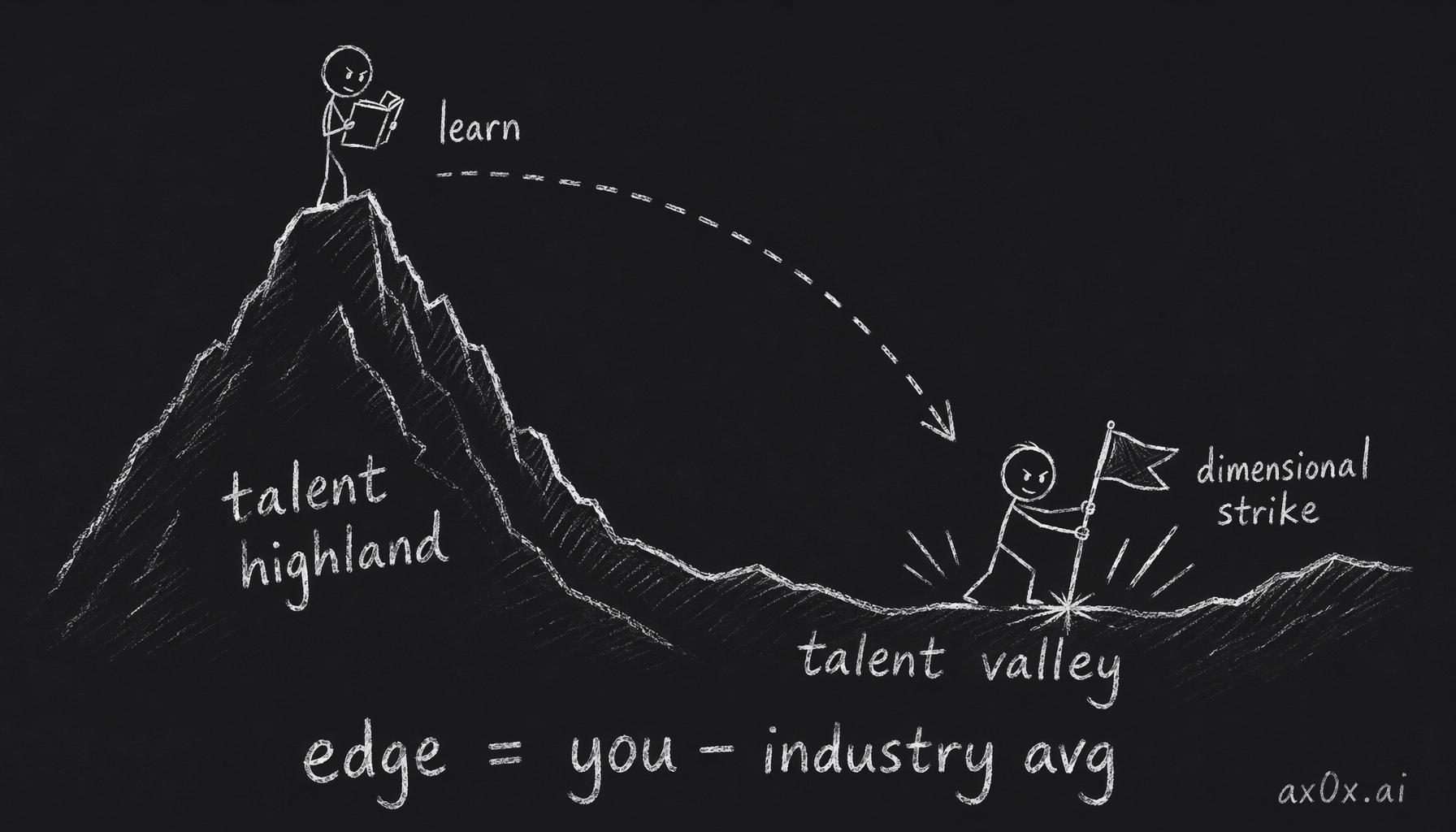 Learn the principles on the talent highland, then carry high-dimensional judgment down into the talent valley for a dimensional strike — your edge equals your ability minus the industry average
This points the same direction as the piece on skills depreciating while judgment appreciates — what's scarce isn't a given skill, it's the person who can carry high-dimensional judgment into a low-dimensional industry.
But don't misread "talent valley." Few people there can also mean the industry has no future, the pool's too small, regulation's too heavy, or the work's too dirty. The right filter isn't simply "where are there few people"; it's four conditions at once: real demand, an existing profit pool, capability mismatch, and room to improve. Miss one and the valley is just a pit.
Books sold out. Jewelry sold zero.
She opened a bookstore for three reasons, each of them very "operating system."
One: learn to sell before you build a product — plenty of people squeeze out a pile of product and can't move it, never even learning to sell, so step one is to be a channel. Two: hedging — if tutoring gets crushed, study aids rise and the bookstore does well; if tutoring is freed up, her TAL stock rises. Two sides hedge, cash flow stays stable. Three: fill a gap — in China nobody explains "what this book actually does for your real life."
Her analogy nailed that third point, and it's exactly a researcher's instinct: selling books is like selling an eyeshadow palette. The e-commerce review rates "did the goods arrive intact"; Douban rates "what colors are in this palette"; the missing layer is — "here's how to actually apply it, and here's what it looks like on your face." So she did the missing layer every day: which passage in Kissinger's On China maps to which Chinese phenomenon, which part of Bob Iger's The Ride of a Lifetime explains why Disney did what it did. By year two the bookstore was CITIC's third-largest channel, behind only JD and Dangdang.
But she doesn't hide her hole card: she already had nearly 2 million followers before opening. This wasn't from-zero entrepreneurship; it was cashing in trust capital.
Her sharpest evidence is the counter-example she offers: same fans, same traffic — books exploded, jewelry sold zero. Because "they envy that I've read a lot of books; they don't envy my taste in jewelry — they think they can pick better than me."
That nails one thing: traffic is not universal purchasing power. Users only trust you in categories where you hold cognitive authority. Conversion ≈ traffic × trust × product-persona fit. Drop any one and it falls apart.
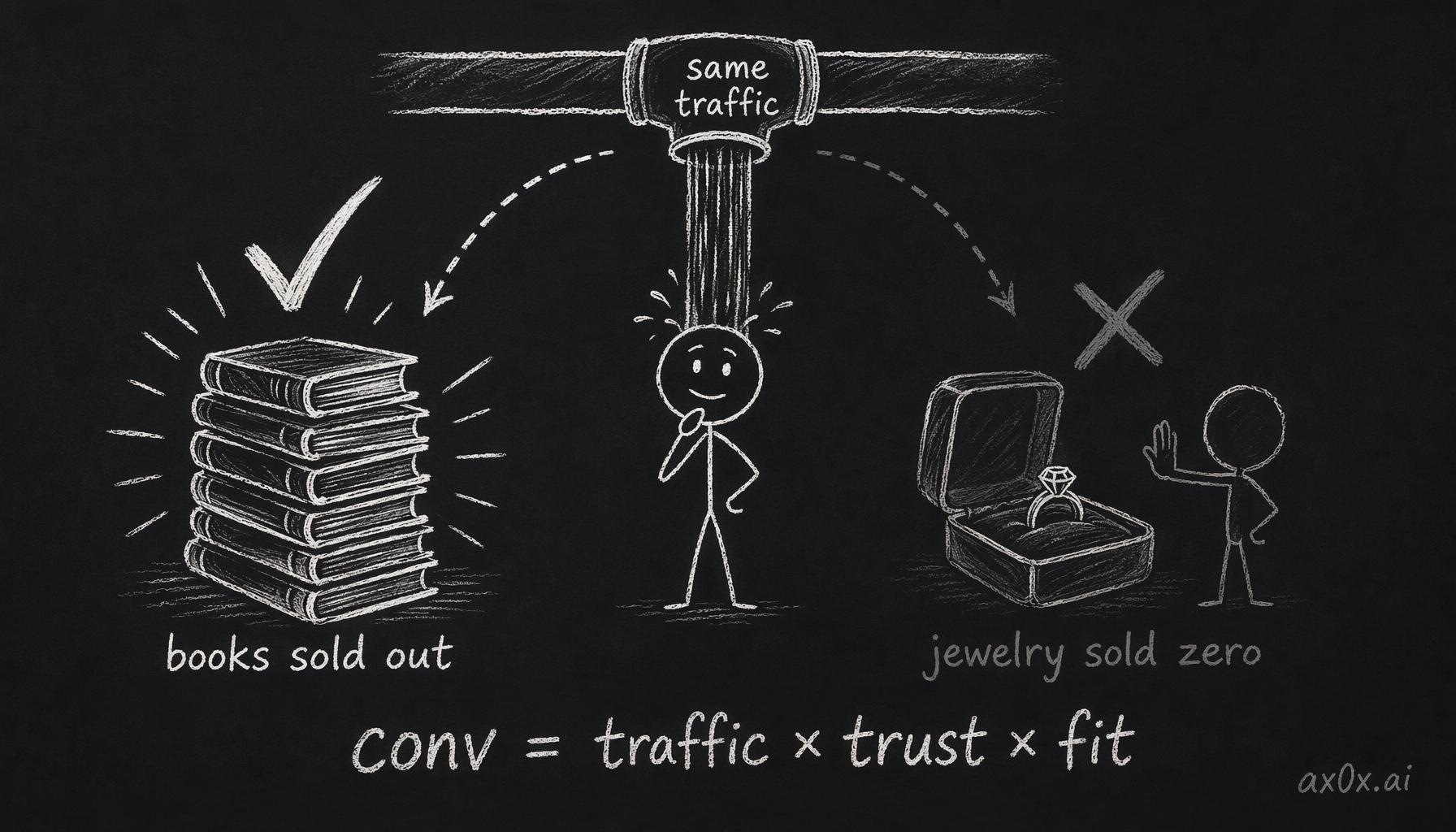 Same traffic, books explode while jewelry sells zero — traffic is not universal purchasing power; conversion equals traffic times trust times category fit
She also ran a harder calculation. A book makes a few cents, margin terrifyingly thin — but Weibo back then was a follow feed, not a recommend feed, so her own fans cost almost nothing to reach. Move to a recommend-feed platform like Douyin or Xiaohongshu and you get no reach without paying, and that paid traffic can't possibly cover a book's cost — "you're dead." That's why a pile of publishers copied her book-selling and all lost money: they were buying paid traffic. Low margin isn't un-doable — it just requires a structural advantage: owned traffic, very high repeat rate, high turnover, or, like her, dragging overall margin up to ~20% with toys.
One more thing about her temperament that runs through the whole episode: when you're small, don't study competitors. Study them and you'll mostly think "this person's idea is sharp, let me grab it," and end up copying yourself into a chimera that's lost its own edge. Same root cause as the piece on copying style — you think you're learning, you're actually shedding.
It's not grinding to the inflection point — it's studying the 22 who didn't check out
She has a few sets of numbers that are the best material for understanding "the inflection point."
Followers: 0 to 50k took 7 years; 50k to 800k took half a year; 800k to 1.6M, another half year. Skincare: roughly 40M, 50M, 60M (RMB) flat for three years, and this year's first quarter — e-commerce's slow season — hit 34M straight, beating the previous half-year.
Everyone asked what she did this year. She said: it's not what I did this year, it's three years of doing the right things. Borrowing Wittgenstein's "causality is humanity's biggest lie," she gives two great metaphors: it's not what happened "the moment you summon the dragon" — it's that you painstakingly collected all seven dragon balls beforehand; the moment the water boils isn't what matters, what matters is that you'd been heating it the whole time.
Here's where a lot of people hear "just persist and you'll win." The opposite. In the full transcript she does not argue for grinding with your eyes shut.
Her example pins you to the chair: a cheap product line had, on average, 26 people a day adding to cart and only 4 checking out. She told her ops person — this is your failure. Go study the other 22: waiting for a sale? Don't understand the ingredients? Not enough trust? Too expensive? A bug in the payment page? "80% of the work is diagnosing the data."
So her long-termism is: the long-term direction holds, but every day she's running small experiments and watching the leak at every funnel stage. It's persistence with a dashboard, not unconditionally repeating the same act. When she can't see results, she isn't white-knuckling it — she's watching whether the leading indicators are moving.
This is the one part I most want to rewrite in the popular consciousness. "Long-termism" gets used by too many people as a fig leaf for sunk cost.
Pricing isn't cost-plus — it's growing the pie and then splitting it
This is the segment with the highest business density. She cites Kazuo Inamori's "pricing is management," and breaks price into three points: cost, retail price, and what the customer feels it's worth.
A sustainable business needs "retail price minus cost" to be big enough (to fund R&D, brand, suppliers, staff, after-sales), and "what the customer feels it's worth minus retail price" to also be big enough (so they feel it's worth it and re-buy). Her words: "A can of cola costs a dime to make. You feel 6 yuan is fine, 2.5 feels cheap — between a dime and 2.5 yuan there's a lot of money for everyone to split."
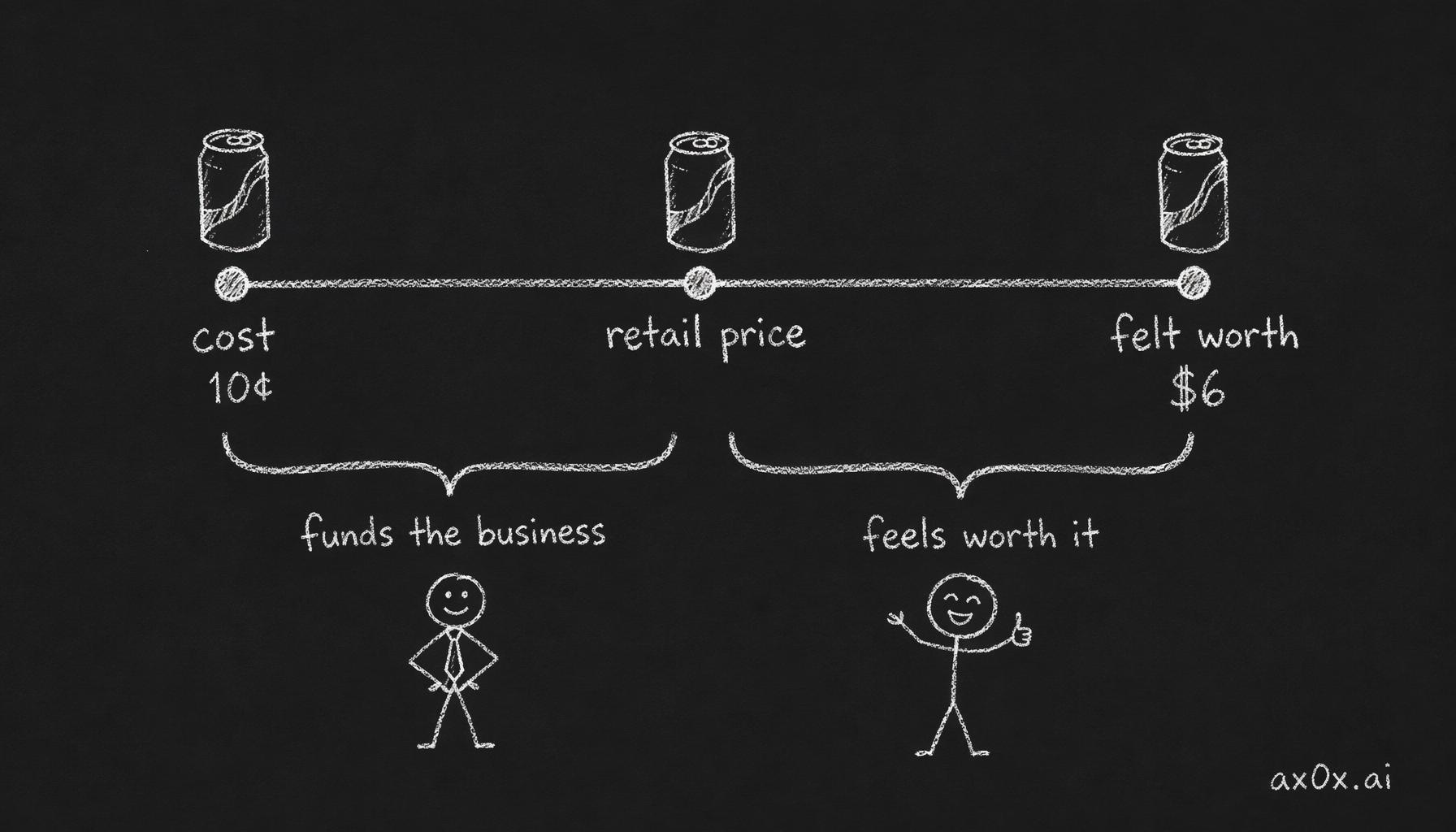 Split price into three points — cost, retail price, felt worth — leaving two surpluses: retail minus cost funds the business, felt worth minus retail makes the customer feel it's worth it
The real craft of running a business is pulling that "felt worth" up. She casually dismantled luxury's playbook: Chanel tells you this 80,000-yuan bag is "versatile" — for a girl earning 20,000 a month who'd have to not eat or drink for four months to afford it, "versatile" is a hook to anchor her perception upward; so are "heritage value," "that celebrity carries it," "icon." Boil it all down: it's all about jacking up the number in your head.
She frankly admits how she anchors her own skincare: next-gen synthetic-biology tech (versus international brands running formulas unchanged for decades), raw material at the same molecule as "injectable collagen" (that shot sells for 6,800, her tube goes for a hundred-something), and tying it to "human collagen used to be an organ-preservation fluid — that stuff sells for thousands per few hundred micrograms." She says it straight: these lines are all for psychological anchoring.
Two brakes you absolutely have to hit here.
One: she strings "price war → low wages → deflation → worsening distribution" into a single one-directional chain. Satisfying to hear, but not wholly right. Low prices from genuine efficiency gains can actually benefit consumers; what's truly harmful is predatory undercutting, raising prices after a monopoly forms, squeezing the supply chain dry — not all low prices. This line is the same logic as "who gets the money depends on bargaining power" in my piece on how technology reshuffles wealth — worth reading side by side.
Two: "pick partial truths to anchor" has a clear ethical boundary. She keeps it herself — "first, you can't tell lies," "others use 10% of retail on raw materials, I use 15%, I'm just more conscientious than them." But that line is slippery: layering narrative on top of real efficacy is business; propping up a weak product purely on narrative is exploiting information asymmetry. The difference is a single thought apart.
Don't fear the haters — fear that no one's talking about you
In the second half she tells a dating-site data story that's genuinely interesting.
OkCupid has researcher accounts that can see anonymized interactions. A book called Dataclysm has a conclusion: which women get pursued fastest by high-income men? Not the ones everyone rates a 7 — the ones with polarized ratings, where one crowd gives a 10 and another gives a 1. The ones rated middling, whom everyone finds "fine," nobody moves on.
She carries this over to products: 70–80% loving you and 10–20% hating you is great; hate gives people energy, indifference is the death sentence. She has a T-shirt that reads "I need new haters because old haters are starting to love me."
But this one also has prerequisites — don't treat it as a cure-all. It only works when three things hold: the product is genuinely good, positive users are the clear majority, and the controversy doesn't touch core trust. In trust-sensitive businesses like healthcare, finance, or enterprise services, negative controversy can cost far more than the spread it buys. More exposure isn't more value — those two metrics get counted separately.
The hardest skill is cross-class translation
The deepest capability of the whole episode hides in the final twenty minutes that look like they're about "EQ."
Her definition of EQ isn't smoothness: a lot of people treat beating around the bush as high EQ, which is actually contempt for the other person's intelligence. "There are plenty of uneducated people in this society, but truly stupid ones are rare — almost anyone can tell, after talking with you, whether you genuinely mean well and respect them."
Her method is "change your thinking, not your personality." When she clashes with someone, she first settles down and asks whether their position has a point and whether she's truly put herself in their shoes — "then what you say, they can accept." Two details that land hard: a professional hater who measured her packaging with a vernier caliper, found a 0.1mm discrepancy, and extorted 1,000 yuan — she still respects him: "the guy's really diligent, he earned that money"; and after understanding the influencer girls who ran from the northeast to Hangzhou, rented basements, livestreamed 16 hours a day, and got fleeced in three waves by deadbeat boyfriends, son-preferring parents, and their MCNs — "even if you speak bluntly, she'll treat you like a sister." The opposite is the Taobao-customer-service "aww honey, I get it" — cloying, but it builds no real connection.
She's used this on investors too. Domestic VCs rarely back female founders as #1; her own junior brings her technical questions yet puts real money into "kids who are nothing." Her companies took no VC and all made money, so at holidays she sends gifts and cards to the people who passed on her, attaching the latest financials and "here's what you'd have made if you'd invested." This isn't pettiness, it's manufacturing FOMO — "for an investor, missing out hurts far more than losing money. I want to dance on their fear." Fool me once shame on me, fool me twice shame on you.
But this is also the stuff people most easily learn wrong
Here we have to pause and separate the hard evidence from the golden-line traps. Without that, this becomes one more entrepreneurship pep talk.
What actually holds up is this. Books exploding while jewelry flopped — a natural controlled experiment, proving traffic alone is nowhere near enough; what matters is whether trust matches the category. Low margin paired with owned traffic — she made clear why the same play wins in the follow-feed era and loses on a paid-feed platform; that's complete unit economics. The add-to-cart-without-checkout funnel diagnosis — proof she doesn't just believe the macro narrative, she slams "nonlinear" into daily operations. The dual surplus in pricing — closer to real business than "cost-plus" or "low price equals conscience."
What's easy to copy wrong is the golden lines.
"Trust first-hand data" — don't forget 50 grannies is a single case; the correct reading is "models must be calibrated by the front line," not "gut beats data."
"Absolutely never look at competitors early" — this only holds for content and new products that need to establish originality; in security, compliance, infrastructure, or standardized SaaS, not knowing the industry baseline kills you faster. Precisely: you can study the competitive structure, just don't copy competitors' surface features, and never let a competitor define who you are.
"Haters spread you" — as said above, three prerequisites, all required; in trust-sensitive businesses it's flat-out negative.
"Pursue the extreme, not balance" — extremes do create differentiation, provided you patch the blind spots with team, process, and risk control; otherwise bold is just reckless and original is just refusing feedback.
"High margin equals a healthy industry" — high margin can fund R&D, or it can come from monopoly and information asymmetry. The point isn't margin high or low, it's whether the profit corresponds to value continuously created.
Put it all together and "she makes money at everything" falls apart as packaging. She doesn't win at everything (jewelry didn't), and the numbers are all self-reported. The tighter statement: she's assembled a method that meaningfully raises her cross-industry odds — not a hand that turns things to gold.
So what is that method in one line? She can carry a researcher's model into the real world, then carry the real world's blood, mud, interests, and human nature back into the model to iterate. Not just a reader, not just a street fighter; not just chasing originality, not just copying the market; not just thinking about consumers, not just about profit. Her moat is this whole closed loop — scientific method, frontline action, distribution, unit economics, org-building, cross-class understanding — the industries keep changing, the loop doesn't.
The ending she chose for herself closes it nicely. She says she prefers "old-money" packaging, but if a designer sells 3 million with a style she dislikes, and another sells 3 million with a style she likes, the former is worth more at her company — because he broke her out of her bubble, into a crowd she herself can't understand.
So she leaves a line for the 20% who hate her: if you dislike me but find some of what I say makes sense and useful, congratulations — I broke you into a world you couldn't otherwise enter, and that beats reading ten thousand books from a professor you already agree with.
This is the bookend to her driving into rural Pennsylvania and talking to 50 strangers. Those of us who've read a few books have one big disease: we're trapped in our own bubble — "running a community is the same; it attracts people who already approve of you, so you lose the chance to break out."
Bring the model to the battlefield, don't forget the model on the battlefield, and after the fight go scoop up some more data from a circle that makes you uncomfortable. That's pretty much the whole thing.
Source: the full auto-generated captions of the YouTube video "16 Years in the Spotlight, Makes Money at Everything? | Dr. Tulong's Startup Secret" (which may contain minor recognition errors), and the same-source podcast Tulong's Straight Talk #59. All business figures are self-reported by the interviewee and not independently verified.