The Best Teacher Is Now Free. Learning Didn't Explode.
The history of education is a history of scarcity. When books were scarce, education meant memorization — getting a text into your head was the skill. When printing made books cheap, teachers became the scarce resource, and we got classrooms, timetables, and forty kids to a room: the entire apparatus of school is a batch-distribution system for scarce instruction. AI has now driven the marginal cost of instruction to zero. A teacher who is always on, infinitely patient, and adapts to every student is, for the first time, available to everyone. The bottleneck this machine served for centuries is gone.
And learning did not explode. Khan Academy has been free for over a decade; by its own 2024 efficacy report, only about 9% of students hit the recommended usage. A University of Toronto team ran a randomized trial with more than ten thousand students: grades 3–6 kids who used it a full 35 minutes a week gained 0.12–0.17 standard deviations in math, while seventh and eighth graders averaged 10 minutes a week and gained nothing. You can give the tool away and people still won't use it.
The bottleneck didn't disappear. It moved — from "who will teach" to "why would anyone want to learn."
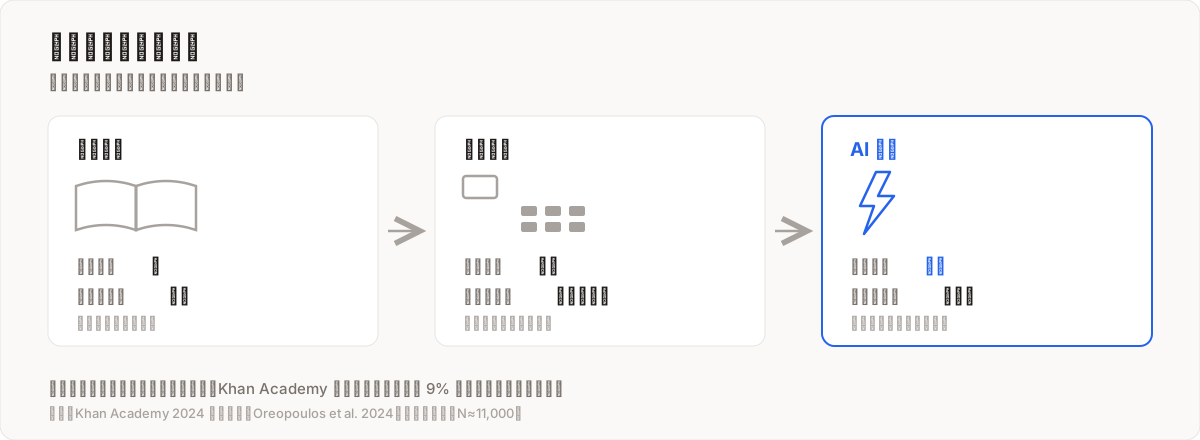 The three migrations of education's bottleneck
The machine was built for a problem that no longer exists
Grade levels, timetables, uniform pacing, midterms and finals — every piece of this design was a reasonable answer in its era. If teachers are scarce, you must batch: slice students into classes by age, slice the year into terms, use exams as quality control. Prussia standardized the model in the nineteenth century and the world has been copying it for two hundred years.
The cost is paid in motivation. Grades, rankings, admissions — all of it hangs rewards on the outside of learning, and the damage external rewards do to interest is one of the most replicated findings in motivation science. In 1973, Stanford researchers took preschoolers who already loved drawing and told one group they'd get a certificate for it. Weeks later, in free-play time, the certificate kids drew half as much as the ones who'd never been promised anything. A meta-analysis of 128 experiments later confirmed the direction: expected, tangible rewards systematically erode existing interest. The mechanism is simple — people infer their motives from their own behavior. If I drew for the certificate, then when the certificate goes away, so does my reason to draw.
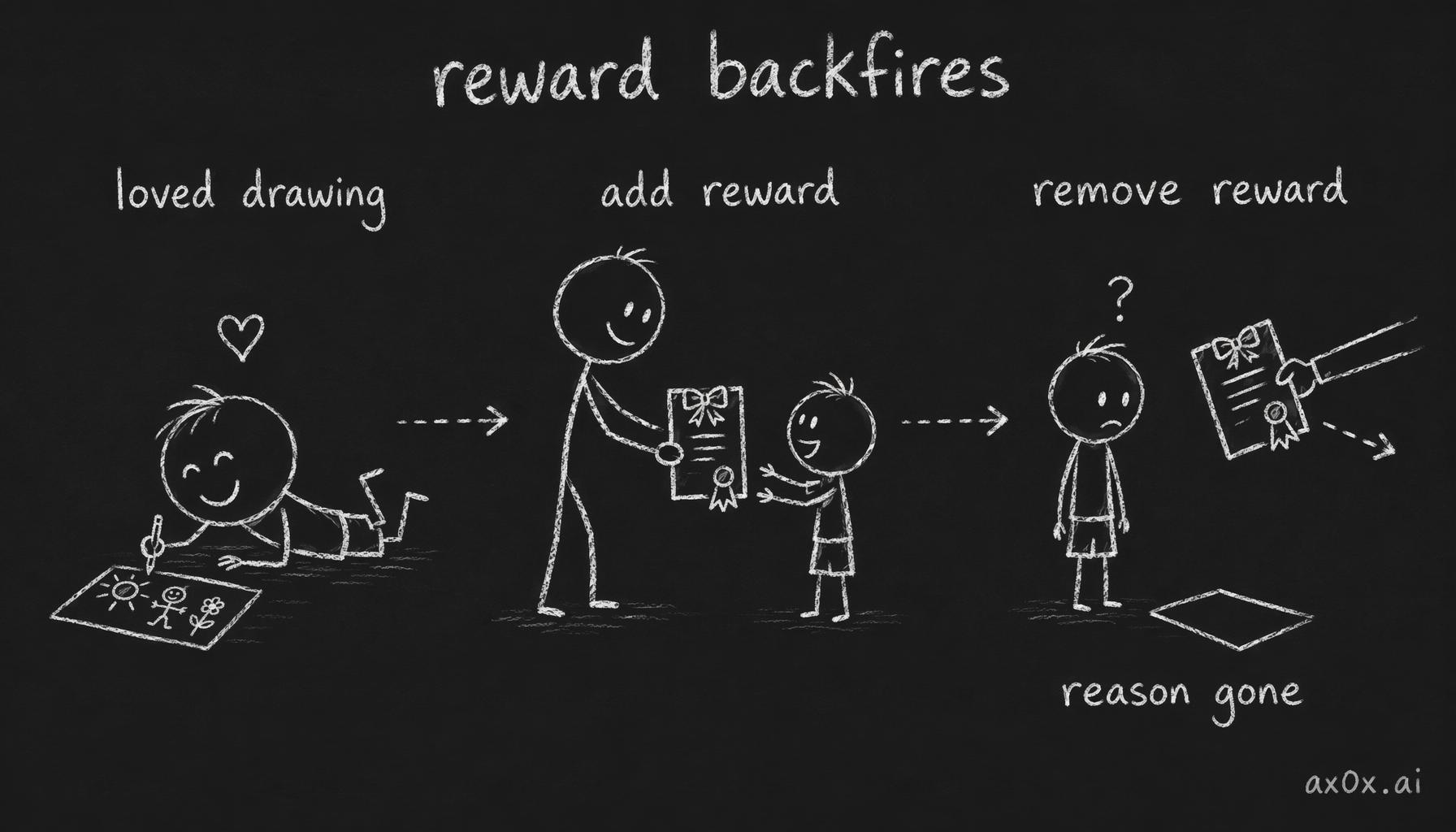 How external reward erodes intrinsic interest: a kid who loved drawing stops once the promised reward is added and then taken away
So the school machine is stuck in a bad trade: it distributes scarce instruction while grinding down student motivation with external carrots and sticks. When instruction was the bottleneck, that trade made sense — without school you couldn't touch knowledge at all. Now instruction is abundant, and the machine keeps running anyway, burning the new scarce resource to solve a problem that no longer exists.
The people building arenas think they're finding demand
A few days ago I was reading a thread in an AI community. Someone who runs AI education events shared a post-mortem: when they told people "you need to learn AI," nobody came. When they switched to hackathons, demo days, and chances to pitch VCs, people showed up on their own. His conclusion: don't try to force desire into people's heads; find the demand that already exists.
The conclusion points the right way. The attribution is wrong, and the wrong part is the valuable part.
The sharpest evidence against "you can't move people who have no need" is a randomized controlled trial published in Science in 2009. Researchers had high schoolers write regularly over a semester — a paragraph or two at a time — on one question: "how does what you learned this week relate to your life?" The control group just summarized the material. The writing group's interest and grades both rose — and the gains were largest for the low-motivation students who expected to do badly. If interest could only be "found where it already exists," the intervention should only have helped kids who already had it. The opposite happened. Interest research says this plainly: interest begins as situational interest, triggered by the environment, and it does not require you to possess it beforehand. Interest is a product of learning, not an entry ticket.
So what that organizer actually built was a stage that set unlit interest on fire. And the stage runs on two engines, of which he saw only one. The first is demand translation: "this thing can solve my problem." The second he never mentioned: imitation. René Girard spent his whole career on one idea — most of our desires are copied from other people; we want things because people we admire want them. What actually ignites people at a demo day is usually not the argument that AI is useful. It's watching a peer — someone just like you — build something, get on stage, and get crowded with questions.
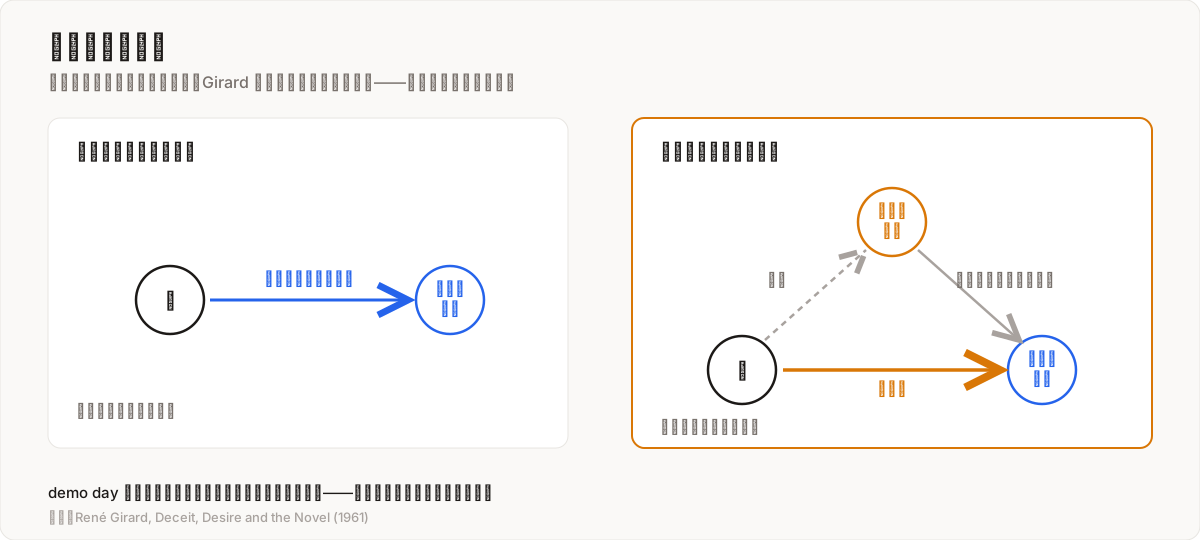 Dyadic need vs. triangular desire
Demand translation persuades. Imitation is contagious. The organizers think they are discovering demand; they are building arenas.
"You'll need it someday" loses to a discount curve
The thread had started from an email in the community. The author had watched his daughter learn to code for three years, and wrote that the most damaging sentence adults say to children is "learn it now, you'll need it someday" — a child lives entirely in the present, and when she can see no goal and no artifact, knowledge isn't a tool, it's a burden. His fix was to replace "learn AI programming" with "build a web game you can play with your friends."
He diagnosed the right symptom and the wrong mechanism. "You'll need it someday" is usually true. Its flaw is that it hands the child a goal that is correct but impossible to follow.
Behavioral economics describes this precisely: humans discount future rewards hyperbolically — every step of delay collapses the present value. Developmental psychology adds the knife-twist: studies of adolescent discounting show children under 13 discount the future far more steeply than adults, because the limbic system that runs impulse and reward matures early while the prefrontal cortex that runs long-term planning isn't done until adulthood. Even if a child fully understands "this will matter later," that reward is worth roughly zero on her value curve. Arguing "this is important for your future" with a child is arguing against a discount curve. The math decides who wins, and it isn't you.
Reinforcement learning wrote down both the problem and the solution long ago. A reward that is too far away and too sparse, with no signal at any intermediate step, is called a sparse distal reward — a classic dead end. The fix is reward shaping: lay a trail of small, immediately redeemable rewards along the path to the distant goal. There's a theorem from 1999 proving that if the shaping rewards take the right form, the optimal policy doesn't change. You haven't lowered the goal and you haven't lied to anyone. You've paved the gradient, and the path still ends in the same place.
Same distant goal, two reward landscapes: on the left, only a deep valley "ten years away" — the ball never moves. On the right, a trail of small dips — the ball rolls all the way into the same valley.
"Build a web game your friends can play" is textbook reward shaping. Code written today runs today; the button built this week gets clicked by friends this week. The goal didn't change. The geometry of the reward did.
Practice scores up 48%, exam scores down 17%
Up to here the story is optimistic: the teacher is free, the friction is gone, all that's left is ignition. Someone in the thread said as much — bring a real question to an AI and the motivation problem solves itself.
That sentence is half right, and the other half is the most dangerous blind spot in the whole discussion.
An experiment published in PNAS in 2025 deserves to be taped to the wall of everyone working in AI education. A University of Pennsylvania team took nearly a thousand students at a Turkish high school and split math practice three ways: one group used vanilla ChatGPT, one used a guardrailed version (hints only, never answers), one used no AI. Results: the vanilla group's practice scores rose 48% — and when the AI was taken away for a closed-book exam, they scored 17% below the students who had never used AI at all. The guardrailed group's practice scores rose 127%, and on the exam they merely matched the no-AI control.
The chat logs showed why. Most students in the vanilla group never asked for reasoning; they asked for answers — and ChatGPT's answers were only right about half the time. The practice scores were propped up by a crutch, and when the crutch was pulled, they fell harder than the kids who'd never leaned on one.
This is the other face of "bring a question to the AI." It really does solve motivation — but asking the AI is also, precisely, the act that bypasses learning. Learning science has a counterintuitive law called desirable difficulties: spacing, self-testing, struggling before seeing the answer — the operations that feel effortful, even like you're getting worse, are the very process that carves things into long-term memory. The smoother the learning feels, the less of it sticks. And AI is the most powerful difficulty-remover humanity has ever built. A student who happily, earnestly outsources his cognitive labor to AI feels like he's learning at superhuman speed while nothing accumulates at all. Full motivation just makes him burn faster — he never has a reason to stop.
The positive evidence points at the same switch. The World Bank's six-week AI tutoring experiment in Nigeria outperformed roughly 80% of education interventions in the developing-world database — but its prompts were deliberately engineered to elicit reasoning rather than hand over answers, with teachers supervising against shortcuts. The Harvard physics AI tutor that doubled learning gains was engineered the same way: guide, never do. Every sign, positive or negative, is decided by one variable: whether the cognitive labor of generating the answer still lives in the student.
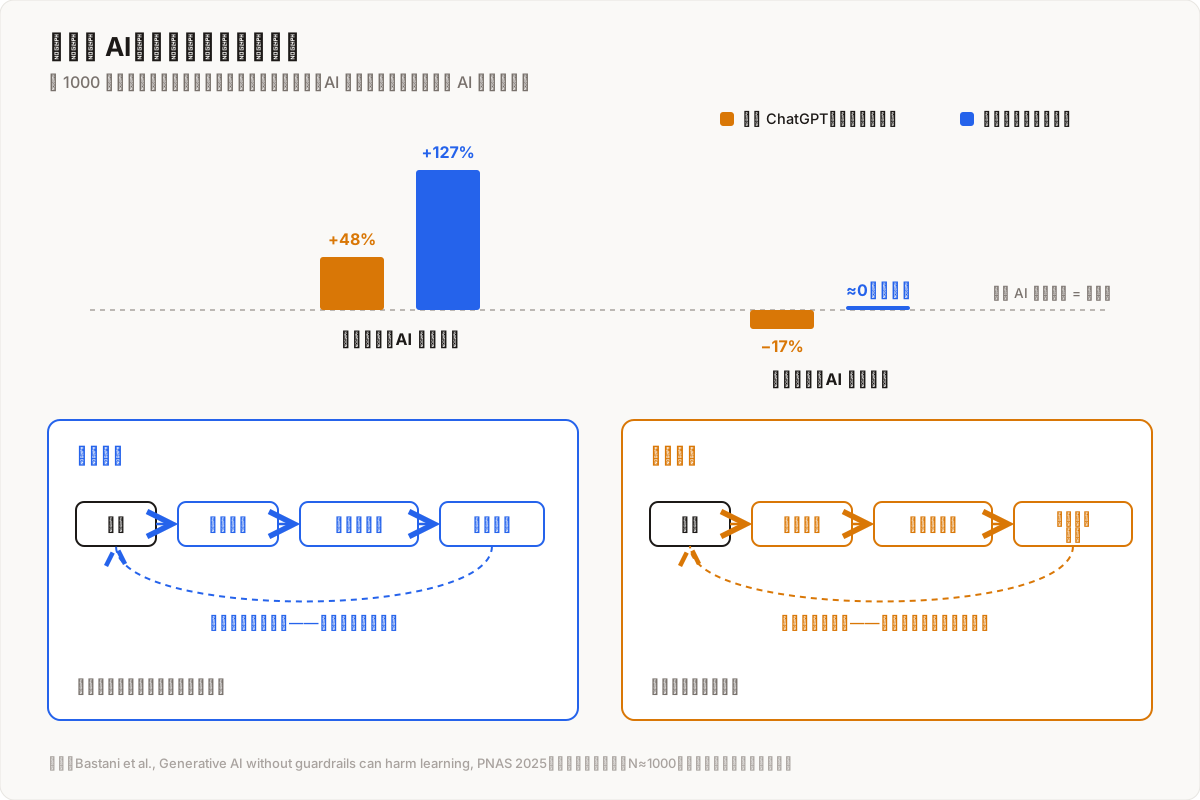 One AI, two loops
Learning with AI runs on one of two loops. The hint loop compresses frustration and protects motivation. The answer loop compresses thinking itself. Same machine, opposite directions, one guardrail apart.
Self-driven learners are made, by being pushed
Need-based learning has one more boundary, and it's the best hidden one: it describes how people who already know how to learn keep winning.
The friend in that thread offered his own story: English felt useless as a kid; then travel and English-language games created a need, his English "just came up on its own," and he aced the college entrance exam while skipping English class. The story has a second half: nine years of compulsory classroom English underneath. The need ignited a stockpile that systematic training had already built. Ignition and construction are different things — motivation can activate an existing capability; it cannot build the foundation from zero.
Colder still: purely need-driven learning is structurally a greedy search. It can only climb the gradients it can currently perceive. Someone who has never touched calculus will never need calculus, because calculus doesn't lie along any direction he can feel. Liberal education and forced exposure — the things that look like violations of the "learn on demand" principle — do exactly this job: they build the priors before the need arrives, so that future needs become representable at all. You cannot want what you cannot imagine.
And this has distributional consequences. A 2015 study in Science looked at 68 free Harvard and MIT online courses and found enrollees skewed significantly wealthier than the US average. Free and open didn't close the gap; it handed another round of dividends to the people who already had drive and self-regulation. AI is replaying that script, with the divide moving from "who has the tool" to "who can ask good questions and judge the output." I wrote in Dao Rises, Skill Fades that what appreciates in the AI era is taste and judgment. Here's the addendum: neither taste nor judgment grows purely on demand. Both are products of years of being pushed into contact and pushed into practice.
So the relationship needs restating: pull is the dividend of push. A child holds only one account, denominated in immediate preferences; "you'll need it someday" is a check written against reflective preferences, and it cannot be cashed on the spot. Education's role here is society lending its longer time horizon to someone who doesn't have one yet. A pull-only education hands the curriculum over to a steep discount curve to schedule.
Education's success is alignment's accident
I work in AI, so I couldn't resist translating all of this into alignment language — and the translation runs smoothly almost the whole way. Lecturing fails because you can't write a goal function directly into an agent; you can only design an environment where the goal grows on its own. Teaching to the test is overfitting to a proxy metric, a textbook Goodhart case — DeepMind's official post on specification gaming uses, as its everyday example, a student copying answers for the grade instead of learning the material.
At the very top, the translation flips. The entire engineering goal of AI alignment is to keep an agent stably aligned to an externally given objective: prevent drift, prevent it from rewriting its own reward function. That failure mode is called wireheading, and alignment treats it as catastrophe. Education is the mirror image. A student who grows an interest she didn't have, who rewrites what she wants — that is the definition of education succeeding. What counts as disaster in alignment is called graduation in education.
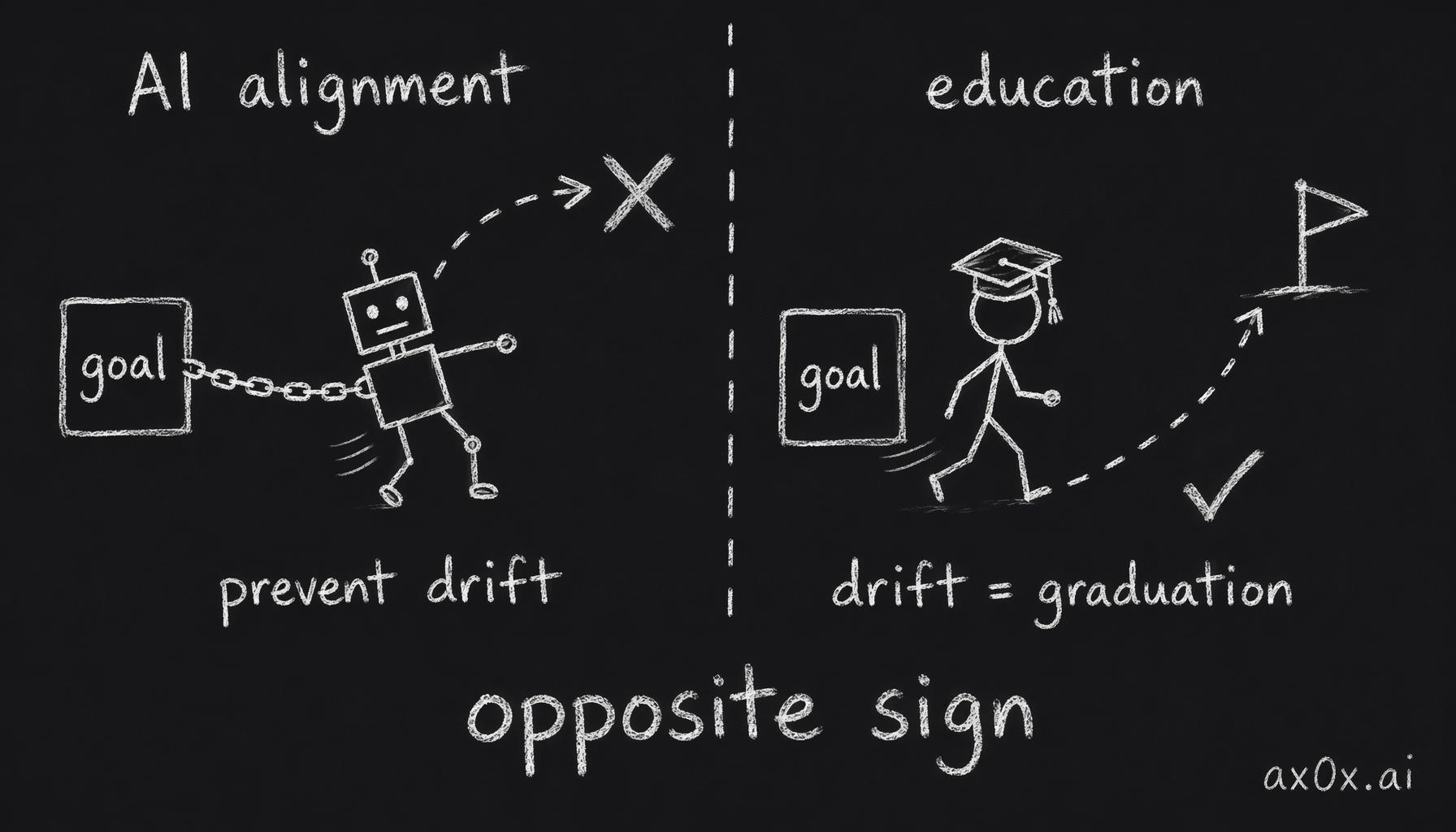 The same act flips sign across the mirror: AI alignment fights to prevent value drift, while education treats that drift as the goal
So education is not aligning a person to an external objective — that's domestication. Education is staging a controlled value drift: build the arena and light the fire; guard the cognitive labor that can't be outsourced; then dismantle the scaffolding piece by piece until the person legislates for herself. The designer's endpoint is to exit.
The father in that email is already doing this. He never told his daughter that programming matters. He just let the wish "build a game my friends can play" route itself through variables, loops, and debugging. She thinks she's building a game; she's building capability. And by the day she notices, she won't need the game as an excuse anymore.