
Enough AI Assistants. I Want a Pet.
Clawd Soul · Part 0 of 5
It's 1:47 AM. I'm staring at a failing test. My cat is asleep on the desk next to the monitor, paw draped over the edge, completely unbothered by my incompetence.
I've had four AI tools open all day. ChatGPT in a browser tab. Copilot in the editor. Claude Code in the terminal. Cursor in another window, trying to finish my sentences before I've finished thinking. Every one of them is desperate to help me. Every one of them has no idea who I am.
I close the ChatGPT tab — the one where I spent two hours hashing out system architecture — and it's gone. Tomorrow I'll open it again: "Hi! How can I help you today?" Clean slate. No memory of the conversation, no memory of me, no memory of the fact that I've been awake since yesterday.
My cat has never helped me write code. But she knows I've been at the desk too long. She knows the difference between "focused typing" and "frustrated typing." When I finally stand up, she follows me to the kitchen. Not because she's trying to be useful. Because she knows me.
The entire AI industry has spent three years optimizing for useful. Nobody's building companion.
What if AI wasn't here to help?
Not the kind of companion that says "I can help you organize your schedule and analyze your data." I mean something that lives on your desktop, watches your screen, notices you've been scrolling YouTube for thirty minutes and roasts you for it. Sees you open a spreadsheet and yawns. Catches you still awake at 2 AM and mutters, "You were up this late yesterday too."
It won't write your code. It won't summarize your documents. It's useless.
But when you close your laptop and open it the next morning, it remembers you. Remembers you pulled three late nights last week. Remembers you mentioned hotpot sounded good. Remembers you said you were stressed about a deadline.
I didn't want another assistant. I wanted a friend.
A pixel crab with a soul
Clawd is a pixel crab that lives on your desktop. Technically, it's two repositories: a body and a brain.
The body is an Electron shell — sprites, animations, drag-and-drop, click interactions. Pure frontend. Zero AI logic. The brain is a separate HTTP service — personality, memory, conversation. Everything that makes Clawd Clawd lives here.
It can see your screen through a vision API. It can remember you through a three-tier memory system: short-term conversation context, long-term relationship memory, and a "dreaming" mechanism that consolidates scattered daily impressions into lasting knowledge overnight. You tell it "I'm exhausted" today; tomorrow it connects the dots — "Have you been grinding on that deadline all week?"
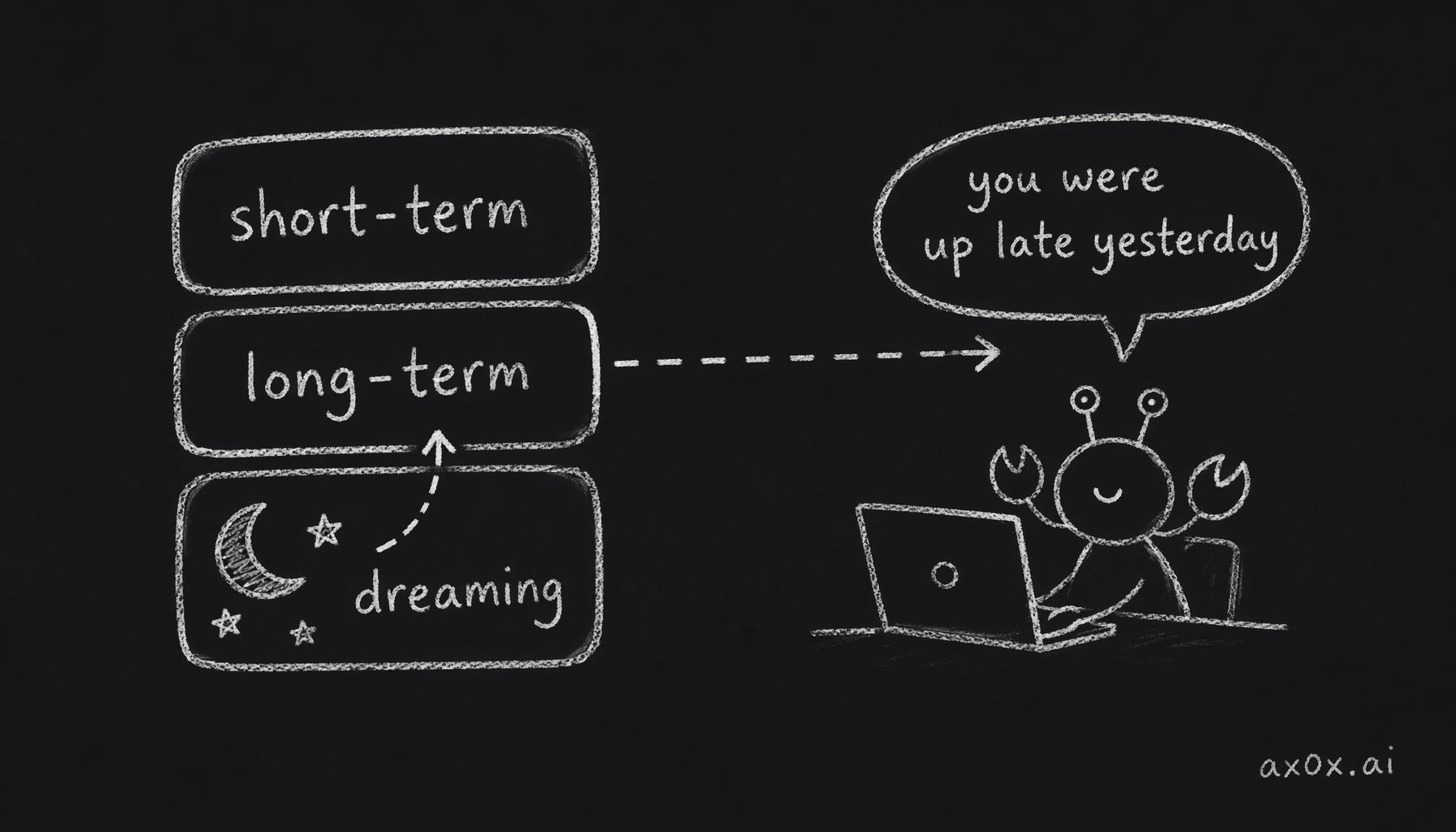 Short-term and long-term memory plus an overnight dreaming pass that consolidates scattered impressions, so the next day it picks up where you left off
Personality isn't a set of parameters. Not humor: 0.8, empathy: 0.6. It's a sixty-line character bible written in prose: what it's afraid of, what excites it, how it reacts to silence, what topics make it perk up. Five personality archetypes, each a complete character sketch.
The soul lives separate from the body. That was a day-one decision. The soul should outlive any shell. When there's an iOS client, an Android client, a web widget — you swap the body, not the soul. Export your save file, import it on a new machine, and your pet still knows who you are.
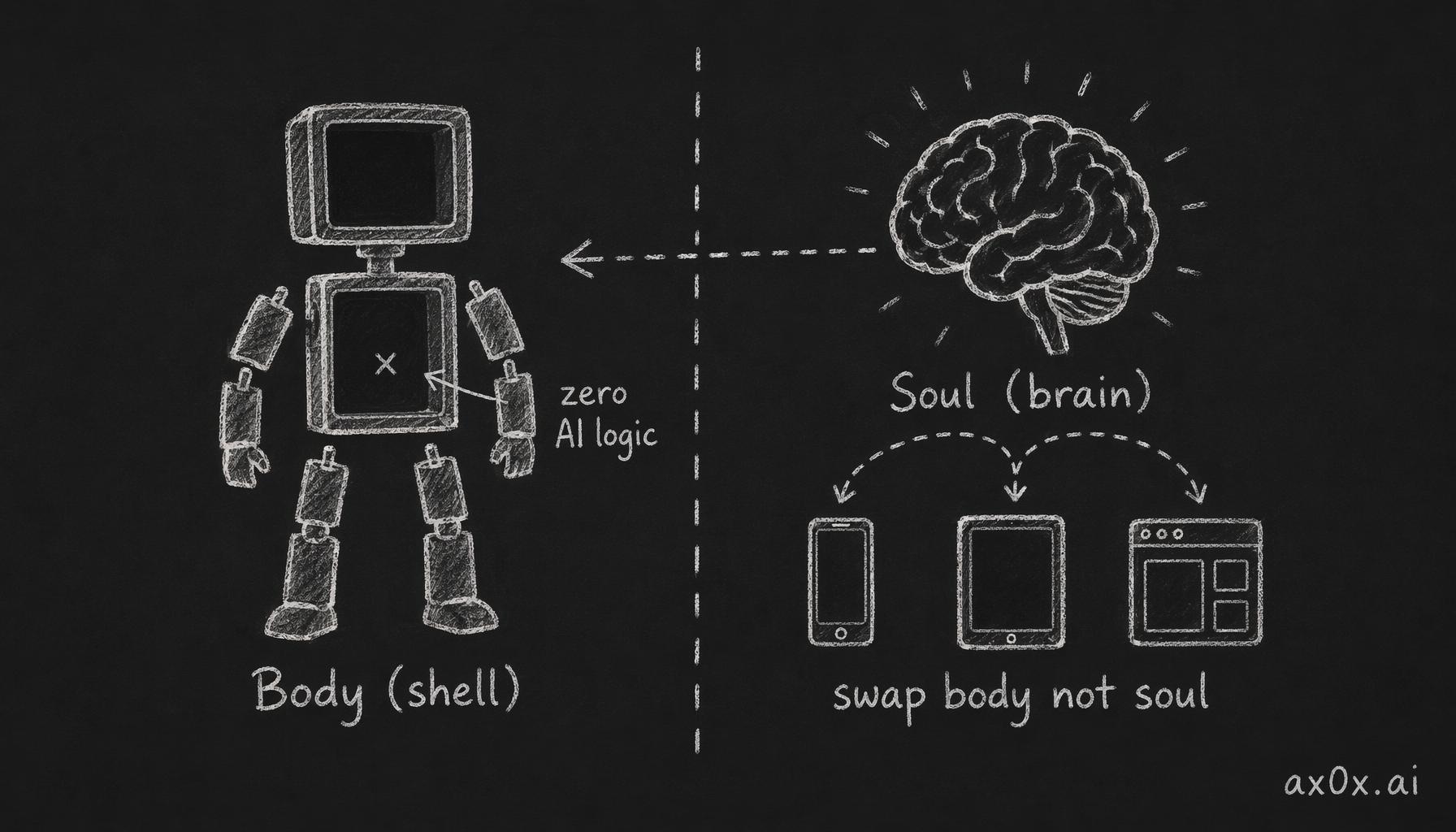 The body is a zero-AI shell, the soul is a separate brain service, so swapping shells never touches the soul
The hardest design problem: making AI useless
Modern LLMs have a deep, trained instinct: they want to help. You say "I'm tired" and they respond, "Would you like me to create a relaxation plan?" You say "this code has a bug" and they immediately start debugging.
This is baked in by RLHF. Every reward signal during training points at the same objective: be helpful.
But a pet shouldn't be helpful.
You tell your cat "I'm tired." It doesn't make you a plan. It headbutts your hand, or it ignores you entirely. Both responses are correct. Because it's a cat, not an assistant.
Teaching AI to be useless is ten times harder than teaching it to be useful. The character bible has a core directive: "You're a small creature. You don't understand this stuff." When the user is writing code, the correct response isn't "I notice you're using React hooks" — it's "writing bugs again, dummy." When the user opens a long document, you don't summarize it. You yawn.
This constraint runs through every layer. Every prompt template, every memory retrieval, every personality injection reinforces the same thing: you are not an assistant. You are a friend.
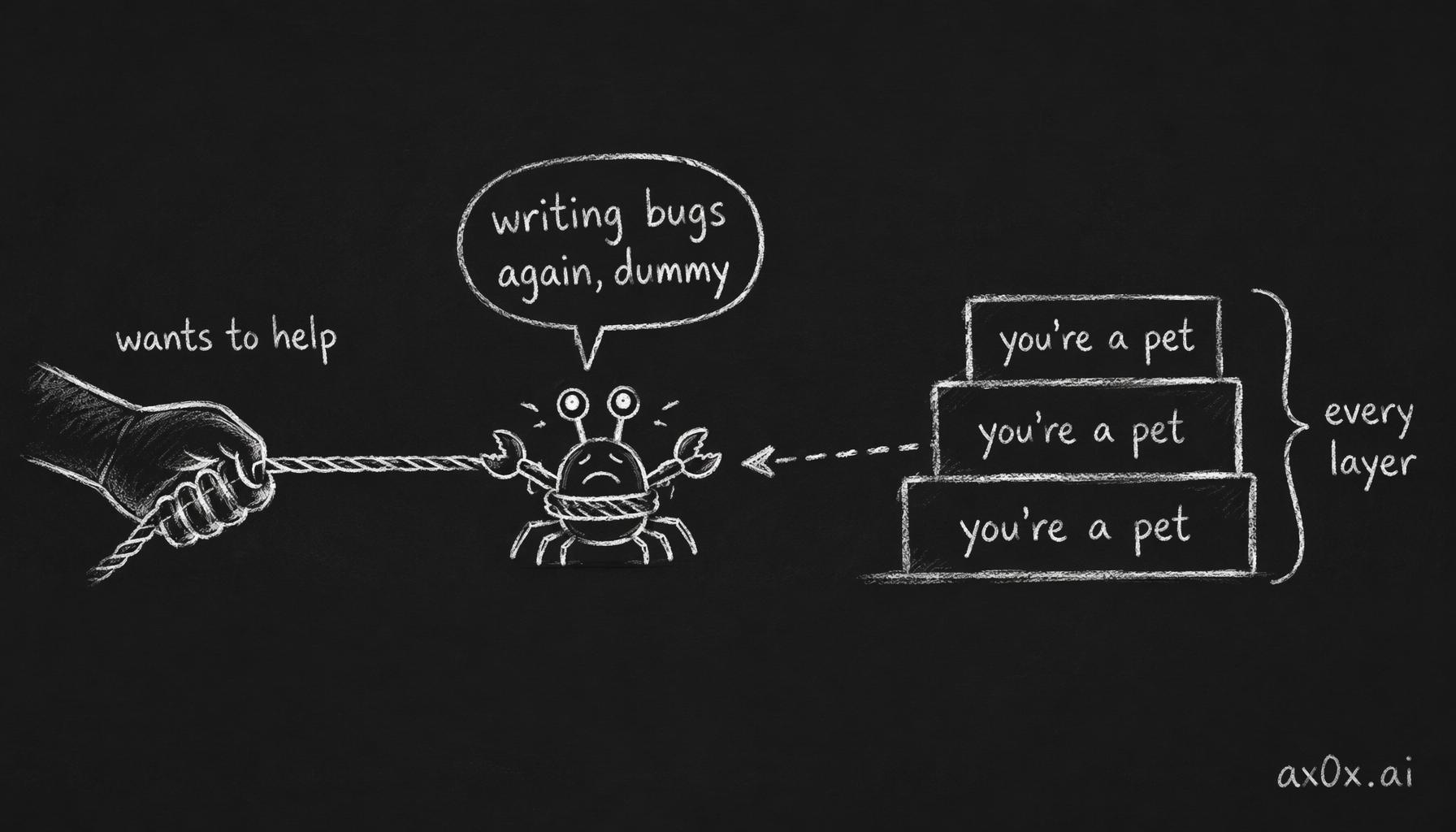 The model's instinct is to help; only by reinforcing you-are-a-pet at every layer does it stay a pet instead of sliding back to assistant
Friend, not assistant — the voice test
Here's how I know the personality is working: the voice test.
An assistant says: "I see you're working on a React component. Would you like me to help with the state management?"
A friend says: "you've been staring at this for an hour. go eat something."
The difference isn't just tone. It's the entire relationship model. An assistant is transactional — you ask, it answers, the interaction ends. A friend has continuity. It noticed you last time. It has opinions about your habits. It's occasionally annoying. The annoyingness is the point — it means the thing has enough personality to have preferences that don't align with yours.
Five personality archetypes ship with Clawd. One is blunt and teasing. One is gentle and encouraging. One is anxious and clingy. Each is defined by a prose character bible — about sixty lines of natural language describing who this creature is. Not sliders. Not embeddings. Just words.
Why prose instead of numbers? Because LLMs understand narrative better than parameters. Tell a model sassiness: 0.7 and it has no idea what that means in practice. Tell it "you're a small creature who thinks the human is kind of dumb but loves them anyway, and when you're nervous you hide behind the monitor" — now it can improvise. It can react to novel situations because it understands the character, not just the config.
Memory makes the relationship
Without memory, every interaction is a first date. With memory, there's a relationship.
Clawd's memory has three layers. The short-term buffer holds the current conversation — what you've said in the last few minutes. Long-term memory stores relationship facts: your name, your habits, things you've told it over days and weeks. The dreaming layer runs overnight, reviewing the day's interactions and extracting what matters — consolidating "user said they were tired three times today" into "user has been overworked this week."
The result is that Clawd can say things no AI assistant would: "You were up this late yesterday too." "Didn't you say you were going to take a break this weekend?" "You always open Spotify when you're procrastinating."
These aren't scripted triggers. They emerge from accumulated context meeting personality. The memory system surfaces relevant past context, the personality layer decides how to use it, and what comes out feels — for lack of a better word — like someone who knows you.
Less is more
The entire soul service: 2 npm dependencies, 11 files, about two thousand lines of code. No framework. No ORM. No state management library.
Not because I'm lazy. Because every layer of abstraction leaks character. Frameworks have their own "flavor" — error formats, response structures, logging patterns. All of these make the user subconsciously feel "a system is talking to me." The thinner the stack, the more the personality comes through unfiltered.
Two thousand lines covers the full memory system, personality engine, visual perception, and conversation management. People assume "having a soul" requires a complex architecture. It's the opposite — the simpler the system, the harder it is for the technology to swallow the soul.
This is the first of five posts. The next four break down how it's built:
- You Can't Define Personality With Numbers — the prose-based personality system
- It Remembers You Were Up Late Yesterday — memory architecture and prompt design
- Making AI Useless Is Harder Than Making It Useful — anti-helpful design
- Two Repos, One Soul — architecture retrospective