
PanPanMao: Democratizing Ancient Wisdom with AI
I. Everyone Wants to Know What's Coming
You're standing at a crossroads. Career change, marriage, children, moving cities. You want to ask someone — not a friend (they don't know), not a therapist ($200/hour, 3-week waitlist). You want a wise elder who's seen a thousand lives and can read the patterns in yours.
But where do you find one?
Traditional masters charge $500 per session. The good ones have month-long waitlists. The great ones don't take new clients. Online "free readings" are ad farms — enter your birthday, get three generic paragraphs, then a paywall.
For thousands of years, deep fortune readings have been a privilege. You needed a master. You needed a temple. You needed lineage, apprenticeship, decades of study. The knowledge was real, but it was gatekept — by geography, by cost, by language, by tradition. If you weren't lucky enough to know the right person, you got the fortune-telling equivalent of fast food: generic, shallow, unsatisfying.
Hundreds of millions of people engage with metaphysics — BaZi, tarot, astrology, dream interpretation, daily divination. The need is ancient and universal. The delivery mechanism hasn't changed in centuries.
Until now.
II. The Market Is Massive, But No One Got It Right
Chinese metaphysics isn't niche. The Chinese digital metaphysics market has reached 120 billion RMB ($16.5 billion), growing at 43.7% year-over-year, with over 120 million paying users. From serious BaZi practitioners who plan major life decisions around their charts, to casual users checking daily horoscopes on social media — this is one of the fastest-growing digital verticals in the world. Globally, astrology apps like Co-Star (raised $21M, 30 million users) and tarot TikTok (billions of views) prove the appetite is universal.
But look at the digital landscape:
Scammy ad farms. Enter your birthday. Get three paragraphs of flattery. Hit a paywall. Get upsold to a $200 "detailed report" generated from a lookup table.
Generic birthday-to-paragraph generators. Zero personalization. "You were born in the Year of the Dragon — you're ambitious and energetic." Thanks, so are 100 million other people.
Expensive offline masters. $500/session. Cash only. No receipts. Quality varies wildly. Some are genuine scholars with decades of study. Many are performers who read your body language better than your birth chart.
No one combined real depth + AI personalization + affordable pricing. The market was massive, the need was urgent, and the solution was stuck in the 19th century.
III. Why I Built PanPanMao
I had zero domain knowledge in fortune-telling.
My career: on-device ML at Apple/Siri, fraud detection at Airbnb, petabyte-scale infrastructure at AWS, then CTO of a startup where I built multi-agent AI systems. I'd never read a BaZi chart. I didn't know what a "ten gods" system was. I couldn't name the twelve earthly branches.
I built PanPanMao to test a hypothesis: can AI bridge any knowledge gap?
Not "can AI do fortune-telling" — that's the wrong question. The question is: can someone with zero domain expertise, armed with AI, build a product that domain experts validate as correct? Can AI compress decades of apprenticeship into weeks?
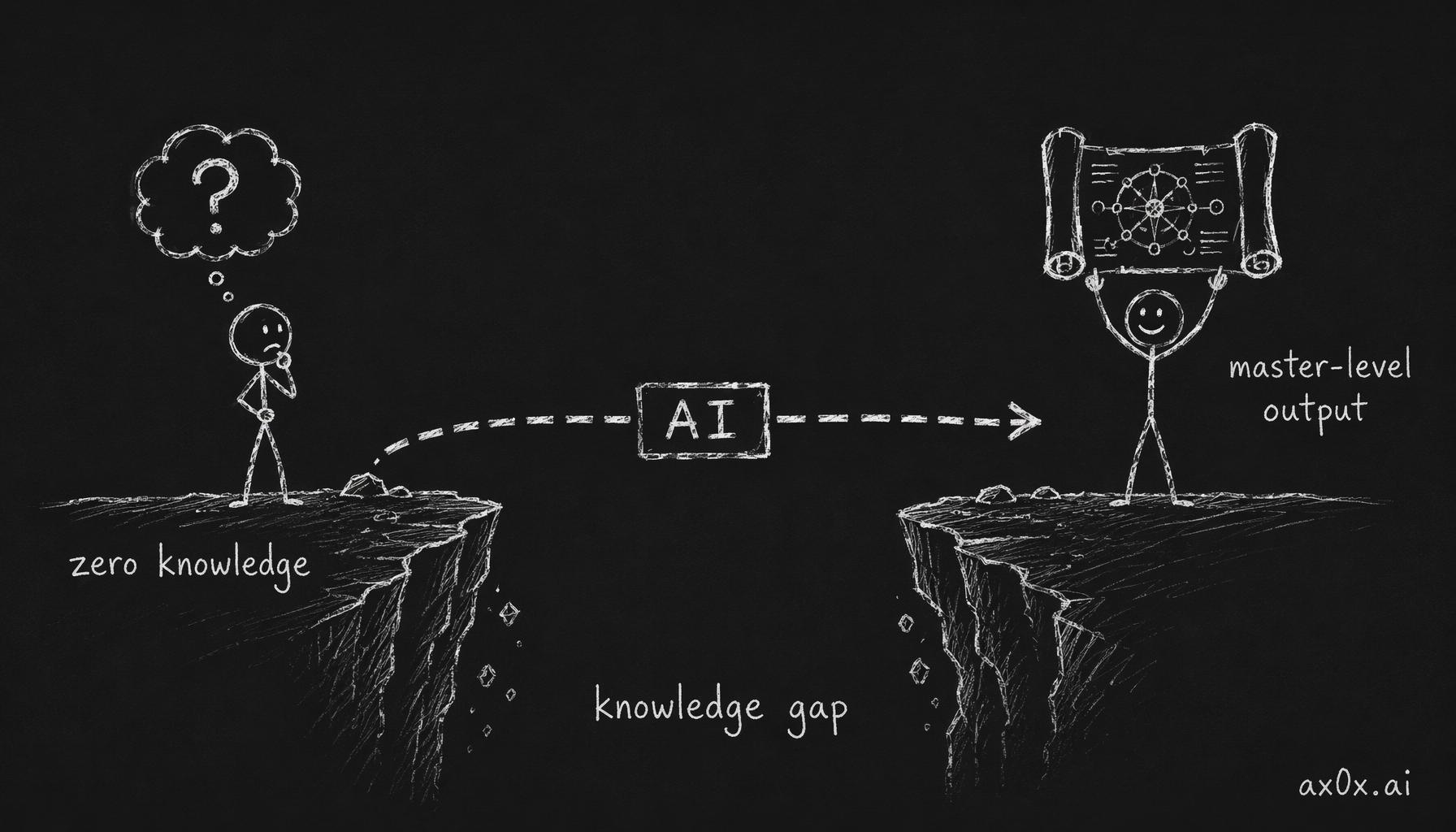 A person with zero domain knowledge uses AI as a bridge across the knowledge gap to produce master-level output
29 days. 10 apps. 1 person. 1,134 commits. 284,000 lines of code. BaZi analysis, tarot readings, dream interpretation, daily divination, MBTI personality testing, palm reading, name analysis, compatibility matching, annual forecasts, life trajectory charting. From an empty repo to a live platform with paying users.
The full build story documents every phase — monorepo consolidation, testing sprint, monetization, the milestone rush. The lessons learned are honest about what worked and what almost didn't.
But PanPanMao isn't interesting because of the speed. It's interesting because of what it proved about who gets to access ancient wisdom.
IV. What PanPanMao Gets Right
Master-level depth, not fortune-telling machines. 20,000 lines of BaZi logic. 1,000+ dream symbols. 78 tarot cards with full interpretive frameworks. Users who practice BaZi professionally said the calculations were correct. One user told me: "What the AI said was almost the same as what expensive masters told me." That's not a toy — that's a paradigm shift.
Honest, not people-pleasing. Early user feedback taught me something crucial. The first version was too gentle — telling everyone their future looked bright. Real masters don't do that. Real masters point out obstacles, warn about timing, tell you what you don't want to hear. So I calibrated the tone (PR #38) — PanPanMao now tells you the truth, with compassion but without sugarcoating. Because flattery isn't guidance. Honesty is.
Personalized to every detail. Not "Aries will be lucky this month." PanPanMao analyzes YOUR specific birth chart, YOUR specific question, YOUR specific context. A user testing the Life K-Line feature said: "Shockingly precise — it even picked up something bad that happened when I was 16." Every reading is unique because every person is unique.
Spiritual comfort, not superstition. Here's the insight that changed everything for me: people don't go to fortune tellers for accuracy. They go for comfort, direction, meaning.
The user who said "Chatting with the MBTI test became my late-night warm companion — so addictive" wasn't looking for a personality classification. She was looking for someone who understood her at 2 AM. The user who said "The dream interpretation feature soothed my anxiety about dreaming of deceased relatives" wasn't looking for Freudian analysis. She was looking for peace.
PanPanMao is affordable emotional healing disguised as fortune-telling. That's not a bug — it's the core product insight. Therapy costs $200/hour with a 3-week waitlist and carries social stigma. Fortune-telling through familiar cultural frameworks is approachable, immediate, and carries no stigma. The emotional outcome is the same: someone sees you, someone hears you, someone tells you it's going to be okay — and explains why, through a framework you already believe in.
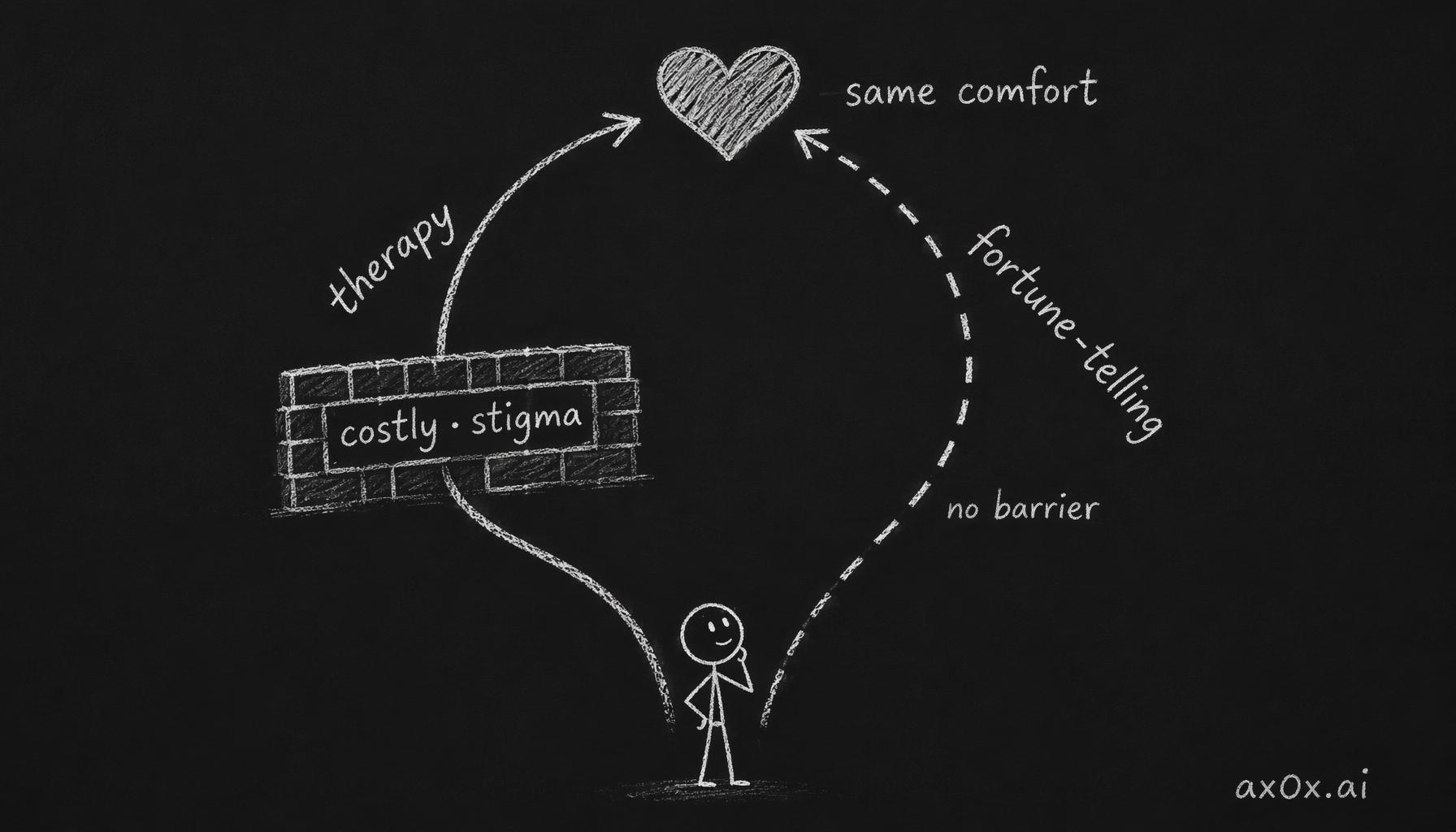 Therapy is blocked by cost, waitlists, and stigma while fortune-telling flows freely, both paths reaching the same emotional comfort
24/7, zero barrier. No appointments. No gatekeeping. No judgment. Three minutes from signup to your first reading. One user said: "I now use the daily divination every single day." Not because she believes the universe speaks through digital coins — because starting her day with a moment of reflection and guidance makes her feel grounded. PanPanMao gave her a ritual.
V. Why Now
The foundation model inflection point is here. This is the fundamental reason. Today's AI foundation models are powerful enough to understand cultural context, make autonomous decisions, and call tools — and cheap enough that each reading costs pennies. Two years ago, no model could handle BaZi's cultural reasoning: the same chart configuration meaning different things depending on the question, the context, the person's life stage. Today they can. And the trajectory only goes one direction: more capable, cheaper, faster. Today is the best starting point on this curve — tomorrow's models will be stronger, but first-mover advantage doesn't wait.
Cost per reading is approaching zero. A traditional master charges $500 for a session that takes 30-60 minutes. PanPanMao delivers a comparable reading for the cost of a few API calls — pennies. This isn't a marginal improvement. It's a 1000x reduction. When the cost of expertise drops by three orders of magnitude, access explodes. And model costs drop every year — today's margins are the floor, not the ceiling.
Hundreds of millions of digitally native Chinese speakers — and they're more spiritual than their parents. Research shows 77% of Gen Z identify as spiritual — not organized religion, but "faith unbundled": astrology, tarot, crystals, meditation, numerology. The first generation that grew up with smartphones AND grew up with grandparents who consulted fortune tellers. They want the wisdom without the friction. They want answers at 2 AM, not next Thursday.
Global mental health crisis — especially severe in China. China has 3.6 psychiatrists per 100,000 people (vs. ~12 in high-income countries). Only 9.5% of people with depression seek treatment — a 90.5% treatment gap. Not because they don't need help — because therapy is expensive, waitlisted, and carries crushing social stigma. But seeking guidance through fortune-telling, astrology, and divination carries zero stigma. Research identifies fortune-telling in Chinese culture as a cognitive coping mechanism — proto-therapy that provides a sense of order and control amid uncertainty. PanPanMao isn't competing with therapy. It's providing an entry point for the 90.5% who would never walk into a clinic — delivering the same emotional outcome through frameworks they already trust.
VI. How Big Is the Market
Today: Chinese Metaphysics
120 billion RMB ($16.5 billion) in China's digital metaphysics market alone, growing at 43.7% year-over-year, with 120 million+ paying users. BaZi, face reading, name analysis, tarot, daily divination — the demand spans every demographic, from executives planning business decisions around their charts to college students checking daily horoscopes. Most of this spend still goes to offline masters and ad-farm websites. The category is massive, growing fast, and has no quality digital winner.
PanPanMao is already here — a working product with paying users across 10 verticals.
Tomorrow: Mental Wellness Entry Point
China has 95 million people with depression, but only 9.5% seek treatment. The global mental wellness market exceeds $100 billion. Meditation apps (Calm, Headspace) proved people will pay for emotional comfort on their phones. Therapy apps (BetterHelp, Talkspace) proved people will pay for guidance through a screen.
PanPanMao sits at the intersection: personalized guidance + emotional comfort + cultural frameworks that feel natural rather than clinical. For the 90.5% who would never walk into a clinic but would absolutely consult a fortune teller, PanPanMao is the bridge — and the emotional outcome is the same.
Day After Tomorrow: Global Expansion
Astrology, tarot, numerology, and divination are universal. The global astrology app market is $3-5 billion, growing at 20% CAGR to a projected $9 billion by 2030. Spiritual wellness apps are a $2.2 billion market. Every culture has frameworks for making sense of uncertainty. Vedic astrology in India. Western astrology in Europe and the Americas. Tarot everywhere. Co-Star raised $21M and has 20 million+ downloads — proving massive digital demand from Western astrology alone.
PanPanMao's architecture — domain knowledge encoded as AI-interpretable logic, cultural tone calibration, personalized readings — is framework-agnostic. The same engine that powers BaZi readings can power Vedic astrology readings. The same emotional comfort that soothes a Chinese user at 2 AM can soothe an Indian user or an American user.
The vision isn't "Chinese fortune-telling app." The vision is: the first AI platform that provides personalized spiritual guidance and emotional comfort to billions, through whatever cultural framework feels like home.
VII. The Moat
Not code — culture.
20,000 lines of BaZi logic. Cultural tone calibration across 10 domains. The difference between a reading that feels like a lookup table and a reading that feels like a wise elder speaking directly to you. Code can be copied in a weekend. Cultural sensitivity — knowing when to be direct, when to be gentle, when to warn, when to comfort, how to frame bad news through a specific cultural lens — that takes thousands of iterations and can't be reverse-engineered from the outside.
Network effects. More users generate more readings. More readings generate more feedback. More feedback improves interpretive quality. The system gets better at understanding what resonates, what comforts, what feels true. This compounds.
Brand trust. In metaphysics, trust is everything. You don't go back to a fortune teller because their website is pretty — you go back because last time they told you something that turned out to be true, or something that made you feel understood. "What the AI said was almost the same as what expensive masters told me" — that sentence, repeated by user after user, is worth more than any marketing budget. Trust in this domain compounds exponentially. Once you're the platform people trust with their deepest questions, no amount of VC money can unseat you.
VIII. Why Me
Lots of people are building AI products. Most of them see AI at the surface — wrap APIs, tweak prompts, ship wrappers. I don't. I understand the AI paradigm at a fundamental level, I see things most people haven't seen yet, and I've already turned vision into running products.
I see where this is going. While most people were still using AI as a chatbot and search engine, I wrote a six-part series reasoning from first principles about why AI won't stay at the tool layer — it will democratize all expert knowledge. Wearables + AI will democratize personal assistants and therapy. Software itself will become disposable — only cognitive assets will be irreplaceable. PanPanMao is proof of this vision — AI democratizing ancient wisdom as the first product realization.
My understanding of AI runs deep. A decade of building AI systems at scale — on-device ML for Siri on every iPhone, fraud detection at Airbnb where I cut $2M/month in losses, petabyte-scale infrastructure at AWS. As CTO, I built multi-agent AI systems. Now 95% of my production code ships through agentic coding — 3B+ tokens burned. This deep understanding of AI's capability boundaries isn't something you get from reading papers — it's forged in production with real stakes. For every PanPanMao domain — BaZi, tarot, dream interpretation — I know exactly what AI can deliver, where it falls short, and how much human calibration is needed. That judgment is my moat.
My execution is already proven. 29 days. 10 apps. 1 person. 1,134 commits. 284,000 lines of code. The workload of a 10-person team over six months. Zero domain knowledge in fortune-telling — and users who practice BaZi professionally validated the calculations. How? Because I lead an AI engineering team. I don't write business code — I design products, make decisions, and direct my AI team. One person + AI team eliminates the massive overhead of human coordination.
The tone calibration lesson — AI can't handle culture alone. PR #38 was a watershed. Early PanPanMao was too nice — like a customer service agent afraid of upsetting you. I spent weeks calibrating each domain's voice — BaZi needs a master's gravitas, tarot needs a reader's mystique, dream interpretation needs gentle reassurance. AI's capability is the foundation, but turning it into a product users trust requires someone who deeply understands both AI's abilities and cultural context. That's me.
I'm obsessed with this. 1,134 commits in 29 days wasn't done on company time — it was nights, weekends, 3 AM tone calibration. I've poured every free hour into PanPanMao because I believe AI democratizing ancient wisdom is something that truly matters. This isn't a job. It's a compulsion.
Vision, deep AI understanding, execution, and passion — finding all four in one person is rare. I've already built a memory system for PanPanMao — so the platform remembers your past readings, your recurring questions, your life context. That's the evolution from tool to companion. What's next? I already know.
IX. What I Need
PanPanMao is live. Paying users. 10 verticals. Working product.
But I'm one person. The platform needs to reach the hundreds of millions of Chinese speakers who are currently paying $500/session or settling for generic ad-farm readings. Then it needs to expand — Vedic astrology, Western astrology, tarot, numerology — same engine, new cultural frameworks, new languages, new markets.
I'm not looking for someone who sees a "fortune-telling app." I'm looking for partners who see what this actually is: the first platform that democratizes spiritual guidance and emotional comfort at scale.
For thousands of years, feeling understood by a wise elder was a privilege — reserved for those who could afford it, who lived near the right temple, who knew the right master. PanPanMao makes that feeling accessible to everyone. Anytime. Anywhere. For the cost of a coffee.
That's not a feature. That's a paradigm shift.
"For millennia, ancient wisdom was locked behind temples, lineage, and price. AI doesn't replace the masters — it gives everyone a seat at their table."
PanPanMao is that table. And it's open.
PanPanMao is live at panpanmao.ai. Try it — 10 apps, from BaZi to tarot to dream interpretation.
Want the full build story? Read Part 1: Why Zero Domain Knowledge, Part 2: The Technical Build, and Part 3: Lessons Learned.